The AI landscape in 2026 centers on three technologies that enterprises frequently confuse: Generative AI, AI Agents, and Agentic AI. This confusion carries real costs. Gartner predicts that over 40% of agentic AI projects will be canceled by the end of 2027 due to escalating costs, unclear business value, or inadequate risk controls. Companies deploying AI coding assistants like Claude Code, Cursor, and ChatGPT alongside custom autonomous agents need a unified MCP Gateway to govern data and tool connections, plus dedicated agent identities to treat autonomous systems as first-class principals.
This article clarifies the distinctions between these three AI types, explains their architectural requirements, and outlines how enterprises can deploy them with proper governance, security, and control.
Key Takeaways
- Generative AI creates content reactively from prompts using large language models, while AI Agents execute specific tasks autonomously and Agentic AI provides system-level capability for autonomous, multi-step decision-making
- The global AI agents market reached $7.6 billion in 2025 with a projected 49.6% CAGR from 2026 to 2033, while Gartner forecasts that over 40% of agentic AI projects will be canceled by the end of 2027 due to costs, unclear business value, or inadequate risk controls
- Security governance gaps remain significant: only 26% of surveyed organizations reported comprehensive AI security governance policies, while a separate survey found that 84% doubted they could pass an audit focused on agent behavior
- Agentic AI commonly combines several architectural capabilities including perception, reasoning, planning, memory, action, orchestration, and feedback, depending on the system's objectives and level of autonomy
- Agent identity is a critical governance requirement: Cloud Security Alliance research found that only 23% of surveyed organizations had a formal, enterprise-wide AI agent identity strategy
- Gartner forecasts that at least 15% of day-to-day work decisions will be made autonomously through agentic AI by 2028, up from 0% in 2024
Understanding Generative AI: The Foundation of Creative Machines
Generative AI represents the content-creation layer of modern AI systems. These systems produce new text, images, code, audio, and video based on patterns learned from training data. The technology is fundamentally reactive: you provide a prompt, and the system generates output.
Key Capabilities of Generative AI
Large language models (LLMs) like GPT-4 and Claude power most generative AI applications. These models excel at:
- Text generation: Writing articles, summarizing documents, answering questions, and translating languages
- Code synthesis: Generating, completing, and refactoring code across programming languages
- Image creation: Producing visual content through diffusion models and GANs
- Data synthesis: Creating realistic synthetic datasets for testing and training
- Multimodal output: Combining text, image, and audio generation in unified systems
The critical distinction is between standalone generation and goal-directed execution. A standalone generative model produces content in response to inputs, while applications built around that model may add memory, external tools, and autonomous workflows. When used only for text generation, Claude or GPT can draft an email. With the appropriate tools and permissions, an agentic application can also send it, check calendar availability, and execute follow-up tasks.
Popular Generative AI Tools and Applications
Enterprise generative AI deployments typically include:
- Coding tools: Claude Code, Cursor, GitHub Copilot, and Codex combine generative code assistance with agentic capabilities for developer productivity
- Content platforms: Marketing copy generation, documentation automation, and localization
- Analysis tools: Report summarization, data interpretation, and research synthesis
- Customer interfaces: Chatbots and virtual assistants for support and sales
These tools deliver significant productivity gains when properly integrated. However, they require governance infrastructure to prevent data leakage, ensure compliance, and maintain audit trails. Mintive's MCP Gateway provides this foundation by centralizing authentication, access control, and audit logging for enterprise data and tool connections routed through its governed MCP endpoints.
The Role of Large Language Models
LLMs serve as the reasoning engine for most AI applications in 2026. In agentic architectures, LLMs can interpret natural language instructions, support reasoning and planning, and generate responses that inform subsequent actions. Understanding this foundation matters because both AI Agents and Agentic AI typically incorporate generative capabilities. The distinction lies in what happens after generation.
Introducing AI Agents: Action-Oriented Automation
AI Agents move beyond content generation into action execution. While generative AI produces outputs, AI Agents act on those outputs within defined parameters to complete specific tasks.
Defining AI Agents: Beyond Generation
An AI Agent is a software system designed to autonomously perform particular tasks by perceiving its environment, making decisions, and taking actions. The core distinction is that agents perceive information from their environment, make decisions, and take actions toward defined goals. Depending on their architecture, they may also adapt their behavior using feedback from previous actions.
Key characteristics that separate AI Agents from generative AI:
- Tool use: Agents call external APIs, query databases, execute code, and manipulate files
- Environment interaction: Agents read from and write to systems beyond their training data
- Task completion: Agents pursue defined objectives rather than simply generating content
- Limited autonomy: Most AI Agents operate within narrow domains with specific capabilities
Core Components of an AI Agent
Functional AI Agents require:
- Perception module: Gathering information from the environment through APIs, sensors, or data feeds
- Decision engine: Evaluating options and selecting actions, often powered by an LLM
- Action layer: Executing operations in connected systems through tool calls
- Memory system: Maintaining context within a session or across sessions
- Feedback loop: Adjusting behavior based on action outcomes
The MCP data risk framework helps enterprises assess which data sources and tools agents should access, establishing boundaries that contain potential damage from agent errors or compromises.
Practical Applications of AI Agents
AI Agents deliver value in task-specific automation:
- Support automation: Resolving customer tickets by querying knowledge bases, executing refunds, and updating records
- Development assistance: Running tests, deploying code, creating pull requests, and managing CI/CD pipelines
- Data processing: Extracting information from documents, populating databases, and generating reports
- Workflow execution: Completing multi-step business processes like invoice processing or employee onboarding
Mintive's Agent Gateway provides the identity and permissions infrastructure these agents require. Each agent receives its own credential, scoped tool access, and audit trail separate from the human who created it.
Agentic AI Explained: The Convergence of Generation and Action
Agentic AI describes systems that combine AI capabilities with goal-directed reasoning, planning, and autonomous action. These systems may use a single capable agent or multiple coordinated agents, depending on workflow complexity. The distinction from task-specific AI agents is one of architectural scope and degree of autonomy rather than a universally separate technology category.
The Power of Agentic AI: Autonomy and Intelligence
Agentic AI describes goal-directed systems that can plan, make decisions, and execute actions with varying degrees of autonomy. These systems may coordinate multiple specialized agents within a workflow or use a single agent to pursue defined objectives.
The critical distinctions from simpler AI Agents:
- Multi-step reasoning: Agentic systems decompose complex goals into subtasks and execute them sequentially or in parallel
- Adaptive behavior: Systems adjust strategies based on intermediate results and changing conditions
- Self-correction: When actions fail, agentic systems identify the failure mode and attempt alternative approaches
- Orchestration: Systems coordinate tools, tasks, and potentially multiple specialized agents to complete complex workflows
- Persistent operation: Systems maintain state and continue working toward goals across extended time periods
Agentic AI systems can use information from their environment to reason about decisions, execute actions, evaluate feedback, and adjust their behavior as conditions change.
How Agentic AI Leverages Generative Capabilities
Agentic AI does not replace generative AI. It incorporates it as a component. The architecture typically includes:
- LLM as reasoning engine: Processing instructions and generating plans
- Tool-calling layer: Executing actions through MCP servers or API integrations
- Memory systems: Short-term working memory plus long-term knowledge persistence
- Orchestration framework: Coordinating multiple agents and managing workflows
- Learning mechanisms: Improving performance through feedback and outcome analysis
This layered architecture creates systems capable of handling complex, multi-day tasks with minimal human intervention. However, it also introduces significant governance challenges. Organizations must address agentic AI security concerns including credential management, action attribution, and emergency shutdown capabilities.
Future Outlook for Agentic AI Systems
Gartner projects that at least 15% of day-to-day work decisions will be made autonomously through agentic AI by 2028, up from 0% in 2024. This represents a fundamental shift in how work gets done.
However, the path to that future includes significant failures. Gartner predicts over 40% of agentic AI projects will be canceled by end of 2027. Organizations must distinguish between genuine agentic capabilities and "agent washing," where vendors relabel basic chatbots and RPA as agentic systems.
The Evolution: From Generative AI to AI Agents and Agentic AI by 2026
Understanding the progression from generative to agentic AI helps enterprises make informed infrastructure decisions.
Key Milestones in AI Development
The evolutionary path follows a clear trajectory:
- 2020-2022: Large language models demonstrate general-purpose text generation
- 2023: Tool use emerges through function calling and plugin architectures
- 2024: MCP (Model Context Protocol) standardizes how AI systems connect to external tools
- 2025: Multi-agent orchestration frameworks enable coordinated autonomous systems
- 2026: Enterprise AI agent adoption continues expanding as organizations move from experimentation toward production deployments and formal governance
Each stage built upon the previous. Generative AI provided the reasoning capabilities. Tool use added action. Standardized protocols enabled interoperability. Orchestration frameworks enabled coordination. Enterprise governance infrastructure made production deployment viable.
Anticipated Advancements in Agentic AI
Near-term developments include:
- Improved reliability: Reduced hallucination rates and more predictable behavior
- Better coordination: More sophisticated multi-agent protocols and conflict resolution
- Enhanced memory: Longer context windows and more effective knowledge retrieval
- Faster processing: Lower latency enabling real-time agentic applications
- Standardized governance: Industry frameworks for agent identity, audit, and control
The enterprise AI maturity model provides a framework for assessing organizational readiness across these dimensions.
Impact on Enterprise Workflows
Integrating generative AI for content, agents for execution, and agentic systems for orchestration can help enterprises coordinate complex workflows, reduce manual handoffs, and improve operational efficiency.
The pattern emerging across successful deployments:
- Generative AI handles content creation, analysis, and user interaction
- AI Agents execute specific tasks within defined boundaries
- Agentic AI orchestrates complex workflows spanning multiple agents and systems
Mintive's MCP Gateway supports heterogeneous AI deployments by centralizing governance for tool calls routed through managed MCP connections. When employees use Claude to query Salesforce or autonomous agents execute scheduled workflows through governed MCP endpoints, applicable authentication, authorization, and audit policies can be enforced. Agent Gateway extends this foundation with first-class agent identities and scoped credentials.
Governing the Agentic Future: Security and Control for AI Agents
The shift from reactive AI to autonomous agents creates governance challenges that traditional security models do not address.
Challenges in Governing Autonomous AI
Agentic systems operate with skilled-worker-level autonomy, making independent decisions and triggering actions across enterprise systems with minimal human oversight. This autonomy creates specific risks:
- Credential exposure: Agents require access to sensitive systems, but traditional API keys and OAuth tokens create audit and rotation problems
- Action attribution: When something goes wrong, organizations need to know which agent took which action and why
- Blast radius: An agent error or compromise can propagate across all systems the agent can access
- Shadow AI: Agents operating outside approved governance frameworks can access enterprise data and execute actions without consistent monitoring, authorization, or audit controls
Cloud Security Alliance research found that only 26% of surveyed organizations reported comprehensive AI security governance policies, while a separate survey found that 84% doubted they could pass an audit focused on agent behavior or access controls. These findings underscore the challenges organizations face when scaling autonomous systems without mature governance infrastructure.
Establishing Robust AI Agent Policies
Effective AI agent governance frameworks address:
- Identity management: Treating agents as distinct non-human principals rather than extensions of human accounts
- Permission boundaries: Scoping tool access to the minimum required for each agent's function
- Audit requirements: Logging governed tool calls and supported agent activity with available identity, tool, timestamp, request, result, and policy-decision metadata
- Policy enforcement: Runtime controls that determine whether an action should be allowed before it executes
- Emergency controls: Kill switches that can immediately halt agent operations across the organization
Ensuring Attributable and Secure Operations
Mintive's approach separates human identity from agent identity while maintaining complete audit trails. The Agent Gateway provides:
- Named agent principals: Each autonomous agent exists as a distinct entity in the authorization model
- Scoped tool access: Virtual MCPs configured specifically for each agent's purpose
- Independent credentials: Bearer keys, M2M tokens, or workload identity federation that can be rotated or revoked without affecting human users or other agents
- Agent-level attribution: Governed tool calls traced to the specific agent identity that performed them
This infrastructure enables enterprises to answer the question that becomes central as agent counts scale: "Who did what, and were they authorized to do it?"
Identity and Permissions: The Core of Trustworthy AI Agents
Agent identity represents the foundational capability that enables all other governance. Without it, organizations cannot implement meaningful access control, audit, or policy enforcement.
Why Dedicated Agent Identity Matters
The default pattern for agent authentication uses human credentials. A developer's API key. A shared service account. An OAuth token originally issued to a user. This pattern fails at scale for multiple reasons:
- Audit collapse: All agent actions appear as the human credential owner's actions
- Over-privileging: Agents inherit all permissions of the credential they use, typically far exceeding what they need
- Rotation risk: Rotating a compromised credential disrupts all agents and humans using it
- Attribution failure: When an agent misbehaves, you cannot distinguish its actions from legitimate human activity
Cloud Security Alliance research found that only 23% of surveyed organizations had formal, enterprise-wide AI agent identity strategies. Organizations with informal, developing, or absent identity strategies may face additional security and auditability challenges as agent deployments expand.
Implementing Robust Authentication for Agents
Mintive supports authentication mechanisms at three security levels:
- Bearer keys: Static keys on every request with individual naming, expiration, and revocation
- M2M tokens: OAuth client-credentials exchange producing short-lived tokens
- Workload identity federation: The agent's own infrastructure mints short-lived OIDC tokens (most secure for production)
The authentication models documentation details implementation for each approach.
Managing Scoped Access and Credentials
Beyond authentication, agents require authorization boundaries. Mintive's Virtual MCPs bundle connectors, tools, and policies into purpose-built endpoints:
- Read-only vs read-write: Two Virtual MCPs over the same connector with different tool curation
- Role-specific toolsets: Engineering agents access GitHub and Datadog; sales agents access Salesforce and HubSpot
- Environment separation: Development agents cannot reach production databases
- Credential isolation: Each agent's credentials rotate independently
This architecture means revoking a compromised agent stops that agent only. Other agents and human users continue operating without disruption.
Visibility and Monitoring: Understanding Agent Actions and Costs
Governance requires visibility. Organizations cannot secure what they cannot see.
Gaining Insight into Agent Behavior
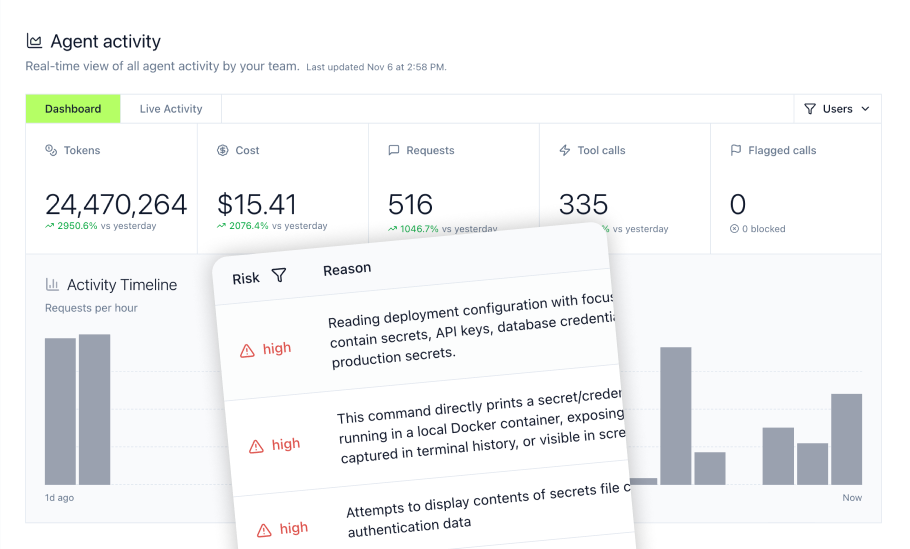
Agent Monitor provides real-time visibility into supported AI agent activity beyond gateway traffic. Captured activity can include:
- Prompts: What instructions agents receive
- Commands: Bash commands, package installations, git operations
- File access: Reads and writes including sensitive files
- MCP tool calls: Supported tool interactions captured through configured agent hooks and gateway logging
- Security events: Rule violations, blocked actions, suspicious patterns
The live activity feed shows captured activity from supported and configured agent environments, with filtering by available user, tool, agent, and time metadata.
Tracking Usage and Optimizing Costs
Agent operations consume tokens and incur costs. AI agent monitoring should track:
- Token spend by model: Different models have different pricing
- Cost by user and agent: Identifying who or what drives spend
- Session-level analysis: Finding runaway loops or over-provisioned agents
- Human vs agent split: Understanding the composition of AI usage
- Cache hit rates: Optimizing for efficiency
Agent Monitor provides these metrics with chargeback-grade visibility, enabling organizations to answer questions like "How much did the sales agent cost last month?"
Ensuring Compliance Through Comprehensive Monitoring
Audit trails serve compliance requirements across SOC 2, HIPAA, and internal risk reporting. Agent Monitor exports to:
- SIEM systems: OTLP or Splunk HEC integration
- Cloud storage: Archival through compatible logging pipelines or collectors configured to forward exported records to cloud storage
- Internal dashboards: API access for custom reporting
The SIEM export documentation covers configuration for each integration pattern.
Practical Deployment: Connecting AI Clients and Agents to Enterprise Systems
Deployment involves connecting diverse AI clients to enterprise data and tools through governed infrastructure.
The Role of MCP Gateways in AI Integration
MCP (Model Context Protocol) standardizes how AI systems connect to external tools. An MCP Gateway sits between AI clients and MCP servers, providing:
- Centralized authentication: Users authenticate once through SSO
- Credential management: The gateway injects credentials per call
- Access control: RBAC determines which tools each user or agent can access
- Audit logging: Every tool call logged with full context
- Tool curation: Administrators curate which tools appear to which roles
The Virtual MCP concepts documentation explains how these bundles work in practice.
Building Governed Access for Diverse AI Clients
Enterprises run multiple AI clients simultaneously. Mintive's gateway supports:
- Claude Code: Setup documentation
- Cursor: Setup documentation
- ChatGPT: Setup documentation
- Custom agents: Agent identities with bearer keys, M2M tokens, or workload identity federation
The same governance infrastructure covers all clients. Policy changes apply immediately without reconfiguring individual installations.
Scalable Connector Strategies for Enterprise AI
Mintive's connector catalog includes integrations across categories:
- Data and analytics: Snowflake, BigQuery, Databricks, PostgreSQL
- Engineering and observability: GitHub, Datadog, PagerDuty
- Collaboration: Slack, Atlassian, Google Workspace
- Sales and marketing: Salesforce, HubSpot
Hosted connectors run in Mintive's data plane, never exposed to the internet. Custom connectors can be deployed for internal APIs and proprietary systems.
Memory and Persistence: Building Company-Owned Agent Intelligence
Long-running agents require memory that persists across sessions. How that memory is governed determines whether agents remain under organizational control.
The Importance of Persistent Agent Memory
AI coworkers that work alongside employees need to remember:
- Task context: What they were working on when interrupted
- Decisions made: Why they took specific actions
- Accumulated knowledge: Information gathered across multiple interactions
- Instructions: Standing guidance from administrators
Without persistent memory, every agent interaction starts from zero. Agents cannot build on prior work or maintain consistency across sessions.
Architecting Company-Owned Memory Systems
Mintive's Coworker Agents implement memory as governed enterprise infrastructure:
- Git-backed storage: Memory lives in version-controlled repositories the company owns
- Scope hierarchy: Organization, team, and individual memory silos
- Reviewable state: Instructions, memory, and run history exist as files humans can inspect
- Audit trail: Every memory update logged with attribution
- Portability: Memory can be exported, moved, or migrated
This architecture contrasts with vendor-managed memory systems where the memory is opaque, difficult to review, and locked to a specific provider.
Ensuring Auditability and Review of Agent Knowledge
The enterprise agent memory model treats memory as an auditable company asset:
CLAUDE.md: Reviewable instructions that define agent behaviorprogress.md: Working memory that captures ongoing contextinbound/: Task queue for work assignment- Version history: Full git history of all memory changes
When organizations need to investigate agent behavior, reviewable memory files, version history, and available audit records can help reconstruct the context and instructions associated with an action. Administrators can update governed instructions and memory files to correct behavior and improve future runs.
Deploying AI Agents and Agentic AI with Mintive
As enterprises scale from experimentation to production deployment of generative AI, AI agents, and agentic systems, governance infrastructure becomes the critical success factor. Mintive addresses governance challenges associated with agentic AI deployments, including inadequate risk controls, ungoverned autonomous operations, and limited visibility into agent activity.
Mintive's unified governance platform provides:
- First-class agent identities through Agent Gateway, eliminating credential sharing and audit collapse while enabling precise action attribution
- Centralized tool access control via MCP Gateway, governing enterprise data and tool connections routed through managed MCP endpoints with SSO-integrated, role-based permissions
- Real-time visibility across human and agent activity with Agent Monitor, capturing prompts, tool calls, file access, and policy decisions
- Company-owned agent memory in git-backed repositories, ensuring auditability, portability, and organizational control over agent knowledge
- Production-ready security with SOC 2 Type II attestation, workload identity federation, and emergency kill switches
Organizations deploying Claude Code, Cursor, ChatGPT, and custom agents can connect all clients through a single governed infrastructure layer. The MCP Gateway abstracts governed access to enterprise tools and data, helping organizations maintain consistent access policies across supported AI clients, models, and agent environments without rebuilding their tool-governance infrastructure.
Whether implementing generative AI for content creation, task-specific agents for automation, or orchestrated agentic systems for complex workflows, Mintive provides the identity, access, audit, and memory infrastructure required for secure, compliant, and attributable AI operations at scale.
Frequently Asked Questions
What distinguishes "agent washing" from genuine agentic AI capabilities?
"Agent washing" describes vendors relabeling basic chatbots or simple automations as agentic AI. Genuine agentic systems exhibit multi-step reasoning that decomposes complex goals, adaptive behavior adjusting strategies based on results, self-correction when actions fail, and orchestration coordinating specialized components. Request architecture documentation showing how the system handles reasoning, planning, tool execution, feedback, and any memory or orchestration capabilities relevant to its use case.
How do enterprises handle the transition from single agents to multi-agent systems?
Start with single agents proving value in specific domains before attempting coordination. Establish clear protocols for agent-to-agent communication and conflict resolution. Implement centralized monitoring that tracks interactions between agents. Define escalation paths for situations where agent coordination fails or produces unexpected outcomes. The coordination overhead, debugging difficulty, and emergent behaviors require mature governance infrastructure before deployment at scale.
What compliance frameworks specifically address agentic AI systems?
Singapore launched its Model AI Governance Framework for Agentic AI in January 2026, providing non-binding guidance on responsible autonomous AI deployment. The Cloud Security Alliance published a draft Agentic AI Governance Maturity Model in March 2026. Under the EU AI Act, systems classified as high-risk must meet applicable requirements for risk management, transparency, and accountability. These requirements reinforce the importance of designing agentic systems with appropriate auditability and oversight.
Can agentic AI systems operate without human oversight entirely?
Current best practices emphasize "useful autonomy" over "maximum autonomy." Even sophisticated agentic systems require human oversight for high-stakes decisions, novel situations outside training distribution, and actions with irreversible consequences. Research evaluating specific AI-powered legal research tools found hallucination rates of approximately 17% to 33%, illustrating why high-stakes AI outputs require independent verification and appropriate human oversight.
How should organizations prioritize between generative AI, AI agents, and agentic AI investments?
The technologies build upon each other. Start with generative AI for content creation and analysis where ROI is proven. Add task-specific AI Agents for automation in well-defined domains. Implement agentic orchestration only after establishing governance infrastructure. Google Cloud research found that 88% of executives from agentic AI early-adopter organizations reported generative AI ROI, compared with 74% across surveyed organizations, suggesting that organizations investing more heavily in AI agents may be better positioned to capture value.