AI agents can make repeated autonomous decisions across enterprise environments, yet many organizations lack visibility into what these systems are actually doing. While 62% of organizations report experimenting with or scaling AI agents, only 23% report scaling an agentic AI system in at least one business function.
MintMCP addresses this through two connected infrastructure layers: MCP Gateway provides governed data and tool connections for AI systems like Claude, Cursor, ChatGPT, Gemini, and Copilot, while Agent Gateway adds the identity, permission, memory, and monitoring controls that enable agents to work alongside users. Together, these layers provide enterprise-grade security for AI deployments.
This article outlines actionable best practices for building an AI agent governance framework, covering identity management, policy enforcement, compliance requirements, risk mitigation, and shadow AI detection to ensure your AI deployments remain secure and auditable.
Key Takeaways
- Gartner projects that by 2030, 50% of AI agent deployment failures will result from insufficient governance-platform runtime enforcement for capabilities and multisystem interoperability
- The EU AI Act requires human oversight capabilities for high-risk AI systems, with the relevant requirements applying from December 2, 2027 or August 2, 2028, depending on how the system is classified
- Mature governance can reduce manual compliance work and policy inconsistency by automating evidence collection, continuous monitoring, and control enforcement
- Per-agent identity management is foundational: shared credentials eliminate the attribution clarity required for compliance and incident response
- Shadow AI detection addresses the governance gap where undocumented agents operate outside sanctioned infrastructure
- Implementation follows a phased approach: agent discovery, identity provisioning, monitoring deployment, and compliance automation, with timing determined by environment complexity and regulatory requirements
- Cross-functional governance councils combining IT, legal, compliance, and operations expertise are non-negotiable for effective policy decisions
Understanding the Imperative for AI Agent Governance in the Enterprise
Traditional IT governance frameworks were built for software that follows deterministic rules. AI agents operate differently. They make autonomous decisions, access multiple data sources, execute multi-step workflows, and adapt their behavior based on context. This creates governance challenges that existing controls cannot address.
Why Traditional IT Governance Falls Short for AI Agents
Standard access control systems assign permissions to users. AI agents blur this model by acting on behalf of users while making independent decisions about which tools to invoke and what data to access. A database query agent might have credentials that allow read access, but the governance question is whether it should query sensitive tables for a particular user request.
The core gaps include:
- Attribution ambiguity: When an agent takes an action, traditional logs show the service account, not the human who initiated the request or the reasoning chain that led to the decision
- Tool sprawl: Agents can access hundreds of MCP servers with different permission models, creating a surface area that exceeds what manual policy management can track
- Behavioral drift: Unlike static software, agents may produce different outputs for similar inputs based on context window contents, conversation history, and upstream model changes
The Evolving Landscape of Enterprise AI Adoption
MCP adoption accelerated dramatically in 2025 as support expanded across major AI models, development tools, and agent platforms. The MCP ecosystem reached 97 million monthly SDK downloads and transitioned to Linux Foundation governance in December 2025. This standardization wave means enterprises now face a choice: implement governance proactively or retrofit controls after agents are already embedded in critical workflows.
Key Pillars of an Effective AI Agent Governance Framework
An effective Agent Gateway governance framework rests on four pillars: identity management, continuous monitoring, policy enforcement, and audit logging. Each pillar addresses specific risks while enabling agents to operate productively within defined boundaries.
Identity management establishes who and what can access your AI infrastructure. Every agent requires a unique identity with scoped permissions, separate from the humans who deploy or invoke them.
Continuous monitoring provides real-time visibility into agent actions, detecting behavioral anomalies, policy violations, and potential security incidents as they occur rather than during post-hoc reviews.
Policy enforcement applies guardrails at runtime, blocking unauthorized actions before they execute rather than flagging them after the fact.
Audit logging captures comprehensive decision chains for compliance investigations, regulatory reporting, and incident response.
MintMCP's Agent Gateway centralizes these pillars through a single control plane. Built on top of its MCP Gateway foundation for tool and data connections, the platform provides OAuth 2.0 and SAML authentication, automatic credential rotation, rate limiting per user and team, and granular tool-level access control that enables database reads while blocking writes.
Implementing Robust AI Risk Management for Agent Deployments
AI agents introduce risks that differ from traditional application security threats. Prompt injection, credential leakage, PII exposure, and excessive agency require specific controls beyond standard vulnerability management.
Identifying and Mitigating Common AI Agent Risks
The primary risk categories include:
- Prompt injection attacks: Malicious inputs that manipulate agent behavior, potentially causing data exfiltration or unauthorized actions. Agents processing user-generated content or external data sources are particularly vulnerable.
- Credential exposure: Agents with access to API keys, tokens, or service account credentials may inadvertently include these in outputs or logs. Credential hygiene at the agent level requires automated detection and masking.
- PII leakage: Customer data flowing through agent workflows can appear in conversation logs, error messages, or downstream integrations without proper data loss prevention controls.
- Excessive agency: Agents granted broad permissions may take actions beyond their intended scope. A code generation agent with write access to production repositories creates risks that read-only access would eliminate.
Proactive Measures for Preventing Data Breaches and Misuse
Effective risk management combines technical controls with operational processes:
- Confidence-based escalation: Set escalation thresholds according to decision risk, then calibrate them against production outcomes, override rates, and observed model reliability
- Input/output inspection: Monitoring prompts and responses for credential patterns, PII, and prohibited content before they leave the governance boundary
- Tool-level allowlisting: Explicitly approving which tools each agent or team can invoke, rather than relying on default-allow models
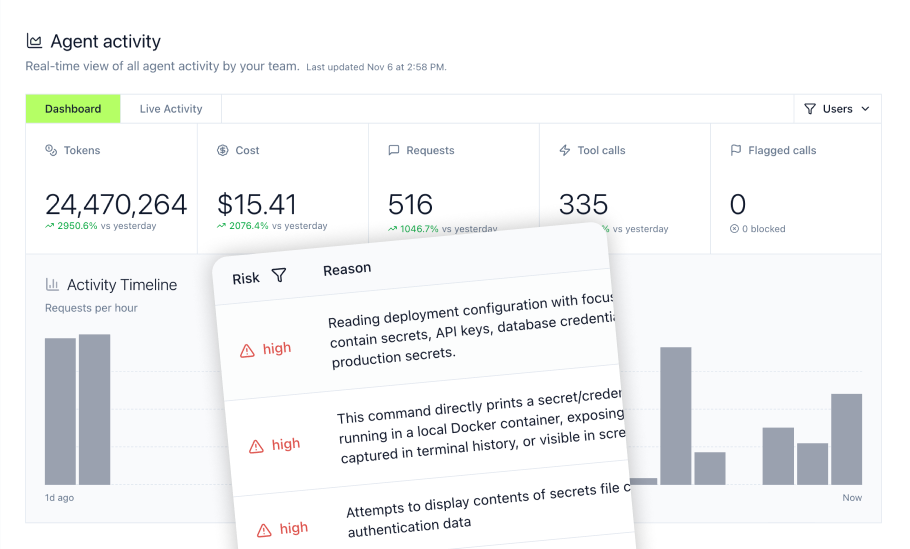
MintMCP's Agent Monitor detects PII exposure, credential leakage, risky bash commands, and prompt injection attempts using built-in rules. The platform supports custom guardrail policies with block, flag, and alert actions, enabling teams to tune detection sensitivity based on their risk tolerance.
Ensuring AI Agent Compliance and Regulatory Adherence
Regulatory frameworks increasingly address AI systems directly. The EU AI Act, NIST AI Risk Management Framework, and industry-specific requirements like HIPAA and SOC 2 create compliance obligations that AI agent deployments must satisfy.
Building Audit-Ready AI Agent Infrastructure
Compliance readiness requires infrastructure that generates evidence automatically rather than relying on manual documentation:
- Comprehensive audit trails: Every agent action, tool call, and data access logged with user attribution, timestamp, and decision context
- Immutable records: Audit logs stored in append-only formats that prevent tampering or retroactive modification
- Retention policies: Configurable retention aligned with applicable legal, contractual, and regulatory requirements, which vary by record type, jurisdiction, and industry
- SIEM integration: Export to security platforms like Splunk, Microsoft Sentinel, and S3 for centralized analysis and compliance reporting
The EU AI Act Article 14 requires high-risk AI systems to support effective oversight by qualified natural persons who can interpret outputs and intervene when necessary. Following the July 2026 amendments, the relevant requirements apply from December 2, 2027 or August 2, 2028, depending on the system's classification.
MintMCP provides full conversation-level logging that captures prompts, tool calls, responses, and context with per-user attribution. Configurable retention and SIEM export support compliance workflows across regulatory frameworks. The platform maintains SOC 2 Type II audited status with continuous Drata monitoring and is compliant with HIPAA standards, with BAA availability for healthcare customers.
Leveraging AI Governance Tools for Enhanced Oversight and Control
Governance tools fall into several categories: observability platforms that monitor agent behavior, policy engines that enforce runtime constraints, identity systems that manage agent credentials, and compliance automation that generates audit evidence.
Evaluating and Selecting the Right AI Governance Platform
Selection criteria should prioritize:
- Framework agnosticism: Platforms that work with multiple agent frameworks (LangChain, CrewAI, AutoGen, custom implementations) avoid vendor lock-in
- Runtime enforcement: The difference between monitoring and governance is whether the platform can block unauthorized actions, not just log them
- Integration depth: Native connections to existing IAM systems, SIEM platforms, and DLP tools reduce implementation complexity
- Scalability economics: Per-agent pricing models become prohibitive at enterprise scale; evaluate total cost at projected agent volumes
MintMCP's Agent Gateway provides centralized management for MCP servers with enterprise authentication and access controls. The platform's middleware layer supports inline DLP integration with AWS Bedrock Guardrails, GCP DLP, Microsoft Purview, Nightfall, and Skyflow. Custom policy code executes on every tool call, enabling pre- and post-processing hooks that transform, mask, or block content based on organizational rules.
Streamlining Agent Access Management with Identity and Bundles
Identity management for AI agents requires different abstractions than human user management. Agents need persistent identities that survive beyond individual sessions, scoped credentials that can be rotated independently, and permission models that reflect their operational purpose rather than the permissions of their creators.
The Importance of Per-Agent Identity and Scoped Credentials
Shared service accounts for AI agents create three problems:
- Audit attribution failure: When multiple agents share credentials, logs cannot distinguish which agent took a specific action
- Blast radius expansion: Compromised credentials affect all agents using them, not just the one that experienced the breach
- Permission creep: Agents inherit the full permission set of the shared account rather than receiving least-privilege access
Per-agent identity addresses these gaps by giving each deployed agent its own credentials that can be rotated and revoked independently.
Simplifying Access Provisioning for Diverse Agent Teams
MintMCP's Bundle architecture packages tool access, policy enforcement, and audit logging into single governance units per team or role. Each Bundle ties SCIM group membership to a curated MCP server list, custom policy rules, and an isolated audit trail. Agent Bundles extend this model to non-human principals, giving each deployed agent rotatable credentials with permission scope independent of the creator's access level.
Virtual MCPs (VMCPs) reduce configuration complexity for non-technical users by bundling multiple servers with role-based tool access into single endpoints. This abstraction enables teams to provision agent access without understanding the underlying MCP server topology.
Detecting and Preventing Shadow AI in Enterprise Environments
Shadow AI describes unauthorized agent usage that operates outside sanctioned governance infrastructure. Developers running local MCP servers, teams using personal API keys, and departments deploying agents without IT approval all create visibility gaps that governance platforms cannot address if they only monitor gateway traffic.
The Hidden Dangers of Unsanctioned AI Agent Usage
Shadow AI creates compliance, security, and operational risks:
- Compliance violations: Unmonitored agents may process regulated data without required controls, creating liability exposure during audits
- Data exfiltration: Agents operating outside governance boundaries can transmit sensitive data to external services without detection
- Inconsistent policies: Different teams applying different guardrails leads to unpredictable behavior and support burden
Strategies for Gaining Full Visibility into Agent Activity
Detecting shadow AI requires monitoring beyond the gateway layer. Approaches include:
- Developer tool hooks: Instrumentation in coding assistants like Cursor and Claude Code that reports MCP activity regardless of whether it routes through the corporate gateway
- MDM integration: Pushing detect-only or enforce-mode configurations to developer machines ensures consistent policy application
- Network analysis: Identifying MCP traffic patterns that bypass sanctioned infrastructure
MintMCP's Agent Monitor provides two-layer governance: the MCP Gateway covers tool and data connections routed through the platform, while Agent Monitor hooks in Cursor and Claude Code detect off-gateway activity. MDM integration enables enforcement configurations pushed to developer machines for consistent policy application across the organization.
Building a Culture of Responsible AI Agent Development and Deployment
Technology controls require organizational alignment to be effective. Teams that view governance as a blocker will find workarounds. Teams that understand governance as an enabler of safe scaling will build within the framework.
Establishing an AI Governance Committee for Ongoing Oversight
Cross-functional governance councils bring together the expertise needed for effective policy decisions:
- IT/Platform Engineering: Technical implementation, integration architecture, performance requirements
- Legal: Regulatory interpretation, contractual implications, liability assessment
- Compliance: Audit readiness, evidence collection, framework mapping
- Operations: Business impact, workflow integration, user adoption
Governance committees should meet regularly, own policy approval workflows, and maintain escalation paths for novel agent use cases that existing policies do not address.
Educating Teams on Ethical AI Agent Practices
Training programs should cover permission models, incident reporting procedures, data handling policies based on classification, and how to apply organizational guardrails to specific use cases.
Implementing MintMCP's Agent Gateway for Production-Ready Governance
Enterprise teams need governance infrastructure that scales with AI adoption while maintaining security and compliance. MintMCP's Agent Gateway provides the identity, permission, memory, and monitoring controls required for agents that work alongside users in production environments.
The platform separates two connected responsibilities:
- MCP Gateway: Governs the tool and data connections used by existing AI systems
- Agent Gateway: Adds the control layer for agent identities, permissions, memory, and monitoring
- Unified governance: Helps teams secure current AI deployments while preparing for more autonomous agent architectures
Key capabilities include:
- Per-agent identity provisioning with independently rotatable and revocable credentials
- Bundle-based access management that packages tools, permissions, and policies by team or use case
- Real-time monitoring for PII exposure, credential leakage, risky commands, and prompt injection through Agent Monitor
- Comprehensive audit logging with SIEM export
- Integration with existing enterprise infrastructure through OAuth 2.0, SAML, SCIM, and MDM hooks
The financial case for implementing an Agent Gateway depends on deployment scale, regulatory exposure, existing infrastructure, and the amount of manual governance and incident-response work being replaced.
MintMCP also provides a compliance foundation for regulated environments:
- SOC 2 Type II audited
- Compliant with HIPAA standards
- Support for BAAs and HIPAA documentation
- Audit trails and configurable security controls
As AI agents move from experimentation to production, governance cannot remain an afterthought. The infrastructure choices teams make today determine whether agent deployments scale safely or experience failures caused by insufficient runtime governance controls. Agent Gateway provides a foundation for organizations that choose proactive governance over reactive remediation.
Frequently Asked Questions
How do I determine appropriate confidence thresholds for human-in-the-loop escalation?
Start conservatively and calibrate thresholds against your production baseline. Track escalation rates, override rates, false positives, and task outcomes rather than applying a universal target. Different agent types warrant different thresholds based on decision reversibility and impact.
What is the typical ROI timeline for implementing AI agent governance?
Break-even timelines vary by deployment scale, regulatory exposure, existing infrastructure, and the amount of manual governance work being replaced. Key ROI drivers include compliance fines avoided, operational efficiency gains, and incident response acceleration through real-time detection versus post-hoc investigation.
How should organizations handle agents that need access to multiple data sources with different sensitivity levels?
Implement layered access controls where agents receive the minimum permissions needed for each data source independently. Use Virtual MCP Bundles to create purpose-specific access packages rather than granting broad permissions. For agents requiring both sensitive and non-sensitive data access, consider decomposing into multiple agents with different permission scopes that hand off work, reducing the blast radius of any single credential compromise.
What metrics should governance committees track to measure program effectiveness?
Track policy violation rates, escalation and override rates, mean time to detect anomalies, audit preparation effort, and shadow AI discovery rates. Establish targets from a documented pre-implementation baseline and adjust them by agent risk tier, workflow volume, and organizational tolerance. Report these metrics monthly to governance committees with trend analysis.
How do open-source governance frameworks compare to managed platforms for enterprise deployments?
Open-source options provide full control and avoid per-agent pricing but require platform engineering expertise for deployment, scaling, and maintenance. Production readiness varies significantly across frameworks. Managed platforms offer faster time-to-value (weeks versus months), include compliance documentation, and provide vendor accountability for uptime and security. Organizations should evaluate total cost of ownership including engineering time, not just licensing fees, when choosing between self-hosted and managed approaches.