Choosing the right agent gateway determines whether your AI deployment becomes a governed, production-ready asset or a security liability waiting to surface. With over 40% of agentic AI projects facing cancellation by 2027 due to escalating costs, unclear value, or inadequate risk controls, selecting a gateway with centralized authentication, real-time monitoring, audit trails, and policy controls is no longer optional.
Agent gateways have evolved from middleware convenience to critical enterprise infrastructure. The MCP Gateway category now serves as the connective tissue between AI agents and internal systems, transforming what was once an N-to-N mesh of point-to-point connections into a manageable hub-and-spoke model with unified governance.
This guide covers the agent gateways that enterprise teams should evaluate in 2026, ranked by governance depth, deployment flexibility, and production readiness.
Key Takeaways
- MintMCP Agent Gateway gives enterprise teams identities, permissions, memory, monitoring, and scoped tool access for internal agents, built on MintMCP’s MCP Gateway foundation with SSO, SCIM-driven RBAC, Agent Bundles, Virtual MCP Bundles, hosted connectors, and audit logs
- Bifrost (Maxim AI) focuses on low-latency performance for high-throughput production environments
- TrueFoundry offers centralized MCP registry and discovery for platform engineering teams
- Cloudflare AI Gateway supports AI traffic management and MCP detection for organizations in the Cloudflare ecosystem
- Kong AI Gateway unifies API and AI governance for teams with existing Kong deployments
- LiteLLM provides open-source flexibility with broad LLM provider support
- Lasso Security focuses on MCP-specific threat detection and tool reputation scoring
- Portkey delivers flexible authentication schemes with OAuth 2.1 support
- Zuplo MCP Gateway introduces virtual server architecture for capability curation
- Composio offers a broad catalog of pre-built MCP integrations for rapid deployment
- Solo.io Agent Gateway brings Kubernetes-native agent governance for infrastructure teams
- Operant MCP Gateway provides OWASP-mapped security scanning for MCP traffic
1. MintMCP Agent Gateway: Governed Agent Identities, Memory, and Tool Access
MintMCP’s Agent Gateway gives enterprise teams a control layer for governing the agents they already run across Claude, Cursor, ChatGPT, Gemini, and Copilot, built on its MCP Gateway foundation. It focuses on the control layer agents need in production: first-class agent identities, scoped permissions, company-owned memory, monitoring, audit trails, and governed access to internal tools.
MintMCP’s Agent Gateway builds on its MCP Gateway foundation. The MCP Gateway governs data and tool connections through SSO, SCIM-driven RBAC, IdP groups, Virtual MCP Bundles, tool-level policy, hosted connectors, and audit logs. The Agent Gateway extends that foundation so internal agents can operate with their own identities, permissions, memory scopes, and monitoring instead of relying on shared service accounts or opaque vendor-controlled access.
What Makes MintMCP Agent Gateway Different
MintMCP solves the core enterprise agent problem: how to let AI agents work across internal systems without giving them unmanaged access, shared credentials, or unreviewable memory. Its Agent Gateway gives each agent a governed operating model with identity, scoped tools, memory controls, monitoring, and auditability.
Underneath that agent layer, MintMCP wraps stdio, hosted, HTTP-streamable, and SSE MCP servers behind SSO-fronted remote MCP endpoints with OAuth brokering, SCIM-driven membership, and rule-based policy.
This approach addresses the 80% of enterprise effort that goes into governance rather than development, reducing fragmented security policies and visibility gaps that create operational challenges when managing point-to-point connections between AI agents and tools.
Core Agent Gateway Capabilities
- Agent Bundles: Give internal agents first-class identities with M2M auth, scoped tools, independent rotation and revocation, and an "act as agent" flow for connectors that require per-agent OAuth
- Scoped Agent Permissions: Define exactly which tools, data sources, and actions each agent can access, so an agent's permissions remain independent from the human who created it
- Enterprise Agent Memory: Support company-owned agent memory that can be scoped by private, team, org, or customer context, with versioned, reviewable, auditable, and portable governance instead of opaque vendor-controlled memory
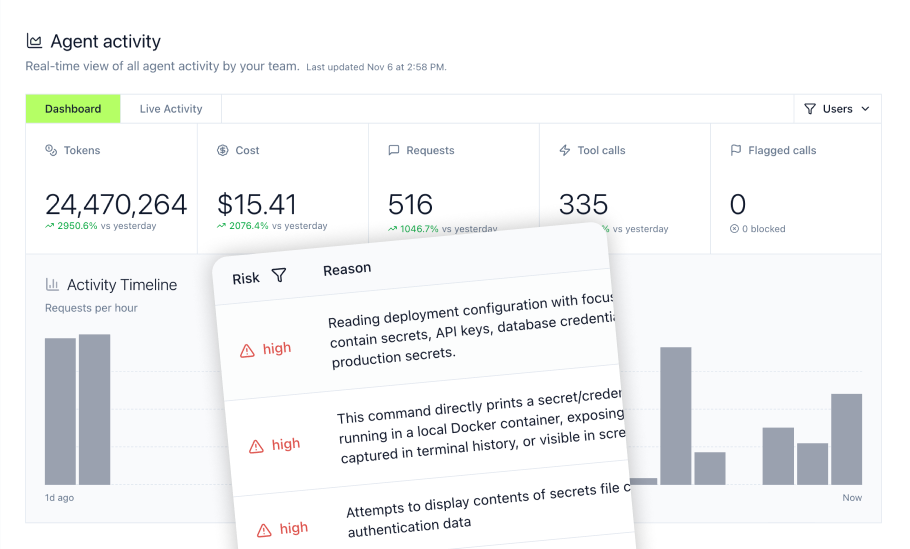
- Agent Monitoring: Track agent activity across tool calls, local commands, file access, prompt submissions, and off-gateway usage patterns through centralized visibility and Agent Monitor coverage
- Virtual MCP Bundles: Create team-specific, per-use-case endpoints that expose only the minimum required tools with SCIM-driven membership, curated tool lists, and fine-grained role-based access
- Hosted MCP Connectors: MintMCP runs connector instances on the customer's behalf with auto-scaling and sandboxed execution per connector, reducing infrastructure overhead
- OAuth Brokering for stdio and hosted MCP servers: Add enterprise authentication to local and hosted MCP servers, including OAuth 2.x, bearer tokens, headers, and SSO-fronted access without rebuilding each server
- Custom Gateway Middleware: Runs customer-authored middleware in a JS sandbox with external DLP and guardrails integrations for masking, blocking, and policy enforcement
Security Architecture
MintMCP implements defense-in-depth security for agent operations through centralized governance, SSO enforcement, SCIM-driven RBAC, tool-level policy, credential management, and observability controls. Each internal agent can receive its own identity and scoped permissions, making access easier to rotate, revoke, audit, and separate from human user credentials.
The platform provides visibility into which teams and agents use which tools, when they access data, and how frequently, solving the visibility gap that exists with direct agent-to-tool connections.
Enterprise Agent Integrations
- Govern Claude, Cursor, ChatGPT, Gemini, and Copilot activity through centralized gateway and Agent Monitor coverage
- Give agents scoped access to Snowflake data warehouse workflows, including natural language queries and Cortex Analyst support
- Let agents search Elasticsearch knowledge bases for HR documentation, support tickets, and log analysis
- Enable agent-assisted workflows through Gmail integration for customer response automation
- Deploy custom MCP servers for internal tools and APIs, then expose only the tools each agent or team should use
Agent Gateway Layer
MintMCP’s Agent Gateway is the control layer for agents that work alongside users. It gives internal agents identities, scoped permissions, memory governance, and monitoring, while the MCP Gateway underneath governs the data and tool connections those agents use.
Agent Monitor adds coverage for local non-MCP agent activity such as Bash usage, file reads/writes, and prompt submissions via Claude Code and Cursor hooks. This matters because enterprise agents do not only call MCP tools. They also read files, run commands, submit prompts, and operate across local developer environments where standard MCP logging may not be enough.
Compliance
- SOC 2 Type II audited
- Compliant with HIPAA standards
- MintMCP signs BAAs
- Penetration tested
- Data encrypted in transit and at rest
Deployment
Deploy quickly with managed SaaS-first delivery, US and EU availability, hosted MCP connectors, pre-configured policies, Agent Bundles, Virtual MCP Bundles, and self-service access for developers. VPC and self-hosted deployment are available on request.
Getting Started
Visit mintmcp.com/mcp-gateway to see how MintMCP’s MCP Gateway foundation supports governed Agent Gateway deployment for enterprise teams.
2. Bifrost (Maxim AI)
Bifrost is an open-source AI gateway built in Go, focusing on performance optimization for high-throughput production environments. The platform unifies LLM gateway, MCP gateway, and Agents gateway capabilities.
Primary Focus
Bifrost targets teams that need low-latency AI infrastructure. Benchmarks show 11 microseconds of gateway overhead at 5,000 requests per second, positioning it for performance-critical deployments.
Technical Capabilities
- Go-based architecture optimized for throughput
- Open source on GitHub under Apache 2.0 license
- Air-gapped and VPC deployment options
- Code Mode for token cost reduction
- Unified gateway for LLM, MCP, and agent traffic
Where Bifrost Fits
Organizations running high-volume AI workloads where latency directly impacts user experience. Teams in regulated industries requiring air-gapped deployments. Platform engineering teams comfortable operating Go-based infrastructure.
Deployment Model
Self-hosted via Docker or binary deployment. Enterprise tier available for VPC installations.
3. TrueFoundry
TrueFoundry provides an enterprise AI gateway platform with centralized MCP registry and discovery capabilities for platform engineering teams.
Primary Focus
TrueFoundry addresses the "M×N integration problem" where multiple agents need access to multiple tools. The centralized registry creates a single MCP endpoint architecture.
Technical Capabilities
- Centralized MCP Registry and Discovery system
- Performance benchmarks showing approximately 3-4ms latency at load, handling 350+ RPS on 1 vCPU
- Security and compliance controls for SOC 2, HIPAA, and GDPR requirements
- Kubernetes, VPC, and on-prem deployment options
- Multi-step agentic workflow support
Where TrueFoundry Fits
Platform engineering teams managing multiple AI agents across complex enterprise environments. Organizations requiring security and compliance controls across multiple frameworks.
Deployment Model
Hybrid: managed SaaS plus self-hosted control plane in customer's Kubernetes or cloud infrastructure.
4. Cloudflare AI Gateway
Cloudflare AI Gateway supports AI workload management, DLP-based MCP traffic detection, and shadow MCP visibility for organizations already using Cloudflare infrastructure.
Primary Focus
Edge-optimized AI traffic management with integration into existing Cloudflare Workers and Access deployments. Durable Objects enable persistent agent state across requests.
Technical Capabilities
- Global edge network presence for reduced latency
- Durable Objects for stateful agent workflows
- Shadow MCP detection via DLP engine
- Native integration with Cloudflare Workers and Access
- Free tier available with enterprise pricing options
Where Cloudflare Fits
Organizations whose security perimeter already operates at the network edge through Cloudflare. Teams seeking to add MCP governance without deploying separate infrastructure.
Deployment Model
Cloud-native, fully managed by Cloudflare.
5. Kong AI Gateway
Kong AI Gateway builds on Kong's established API management framework to provide unified governance for LLM, MCP, and A2A traffic.
Primary Focus
API-first organizations seeking to extend existing gateway investments to AI workloads. Kong provides semantic caching for LLM responses and flexible deployment across Konnect, hybrid, and self-managed configurations.
Technical Capabilities
- Unified governance across API and AI traffic
- Semantic caching for LLM response optimization
- Konnect SaaS control plane with self-hosted data plane options
- Kong ecosystem plugin compatibility
- Rate limiting and authentication inherited from API gateway
Where Kong Fits
Large enterprises with existing Kong deployments seeking to unify API and AI governance. Platform teams managing both traditional APIs and emerging AI agent traffic.
Deployment Model
Hybrid: Konnect SaaS control plane with self-hosted data plane, or fully self-hosted.
6. LiteLLM
LiteLLM is an open-source LLM gateway with broad provider compatibility through OpenAI format standardization. Built in Python for accessibility and extensibility.
Primary Focus
Provider abstraction for teams working across multiple LLM vendors. LiteLLM standardizes API calls so switching providers requires configuration changes rather than code rewrites.
Technical Capabilities
- Broad LLM provider compatibility
- OpenAI format standardization
- Python-based architecture
- Self-hosted deployment with full control
- Active open-source community
Where LiteLLM Fits
Development teams prototyping AI applications across multiple providers. Organizations requiring full infrastructure control and customization. Python-centric engineering teams.
Deployment Model
Self-hosted. Open source with optional enterprise support.
7. Lasso Security
Lasso Security provides a security-focused MCP gateway with threat detection capabilities specific to agent workflows.
Primary Focus
MCP-specific threat detection including tool reputation analysis, prompt injection blocking, and supply-chain integrity verification. Plugin-based architecture for security scanning.
Technical Capabilities
- Real-time prompt injection detection and blocking
- Tool reputation analysis and scoring
- Credential encryption and secret management
- Network filtering and allowlisting
- Open-source option available on GitHub
Where Lasso Fits
Security teams in regulated industries requiring defense-in-depth for AI deployments. Organizations prioritizing threat detection over performance or integration breadth.
Deployment Model
Cloud-managed service with enterprise SLA. Open-source self-hosted option available.
8. Portkey
Portkey provides AI gateway capabilities with flexible authentication schemes, including fine-grained controls at organization, team, and user levels.
Primary Focus
Authentication flexibility for complex enterprise hierarchies. OAuth 2.1 flow support with multiple deployment options including SaaS, VPC, and self-hosted.
Technical Capabilities
- Fine-grained authentication at org, team, and user levels
- OAuth 2.1 flow support
- In-depth tracing and observability
- AI gateway integration for unified governance
- Flexible deployment across SaaS, VPC, and self-hosted
Where Portkey Fits
Organizations with complex authentication requirements spanning multiple organizational levels. Teams requiring detailed tracing across AI interactions.
Deployment Model
Hybrid: SaaS, VPC, and self-hosted options.
9. Zuplo MCP Gateway
Zuplo MCP Gateway introduces virtual server architecture for capability curation, allowing teams to expose only selected tools, prompts, and resources from upstream MCP servers.
Primary Focus
Virtual MCP servers that provide curated views of upstream servers. This architecture enables governance at the capability level rather than the server level.
Technical Capabilities
- Virtual MCP servers with capability curation
- OAuth 2.0 with credential brokering
- OpenAPI-to-MCP generation
- Curated library of popular MCP servers
- Fully managed cloud platform
Where Zuplo Fits
Teams requiring fine-grained control over which capabilities agents can access. Organizations seeking fully managed infrastructure with minimal operational overhead.
Deployment Model
Fully managed cloud platform.
10. Composio
Composio provides an MCP integration platform with a broad catalog of pre-built server integrations. The platform emphasizes runtime tool selection to reduce context window usage.
Primary Focus
Integration breadth for teams needing rapid access to multiple tools. Just-in-time tool selection loads only the capabilities needed for each request rather than the full tool set.
Technical Capabilities
- Broad catalog of pre-built MCP integrations
- Runtime tool selection for efficiency
- IdP delegation through Okta, Entra, and Google
- Sandboxed environments for response summaries
- Fully managed cloud delivery
Where Composio Fits
Engineering teams requiring rapid integration across many tools without building custom connectors. Organizations prioritizing time-to-value over infrastructure control.
Deployment Model
Fully managed cloud. VPC and on-prem available on Enterprise tier.
11. Solo.io Agent Gateway
Solo.io Agent Gateway brings Kubernetes-native agent governance built on the Gloo Gateway foundation. The platform supports MCP and A2A protocols for agent-to-agent communication.
Primary Focus
Infrastructure teams with Kubernetes expertise requiring agent governance integrated into existing orchestration.
Technical Capabilities
- Native MCP and A2A protocol support
- Kubernetes-native deployment
- Tool registry and multiplexing
- Secure, stateful communication for agents
- Open source with enterprise support
Where Solo.io Fits
Platform engineering teams with Kubernetes infrastructure seeking agent governance that integrates with existing orchestration. Organizations requiring open-source transparency with commercial support options.
Deployment Model
Self-hosted on Kubernetes. Open source with enterprise support available.
12. Operant MCP Gateway
Operant MCP Gateway focuses on security vulnerability scanning for MCP traffic, mapping threats to OWASP Top 10 LLM categories.
Primary Focus
Security scanning capabilities including prompt injection detection, tool poisoning identification, and traffic pattern visualization. Cloud-native deployment with runtime threat detection.
Technical Capabilities
- OWASP Top 10 LLM threat mapping
- Tool poisoning detection
- Prompt injection identification
- Traffic pattern visualization
- Runtime threat detection
Where Operant Fits
Security teams requiring MCP-specific vulnerability scanning mapped to industry-standard threat categories. Organizations building security programs around OWASP frameworks.
Deployment Model
Cloud-native deployment.
Making Your Choice: Selection Criteria
Governance vs. Performance Trade-offs
Organizations face a fundamental choice between governance depth and raw performance. MIT Sloan research indicates that 80% of enterprise AI effort goes into governance rather than development. Purpose-built gateways like MintMCP prioritize governance primitives such as SCIM-driven RBAC, Virtual MCP Bundles, and Agent Bundles, while performance-focused options prioritize throughput and latency.
Authentication Architecture
OAuth support was added to the MCP authorization specification in March 2025, but implementation varies. Some gateways broker OAuth and wrap stdio servers with enterprise SSO, while others require manual OAuth configuration per server. Consider whether you need shared service accounts, per-user authentication, or per-agent identity with M2M auth.
STDIO vs. Remote Server Support
Many community-built MCP servers use STDIO transport. Solutions that only support remote HTTP or SSE servers limit ecosystem access. Evaluate whether your gateway hosts and operates STDIO servers or requires you to rebuild them for remote deployment.
Observability Requirements
Without comprehensive logging, organizations face visibility gaps where they cannot track which tools agents use or audit data access. Essential capabilities include tool call tracking, performance analytics, error rates, and cost allocation per team.
Deployment Speed vs. Control
Managed services like MintMCP Gateway provide fast deployment with hosted MCP connectors and pre-configured governance. Self-hosted options offer infrastructure control but require setup time and operational expertise.
Deploy Agent Infrastructure with Full Governance
The agent gateway you choose determines whether your AI deployment scales with confidence or stalls under security and compliance scrutiny. As enterprises move from proof-of-concept to production AI, the infrastructure layer becomes the difference between governed, auditable agent operations and fragmented security policies that create operational risk.
MintMCP Gateway provides the governance foundation enterprises need for both MCP Gateway and Agent Gateway capabilities. The platform starts with SSO-fronted access, SCIM-driven RBAC, Virtual MCP Bundles for team-specific permissions, and Agent Bundles for per-agent identity. MintMCP operates hosted MCP connectors on your behalf, eliminating infrastructure overhead while maintaining enterprise authentication, tool-level policy enforcement, and comprehensive audit trails.
This two-layer architecture extends beyond MCP traffic. MintMCP’s Agent Gateway adds the control layer for agent identities, permissions, memory, and monitoring, while Agent Monitor provides visibility into local non-MCP activity through Cursor and Claude Code hooks. For enterprise teams, agent memory should be company-owned, scoped by private, team, org, or customer context, and reviewable, auditable, and portable rather than locked inside an opaque vendor store. The result is unified visibility across all agent operations, from data access to tool invocation to local file system changes.
Organizations evaluating agent gateways should consider deployment speed, governance depth, and operational model. MintMCP delivers production-ready infrastructure in minutes through managed SaaS delivery, pre-configured policies, and self-service access for developers, while maintaining the flexibility for VPC and self-hosted deployment when required.
Start your evaluation at mintmcp.com/mcp-gateway and see how governed AI agent deployment works in practice.
Frequently Asked Questions
What is an AI Agent Gateway and why does my enterprise need one?
An agent gateway centralizes authentication, authorization, and observability for AI agents connecting to enterprise tools and data. Without a gateway, organizations face fragmented security policies across individual MCP servers, zero visibility into which agents access which tools, and duplicated authentication logic. The gateway transforms an N-to-N mesh of point-to-point connections into a manageable hub-and-spoke model with unified governance.
How does MintMCP's Bundle architecture improve AI agent governance compared to traditional methods?
Traditional approaches require configuring separate objects for plugins, access rules, and agent accounts across each MCP server. MintMCP's Bundle architecture packages tool access, policy enforcement, and audit logging into single governance units per team or role. Virtual MCP Bundles create per-use-case endpoints with SCIM-driven membership, while Agent Bundles give each deployed agent its own rotatable credentials and permission scope independent of creator access levels.
Can AI Agent Gateways help detect unauthorized AI agent usage, often called "Shadow AI"?
Yes. Gateways transform shadow AI into sanctioned AI by routing agent connections through governed infrastructure. The gateway catalogs approved MCP servers, enforces role-based access controls, maintains audit trails of tool invocations, and can block unauthorized server connections. MintMCP extends this with Agent Monitor hooks that detect off-gateway MCP usage in developer tools like Cursor and Claude Code.
What are the key security and compliance features an enterprise should look for in an agent gateway?
Essential features include SOC 2 Type II audited security posture, SSO enforcement through OAuth 2.x and SAML, SCIM-driven RBAC tied to identity provider groups, tool-level access controls, comprehensive audit trails, and credential management with rotation capabilities. For regulated industries, look for HIPAA documentation and whether the vendor signs BAAs. The gateway should provide visibility into which teams and agents use which tools, when they access data, and how frequently.
How does 2026's AI agent landscape differ from previous years, and what role does MCP play?
The MCP ecosystem reached 97 million monthly SDK downloads and transitioned to Linux Foundation's Agentic AI Foundation governance on December 9, 2025. All major foundation model providers including OpenAI, Anthropic, Google, and Microsoft now offer native MCP support. This standardization wave makes MCP gateways the infrastructure layer for enterprise AI agent deployments, analogous to API gateway category emergence in prior years.