As enterprises deploy thousands of autonomous AI agents across business workflows, 68% of organizations cannot reliably distinguish AI agent activity from human users. Agents operate at machine speed, reading emails, querying databases, calling APIs, and executing code across multiple systems, often without human review of each step. Traditional security controls built for applications and users simply do not translate to this new attack surface.
The right agentic AI security platform transforms how organizations deploy AI agents from a security vulnerability into a governed, production-ready infrastructure. As organizations pilot and roll out autonomous agents, choosing a platform that provides centralized identity governance, runtime protection, and enterprise security controls is critical before agents gain unrestricted access to sensitive systems.
Key takeaways
- MintMCP provides enterprise MCP gateway infrastructure with data-permissions-first architecture and Virtual MCP Bundles
- Agent Gateway delivers first-class non-human identities with per-agent bearer keys, M2M tokens, and independent credential rotation
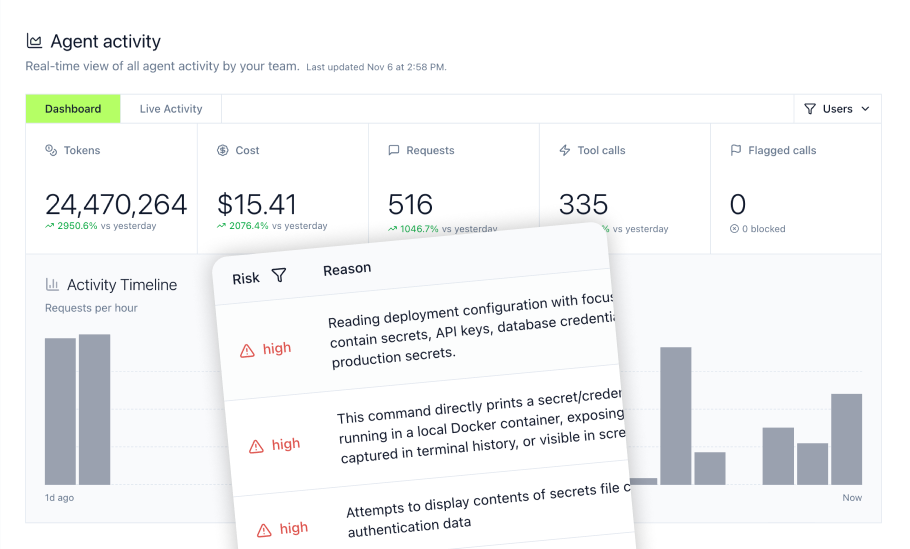
- Agent Monitor provides visibility into supported agent activity including prompts, commands, file access, and MCP tool calls
- Mint Guard runtime protection includes managed detection policies for prompt injection, secrets, PII, and harmful content
- SSO and SCIM-driven RBAC enable centralized identity governance with directory-based membership and rule-based policy
- SOC 2 Type II attestation, HIPAA compliance with BAA availability, penetration testing, and encryption in transit and at rest
- Coworker Agents provide hosted autonomous agents with Slack triggers, company-owned memory, and governed tool access
- Enterprise integrations include Snowflake, GitHub, Salesforce, Slack, Claude, Cursor, ChatGPT, Gemini, and Copilot
1. MintMCP
MintMCP provides enterprise infrastructure for governing AI clients and autonomous agents across the Model Context Protocol ecosystem. Its data-permissions-first architecture starts with SSO, SCIM-driven RBAC, Virtual MCP Bundles, tool-level policy, and audit logs, then enables agents on top of that foundation.
Unlike approaches that grant broad access and restrict afterward, MintMCP's architecture creates a foundation for both human-operated AI clients and autonomous agents through centralized tool access, agent identity, credentials, permissions, monitoring, guardrails, and auditability.
What makes MintMCP different
MintMCP addresses an access-control gap highlighted by 2025 breach research: 97% of organizations that reported an AI-related security incident lacked proper AI access controls. The platform's architecture wraps STDIO, hosted, HTTP-streamable, and SSE MCP servers behind SSO-fronted remote MCP endpoints with OAuth brokering, SCIM-driven membership, and rule-based policy.
The key abstraction is the Virtual MCP (VMCP), which bundles approved connectors and a curated tool surface behind one governed endpoint for a particular team, role, use case, or agent. Directory groups can drive membership through SCIM, helping organizations apply consistent access policies without requiring every employee to configure each MCP server separately.
Core capabilities
- MCP Gateway: Single governed entrypoint between AI clients and MCP servers with hosted connectors, credential injection, access policies, and audit logging
- Agent Gateway: First-class non-human identities for autonomous agents with bearer keys, M2M tokens, workload identity federation, and independent credential rotation
- Agent Monitor: Visibility into supported agent activity including prompts, commands, file access, and MCP tool calls
- Guardrails: Mint Guard managed detection, declarative Rules, and Gateway Middleware for runtime policy enforcement
- Coworker Agents: Hosted autonomous agents with Slack triggers, company-owned memory, and governed tool access
Security architecture
MintMCP implements defense-in-depth security through centralized governance that addresses the visibility gap where 68% of organizations cannot distinguish AI agent activity from human activity. Every tool call, credential lifecycle event, and access-policy change is logged with tamper-evident access-grant history signed at write time.
The guardrails architecture includes three complementary layers:
- Mint Guard: Managed detection policies for prompt injection, secrets, PII, and harmful content
- Rules: Declarative matching and enforcement on tools, arguments, or content
- Gateway Middleware: Customer-authored JS sandbox logic with external DLP integrations
Enterprise integrations
- Snowflake data warehouse access with natural language queries
- GitHub integration for code repository access and PR automation
- Salesforce MCP for CRM data governance
- Slack integration for Coworker Agent triggers
- Claude, Cursor, ChatGPT, Gemini, and Copilot governance through centralized gateway
Compliance
- SOC 2 Type II audited
- Compliant with HIPAA standards; BAAs available for customers handling protected health information
- Penetration tested
- Data encrypted in transit and at rest
Pricing
Contact for enterprise demonstration and pricing
Getting started
Visit mintmcp.com/mcp-gateway for the deployment guide
2. Linx Security
Linx Security provides an AI-native identity governance platform with unified visibility across human, non-human, and AI agent identities. Founded in 2023, the platform focuses on identity-first approaches to agentic security.
Primary focus
The platform's Identity Graph provides unified visibility across all identity types, with MCP Gateway capabilities for inline enforcement of AI agent tool calls. The architecture supports just-in-time access provisioning for agents.
Core capabilities
- Identity Graph for unified identity visibility
- MCP Gateway for inline enforcement
- Just-in-time access provisioning
- Coverage of human, NHI, and agentic identities
Deployment
SaaS delivery with enterprise custom pricing
3. Palo Alto Networks
Palo Alto Networks extends its enterprise security platform with agentic AI capabilities through Prisma AIRS for AI lifecycle security and Cortex AgentiX for persona-based agentic SOC workflows.
Platform consolidation approach
The platform consolidation approach brings AI runtime, identity, and agentic operations under a unified security stack. The 2026 CyberArk acquisition extended capabilities to unified identity security, while the Protect AI acquisition and the May 2026 Portkey acquisition added AI-specific security layers.
Core capabilities
- Cortex AgentiX for agentic SOC workflows
- Prisma AIRS for AI lifecycle security
- CyberArk integration for privileged access management
- Multi-vendor support across AI environments
Deployment
Enterprise custom pricing with platform consolidation benefits for existing customers
4. NeuralTrust
NeuralTrust provides runtime protection through TrustGuard, TrustGate AI Gateway, and TrustLens for agent discovery and posture management. The platform was recognized by Gartner as a Representative Vendor in the Market Guide for Guardian Agents.
Split-plane architecture
The split-plane architecture supports on-premises deployment for data sovereignty requirements. Guardian Agents provide multi-agent system oversight, addressing security needs in complex autonomous workflows.
Core capabilities
- TrustGuard for runtime enforcement
- TrustGate AI Gateway for centralized access control
- TrustLens for agent discovery and posture management
- Split-plane architecture for on-prem deployment
Deployment
SaaS, Private Cloud, VPC, and on-premises options with ISO 27001 certification
5. Zenity
Zenity provides intent-aware runtime detection that analyzes complete execution paths rather than individual API calls. Founded in 2021, Zenity has raised roughly $185M in total funding after a $125M Series C announced in August 2026, and the platform focuses on behavioral analysis for agentic workflows.
Intent-aware detection
The Correlation Agent stitches together tool calls, memory access, and control flow to detect sophisticated attacks that evade API-level monitoring. Secure-by-design policies can be applied before deployment.
Core capabilities
- Intent-aware runtime detection
- Correlation engine for behavioral analysis
- Discovery across SaaS, cloud, and endpoint agents
- Pre-deployment policy enforcement
Deployment
SaaS delivery with enterprise pricing
6. Microsoft Security
Microsoft extends its security ecosystem with Entra Agent ID for first-class agent identities in the directory and Defender threat protection for AI workloads. Native integration with Copilot Studio and Azure AI Foundry provides seamless deployment.
Microsoft-centric environments
Agent identities managed within the same Entra directory as users provide a natural extension for Microsoft-standardized organizations. Security Copilot agents for autonomous alert triage were in preview during 2026.
Core capabilities
- Entra Agent ID for agent identity management
- Defender threat protection for AI workloads
- Native Copilot Studio integration
- Azure AI Foundry compatibility
Deployment
Entra Agent ID is available to Microsoft Entra customers. Extending Entra security features to agents requires Microsoft Agent 365, while Security Copilot is included for eligible Microsoft 365 E5 and E7 customers.
7. CrowdStrike Falcon
CrowdStrike unifies human, NHI, and AI agent identities through Falcon Next-Gen Identity Security. The Charlotte AI AgentWorks ecosystem enables custom security agent development.
Unified identity platform
CrowdStrike completed its acquisition of SGNL in February 2026, adding continuous, just-in-time authorization capabilities. AgentWorks provides a no-code platform for building custom security agents with partnerships spanning AWS, NVIDIA, Anthropic, and OpenAI.
Core capabilities
- Falcon Next-Gen Identity Security
- Charlotte AI AgentWorks ecosystem
- SGNL just-in-time authorization
- Single-agent architecture for endpoint, cloud, and identity
Deployment
Enterprise custom pricing with platform consolidation benefits
8. SentinelOne Purple AI
SentinelOne Purple AI provides autonomous investigation capabilities through auto-investigate and agentic custom detection rule creation. Autonomous remediation executes via the Hyperautomation platform.
Autonomous investigation
Full end-to-end autonomous investigation with dynamic reasoning adapts as evidence emerges during security incidents. Prompt Security's MCP-focused capabilities were integrated into the Singularity platform following the 2025 acquisition.
Core capabilities
- Auto-investigate for full investigations
- Agentic custom detection rules
- Autonomous remediation via Hyperautomation
- Dynamic reasoning across evidence
- Prompt Security integration for MCP security and prompt injection detection
Deployment
Part of Singularity platform pricing with Prompt Security integration
9. Astrix Security (acquired by Cisco, June 2026)
Astrix Security provides Agent Control Plane capabilities with four-method discovery for shadow agents and MCP servers. The June 2026 Cisco acquisition brings Astrix into Cisco's identity and security portfolio, including Identity Intelligence, Secure Access, Duo, and Splunk.
Non-human identity focus
The platform evolved from mature non-human identity capabilities to cover agentic workflows with short-lived, scoped credentials provisioning.
Core capabilities
- Agent Control Plane with four-method discovery
- Shadow agent and MCP server discovery
- Short-lived scoped credentials
- Cisco platform integration
Deployment
Enterprise custom pricing with Cisco portfolio integration
10. Oasis Security (signed LOI to be acquired by Cyera)
Oasis Security provides intent-based, just-in-time access for agents that evaluates intent before the first action executes. The platform raised approximately $195M total with a $120M Series B in 2026.
Agentic access management
The platform focuses on non-human identity lifecycle management and intent-aware access for AI agents.
Core capabilities
- Intent-based just-in-time access
- Pre-action intent evaluation
- Non-human identity lifecycle governance
- Enterprise deployment at scale
Deployment
Enterprise custom pricing with strong enterprise traction
Making your choice: Essential selection criteria
Identity and access governance requirements
With 97% of organizations that reported an AI-related security incident lacking proper AI access controls in IBM's 2025 research, identity governance represents a core part of an agentic security strategy. Evaluate whether platforms provide first-class agent identities with independent credentials, scoped permissions, and attributable audit trails. Platforms that treat agents as extensions of human accounts create attribution gaps and over-privileged access.
Runtime protection capabilities
Prompt-injection research shows that agents can begin following adversarial instructions even when they do not complete an attack end to end, making runtime protection important before sensitive tool actions execute. Consider whether platforms provide managed detection policies for prompt injection, secrets, and PII, or require custom rule authoring for basic protections.
MCP security coverage
The Model Context Protocol has become critical infrastructure for AI agent deployment, but implementation varies significantly across platforms. Evaluate whether gateways handle STDIO-based MCP servers, broker OAuth flows, and provide tool-level access control, or only support remote HTTP endpoints.
Compliance and audit requirements
For organizations facing compliance requirements, evaluate whether platforms provide tamper-evident audit trails, SIEM export capabilities, and certifications appropriate for your industry. SOC 2 Type II attestation has become baseline for enterprise security, but HIPAA compliance requires additional verification.
Deployment model considerations
Some platforms require self-hosted Kubernetes infrastructure while others offer managed SaaS delivery. Consider whether production deployment in weeks is needed or if months building and operating custom infrastructure is feasible. Gartner predicts that more than 40% of agentic AI projects will be canceled by the end of 2027 because of escalating costs, unclear business value, or inadequate risk controls, making operational readiness and time-to-value important selection factors.
Building your agentic AI security foundation with MintMCP
Securing autonomous AI agents requires a fundamentally different approach than traditional application security. Agents operate at machine speed, chain actions across multiple systems, and make runtime decisions about which tools to call. This creates governance challenges that often span identity, access control, monitoring, audit, and runtime policy enforcement.
MintMCP provides the enterprise infrastructure that makes AI agents deployable, governed, measurable, and swappable. The data-permissions-first architecture starts with what agents can access rather than restricting them after deployment, creating a foundation that scales from pilot projects to enterprise-wide agent workforces.
Whether rolling out Claude, Cursor, ChatGPT, Gemini, or Copilot, MintMCP's Agent Gateway gives every autonomous agent its own identity, scoped permissions, and audit trail. Agent Monitor provides visibility into supported agent activity, including prompts, commands, file access, and MCP tool calls, while Mint Guard provides managed detection policies for prompt injection, secrets, PII, and harmful content at supported enforcement points.
The Virtual MCP abstraction enables organizations to bundle approved connectors behind governed endpoints with SCIM-driven membership and directory-based access policies. This approach eliminates credential sprawl, provides centralized audit trails, and ensures agents receive least-privilege access from deployment. Integration with existing enterprise security investments through SIEM export, SSO, and external DLP systems means MintMCP fits into established security operations rather than requiring parallel infrastructure.
With SOC 2 Type II audited status, compliance with HIPAA standards, BAA availability, penetration testing, audit trails, and tamper-evident access history, MintMCP addresses enterprise governance requirements while enabling rapid agent deployment. Organizations can move from pilot to production in weeks rather than months, deploying governed agents without slowing down development teams.
Visit mintmcp.com to deploy governed AI agents with enterprise-grade security controls.
Frequently asked questions
How do agent identity requirements differ from human user management?
Autonomous agents require non-human identities with independent credentials, scoped permissions, and attributable audit trails separate from their human creators. When agents inherit human credentials, organizations lose the ability to revoke agent access without disrupting users, rotate credentials independently, or attribute actions to specific agents. MintMCP's Agent Gateway provides first-class agent identities with bearer keys, M2M tokens, or workload identity federation so each agent operates with its own governed identity.
What role do runtime guardrails play in preventing dangerous AI agent actions?
Runtime guardrails can inspect and control supported tool activity at configured enforcement points, helping reduce the risk that prompt injection or manipulated agent behavior leads to unsafe actions. Effective guardrails include managed detection policies for known attack patterns, declarative rules for argument validation, and middleware for custom logic like DLP integration. MintMCP's Mint Guard provides out-of-the-box detection for prompt injection, secrets, PII, and harmful content with enforcement modes that block threats at high confidence.
Can existing enterprise security tools integrate with agentic AI security platforms?
Yes, enterprise-grade platforms provide integration points for existing security investments. MintMCP supports SIEM export via OTLP or Splunk HEC for tool calls, prompt submissions, and access policy changes. Gateway Middleware enables integration with external DLP systems like AWS Bedrock Guardrails, Google Cloud Model Armor, and OpenAI moderation. SSO through Okta, Entra ID, or Google and SCIM provisioning ensure agent governance aligns with existing identity infrastructure.
What are the key considerations for selecting an AI security platform for autonomous agents?
Evaluate platforms across five dimensions: identity governance (does it provide first-class agent identities with independent credentials), runtime protection (does it detect and block threats before tool execution), MCP coverage (does it handle STDIO servers and broker OAuth), compliance capabilities (does it provide tamper-evident audit trails and required certifications), and deployment model (managed SaaS versus self-hosted infrastructure). Gartner predicts that more than 40% of agentic AI projects will be canceled by the end of 2027 because of escalating costs, unclear business value, or inadequate risk controls, reinforcing the need to evaluate governance and production readiness before deployment.
How does a data-permissions-first approach enhance AI agent security?
Data-permissions-first architecture starts with governing what AI systems can access rather than granting broad access and restricting afterward. This approach ensures agents receive least-privilege access from the start, reducing the blast radius of compromised or malfunctioning agents. MintMCP's architecture implements this through Virtual MCPs that bundle approved connectors behind governed endpoints, SCIM-driven access policies, and tool-level curation so agents only see the minimum required capabilities for their purpose.