Persistent AI agents with long-term memory represent a fundamental shift from stateless chatbots to context-aware systems that retain information across sessions. In 2026, the strongest AI coworker pattern is a long-running agent that lives in Slack, holds memory, continues work across days, and operates alongside employees. This capability transforms agents from reactive tools into intelligent coworkers that maintain institutional knowledge, adapt to organizational policies, and scale operations while preserving audit trails and compliance requirements.
For enterprises deploying AI agents like Claude, Cursor, ChatGPT, Gemini, and Copilot, addressing the "last mile problem" requires secure, governed access to internal systems through centralized infrastructure like MintMCP Gateway. MintMCP's MCP Gateway governs data and tool connections, while its Agent Gateway builds on that foundation to govern agent identities, permissions, memory, and monitoring.
This guide covers the architectural foundations, governance frameworks, and practical implementation strategies for deploying persistent AI agents in 2026.
Key Takeaways
- AI coworkers are long-running agents, not simple chatbots: The emerging pattern is a Slack-native agent that holds memory, continues work across days, and operates alongside employees
- Persistent memory is maturing quickly: The ecosystem now includes more implementation options across frameworks and vector stores, giving teams more flexibility for production pilots
- Memory quality beats repeated context-setting: Selective retrieval with intelligent consolidation can improve relevance and reduce token usage compared to repeatedly sending full conversation history
- Enterprise memory needs governance: Private, team, organization, and customer memory scopes should be company-owned, versioned, reviewable, auditable, and portable
- Four-layer architecture is a useful pattern: One common design pattern separates working memory, episodic memory, semantic memory, and procedural memory, with each layer requiring different storage and governance considerations
- Graph memory is becoming more important: Hybrid approaches combining vector similarity with graph-based entity relationships can help compliance workflows that require richer audit trails
- Token efficiency matters: The shift from full-context prompting to selective memory retrieval can reduce token usage, which may lower costs for memory-heavy workflows
- Productivity should be measured workflow by workflow: Customer support, engineering, sales, and data analysis teams should track time saved, resolution quality, and context reconstruction effort after deployment
- Memory staleness remains unsolved: Detecting when highly retrieved memories become confidently wrong due to real-world changes represents a frontier challenge requiring organizational policies
Understanding AI Coworkers: Persistent Agents Reimagined for 2026
AI coworkers differ fundamentally from traditional chatbots through their ability to maintain context across sessions, learn from interactions, and adapt to organizational workflows. Unlike stateless systems with limited continuity between conversations, persistent agents retain institutional knowledge and build on previous interactions.
In enterprise settings, AI coworkers are best understood as long-running agents that work beside employees rather than one-off automations. They may live in Slack, remember the state of projects, continue work across days, and call governed tools through approved infrastructure. MintMCP's practitioner view is that AI coworkers become most useful when they are run like governed teammates, with identity, scoped permissions, reviewable memory, and monitored actions.
What Defines an AI Coworker
- Session continuity: Agents remember previous interactions without users re-establishing context
- Accumulated learning: Systems improve through episodic memory of past workflows and outcomes
- Organizational awareness: Agents understand company policies, team structures, and individual preferences
- Multi-step workflow capability: Complex tasks spanning days or weeks become possible through persistent state
- Slack-native operation: Agents can be invoked where employees already coordinate work
- Governed identity: Each agent operates with scoped credentials, policy, audit trails, and monitoring
One useful architectural pattern for these capabilities is a four-layer memory architecture:
- Working Memory: Ephemeral current session context using Redis, checkpointers, or similar short-term state stores
- Episodic Memory: Time-series event history and conversation logs governed by defined retention policies
- Semantic Memory: Persistent facts, user preferences, and knowledge stored in vector stores or unified databases
- Procedural Memory: Learned workflows, policies, and behaviors refined through rules, examples, or knowledge graphs
Each layer requires different storage substrates and maps to specific governance requirements around retention, access control, and audit trail needs. Organizations should align their memory architecture with responsible AI governance standards. For enterprise use, memory should follow Git-like principles: scoped by private, team, organization, and customer context; owned by the company; versioned; reviewable; auditable; and portable across systems where practical.
The 'Last Mile' Problem: Empowering AI Agents with Secure Enterprise Access
The gap between AI agent capabilities and enterprise deployment readiness centers on secure access to internal systems. While foundation models have grown powerful, connecting them to organizational data sources, databases, CRM systems, and internal tools without compromising security remains the critical challenge.
MintMCP frames this as two connected layers. The MCP Gateway governs data and tool connections for AI systems users already run, including Claude, Cursor, ChatGPT, Gemini, and Copilot. The Agent Gateway builds on that MCP Gateway foundation to govern the agents themselves, including their identities, permissions, memory, and monitoring.
Core Challenges Enterprises Face
- Authentication complexity: Each internal system requires different credential types, rotation policies, and access patterns
- Credential sprawl: Managing API keys, OAuth tokens, and service accounts across multiple agents creates security risk
- Audit requirements: Regulated industries need complete trails of what agents accessed, when, and why
- Tool governance: Preventing agents from executing unauthorized actions while enabling legitimate workflows
- Memory governance: Ensuring persistent agent memory is scoped, reviewable, auditable, and portable rather than an opaque vendor-controlled store
Integrating AI Coworkers with Enterprise Infrastructure
Production deployments require infrastructure that normalizes authentication across diverse systems. MintMCP's Virtual MCP Bundles address this by packaging tool access, policy enforcement, and audit logging into single governance units per team, role, use case, or agent identity.
Integration considerations:
- OAuth brokering: Converting stdio-based MCP servers to hosted services with OAuth wrapping without code changes
- Identity forwarding: Ensuring agent actions are attributed to specific users or agent identities for audit purposes
- Usage controls: Monitoring tool activity and applying access policies per user, team, or agent
- Tool-level access control: Enabling database reads while blocking writes, or allowing specific Slack channels while restricting others
- Memory scoping: Separating private, team, organization, and customer memory so agents retrieve only the context they are allowed to use
Security and Compliance in Agent Deployment
Organizations must establish governance frameworks before deployment, not after. The MCP data risk framework provides structured approaches for assessing and mitigating risks associated with agent access to enterprise data.
Unleashing Efficiency: Top Use Cases for AI Coworkers in Business
Persistent memory enables use cases that are difficult to scale with stateless systems. The strongest results come from workflows where employees repeatedly reconstruct the same context across systems, teams, or customer interactions.
Transforming Data Analysis with AI Agents
Data analysis agents querying databases and generating reports benefit substantially from memory. Agents remember query patterns, understand data schemas, and build on previous analyses rather than starting fresh each session.
Measured outcomes to track:
- Reduced time spent on routine analysis through accumulated context
- Improved query accuracy through learned understanding of data relationships
- Faster report generation through procedural memory of successful templates
Automating Customer Support Workflows
Customer support workflows demonstrate where persistent memory can be especially useful. Agents can maintain context across multiple interactions with the same customer over weeks or months, remembering previous issues, resolutions attempted, and customer preferences.
Continuous context retention can help support agents avoid repeated background gathering and maintain continuity across long-running customer issues. In governed enterprise deployments, customer memory should be scoped separately from private, team, and organization memory so agents can use customer context without overexposing unrelated internal knowledge.
Accelerating Development Workflows
Engineering teams connecting agents to GitHub, Jira, and CI/CD pipelines through MCP gateway integrations can reduce repeated context gathering across code review, incident response, and deployment workflows. Agents with episodic memory can understand codebase history, previous deployment issues, and team coding patterns.
Enhancing Sales Relationship Intelligence
AI coworker case studies often emphasize reduced manual context reconstruction as a benefit for employee experience and workflow continuity. For sales teams, relationship memory can support more consistent follow-up across Salesforce, Slack, email, and calendar systems.
Governing AI Agents: Bundles, Policies, and Persistent Identity
Effective governance requires architectural primitives that map cleanly to organizational structures and compliance requirements. The Bundle model provides this foundation. In MintMCP's model, MCP Gateway handles governed data and tool connections, while Agent Gateway extends that foundation to agent identities, permissions, memory, and monitoring.
Streamlining Governance with Bundle Architecture
MintMCP's Bundle architecture differs from traditional configuration approaches by packaging three concerns into single units:
- Tool access: Which MCP servers and specific tools the bundle includes
- Policy enforcement: What rules apply to tool usage within the bundle
- Audit logging: Isolated audit trails per bundle for compliance investigations
Bundle Administration Features
- Bundles sync automatically with Okta or Azure AD group changes via SCIM
- New tool additions can require admin approval to prevent capability creep
- Policies cascade from organization to team level with inheritance
- Each bundle produces separate audit streams for compartmentalized compliance
Ensuring Auditability and Credential Security
Agent Bundles extend the model to non-human principals. Each deployed agent receives its own persistent identity with scoped credentials that can be rotated independently of human user credentials. For connectors that require per-agent OAuth, MintMCP supports an "act as agent" flow so agents can operate with explicit, governed identity rather than shared service-account keys.
Per-agent identity benefits:
- Audit attribution: Every action traceable to specific agent identity
- Credential hygiene: Agent credentials rotated without disrupting human access
- Scope isolation: Agent permissions explicitly bounded, never inherited from creator
- M2M authentication: OAuth 2.0 client-credentials per agent with bearer API keys
- Memory boundaries: Each agent can be tied to explicit private, team, organization, or customer memory scopes
Per-agent credential scoping helps security teams govern autonomous systems without relying on shared service-account keys or inherited human permissions.
Detecting Shadow AI: Monitoring Agent Activity On and Off-Gateway
Shadow AI presents a growing challenge as developers adopt AI coding assistants and automation tools outside sanctioned channels. Understanding both gateway-controlled and off-gateway activity is essential for comprehensive governance.
The Risks of Unsanctioned Agent Usage
Unsanctioned MCP usage in tools like Cursor or Claude Code creates blind spots in enterprise security posture:
- Credential exposure: Developers configuring local MCP servers may embed sensitive credentials
- Data leakage: Agent interactions with code or documents may transmit sensitive information
- Compliance gaps: Unmonitored agent activity creates audit trail holes in regulated environments
- Policy violations: Agents executing bash commands or file operations without oversight
Proactive Detection and Enforcement
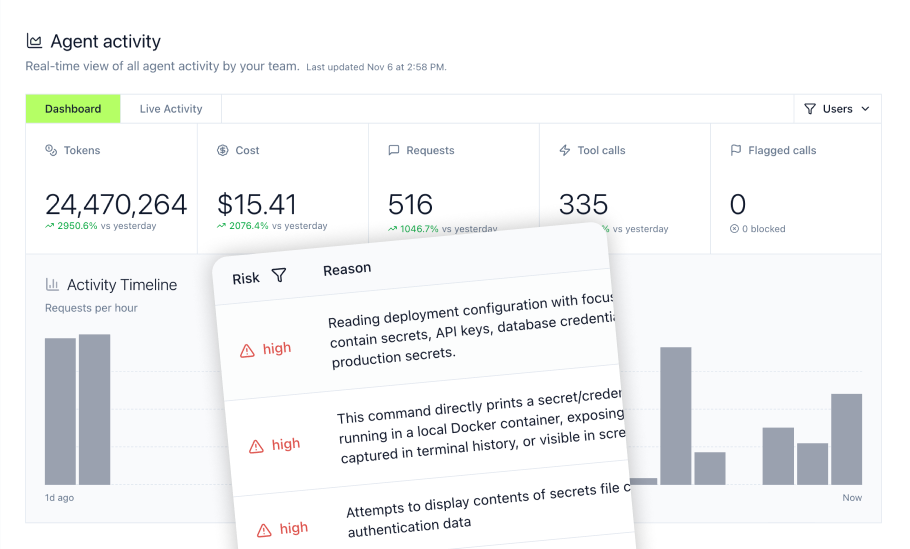
Agent Monitor addresses shadow AI through hooks in Cursor and Claude Code that provide visibility into local agent activity beyond gateway-managed MCP traffic. Together, Gateway and Agent Monitor create a two-layer governance model: the Gateway covers MCP traffic, while Agent Monitor covers local non-MCP agent activity such as bash commands, file reads and writes, and prompt submissions.
Detection capabilities:
- PII exposure in agent interactions
- Credential leakage including API keys and tokens
- Risky bash commands and file system operations
- Prompt injection attempts using built-in rule sets
Enforcement options:
- Detect-only mode for visibility without blocking
- Enforce mode for active policy application
- MDM integration for pushing configurations to developer machines
- Custom JS middleware and guardrail rules that can transform, mask, block, or alert on sensitive agent interactions
Compliance and Security for AI Coworkers: Industry Standards for 2026
Enterprise deployment requires alignment with regulatory frameworks across jurisdictions and industries.
Aligning AI Agents with Security, Privacy, and Compliance Requirements
Data retention and right to deletion:
Agent memory systems must support complete user data deletion upon request where applicable. Memory platforms need verifiable deletion mechanisms and audit logs. Challenge: consolidated memories may contain information from multiple users.
Healthcare and medical workflows:
PHI stored in agent memory requires strong encryption, access controls, and appropriate contractual coverage such as BAAs. Episodic memory storing patient interactions should be governed by documented retention and deletion policies.
Financial services workflows:
Agent memory handling financial data requires accuracy and auditability controls. Memory staleness becomes compliance risk when outdated regulatory guidance or customer information remains in active retrieval. Communication records may be subject to industry-specific retention rules, depending on the workflow and jurisdiction.
MintMCP is SOC 2 Type II audited, with continuous compliance monitoring via Drata. Enterprise SSO, complete audit trails, PII detection, and role-based access control are built into every layer of the platform. Customers handling protected health information can request HIPAA documentation. MintMCP signs BAAs. For detailed security documentation, teams can review the MintMCP Trust Center.
Data Protection and Infrastructure Security
Memory governance framework:
- Tag every memory with source timestamp, extraction method, and confidence level
- Assign each memory to a private, team, organization, or customer scope
- Maintain version history so high-impact memory changes can be reviewed and rolled back
- Implement RBAC for memory systems with least-privilege access
- Establish different retention policies per memory layer
- Conduct regular audits to identify and correct inaccurate memories
- Prefer Git-like memory workflows where memory is company-owned, reviewable, auditable, and portable
MintMCP supports customer-authored JS middleware for inline policy enforcement, with documented integrations for AWS Bedrock Guardrails, Google Cloud DLP, Microsoft Purview, Nightfall, and Skyflow. Pre- and post-phase hooks can transform, mask, or block sensitive data in agent interactions. For detailed security guidance, see the MCP security whitepaper.
Comparing AI Coworker Platforms: Beyond Basic Connectors
The MCP gateway market has matured with multiple vendors addressing different buyer personas and use cases. MintMCP distinguishes itself through Virtual Bundles for per-use-case endpoints, Agent Bundles for per-agent identity, programmable policy controls, and visibility that extends beyond gateway-managed traffic.
For AI coworker deployments, teams should also evaluate the Agent Gateway layer: whether the platform governs agent identities, permissions, memory, and monitoring on top of the underlying MCP Gateway.
Key Differentiators in Gateway Platforms
Architecture approaches vary significantly:
- Bundle-based governance: MintMCP packages tool access, policy, and audit into single units versus approaches that require separate configuration
- Per-agent OAuth: Individual agent identities with M2M authentication versus shared account tokens
- Custom policy hooks: Programmable JavaScript middleware versus declarative-only rules or preset guardrails
- Shadow AI detection: Gateway plus Agent Monitor coverage versus gateway-only visibility
- Governed memory model: Scoped, reviewable, auditable memory versus opaque memory stores that are harder to inspect or move
Evaluating Features for Enterprise Needs
Critical evaluation criteria:
- Identity model: Does the platform support per-agent identity or only human user identity?
- Policy flexibility: Can you write custom policy code or only use predefined rules?
- Off-gateway visibility: Can you detect AI agent activity outside the gateway?
- Hosting model: Does the vendor operate MCP server runtimes or must you self-host?
- Memory governance: Can memory be scoped, reviewed, audited, versioned, and exported?
- Slack-native operation: Can agents work where employees already coordinate tasks?
The agentic AI governance framework provides detailed guidance on evaluating platforms against enterprise requirements.
Building Your AI Coworker Ecosystem: Integrations and Scalability
Production deployments require broad integration coverage and infrastructure that scales with organizational growth.
Connecting AI Agents to Enterprise Applications
MintMCP supports pre-configured connectors including GitHub, HubSpot, Notion, Linear, Gmail, Stripe, and Snowflake.
Transport support:
- stdio transport for local subprocess-based MCP servers
- HTTP and SSE transport for remote servers
- OAuth 2.0 and SSO authentication normalization
Custom connector deployment:
- Hosting of custom stdio-based MCP servers from community ecosystem
- Containerized sandbox execution for untrusted MCP server code
- Auto-scaling and isolated execution per connector
Scaling Agent Deployments with Infrastructure
Infrastructure capabilities:
- REST APIs and SDKs enable programmatic management for CI/CD integration
- Infrastructure-as-code workflows through API-first design
- SIEM export to Microsoft Sentinel, Splunk, and S3
- Data residency options, which should be reviewed with security and compliance teams based on deployment needs
Compatibility spans Claude, Cursor, ChatGPT, Gemini, and Copilot governance through a centralized gateway and monitoring model. For teams deploying AI coworkers, MintMCP's Agent Gateway extends that model with governed agent identities, scoped tool access, memory, monitoring, and Slack-native invocation.
The Future of Work: Deploying AI Coworkers with MintMCP
MCP adoption accelerated in 2025 as major AI clients and developer tools added support for connecting agents to external systems through standardized interfaces like the Model Context Protocol. Open governance and standards efforts have helped increase enterprise confidence in protocol stability.
Organizations deploying AI coworkers in 2026 face a transformed landscape where the technology foundations exist, but the governance and security infrastructure determines success. MintMCP addresses this gap with an MCP Gateway for governed data and tool connections, plus an Agent Gateway for identities, permissions, memory, and monitoring.
The next phase of agent maturity will depend less on bigger context windows alone and more on governed architectures for storing, consolidating, validating, and retrieving knowledge over time. Memory engineering becomes a more formal discipline as teams define how agents store, consolidate, validate, and retrieve organizational knowledge. Organizations that establish robust memory governance today will gain compounding advantages as their AI coworkers accumulate institutional knowledge.
MintMCP's Bundle architecture gives enterprises a structured way to scale agent deployments securely. By packaging tool access, policy enforcement, and audit logging into governance units that map to organizational structures, MintMCP enables teams to deploy with confidence. The platform's support for both gateway-controlled and off-gateway monitoring ensures comprehensive visibility, while flexible policy hooks allow organizations to implement custom security controls that align with their specific compliance requirements.
For organizations ready to move from AI agent experiments to production deployments, MintMCP provides the governance foundation that transforms powerful but risky AI capabilities into reliable, auditable, and scalable coworkers. Its practitioner POV is clear: AI coworkers become useful when they are long-running, Slack-native, memory-aware, and governed like teammates rather than treated as disconnected tools.
Unsolved challenges requiring attention:
- Memory staleness: Detecting when highly retrieved memories become confidently wrong requires organizational policies for validation cycles and truth reconciliation
- Multi-agent coordination: Shared memory with proper isolation and conflict resolution needs maturation
- Cost modeling: Predicting and controlling memory storage, embedding generation, and retrieval costs at scale lacks established frameworks
Frequently Asked Questions
How do persistent AI agents handle memory consolidation without losing important context?
Production memory systems use hierarchical extraction combined with multi-signal retrieval spanning semantic, temporal, graph-based, and BM25 approaches. This catches what single-strategy systems miss. The consolidation process merges redundant memories, updates contradictory information, and assigns decay scores to low-relevance content while preserving high-retrieval memories indefinitely.
For enterprise deployments, memory consolidation should also be governed. Teams should preserve source timestamps, ownership, scope, and version history so important memory changes can be reviewed and audited.
What happens when an AI coworker's memory becomes outdated due to real-world changes?
Memory staleness represents a frontier challenge for production systems in 2026. While systems can handle low-relevance decay, detecting when highly retrieved memories become confidently wrong, for example, a contact changes companies but the agent continues using outdated information, lacks systematic solutions. Organizations must establish explicit policies for memory validation cycles, implement periodic re-verification of critical facts, and define truth reconciliation processes. This is particularly important in regulated industries where outdated information creates liability.
Can organizations migrate between AI coworker platforms without losing accumulated memory?
Migration carries significant risk and cost once agents accumulate months of memory in a specific platform's format. Before committing to a platform, evaluate memory export capabilities, support for multiple vector stores, unified database approaches, and contractual portability guarantees. Some organizations adopt unified database approaches that consolidate memory types to reduce complexity and improve portability.
A Git-like memory model can reduce lock-in risk by treating memory as company-owned, versioned, reviewable, auditable, and portable rather than as an opaque vendor-controlled blob.
How do AI coworkers handle conflicts when multiple agents share access to the same memory?
Multi-agent memory coordination remains an emerging area with limited production case studies. Current approaches include memory ownership tagging, conflict resolution rules based on recency or confidence scores, and synchronized update protocols. Organizations deploying multi-agent systems should establish clear memory isolation boundaries, define which agents can write versus read-only access, and implement audit trails for memory modifications. The MintMCP Bundle architecture supports this through explicit scope boundaries per agent identity.
What are the cost implications of running persistent memory for AI agents at enterprise scale?
Memory systems introduce new cost centers including vector storage, embedding generation for each memory extraction, and retrieval operations at query time. These costs can scale unpredictably with usage. Organizations should model costs based on expected memory volume, including number of conversations and extracted facts, retrieval frequency, including queries per agent per day, and retention requirements, including how long memories must persist. Managed platforms offer predictable pricing but may be cost-prohibitive at scale, while self-hosted approaches require infrastructure investment but provide more cost control.