Most organizations deploying AI agents today operate without a clear framework for measuring progress or identifying gaps. Teams pilot Claude Code or Cursor in isolation, credentials get shared across projects, and security teams lack visibility into what agents are actually accessing. The result is scattered adoption that creates risk without delivering enterprise value. A structured AI governance framework provides the roadmap organizations need to move from ad-hoc experimentation to governed, scalable agent infrastructure.
This article presents a four-level maturity model for enterprise AI agent adoption, with specific indicators at each stage, practical progression strategies, and a self-assessment framework to help your organization identify where you stand today and what it takes to advance.
Key Takeaways
- Level 1 (Exploratory) organizations run isolated agent pilots with manual oversight and no centralized governance, creating credential sprawl and audit gaps
- Level 2 (Managed) introduces centralized access control, authentication, and basic logging through an MCP gateway, reducing integration overhead by consolidating connector management
- Level 3 (Strategic) adds an Agent Gateway layer for policy-driven deployments with DLP integration, per-agent identities, and shadow AI detection to enforce compliance at scale
- Level 4 (Optimized) achieves autonomous agent ecosystems with infrastructure-as-code workflows, Virtual MCPs for role-based bundling, and proactive monitoring
- At Block, most employees using Goose with curated internal MCP servers reported 50-75% time savings on common tasks
- The Bundle architecture packages tool access, policy enforcement, and audit logging into single governance units per team or role
- Shadow AI detection helps security teams identify ungoverned activity in supported tools such as Cursor and Claude Code
- Self-assessment should evaluate five dimensions: governance policies, technical infrastructure, credential management, audit capabilities, and organizational readiness
Level 1: Exploratory - Initial Steps in AI Agent Adoption
At the exploratory stage, organizations experiment with AI agents through isolated proof-of-concept projects. Individual developers or small teams adopt tools like Claude Code, Cursor, or GitHub Copilot without centralized coordination. Each agent deployment operates independently with its own credentials, configurations, and access patterns.
Identifying Early Use Cases
Exploratory deployments typically target low-risk, high-visibility use cases where agents can demonstrate value without requiring access to sensitive systems:
- Code generation and review: Developers use AI coding assistants for boilerplate generation, test writing, and code explanations
- Documentation tasks: Agents summarize meeting notes, generate technical documentation, or draft internal communications
- Data exploration: Teams query databases through natural language interfaces for ad-hoc analysis
- Workflow automation: Simple automations handle repetitive tasks like ticket triage or status updates
Characteristics of Level 1 Organizations
- Manual oversight required: Every agent action requires human review before execution
- No unified credential management: Developers create and manage their own API keys and service accounts
- Limited visibility: Security teams have no centralized view of agent activity across the organization
- Ad-hoc tool selection: Teams choose their own AI tools without standardized evaluation criteria
Risks at the Exploratory Stage
Without centralized governance, exploratory deployments create hidden risk exposure. Shared credentials make incident attribution impossible. Agents may access production systems through developer workstations without logging. PII exposure goes undetected because no monitoring exists.
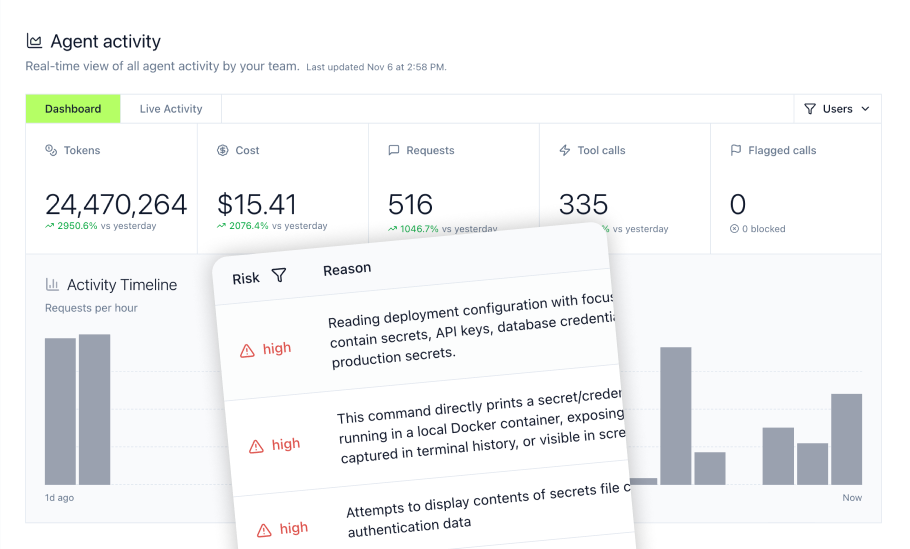
Agent Monitor provides visibility into early adoption by detecting agent activity in developer tools like Cursor and Claude Code, even before organizations implement formal gateway infrastructure.
Level 2: Managed - Integrating AI Agents with Basic Governance
The transition to Level 2 marks a critical shift from isolated experimentation to coordinated management. Organizations implement centralized access control, standardized authentication, and systematic logging for agent interactions through an MCP gateway.
Establishing Centralized Agent Management
At this stage, organizations deploy an MCP gateway as the single point of control for agent-to-system connections. Key capabilities include:
- Authentication consolidation: OAuth 2.0 and SAML integration replaces scattered API keys with identity-provider-backed access
- Credential management: Centralized storage and independently rotatable credentials reduce reliance on shared secrets across teams
- Pre-configured connectors: Access to hundreds of enterprise connectors, including Salesforce, GitHub, Slack, HubSpot, Notion, Linear, Gmail, and Stripe, without custom integration work
- Rate limiting: Per-user and per-team throttling prevents runaway agent activity
Implementing Core Security Controls
Level 2 organizations establish baseline security controls that address the most common agent risks:
Access boundaries
- Tool-level allowlisting enables database reads while blocking writes
- Scope restrictions limit agents to specific repositories, folders, or data sets
- Time-based access windows restrict agent activity to business hours
Audit infrastructure
- Conversation-level logging captures prompts, tool calls, responses, and context
- Per-user attribution enables incident investigation and usage analysis
- Configurable retention meets compliance requirements for log storage
Identity integration
- SSO enforcement ensures all agent access flows through corporate identity
- SCIM provisioning automatically manages team membership and access rights
- Group-based permissions simplify administration for large organizations
Scaling Agent Access to Internal Systems
The managed stage addresses what security practitioners call the "last mile problem" in enterprise AI: giving agents secure, governed access to internal systems without requiring custom integration engineering for each connection.
Organizations at Level 2 can enable agents to query databases through governed SQL interfaces, access CRM records with appropriate field-level restrictions, read and update project management systems, and send communications through approved channels.
Level 3: Strategic - Advanced Governance and Policy-Driven Agent Deployments
Level 3 organizations move beyond basic access control by adding an Agent Gateway on top of the MCP Gateway foundation. The MCP Gateway governs data and tool connections, while the Agent Gateway governs agent identities, permissions, memory, and monitoring. Policy enforcement becomes proactive rather than reactive.
Enforcing Granular Policy Controls
Strategic deployments leverage custom policy code execution on every tool call. This enables:
- Inline DLP integration: Connect existing data loss prevention tools (AWS Bedrock Guardrails, GCP DLP, Microsoft Purview, Nightfall, Skyflow) to inspect agent interactions in real time
- Content filtering: Block or flag specific data patterns before they leave the organization
- Contextual rules: Apply different policies based on user role, data sensitivity, or destination system
- Automated remediation: Redact sensitive content rather than blocking entire requests
The Bundle model packages tool access, policy enforcement, and audit logging into single governance units per team or role. Unlike approaches requiring separate configuration of plugins, access rules, and credential objects, Bundles create manageable units that map directly to organizational structure.
Detecting and Mitigating Shadow AI Risks
Shadow AI represents one of the most significant risks at scale: developers using AI agents outside governed channels. Level 3 organizations implement detection mechanisms that identify:
- Off-gateway MCP usage in supported developer tools
- Local shell commands, file operations, prompts, and MCP tool calls captured through installed hooks
- Policy violations or risky actions detected in monitored workflows
- Ungoverned credential use visible within supported agent activity
Agent Monitor hooks into Cursor and Claude Code to provide visibility into local agent activity. MDM-pushed configurations enable consistent policy enforcement across developer machines.
Ensuring Compliance and Auditability at Scale
Strategic governance requires comprehensive audit capabilities:
- Comprehensive audit records for compliance investigations
- Activity tracking across agent prompts, tool calls, and responses
- Real-time log export through OpenTelemetry or Splunk HEC for centralized security operations
- Per-agent credential scoping for independent rotation and access control
This separation improves audit attribution and lets teams rotate or revoke one agent's access without disrupting human users or other agents.
Agent identities give each deployed agent its own persistent identity with scoped credentials that can be rotated independently of user accounts.
Level 4: Optimized - Autonomous and Proactive AI Agent Ecosystems
At Level 4, organizations achieve integrated agent ecosystems that operate with minimal manual intervention while maintaining full governance visibility. Infrastructure-as-code workflows enable repeatable, auditable deployments.
Building Integrated Agent Ecosystems
Optimized organizations deploy agents as first-class infrastructure components:
- Virtual MCPs (VMCPs) bundle multiple servers with role-based tool access, reducing configuration complexity for non-technical users
- Agent Bundles extend the governance model to non-human principals, giving each agent its own rotatable credentials and a scoped permission set managed independently from human user credentials
- STDIO server support automatically converts locally-run MCP servers to hosted, production-ready services with OAuth wrapping and no code changes required
- Programmatic management through MintMCP's Terraform provider, Admin MCP, and Hosted Server CLI supports configuration-as-code and automated deployment workflows
Achieving End-to-End Automation with Agents
Level 4 deployments support complex multi-step workflows:
Data analysis pipelines
Agents query databases, generate reports, and distribute findings through governed channels with full audit trails.
Customer support automation
Agents access CRM and ticket systems, suggest resolutions, and update records while respecting data access policies.
Development workflows
Agents connect to GitHub, Jira, and CI/CD pipelines with appropriate permissions for code review, issue management, and deployment automation.
Coworker Agents: The Next Evolution
The most advanced organizations are deploying what practitioners call coworker agents: long-running agents that live in Slack, hold memory, continue work across days, and operate alongside employees in communication channels.
Coworker agents require additional governance considerations:
- Scoped memory: Private, team, organization, and customer memory scopes that are company-owned, versioned, reviewable, and auditable
- Persistent identity: Agent identity that survives session boundaries
- Channel integration: Native presence in team communication tools
- Model flexibility: Ability to choose AI models based on cost and capability rather than vendor lock-in
Self-Assessment: Where Does Your Enterprise Stand on the AI Maturity Curve?
Use this framework alongside a recognized baseline such as the NIST AI Risk Management Framework to evaluate your organization's current maturity level across five dimensions.
Governance Policies
| Indicator | Level 1 | Level 2 | Level 3 | Level 4 |
|---|---|---|---|---|
| Usage policies | None or informal | Basic guidelines documented | Automated policy enforcement | Policy-as-code with CI/CD |
| Approval workflows | None | Manual for new tools | Automated with exceptions | Self-service within guardrails |
| Compliance mapping | None | Partial | Complete with audit evidence | Continuous compliance monitoring |
Technical Infrastructure
| Indicator | Level 1 | Level 2 | Level 3 | Level 4 |
|---|---|---|---|---|
| Access control | Per-developer | Centralized gateway | Policy-driven with DLP | Infrastructure-as-code |
| Credential management | Shared secrets | Centralized storage | Per-agent identities | Automated rotation |
| Monitoring | None | Basic logging | Real-time alerts | Proactive remediation |
Key Indicators for Each Maturity Level
You are at Level 1 if:
- Developers manage their own AI tool credentials
- No centralized visibility into agent usage exists
- Security teams learn about agent deployments after the fact
You are at Level 2 if:
- All agent access flows through a centralized gateway
- Authentication integrates with corporate identity providers
- Basic logging captures agent interactions
You are at Level 3 if:
- Custom policies enforce compliance requirements automatically
- Shadow AI detection identifies ungoverned usage
- Each agent has its own identity and scoped credentials
You are at Level 4 if:
- Agent infrastructure deploys through code pipelines
- Multi-step workflows execute autonomously within governance boundaries
- Coworker agents persist across sessions with governed memory
Planning Your Path to the Next Level
Progression between levels requires investment across people, process, and technology:
Level 1 to Level 2:
- Select and deploy an MCP gateway solution
- Migrate existing agent integrations to centralized management
- Establish baseline logging and access policies
- Timeline varies by integration count, identity architecture, security review, and migration scope
Level 2 to Level 3:
- Implement DLP integration for sensitive data protection
- Deploy shadow AI detection on developer machines
- Establish per-agent identity management
- Create policy frameworks for different data classifications
- Timeline varies by policy complexity, DLP coverage, endpoint rollout, and audit requirements
Level 3 to Level 4:
- Codify agent infrastructure in version control
- Build CI/CD pipelines for agent deployment
- Implement proactive monitoring and automated remediation
- Deploy coworker agents with governed memory
- Timeline varies by automation scope, deployment tooling, and the maturity of existing platform engineering practices
Overcoming Challenges in Enterprise AI Agent Adoption
Addressing Security and Compliance Gaps
The most common barrier to advancement is security team resistance rooted in visibility gaps. Organizations address this by:
- Demonstrating comprehensive audit capabilities before expanding agent access
- Implementing detection-only monitoring before enforcement
- Starting with read-only access and progressively enabling write operations
- Documenting compliance controls that map to existing frameworks
Simplifying Agent Integration and Deployment
Technical complexity often stalls progression. Approaches that reduce friction:
- Pre-configured connectors eliminate custom integration work for common systems
- OAuth brokering handles authentication complexity for legacy systems
- STDIO conversion enables existing local tools to run as governed services without code changes
- Bundle architecture reduces configuration objects from multiple components to single governance units
Building Internal AI Competencies
Skill gaps frequently prevent organizations from advancing past Level 2. Address this through:
- Training programs on MCP data risk frameworks
- Cross-functional teams combining security, platform engineering, and AI expertise
- Documentation of approved patterns and reference architectures
- Pilot programs that build institutional knowledge before broad rollout
Accelerating Enterprise AI Maturity with MintMCP
The maturity model presented in this article reflects a foundational insight: sustainable agent adoption requires separating data connectivity from agent governance. Organizations that try to solve both problems through a single undifferentiated layer often create fragile architectures that block innovation or introduce unmanaged risk.
MintMCP addresses these needs through two connected layers:
- MCP Gateway: Provides governed data and tool connections for AI systems users already run, including Claude, Cursor, ChatGPT, Gemini, and Copilot
- Agent Gateway: Extends governance to agent identities, permissions, memory, and monitoring
- Agent Monitor: Helps security teams identify ungoverned activity in supported developer tools such as Cursor and Claude Code
At Level 2, the MCP Gateway helps organizations centralize authentication, credential management, and agent-to-system logging. This gives agents secure access to internal systems without requiring separate integration and governance work for every connection.
As organizations progress toward Level 3 and Level 4, the Agent Gateway adds capabilities for more advanced deployments:
- Policy-driven controls for agent activity
- Shadow AI visibility through supported developer tools
- Persistent agent identities with independently rotatable credentials
- Scoped memory that is company-owned, versioned, reviewable, and auditable
- Governance for long-running coworker agents that operate alongside employees
Together, the MCP Gateway and Agent Gateway provide a vendor-neutral control layer that can adapt as the AI ecosystem evolves. MintMCP's listing as a Cursor Hooks partner, combined with integrations across major AI clients, helps organizations apply consistent governance across the models and interfaces their teams use.
For detailed guidance on implementing enterprise agent governance, see the Executive Guide to MCP and the published whitepaper Securing the Model Context Protocol.
Frequently Asked Questions
How long does it typically take to progress from Level 1 to Level 4?
There is no universal timeline for progressing from Level 1 to Level 4. The pace depends on organizational complexity, existing identity and platform infrastructure, regulatory obligations, security review, and the number of agent workflows being governed. Organizations with established platform engineering and security automation may move faster, while regulated or highly distributed environments may require longer validation and rollout cycles.
Can organizations skip maturity levels?
Attempting to skip levels creates fragile deployments. Organizations that jump directly to Level 4 infrastructure without establishing Level 2 centralized management typically face credential sprawl, audit gaps, and security incidents that force regression. The maturity model represents capability dependencies: Level 3 policy enforcement requires Level 2 centralized access control, and Level 4 automation requires Level 3 governance frameworks.
How should organizations handle teams at different maturity levels?
Mixed maturity is common in large organizations. The recommended approach is establishing enterprise-minimum requirements (typically Level 2 gateway access and logging) while allowing advanced teams to operate at higher levels. Shadow AI detection at Level 3 helps identify teams operating below enterprise minimums without blocking innovation in advanced teams.
What metrics indicate successful progression between levels?
Track both governance health and business value. Governance metrics include: percentage of agent traffic flowing through governed channels, mean time to detect unauthorized agent usage, credential rotation frequency, and policy violation rates. Business value metrics include: time savings on governed workflows, agent-assisted task completion rates, and reduction in manual integration maintenance.
How do regulated industries approach this maturity model?
Organizations in healthcare, financial services, and government should determine production requirements through use-case-specific risk assessment rather than treating Level 3 as a universal legal threshold. Higher-risk deployments commonly need stronger identity controls, human accountability, logging, data protection, and evidence of ongoing oversight, consistent with Singapore's Model AI Governance Framework for Agentic AI.