Enterprises are rolling out AI agents across Claude, Cursor, ChatGPT, Gemini, and Copilot faster than security teams can govern what those systems access. As organizations scale from experimental AI pilots to production deployments, the need for centralized governance, identity management, and auditability becomes critical.
Operant AI provides security and governance across endpoints, cloud agents, MCP traffic, AI applications, APIs, and cloud workloads. Organizations evaluating alternatives should compare differences in identity, access control, monitoring, guardrails, connector operations, and deployment models. This guide examines the top Operant AI MCP Gateway alternatives, with particular emphasis on how MintMCP differs for enterprise AI governance.
Key takeaways
- MintMCP combines Virtual MCPs with first-class agent identities for enterprise AI governance, alongside hosted connectors, Agent Monitor visibility, runtime guardrails, and SOC 2 Type II audited controls
- MintMCP uses a data-permissions-first architecture: SSO, SCIM-driven access, Virtual MCPs, tool-level policies, credential controls, and audit establish governed access before autonomous-agent capabilities are layered on top
- Deployment flexibility varies across vendors: MintMCP offers managed SaaS with VPC and self-hosted options, Operant AI offers additional VPC, on-premise, and air-gapped options on Enterprise, and TrueFoundry supports private and air-gapped deployments
- Agent identity requirements emerge as enterprises scale from 10 to 100+ agents and need to answer "which agent did what" with attributable audit trails
- Hosted MCP connectors reduce operational overhead: MintMCP operates connector instances on behalf of customers, eliminating the need to deploy and maintain connector infrastructure
- The NIST AI Risk Management Framework recommends establishing governance controls including identity, access management, logging, and accountability for AI systems
Understanding Operant AI: AI and agent runtime security
Operant AI positions itself as an AI and agent security platform spanning employee endpoints, production agents, MCP connections, AI applications, APIs, and cloud workloads. Operant AI says it was featured in Gartner's 2025 Market Guide for API Protection and the separate Innovation Insight: MCP Gateways report.
Key Operant AI capabilities
- 3D Runtime Defense approach covering Discovery, Detection, and Defense
- Runtime threat detection and inline enforcement across supported agent, MCP, endpoint, API, and cloud environments
- Shadow AI discovery through Endpoint Protector
- Real-time MCP cataloging across environments
- MCP trust zones for tool-level allowlisting
- Research credibility with published work on Shadow Escape attacks
Deployment and pricing considerations
- Pro tier: MCP Gateway available as an add-on
- Scale tier: MCP Gateway included
- Enterprise tier: Full platform bundling with VPC, on-premise, and air-gapped options
- 7-day trial available
- No public dollar-amount pricing
Operant AI targets security teams that need runtime protection across AI endpoints, production agents, MCP connections, applications, APIs, and cloud workloads. Its deployment model now extends beyond Kubernetes environments, with Endpoint Protector for employee devices and VPC, on-premise, and air-gapped options on Enterprise.
1. MintMCP: Enterprise AI governance across clients and agents
MintMCP provides enterprise infrastructure for governing AI clients and autonomous agents across the Model Context Protocol ecosystem. The platform makes AI systems deployable, governed, measurable, and swappable by centralizing tool access, agent identity, credentials, permissions, monitoring, guardrails, and auditability.
Key MintMCP advantages
- Virtual MCP Bundles: Per-role, per-team endpoints with SCIM-driven membership, curated tools, and access policies
- Agent Gateway: First-class non-human identities for autonomous agents with independent credentials and attributable audit trails
- SOC 2 Type II audited and compliant with HIPAA standards, with BAAs available for customers handling protected health information
- Hosted MCP connectors: MintMCP operates connector instances, reducing DevOps overhead
- Data-permissions-first architecture: Governance is the foundation, agents are enabled on top
- Official Okta and Cursor partnerships for verified ecosystem integrations
Product components
- MCP Gateway: Governed data and tool connections for AI clients including Claude, Cursor, ChatGPT, Gemini, and Copilot
- Agent Gateway: Identity and governance for autonomous agents with bearer keys, M2M tokens, and workload identity federation
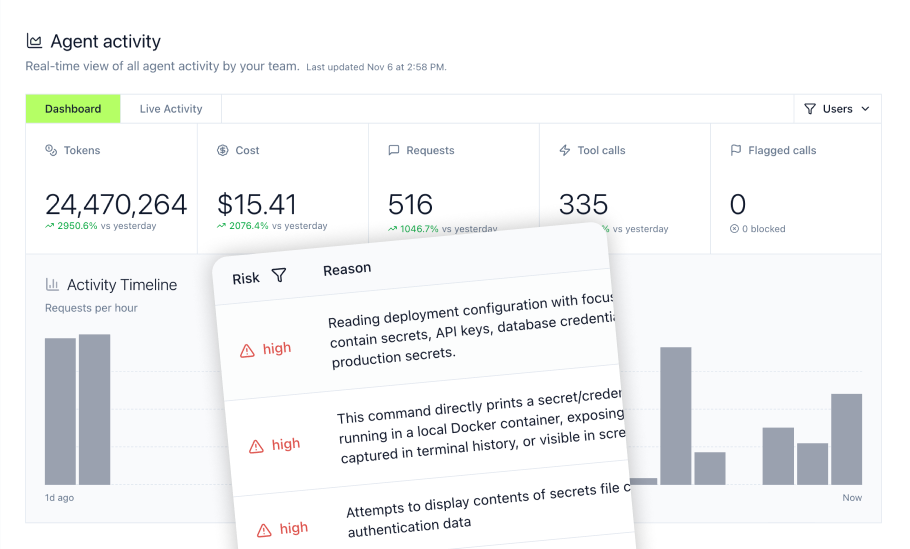
- Agent Monitor: Visibility into supported AI agent activity including prompts, file access, commands, MCP tool calls, and token costs
- Guardrails: Runtime policy and security controls through Mint Guard, Rules, and Gateway Middleware
- Coworker Agents: Long-running autonomous agents with company-owned memory, Slack triggers, and governed execution
Pricing
- Enterprise quote-based pricing
- SOC 2 Type II audited and compliant with HIPAA standards, with BAA availability
- Hosted connectors managed by MintMCP
IT, Security, and AI Operations teams in mid-market and enterprise organizations that need governed MCP access across multiple AI clients. Teams requiring per-agent identities, centralized auditability, and enterprise security and compliance controls. Organizations that want MintMCP to host and run custom MCP servers rather than operating connector infrastructure themselves.
2. TrueFoundry: Performance-focused AI infrastructure
TrueFoundry positions itself as an AI infrastructure platform with MCP Gateway capabilities. The platform emphasizes performance metrics and supports multiple deployment models including private environments.
Key TrueFoundry capabilities
- Vendor-reported MCP Gateway performance of approximately 10ms latency under load and 350+ RPS on 1 vCPU; separate AI Gateway materials report approximately 3-4ms latency
- Unified AI Gateway and MCP Gateway in a single control plane
- Virtual MCP Servers for endpoint organization
- OAuth 2.0 authentication with federated SSO
- Private and air-gapped deployment support
- Tool-level RBAC controls
Deployment options
- Free tier available for evaluation
- Cloud, on-premise, and air-gapped deployments
- Enterprise pricing for production workloads
3. Runlayer: MCP-specific threat detection
Runlayer focuses on security-first MCP governance with specialized threat detection capabilities and an extensive server catalog.
Key Runlayer capabilities
- ToolGuard and ListGuard threat detection with approximately 95% accuracy for tool poisoning and command injection
- Catalog of 18,000+ vetted MCP servers
- Shadow MCP discovery through Runlayer Watch
- Agent Accounts for per-agent identity
- SSO and MFA support
- Self-hosted VPC deployment with zero data egress
Deployment options
- AWS single-tenant deployment
- VPC-isolated environments
- Quote-based enterprise pricing
4. Portkey (Prisma AIRS AI Gateway): LLM routing with MCP support
Portkey, acquired by Palo Alto Networks in May 2026, provides an AI gateway with MCP capabilities as part of the broader Prisma AIRS platform.
Key Portkey capabilities
- Access to 1,600+ LLMs across 50+ providers for model routing
- OAuth 2.1 specification compliance for MCP security
- Open-source AI Gateway core under the MIT license
- Guardrails for runtime controls
- Palo Alto Networks security ecosystem integration
- SaaS, VPC, and self-hosted deployment options
Pricing
- Portkey's current pricing page lists a Free plan, Production at $49/month plus usage overages, and custom Enterprise pricing
- Prisma AIRS AI Gateway is also available through Palo Alto Networks licensing and flex credits
5. Composio: Rapid tool integrations
Composio positions itself as an integration platform for agentic AI applications with a large pre-built connector catalog.
Key Composio capabilities
- 500+ pre-built integrations with managed authentication
- Developer-focused SDK and API surface
- Managed authentication flows for connected tools
- Quick time-to-value for tool connectivity
- VPC and on-premise deployment on Enterprise tier
Deployment options
- Managed SaaS-first approach
- Enterprise tier for VPC and on-premise requirements
- Trial available for evaluation
6. Lasso Security: AI security platforms
Lasso Security provides AI security capabilities with a focus on protecting LLM interactions and agent activities.
Key Lasso Security capabilities
- MCP Security Gateway for inspecting MCP connections, tool descriptions, requests, and responses
- Inline policy enforcement and DLP across AI gateway traffic
- AI application, agent, model, and tool discovery
- Prompt-injection, tool-poisoning, and data-exfiltration detection
- Audit trails and enterprise security integrations
Security-focused organizations evaluating AI lifecycle security, runtime policy enforcement, and MCP-specific threat protection.
7. Obot: Open-source MCP management
Obot offers an open-source approach to MCP management with catalog-driven server organization.
Key Obot capabilities
- Open-source licensing for transparency
- Catalog-driven MCP management
- Self-hosted deployment model
- Docker for development, Kubernetes for production
- No managed SaaS offering
Deployment options
- OSS-first, self-hosted only
- Docker containers for development environments
- Kubernetes for production deployments
- No managed cloud option
Migration planning considerations
Moving between MCP gateway providers involves planning around configuration, credentials, and access policies. The following planning areas apply to common migration paths:
Operant AI to MintMCP
Map existing MCP, endpoint, runtime-security, identity, and access policies to the relevant MintMCP controls. Inventory current trust zones, agent identities, and connector deployments.
TrueFoundry to MintMCP
Inventory MCP servers, authentication flows, access policies, and deployment requirements before migration. Document existing Virtual MCP Server configurations and OAuth integrations.
Runlayer to MintMCP
Map connectors, agent identities, credentials, access policies, and audit requirements to MintMCP equivalents. Export Agent Accounts and prepare to recreate as MintMCP agent identities.
What organizations gain with MintMCP
- Virtual MCP Bundles with SCIM-driven membership and curated tool access
- Agent Gateway with first-class identities and independent credential lifecycle
- Hosted connectors that reduce connector infrastructure management requirements
- SOC 2 Type II audited controls and compliance documentation supporting enterprise security review processes
- Agent Monitor for visibility beyond gateway traffic
Total cost of ownership considerations
When evaluating MCP gateway alternatives, consider these cost factors beyond software licensing:
Infrastructure overhead
- Managed SaaS can reduce customer-managed infrastructure requirements
- VPC, on-premise, self-hosted, and air-gapped deployments can add customer-managed compute, storage, networking, and operational costs
- Actual infrastructure costs vary by vendor, deployment model, usage, and support requirements
Compliance and audit
- Compare each platform's current audit controls, identity features, logging, compliance documentation, and BAA availability
- External compliance and assurance costs depend on the organization's regulatory scope and existing controls
Implementation and training
- Implementation effort varies with connector count, identity integration, policy complexity, deployment model, migration scope, and internal change management
Operational considerations with MintMCP
- Hosted connectors reduce the amount of connector runtime infrastructure customers need to operate themselves
- SOC 2 Type II audited controls and compliance documentation support enterprise security review processes
- Virtual MCPs centralize tool access and credential administration, reducing repeated per-machine and per-server setup
Customer validation
MintMCP serves enterprise customers including Coursera, Stability AI, Modern Treasury, Deerfield Group, and Workstream. Customer feedback highlights specific value drivers:
Stability AI (Head of Security): "I'm very happy that we found MintMCP. It solved our most immediate MCP problems."
Deerfield Group (CTO): "It's as simple as adding the bundle to your Claude or Codex, and it has all the tools our IT team has already vetted. The virtual bundles are our number one feature."
Modern Treasury (Engineering Leader): "It saves our Technical Account Managers 30 minutes to 4 hours per case."
MintMCP for enterprise AI governance
MintMCP provides several capabilities designed for organizations seeking centralized identity, permissions, monitoring, runtime controls, and governed access across multiple AI clients and autonomous agents.
The platform's architecture establishes governance controls first, then enables AI capabilities on that foundation:
- Data-permissions-first design: Virtual MCP Bundles establish SSO, SCIM-driven membership, curated tools, and access policies before agents interact with resources
- First-class agent identities: The Agent Gateway treats autonomous agents as independent principals with their own credentials, scoped permissions, and attributable audit trails
- Hosted connector operations: MintMCP operates MCP server infrastructure on behalf of customers, reducing the DevOps overhead of deploying and maintaining connector instances
- SOC 2 Type II audited controls: Enterprise security and compliance documentation, HIPAA compliance with BAA availability, and audit trails supporting regulatory requirements
- Cross-platform governance: Unified access control for Claude, Cursor, ChatGPT, Gemini, and Copilot through a single control plane
Organizations can evaluate MintMCP to govern AI agent workforces with infrastructure designed for production enterprise deployments.
Frequently asked questions
What is an MCP Gateway and why do enterprises need one?
An MCP Gateway provides a governed entrypoint between AI clients (Claude, Cursor, ChatGPT, Gemini, Copilot) and enterprise tools accessed through the Model Context Protocol. Enterprises need MCP gateways because AI adoption outpaces security governance. Without centralized control, organizations face scattered credentials on developer laptops, no visibility into agent activity, missing audit trails for compliance, and tool access that bypasses established security policies.
How do agent identities improve AI security and auditability?
Agent identities treat autonomous agents as first-class non-human principals rather than extensions of human credentials or shared API keys. Each agent receives its own identity, credentials, scoped permissions, and audit trail. This architecture enables independent credential rotation and revocation, attributable audit logs showing which agent performed which action, reduced blast radius when credentials are compromised, and clean separation between human and agent access for compliance reporting.
What runtime guardrails prevent dangerous AI agent actions?
MintMCP's guardrails architecture includes three complementary layers. Mint Guard provides managed detection policies for prompt injection, secrets, PII, and harmful content. Rules offer declarative matching with actions including flag, block, ask, mask, and notify. Gateway Middleware supports customer-authored JavaScript for DLP integrations, external classifiers, and custom policy enforcement. These controls operate at runtime on tool arguments and results, not just at configuration time.
Can MCP Gateways integrate with existing enterprise identity systems?
Yes. MintMCP supports SSO through Okta, Entra ID, and Google. SCIM integration enables directory groups to drive both admin roles and tool access automatically. When users are suspended in the identity provider, access propagates to the MCP gateway. Cross App Access through Okta provides IdP-governed token exchange with dual attribution for human and agent actions.
What differentiates traditional API Gateways from AI-specific MCP Gateways?
Traditional API gateways focus on routing and rate limiting for REST/GraphQL endpoints. MCP Gateways address AI-specific requirements including credential injection per tool call (not per API endpoint), tool curation and context window management, agent identity distinct from human identity, runtime screening of tool arguments for prompt injection, and audit logs that capture AI-agent interactions at the tool level rather than raw API traffic.