Healthcare organizations deploying AI agents face a critical compliance gap: when the HIPAA auditor asks which agent accessed patient John Doe's record on March 15, who authorized it, and what policy governed that access, most teams cannot answer in five minutes. They might not be able to answer in five weeks. As healthcare data breaches cost an average of $7.42M, the stakes for getting AI agent governance right have never been higher.
Agent gateways solve this problem by sitting between AI agents and healthcare systems, enforcing authentication, authorization, and audit trails for every AI-to-system interaction. The right MCP gateway helps organizations build auditable infrastructure that supports HIPAA compliance through centralized access controls, logging, and policy enforcement. The gateway is one component of a compliant deployment, alongside appropriate configuration, risk assessment, policies, and Business Associate Agreements.
Because security, access control, and regulatory compliance remain major barriers to enterprise AI deployment, healthcare organizations should prioritize gateways that provide attributable agent identities, detailed audit logging, and granular access enforcement.
Key Takeaways
- MintMCP Agent Gateway provides agent identities, permissions, memory, and monitoring for healthcare AI deployments, with Virtual MCP Bundles for role-based tool curation, Agent Bundles for per-agent identity, hosted MCP connectors, and HIPAA BAA availability
- Agent gateways help satisfy HIPAA technical safeguards including access control, audit controls, and person or entity authentication through centralized governance infrastructure
- Proposed HIPAA Security Rule updates would introduce mandatory encryption, multi-factor authentication, penetration testing, and 72-hour recovery procedures if finalized
- Appropriate BAA coverage is required across the vendor chain when gateway or LLM providers create, receive, maintain, or transmit PHI. The covered entity typically signs a BAA with its direct business associate, which must obtain appropriate agreements with downstream subcontractors handling PHI
- Per-agent credential sets improve attribution, auditing, and independent revocation compared with broadly shared service accounts
1. MintMCP Agent Gateway: enterprise agent governance infrastructure
MintMCP Agent Gateway provides enterprise governance for AI agents accessing Protected Health Information, with agent identities, permissions, memory, and monitoring built on a data-permissions-first foundation. The platform starts with SSO, SCIM-driven RBAC, IdP groups, Virtual MCP Bundles, tool-level policy, and audit logs, then enables agents on top through its Model Context Protocol infrastructure.
The platform addresses the challenge of governing agent access across multiple enterprise data sources. For healthcare organizations, this can include clinical data warehouses, EHR systems, scheduling platforms, and FHIR APIs.
What makes MintMCP Agent Gateway different for HIPAA
MintMCP's architecture wraps stdio, hosted, HTTP-streamable, and SSE MCP servers behind SSO-fronted remote MCP endpoints with OAuth brokering, SCIM-driven membership, and rule-based policy. This addresses the fragmented security policies and visibility gaps that create compliance challenges when managing connections between AI agents and healthcare tools.
Core HIPAA capabilities
- Virtual MCP Bundles create team-specific endpoints exposing only minimum required tools per clinical role. Clinical research teams get read-only data warehouse access while administrative staff access scheduling systems without clinical data exposure
- Agent Bundles provide each AI agent with unique credential sets, M2M authentication, and independent rotation, supporting stronger attribution, least-privilege access, and credential lifecycle management
- Custom Gateway Middleware runs customer-authored code in a JS sandbox with external DLP integrations for masking, blocking, and policy enforcement
- Real-time PII and sensitive data detection can block, flag, or alert based on configured policies, while Custom Gateway Middleware can connect external DLP and jailbreak-detection services for additional inspection
Audit and compliance infrastructure
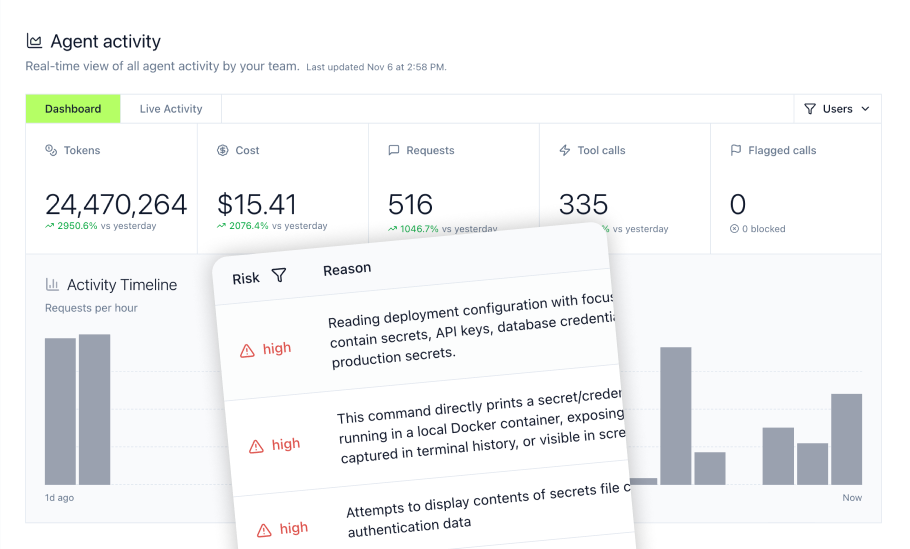
MintMCP captures audit trails showing who initiated actions, which tools were called, what data flowed through, and when. Retention periods are configurable, and logs can be exported to SIEM platforms including Microsoft Sentinel and Splunk. Healthcare organizations should configure retention according to their documented compliance and records-management policies. The six-year requirement under 45 CFR §164.316 applies to specified Security Rule documentation, not automatically to every audit log.
Healthcare integrations
- Snowflake data warehouse access for clinical analytics with natural language queries
- Elasticsearch knowledge base search for clinical documentation and support tickets
- Custom MCP server deployment for FHIR APIs and internal healthcare tools
- Claude, Cursor, ChatGPT, Gemini, and Copilot governance through centralized gateway
Compliance posture
MintMCP is SOC 2 Type II audited with continuous compliance monitoring via Drata. The platform is compliant with HIPAA standards and signs Business Associate Agreements for healthcare customers. Customers can access full security documentation through the MintMCP Trust Center.
Pricing
Contact for enterprise demonstration and pricing
Getting started
Visit mintmcp.com/mcp-gateway for deployment guides and documentation
2. DoctorConnect AI Gateway
DoctorConnect AI Gateway focuses on healthcare-specific integrations, providing connections to electronic health record and practice management systems.
Primary focus
DoctorConnect targets healthcare practices and organizations that need AI agent access to clinical systems. The platform provides over 150 EHR and practice management system connectors covering platforms like Epic, Cerner, and Athena.
Healthcare integration capabilities
- Patient engagement workflows including appointment reminders and recalls
- Secure messaging integration for clinical communications
- Digital forms and intake automation
- OAuth 2.1 REST interface for AI agent connections
DoctorConnect for healthcare organizations
Organizations prioritizing EHR integration depth over general-purpose MCP governance may find DoctorConnect's healthcare-specific connector library addresses their immediate needs.
Deployment
Currently in private pilot with expansion planned for 2026
3. Aptible AI Gateway
Aptible AI Gateway provides access to large language models with centralized BAA coverage, audit logging, key management, and model governance. Aptible currently lists PHI de-identification as coming soon.
Primary focus
Aptible targets digital health startups and healthcare organizations that need to send data to LLM providers. The gateway sits between applications and AI model APIs.
Core capabilities
- HITRUST R2 certified infrastructure providing healthcare security assurance
- Planned PHI de-identification functionality, currently listed as coming soon; verify de-identification and re-identification availability before production use
- Single BAA covering multiple model providers including OpenAI, Anthropic, and AWS Bedrock
- Automatic audit logging for compliance documentation
Aptible for LLM-focused workflows
Healthcare teams building applications that query LLMs with clinical data can use Aptible for centralized BAA coverage, logging, access controls, and key management. Teams should not assume they can eliminate their existing de-identification pipelines until Aptible confirms that the required functionality is generally available.
Deployment
Managed access is available; confirm current feature availability, supported models, and commercial terms directly with Aptible
4. TrueFoundry
TrueFoundry provides unified LLM and MCP infrastructure with self-hosted deployment options for organizations requiring control over their AI agent infrastructure.
Primary focus
TrueFoundry targets platform engineering and ML teams that want to run AI infrastructure in their own cloud environment. The platform supports Kubernetes-based deployments with HIPAA support available on Enterprise tier.
Infrastructure capabilities
- Self-hosted control plane deployment in customer Kubernetes clusters
- HIPAA support on Enterprise tier
- Air-gapped deployment via forward proxy for isolated environments
- High-throughput architecture for production workloads
TrueFoundry for self-hosted requirements
Healthcare organizations with existing Kubernetes expertise and requirements to keep all PHI processing within their own infrastructure can deploy TrueFoundry in their VPC. This approach provides control over data residency and network configuration with operational overhead.
Deployment
Hybrid model with managed SaaS or self-hosted options
5. AWS Bedrock AgentCore
AWS Bedrock AgentCore provides cloud-native agent infrastructure within Amazon's AI services portfolio.
Primary focus
AgentCore targets organizations already standardized on AWS who want to deploy AI agents using native cloud services. Amazon Bedrock AgentCore is HIPAA eligible. Organizations processing ePHI must execute an AWS Business Associate Agreement and configure AgentCore and related services appropriately under AWS's shared responsibility model.
Cloud-native capabilities
- Automatic API-to-MCP conversion for agent tool access
- CloudTrail integration for management events, with Gateway data-event logging available when explicitly enabled; request and response contents for data events are redacted
- VPC endpoints for private network connectivity
- IAM-based access controls integrated with AWS identity infrastructure
AgentCore for AWS-standardized organizations
Healthcare organizations with existing AWS investments and enterprise agreements can add agent capabilities. The platform's native integration with CloudWatch, CloudTrail, and IAM reduces configuration overhead for teams already managing AWS infrastructure.
Healthcare MCP integration
Innovaccer uses Amazon Bedrock AgentCore Gateway to expose healthcare workflows through Healthcare Model Context Protocol servers within its healthcare AI platform.
Deployment
Amazon Bedrock AgentCore is HIPAA eligible. Use with ePHI requires an executed AWS BAA and a customer configuration that meets applicable HIPAA requirements.
Understanding HIPAA requirements for AI agent gateways
Healthcare organizations evaluating agent gateways need to understand how HIPAA Security Rule requirements translate to AI agent governance. The gap between standard API security and compliant agent infrastructure creates material compliance risk.
Per-agent identity requirements
HIPAA requires unique user identification and person or entity authentication under §164.312(a)(2)(i) and §164.312(d). The rule does not explicitly require a separate identifier for every AI agent. However, distinct agent credentials improve attribution, scoping, auditing, and independent revocation compared with broadly shared service accounts.
Gateways that provide per-agent identity with independent credential rotation address these concerns directly. When agents each have their own credentials and scope, organizations gain the ability to revoke one agent's access without affecting users or other agents.
Operation-level audit logging
HIPAA audit controls under §164.312(b) require mechanisms that record and examine activity in information systems containing or using ePHI. The regulation does not prescribe a universal set of log fields specifically for AI gateways.
Healthcare organizations should determine appropriate logging through their risk analysis. Useful fields can include:
- Authenticated user or agent identity
- Human requester or authorizer, where applicable
- Tool, system, or resource accessed
- Operation type, such as read, download, or export
- Authorization or policy context
- Outcome and timestamp
Session-only logs may be insufficient when they cannot support investigation of ePHI access. Retention and immutability should follow the organization's documented compliance and records-management policies. HIPAA's six-year rule applies to specified Security Rule documentation and does not automatically require every audit log to be retained for six years or stored in write-once media.
Minimum necessary access enforcement
HIPAA's minimum necessary standard under §164.502(b) generally requires covered entities and business associates to make reasonable efforts to limit PHI uses, disclosures, and requests to the minimum necessary for the intended purpose, subject to applicable exceptions. Broad service-account access can conflict with an organization's minimum-necessary policies when an agent can reach more PHI than its workflow requires. Whether a particular use, disclosure, or request violates HIPAA depends on the context, applicable exceptions, and the organization's documented policies.
Agent gateways can use attribute-based, role-based, record-level, or operation-level controls to evaluate data requests against:
- Agent profile and authorized scope
- PHI classification of requested data
- Workflow context for the request
- Specific operation being attempted
This operation-level enforcement prevents over-privileged access patterns that create compliance gaps.
Proposed HIPAA Security Rule updates
HHS published a Notice of Proposed Rulemaking in January 2025 to strengthen the HIPAA Security Rule. As of July 30, 2026, the proposal has not been finalized, and the current Security Rule remains in effect.
If finalized substantially as proposed, the rule would introduce requirements including:
- Encryption of ePHI at rest and in transit, with limited exceptions
- Multi-factor authentication, with limited exceptions
- Vulnerability scanning at least every six months
- Penetration testing at least once every 12 months
- Written procedures to restore certain systems and data within 72 hours
- Network segmentation
Healthcare organizations may prepare for these controls now, but they should not be described as requirements already in effect. The proposal also does not support a blanket statement that every organization must use FIPS 140-3 validated cryptographic modules.
Implementation roadmap for HIPAA-compliant agent deployment
Deploying agent gateways in healthcare environments requires careful planning to satisfy compliance requirements while enabling clinical teams to use AI tools productively. The sequence below is illustrative; actual timelines depend on vendor review, BAA execution, identity integration, clinical-system access, testing, and organizational procurement.
Phase 1: compliance foundation
Start with an AI-specific HIPAA risk assessment covering all PHI data flows, vendor relationships, and clinical impact. Document every AI system that will access PHI and the data flows involved.
Execute a Business Associate Agreement with your gateway vendor and verify that downstream AI model providers receiving PHI are covered either by direct agreements or by the gateway vendor's HIPAA-compliant subcontractor agreements. BAA negotiation timelines vary significantly:
- OpenAI reviews API BAA requests case by case and says the process is usually completed within a few business days
- Anthropic BAA eligibility and covered services depend on the selected product and agreement
- Cloud-provider and gateway-vendor agreement timelines vary by account, service scope, and procurement requirements
- Begin BAA review early and verify that every service receiving PHI is covered before transmitting patient data
Phase 2: gateway configuration
Configure SSO integration with your existing identity provider (Okta, Azure AD, Google Workspace) and enable SCIM provisioning for automatic user and group syncing. Define initial RBAC groups mapping clinical roles to tool permissions.
Create team-specific MCP endpoints using Virtual Bundles or equivalent role-based constructs. Example configurations:
- Clinical research team: read-only data warehouse access to de-identified research cohorts
- Administrative staff: scheduling system access without clinical data exposure
- Documentation assistants: EHR read access scoped to assigned patient panels
Phase 3: agent deployment and monitoring
Deploy AI agents with gateway endpoint URLs and configure per-agent credential sets. Enable audit logging export to your SIEM platform and set up real-time alerts for PHI exposure attempts.
Configure DLP integration with existing security tools (AWS Bedrock Guardrails, Microsoft Purview, Nightfall, Skyflow) for inline content inspection and blocking.
Common implementation challenges
BAA delays blocking deployment: Organizations frequently underestimate BAA negotiation timelines. Start the BAA process before gateway evaluation begins, and consider deploying de-identification pipelines as a temporary measure while BAAs finalize.
Tool access permissions too broad: Start with deny-all default policies and explicitly allowlist only the tools each role requires. Use Virtual MCP Bundles or equivalent constructs to enforce separation between clinical and administrative workflows.
Audit log volume overwhelming SIEM: Configure log filtering to capture PHI-touching requests rather than all gateway traffic. Use the gateway's built-in observability dashboard for operational monitoring and export full logs to long-term archival storage separately from active SIEM.
Evaluating agent gateways for healthcare: selection criteria
When comparing agent gateways for HIPAA compliance, healthcare organizations should evaluate capabilities against specific regulatory requirements rather than general feature lists.
BAA availability
A vendor that creates, receives, maintains, or transmits PHI on behalf of a covered entity or another business associate generally must enter into an appropriate Business Associate Agreement. Confirm whether the vendor will receive PHI, which products and services are covered, and whether downstream subprocessors are included.
Per-agent identity architecture
Assess whether the gateway provides true per-agent identity with independent credential rotation, or whether it relies on shared service accounts. Shared credential models weaken attribution and can make it harder to demonstrate appropriate access controls when investigating PHI access.
Audit logging structure
Evaluate whether audit logs capture operation-level detail (what PHI accessed, what operation performed, what policy governed) or only session-level information. Request sample log formats and verify they contain the fields needed for HIPAA compliance investigations.
Minimum necessary enforcement
Determine whether access controls operate at the tool level, the operation level, or only at the server level. Server-level authorization ("can access this database") does not provide the granularity needed for minimum necessary compliance. Look for tool-level and operation-level controls (read vs. download vs. export).
Self-hosted requirements
Organizations with requirements to keep all PHI processing within their own infrastructure should evaluate self-hosted deployment options. Managed SaaS gateways reduce operational overhead but may not satisfy data residency requirements for some healthcare organizations.
Choosing MintMCP for healthcare AI governance
Healthcare organizations face mounting pressure to deploy AI agents while maintaining HIPAA compliance. Data breaches carry material financial and reputational risk, making governance infrastructure a risk management imperative rather than a technical nice-to-have.
MintMCP Agent Gateway provides the governance layer healthcare organizations need for agent identities, permissions, memory, and monitoring. The platform's Agent Bundles give each AI agent unique credentials with M2M authentication and independent rotation. Virtual MCP Bundles create role-based tool curation so clinical research teams get read-only data warehouse access while administrative staff access scheduling systems without clinical data exposure.
The platform's data-permissions-first architecture means governance is the foundation, not an afterthought. MintMCP starts with SSO, SCIM-driven RBAC, IdP groups, tool-level policy, and audit logs, then enables agents on top through its MCP gateway infrastructure. This approach bridges governed data and tool connections (MCP Gateway) with the agent-specific controls needed for healthcare deployments (Agent Gateway).
Healthcare teams can deploy AI agents across Claude, Cursor, ChatGPT, Gemini, and Copilot with centralized security governance and complete audit trails. Operation-level logging captures who initiated actions, which tools were called, what data flowed through, and when. Custom Gateway Middleware connects external DLP integrations for masking, blocking, and policy enforcement tailored to your organization's HIPAA compliance program.
For organizations ready to deploy AI agents with governance controls that support HIPAA compliance from day one, start your free trial or contact enterprise@mintmcp.com for a demonstration.
Frequently asked questions
What is the primary purpose of an agent gateway for HIPAA compliance?
Agent gateways sit between AI agents and healthcare systems, enforcing authentication, authorization, and audit trails for every AI-to-system interaction. They help organizations implement auditable infrastructure supporting HIPAA Security Rule requirements for access control, audit controls, and minimum necessary policies. Whether the overall deployment complies with HIPAA depends on how the organization configures and operates the gateway and related systems. Without a gateway, organizations face fragmented security policies, zero visibility into which agents access which PHI, and audit logs that cannot answer basic compliance questions.
How does a Business Associate Agreement relate to using AI agents with patient data?
A vendor that creates, receives, maintains, or transmits PHI on behalf of a covered entity or another business associate generally must enter into an appropriate Business Associate Agreement. This can include agent gateway vendors and LLM providers when they process patient data. Confirm whether each provider is your direct business associate or a subcontractor covered through another vendor's agreement. Healthcare organizations should confirm whether the vendor will receive PHI, which products and services are covered, and whether downstream subprocessors are included before transmitting patient data.
What role does per-agent identity play in HIPAA compliance?
HIPAA requires unique user identification and person or entity authentication, but it does not expressly state that every AI agent must receive a separate identifier. Giving each agent its own scoped credentials remains a strong security practice because it improves attribution, auditing, and independent revocation compared with shared accounts. Agent gateways that provide per-agent identity with independent credential rotation can support stronger authentication, attribution, and access management while allowing organizations to revoke one agent's access without affecting users or other agents in the system.
Can agent gateways detect and prevent prompt injection attacks on healthcare data?
Agent gateways with real-time monitoring capabilities can detect prompt injection attempts, PII exposure, and credential leakage in agent interactions. When agents attempt to access PHI through unauthorized channels or respond to malicious prompts designed to extract sensitive data, the gateway can flag, alert, or automatically block the request based on configured policies. Custom Gateway Middleware can also connect external jailbreak-detection and DLP services for additional inspection. This protection layer addresses security vulnerabilities specific to AI agent deployments that traditional API security does not cover.
How does audit logging differ for HIPAA compliance compared to standard API logging?
Standard API logs may record only that a request or session occurred. HIPAA audit controls require mechanisms capable of recording and examining activity in systems containing or using ePHI, but the regulation does not prescribe one universal log schema. Healthcare organizations should configure sufficient identity, action, resource, authorization, outcome, and timestamp data to support investigations. Retention and storage protections should follow the organization's documented risk, compliance, and records-management requirements. Session-only logs are often insufficient when they cannot answer basic questions about who accessed which patient records and why.