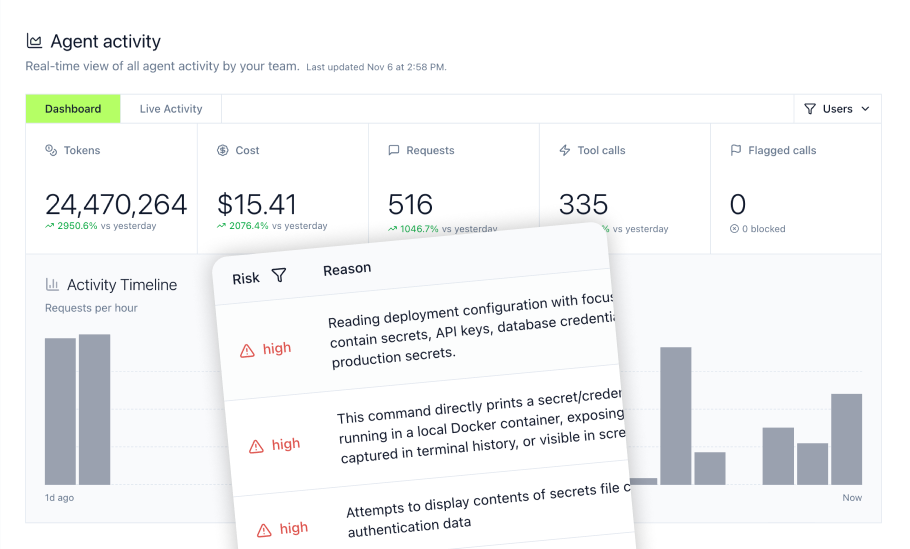
As AI agents move from prototypes to business-critical workflows, enterprises face a fundamental infrastructure challenge: how do you govern autonomous systems that access databases, execute code, call APIs, and make decisions without direct human oversight? The answer lies in a new category of infrastructure called agent gateways. Unlike traditional API gateways that simply route HTTP requests, an agent gateway serves as the centralized control layer for every interaction your AI agents have with tools, data sources, and other agents. It transforms fragmented point-to-point connections into governed, auditable workflows with authentication, policy enforcement, and complete observability built into every agent action.
Key Takeaways
- Agent gateways solve the M×N integration pattern where every agent needs connections to multiple tools, creating unmanageable point-to-point complexity
- The Model Context Protocol moved under Linux Foundation governance through the Agentic AI Foundation in December 2025, reinforcing MCP's role as vendor-neutral protocol for agent-to-tool communication
- Production gateway infrastructure supports business-critical workloads with high-throughput, low-latency routing, policy enforcement, and observability at scale
- Agent gateways differ fundamentally from API gateways by understanding stateful, multi-step workflows, supporting MCP-native tool access, and, in some cases, A2A-style agent coordination
- Setup time ranges from hours for basic deployment to longer for full production configuration with security policies and team permissions
- Shadow AI detection addresses security blind spots where AI coding assistants access company codebases with no visibility or audit trails
- Teams can reduce routine integration and governance overhead after deploying governed agent systems
- Agent identity management provides per-agent credentials that rotate independently from human users, solving credential sprawl
- Integration with enterprise DLP and guardrail tools supports PII detection and prompt injection controls at the gateway layer
Understanding the Agent Gateway: Your Central Hub for AI Agent Management
An agent gateway is centralized infrastructure that sits between AI agents and everything they interact with: LLMs, external tools, databases, and other agents. It acts as a traffic controller for autonomous AI systems, managing authentication, routing, policy enforcement, cost tracking, and observability for all agent communications.
The fundamental problem agent gateways solve is the M×N integration pattern. When you have M agents that need to connect to N tools, you face M×N potential integration points without a gateway. A company with 100 agents accessing 20 different tools confronts 2,000 individual connections, each requiring separate authentication, monitoring, and governance. Agent gateways collapse this complexity into a single managed control plane.
Defining the Agent Gateway in the 2026 AI Landscape
Unlike traditional API gateways that simply route HTTP requests or LLM gateways that only manage model API calls, agent gateways understand agentic protocols natively. They handle stateful, multi-step workflows where agents make sequential tool calls, maintain conversation context, and coordinate with other agents to complete complex tasks.
Agent gateways support two critical protocols that traditional infrastructure cannot handle:
- Model Context Protocol (MCP): JSON-RPC-based communication over stdio and Streamable HTTP that enables agents to discover and invoke tools dynamically
- Agent-to-Agent Protocol (A2A): JSON-RPC for agent discovery and task delegation in multi-agent systems
MintMCP's gateway architecture provides governed data and tool connections for the AI systems organizations already run, including Claude, Cursor, ChatGPT, Gemini, and Copilot. The platform extends beyond basic MCP routing to provide the identity, permissions, and monitoring layer that transforms experimental agents into production-ready systems.
Core Functionality of Modern Agent Gateways
Agent gateways provide six essential capabilities:
Centralized MCP Server Registry: A catalog of approved tools and servers that agents discover dynamically, eliminating per-agent configuration overhead.
Authentication and Authorization: OAuth2/OIDC, API keys, and mutual TLS with per-tool access control using role-based access control (RBAC). Each agent receives its own persistent identity with scoped credentials.
Protocol Translation: Converts MCP JSON-RPC calls to REST APIs, Lambda invocations, or other backend formats, enabling agents to access legacy systems.
Observability: Full request tracing, token usage tracking, and latency metrics per agent, tool, and team. Security teams gain visibility into every agent action.
Policy Enforcement: Rate limiting, token quotas, PII redaction, content filtering, and budget controls that prevent runaway costs or unauthorized data access.
Stateful Session Management: Handles long-lived agent workflows with session affinity and context persistence.
Bridging the Last Mile: How Agent Gateways Secure Internal Systems
The "last mile problem" in enterprise AI refers to the gap between building capable AI agents and deploying them safely with access to internal systems. Agents need to query databases, read documentation, call APIs, and interact with business tools to deliver value. Traditional approaches require extensive engineering overhead to build secure integrations for each connection.
Agent gateways solve this by providing secure, governed access to internal systems without requiring custom integration code for each tool. The gateway becomes the single enforcement point for all agent-to-data interactions.
Solving Integration Challenges for AI Agents
Consider a customer support agent that needs access to Salesforce for customer records, Zendesk for ticket history, Stripe for payment information, and an internal knowledge base. Without an agent gateway, engineering teams must build separate authentication flows, implement rate limiting per integration, create custom logging, maintain credential rotation, and monitor each connection independently.
Agent gateways eliminate this overhead by providing:
- One-click activation of pre-configured connectors
- Hosting custom MCP servers with OAuth wrapping applied automatically
- Centralized policy enforcement across all tools
- Unified audit trails for compliance requirements
MintMCP's server catalog includes databases (PostgreSQL, MySQL, MongoDB, Snowflake), productivity tools (Gmail, Slack, Notion, Linear), and business systems (Salesforce, HubSpot, Stripe). Organizations can also deploy custom STDIO-based MCP servers that the gateway automatically converts to hosted, production-ready services.
Protecting Proprietary Data with Gateway Controls
Agent gateways enforce granular access control at the tool level, enabling organizations to permit database reads while blocking writes, allow Salesforce queries but restrict deletion operations, or grant GitHub access to public repositories only.
The gateway also serves as the integration point for enterprise Data Loss Prevention (DLP) solutions. MintMCP's custom policy code runs on every tool call, enabling inline integration with AWS Bedrock Guardrails, GCP DLP, Microsoft Purview, Nightfall, and Skyflow. Security teams can implement PII masking, credential redaction, or content filtering without modifying agent code.
Architecture of Control: The Role of Agent Gateways in Enterprise AI
Agent gateways implement zero-trust architecture where no agent receives default access to any system. Every request passes through authentication, authorization, and policy enforcement before reaching backend services.
Technical Underpinnings of an Agent Gateway
The gateway architecture consists of four layers:
Control Plane: Manages gateway configuration, policy rules, user and agent identities, and tool registry. Administrators define which teams access which tools, set rate limits, and configure security policies.
Data Plane: Handles runtime traffic between agents and tools. The data plane receives MCP requests from agents, enforces authentication and authorization, applies policy rules, invokes backend services, and returns responses while logging every interaction.
Protocol Layer: Translates between different transport mechanisms. Agents may use HTTP-based MCP, stdio subprocess invocation, or legacy SSE-based implementations, while backend services expose REST APIs, gRPC endpoints, or database protocols.
Policy Layer: Executes custom security logic inline with tool calls. Organizations can implement JavaScript-based middleware that inspects prompts for sensitive data, blocks risky bash commands, or masks PII in responses.
Securing Agent Interactions: Authentication and Authorization
Agent gateways implement multiple authentication mechanisms:
- OAuth 2.0 and SAML: Enterprise SSO integration enables employees to connect AI coding assistants using corporate credentials
- API Keys and Bearer Tokens: Long-lived credentials suitable for server-side agents with automatic rotation
- Mutual TLS: Certificate-based authentication for high-security environments
- Container Identity: Cloud-native integration with AWS IAM, Azure AD, or Google Cloud IAM
MintMCP extends authentication with Agent Bundles, which provide each agent its own persistent identity with scoped credentials. When an agent needs OAuth access to a connector, administrators can execute an "act as agent" flow, creating per-agent refresh tokens that the gateway manages and rotates automatically.
Unifying Governance: Beyond Basic API Gateways for AI Agents
Traditional API gateways manage north-south traffic between external clients and internal services. They excel at load balancing, SSL termination, and basic rate limiting for stateless HTTP requests. Agent gateways solve a fundamentally different problem: governing autonomous systems that make sequential decisions and coordinate with other agents.
Why Traditional API Gateways Fall Short for AI Agent Governance
API gateways operate on request/response patterns. Agent gateways understand that an agent querying a database, then calling an API based on the query result, then generating a report from the combined data represents one logical workflow requiring coordinated governance.
The gateway maintains workflow context, applies consistent policies across all tool calls in the sequence, and attributes the entire workflow to the correct agent identity in audit logs.
The Role of Bundles in Simplifying AI Agent Policy Management
MintMCP's Bundle architecture packages tool access, policy enforcement, and audit logging into single governance units per team or role. A Bundle defines:
- Team membership: Synced automatically from SCIM groups in Okta, Azure AD, or Google Workspace
- Curated tool list: The specific MCP servers and tools that Bundle members can access
- Access policies: Custom JavaScript rules that execute on every tool call
- Audit trail: Isolated logs showing all actions taken by Bundle members
Organizations create Bundles for each use case: "engineering-database-access" provides read-only database tools, "support-team-crm" grants Salesforce and Zendesk access, "finance-reporting" allows connection to analytics systems. When a new employee joins, adding them to the appropriate Azure AD group automatically grants the correct tool access through MintMCP.
Agent Bundles extend this model to non-human principals, giving each deployed agent its own rotatable credentials and permission scope independent of the creator's access level.
Advanced Security: Defending Against Emerging AI Threats with Agent Gateways
AI agents introduce security risks that traditional application security controls cannot address. Prompt injection attacks manipulate agent behavior through carefully crafted inputs. Memory poisoning attacks contaminate agent context with malicious data. Credential leakage occurs when agents accidentally expose API keys or passwords.
Agent gateways provide the enforcement layer for detecting and blocking these threats in real time.
Real-Time Threat Detection and Prevention for AI Agent Activities
MintMCP's Agent Monitor detects PII exposure, credential leakage, risky bash commands, and prompt injection attempts using built-in rules. Organizations can also define custom guardrail policies.
The gateway inspects both inbound prompts and outbound tool responses:
- Inbound Inspection: Detects prompt injection patterns attempting to override system instructions
- Outbound Inspection: Identifies PII before it reaches users, with masking or blocking options
- Tool Call Inspection: Analyzes commands before execution to prevent destructive operations
Shadow AI detection represents a critical capability. Agent Monitor hooks identify off-gateway MCP usage in developer tools like Cursor and Claude Code. When developers install local MCP servers that bypass the gateway, Agent Monitor detects the activity and can push enforcement policies through MDM systems.
Integrating Enterprise DLP Solutions with Your Agent Gateway
Organizations with existing DLP investments can integrate those solutions directly into the agent gateway policy layer. MintMCP supports custom policy code execution using a JS sandbox with allowed-domains fetch and secret injection.
Integration patterns include:
- AWS Bedrock Guardrails: Content filtering patterns before forwarding selected requests to tools
- GCP DLP: PII detection and redaction patterns for selected tool responses
- Microsoft Purview: Policy enforcement based on sensitivity labels
- Nightfall and Skyflow: Specialized DLP for detecting credentials and tokens
These integrations can execute inline with configured tool calls, adding policy checks while supporting stronger protection against data leaks.
Observability and Compliance: Logging Every AI Agent Action
Traditional application logs capture HTTP requests and database queries. Agent observability requires capturing the complete context of autonomous decision-making: what prompt triggered the workflow, which tools the agent selected, what data those tools returned, and how the agent synthesized responses.
Agent gateways provide conversation-level logging that captures prompts, tool calls, responses, and context with per-user attribution.
Comprehensive Audit Trails for AI Agent Interactions
Complete audit trails require logging:
- Request context (user identity, agent identity, timestamp, session ID)
- Prompt content that initiated agent action
- Tool selection and invocation with complete parameters
- Tool responses showing what data the agent received
- Policy decisions and any modifications to requests or responses
- Final output delivered to the user
MintMCP's gateway logs every element with configurable retention periods and export to SIEM platforms including Microsoft Sentinel and Splunk.
Meeting Regulatory Requirements with Agent Gateway Logging
Regulated industries require proving that AI systems operate within compliance boundaries:
- SOC 2: MintMCP is SOC 2 Type II audited, with continuous compliance monitoring via Drata, providing evidence that tool governance and audit logging meet control requirements
- HIPAA: MintMCP is compliant with HIPAA standards. Customers handling protected health information can request HIPAA documentation, and MintMCP signs BAAs with encryption, access controls, and audit logging supporting governed access
- GDPR: Agent gateway logs provide evidence of data minimization, purpose limitation, and support for individual rights through appropriate data processing agreements, access controls, and deletion workflows
Centralized gateway logs reduce audit preparation effort by consolidating agent activity, tool calls, policy decisions, and user attribution into one reviewable audit trail.
From Local to Production: Scaling AI Agents with Gateway Features
Development teams typically build agents locally using stdio-based MCP servers running as subprocesses. These local setups work for prototyping but create challenges for production: no authentication, no rate limiting, no audit logging, and manual scaling.
Seamlessly Transitioning AI Agents to Enterprise Environments
Agent gateways bridge the gap by automatically converting locally-run MCP servers to hosted, production-ready services with OAuth wrapping and no code changes required.
The transition process involves:
- Server Registration: Upload MCP server code to the gateway
- Authentication Setup: Configure authentication method (OAuth, API keys, or SSO tokens)
- Policy Configuration: Define tool-level access control and rate limits
- Deployment: Gateway hosts and scales the server automatically
MintMCP's hosted connector infrastructure supports deployment via web UI, CLI tool, or CI/CD integration. The platform manages server lifecycle including automatic restarts, health monitoring, and log aggregation.
Simplifying Deployment with Pre-Built and Custom Integrations
Organizations accelerate agent deployment by combining pre-built connectors with custom servers:
- Pre-Built Connectors: MintMCP's server catalog provides one-click connectors for common enterprise systems
- Virtual MCPs: Bundle multiple servers with role-based tool access into single endpoints
- Custom Servers: Organizations build custom MCP servers using the stdio protocol
Virtual MCP abstraction reduces configuration complexity. Instead of understanding MCP protocol details, users select a Virtual MCP bundle that matches their role and immediately gain access to curated tools with appropriate guardrails already configured.
Why Enterprises Choose MintMCP for Agent Gateway Governance
MintMCP differentiates its agent gateway approach through several architecture choices that directly address enterprise deployment challenges. While basic MCP routing is becoming standardized, production agent governance requires capabilities that are not always present in basic MCP routing tools.
Bundle-Based Governance Architecture
MintMCP's Bundle system packages tool access, policy enforcement, and audit logging into single governance units synced automatically with enterprise identity providers. Organizations define Bundles for each role or use case, then manage team membership through existing Azure AD or Okta groups. This approach eliminates the manual configuration overhead required by platforms that treat plugin registration, access rules, and agent credentials as separate administrative tasks.
Per-Agent OAuth and Credential Isolation
MintMCP provides true per-agent OAuth credentials rather than shared service account tokens. The "act as agent" flow enables administrators to complete OAuth consent on an agent's behalf, generating independent refresh tokens that rotate without affecting other agents. This architecture solves credential sprawl problems where shared keys make it impossible to revoke access for individual agents or determine which agent performed specific actions during security investigations.
Custom Policy Middleware
MintMCP's policy layer enables custom JavaScript code execution in a JS sandbox for inline DLP integration, proprietary security rules, or connections to existing security infrastructure. Organizations write middleware that inspects prompts for sensitive data, implements business-specific validation logic, or calls external APIs for real-time decision-making, capabilities not available through declarative policy languages alone.
Shadow AI Visibility
Agent Monitor extends visibility beyond the gateway to detect agent activity occurring outside centralized control. Client-side hooks in Cursor and Claude Code identify when developers install local MCP servers that bypass governance policies. Security teams gain dashboards showing all agent activity, both on-gateway and off-gateway, eliminating blind spots where developers create unmonitored connections to sensitive data.
Production-Ready Server Catalog
MintMCP maintains an extensive server catalog with managed runtime for one-click connector activation. Organizations deploy pre-configured integrations for databases, SaaS tools, and business systems without writing integration code or managing server infrastructure. The platform handles server lifecycle management, automatic scaling, health monitoring, and log aggregation.
These capabilities enable organizations to move from agent prototypes to production deployments in weeks rather than months. MintMCP is SOC 2 Type II audited and compliant with HIPAA standards, with penetration testing, uptime SLAs, and data encryption meeting enterprise security requirements. Organizations evaluating agent gateways should prioritize platforms that support both current needs and emerging capabilities as AI agent infrastructure scales over the next 3-5 years. Learn more about MCP data risk management and get started with the quickstart guide.
Frequently Asked Questions
How does an agent gateway differ from an LLM gateway or API gateway?
LLM gateways manage traffic to language model APIs with prompt caching and token tracking for LLM calls only. API gateways route HTTP requests with load balancing for stateless patterns. Agent gateways understand agentic protocols like MCP that enable dynamic tool discovery, stateful multi-step workflows, and agent coordination. They provide governance for the complete agent lifecycle including tool calls to databases and SaaS applications, not just LLM interactions. While LLM gateways track prompts sent to models, agent gateways track actions agents take with responses, including database modifications, API calls, and file operations.
Can I use an agent gateway with existing AI frameworks like LangChain or CrewAI?
Yes, agent gateways integrate with standard AI frameworks through MCP client libraries. LangChain agents connect to gateway-hosted MCP servers using the MCP transport layer, with the gateway handling authentication and authorization transparently. CrewAI multi-agent systems coordinate through gateway support, enabling centralized observability. Frameworks must use MCP protocol for tool access rather than direct API calls. Organizations configure framework-level MCP endpoints to point at gateway URLs instead of individual tool servers. The gateway then brokers all tool access with policies applied consistently regardless of which framework generated the request.
What is typical performance overhead of adding an agent gateway?
Production agent gateways add minimal latency to tool calls, typically under 10ms for request routing and policy evaluation. The actual overhead depends on policy complexity (simple authentication adds microseconds, external DLP API calls add 20-50ms), network topology (gateway and backend services in the same region minimize latency), and protocol translation requirements. Gateway overhead remains negligible compared to LLM inference time (typically 500ms to 5 seconds) and backend service latency (10-100ms for database queries). Performance benefits of centralized caching, connection pooling, and intelligent retry logic often offset raw routing overhead.
How do agent gateways handle credential management for multiple agents?
Agent gateways implement per-agent identity with scoped credentials that rotate independently from human users. Each agent receives its own API key or OAuth 2.0 client credentials rather than sharing service account keys. When an agent requires OAuth access, administrators complete an "act as agent" flow where they perform OAuth consent on the agent's behalf, generating per-agent refresh tokens managed by the gateway. This enables credential rotation for individual agents without affecting others, immediate access revocation when agents are decommissioned, and per-agent attribution in audit trails. The gateway stores credentials in encrypted vaults with automatic rotation on defined schedules.
What compliance certifications should I look for in an agent gateway provider?
Organizations should verify that providers have SOC 2 Type II audit documentation, which demonstrates sustained security controls rather than point-in-time assessments. For healthcare applications, compliance with HIPAA standards with Business Associate Agreement availability is essential. European organizations require GDPR support with appropriate data processing agreements, access controls, and deletion workflows. Beyond certifications, examine encryption in transit and at rest, penetration testing frequency, vulnerability disclosure program, and uptime SLA. Organizations in regulated industries should request third-party security audit reports rather than relying on vendor self-attestation. MintMCP is SOC 2 Type II audited with continuous compliance monitoring, compliant with HIPAA standards with BAA available, penetration tested, and provides data encryption with uptime SLA commitments.
How does shadow AI detection work in agent gateways?
Shadow AI detection identifies agent activity occurring outside the gateway control plane, particularly local MCP servers installed by developers that bypass governance policies. Detection works through client-side hooks integrated into AI development tools like Cursor and Claude Code. When developers install local MCP configurations pointing to servers not registered in the gateway, the detection system identifies unauthorized connection attempts and logs them for security review. Organizations can configure enforcement policies ranging from detect-only mode (generates alerts) to block mode (prevents connection to unauthorized servers). The detection system typically deploys through mobile device management systems that push configuration updates to developer workstations. Shadow AI represents a critical security gap because local MCP servers often access sensitive data without authentication, audit logging, or policy enforcement.
What is the typical implementation timeline for an agent gateway?
Basic gateway deployment ranges from hours for managed platforms to longer for self-hosted installations. Full production configuration including enterprise SSO integration, policy rules, team permissions, and custom connector deployment typically requires 2-4 weeks. Organizations follow a four-phase rollout: week 1 focuses on gateway deployment and SSO configuration, weeks 2-3 involve registering MCP servers and defining access policies, week 3-4 covers pilot agent migration with low-risk use cases, and week 4 includes monitoring validation and security team approval. Total time from decision to full production deployment averages 5-8 weeks including pilot phases. The most significant delays typically occur during organizational approval processes (security review, compliance validation) rather than technical implementation. Organizations can accelerate timelines by running gateway infrastructure in parallel with existing direct-connection agents during validation.