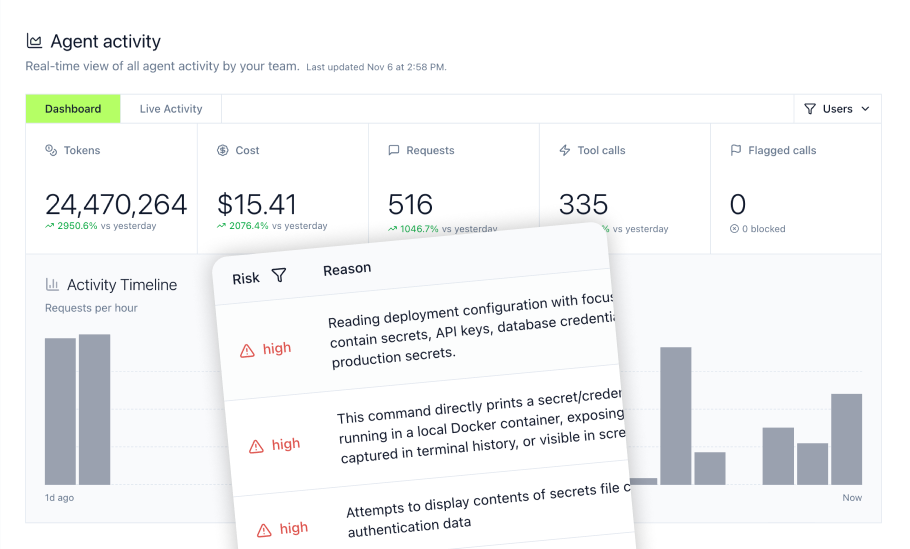
Your AI agents are already deployed. They're querying databases, drafting customer responses, and executing workflows across your entire tech stack. But most enterprises lack comprehensive AI security frameworks—leaving autonomous systems operating as black boxes with zero visibility into what data they access or what actions they take. The fix isn't starting over. It's adding production-grade guardrails to the AI infrastructure you've already built. With the right approach—and tools like MintMCP Gateway that wrap existing MCP servers in enterprise security—you can transform ungoverned AI into compliant, observable, controlled systems in weeks, not months.
Key takeaways
- Most enterprises lack comprehensive AI security frameworks for their deployed AI agents
- Organizations with mature guardrails report significant cost savings per prevented data breach
- Many enterprises struggle with data classification—a prerequisite for effective guardrails
- Implementation timelines range from 4-12 weeks for initial deployment, with enterprise-wide rollout taking 3-6 months
- Enterprises with guardrails achieve significant reduction in AI-related security incidents
- Mean time to detect (MTTD) threats can be significantly reduced with proper observability
Understanding the unseen: Why AI security guardrails are crucial for enterprise AI
AI agents aren't like traditional software. They don't follow deterministic paths. They reason, adapt, and make autonomous decisions—accessing sensitive data, triggering workflows, and interacting with production systems in ways that change based on context. Without guardrails, you have no visibility into agent behavior and no control over their actions.
The three-pillar framework for safe agentic AI addresses this gap:
- Guardrails: Real-time safety mechanisms that prevent harmful behavior before it occurs
- Permissions: Role-based controls defining what agents can access and execute
- Auditability: Complete trails of every action for compliance and forensics
Traditional security tools weren't designed for this challenge. Firewalls protect network perimeters. Antivirus detects known malware signatures. Neither addresses an AI agent that decides—based on a prompt—to query your customer database, extract PII, and email results to an external address.
The shadow AI problem
Your teams are already using AI tools. Most organizations regularly use generative AI, but only a small fraction have enterprise-wide AI governance councils. This gap creates shadow AI—unauthorized deployments operating without oversight, audit trails, or security controls.
Shadow AI introduces specific risks:
- Zero Telemetry: No visibility into which tools are installed or what they access
- No Request History: No audit trail of prompts, responses, or actions
- Uncontrolled Access: Agents operating with excessive permissions
- Compliance Gaps: Unmonitored systems that can't meet SOC 2, HIPAA, or GDPR requirements
The solution isn't blocking AI adoption—that's not realistic. The solution is adding governance infrastructure that makes shadow AI sanctioned AI.
Bridging the gap: Turning shadow AI into sanctioned enterprise AI
Converting ungoverned AI deployments into production-grade infrastructure requires three capabilities: centralized control, authentication enforcement, and observability. The MintMCP Gateway provides all three without requiring you to rebuild existing systems.
Centralized governance for distributed AI
Most enterprise AI deployments look like sprawl: individual teams running their own agents, connecting to their own data sources, with no unified control plane. Centralized governance means:
- Single registry of all MCP servers and AI tools across the organization
- Unified authentication through OAuth 2.0 and SAML integration with existing identity providers
- Consistent policy enforcement for data access, tool permissions, and rate limiting
- Real-time dashboards showing usage patterns, security alerts, and compliance status
Organizations report faster incident response when they have centralized visibility into AI agent behavior versus fragmented, per-team monitoring.
OAuth + SSO: Authentication that scales
Most MCP servers run as STDIO-based local processes with no built-in authentication. Anyone with access to the machine can invoke any tool. This model breaks down entirely at enterprise scale.
Adding OAuth protection automatically transforms local MCP servers into authenticated services. Every request requires identity verification. Every action ties to a specific user. Access policies enforce least-privilege automatically.
The implementation path:
- Register existing MCP servers with the gateway
- Configure identity provider integration (Okta, Azure AD, Ping Identity)
- Define role-based access policies
- Enable enforcement—no changes to underlying MCP servers required
Virtual MCPs: Curated tool access
Not every user needs access to every tool. The Virtual MCP concept solves this by exposing curated subsets of capabilities to specific roles:
- HR teams: Access only to Elasticsearch knowledge base queries—no write permissions
- Support teams: Gmail search and draft capabilities—no send permissions without approval
- Analysts: Snowflake read queries—no DDL or DML operations
Virtual servers expose minimum tools, not entire MCP servers. This reduces the attack surface while maintaining productivity.
Implementing granular security: Real-time monitoring and access control
Guardrails operate at three stages: input validation, model execution, and output filtering. Each stage requires specific controls to prevent different categories of risk.
Input validation: Stopping attacks before they execute
Prompt injection remains the primary attack vector against AI agents. Attackers embed malicious instructions in user inputs, attempting to override system prompts and trigger unauthorized actions.
Effective input guardrails include:
- Prompt attack filters: Pattern matching to detect injection attempts
- Input sanitization: Stripping potentially dangerous content before processing
- Token limits: Preventing context overflow attacks
- Rate limiting: Blocking automated probe attempts
AWS Bedrock Guardrails provides native prompt attack detection for Bedrock-hosted models. For multi-model deployments, the Guardrails AI framework offers dozens of open-source validators that work across any LLM.
Monitoring AI agents: What, when, and how
The MintMCP LLM Proxy sits between AI clients (Cursor, Claude Code, custom agents) and the model itself, capturing complete telemetry:
- Every MCP tool invocation with parameters and results
- Every bash command executed by coding agents
- Every file access with read/write operations logged
- Every external API call with request/response data
This observability enables:
- Anomaly detection: Identifying unusual access patterns that indicate compromise
- Behavioral baselines: Understanding normal agent activity to spot drift
- Forensic investigation: Reconstructing exactly what happened during incidents
- Compliance auditing: Proving data access controls to regulators
Organizations with mature observability achieve significantly reduced mean time to detect threats—compared to much longer periods without visibility.
Protecting your most sensitive data from AI access
Not all data should be accessible to AI agents. The LLM Proxy's security guardrails block dangerous operations in real-time:
- Sensitive file protection: Prevent access to .env files, SSH keys, credentials
- Command blocking: Stop dangerous bash commands before execution
- PII redaction: Mask or tokenize sensitive data before it reaches the model
- Data classification enforcement: Restrict access based on sensitivity tiers
Implementation requires defining what "sensitive" means for your organization—which brings us to a critical prerequisite.
The data classification prerequisite
Many enterprises struggle with data classification—and you cannot enforce guardrails without knowing what data is sensitive. Before deploying technical controls:
- Inventory data sources that AI agents access or might access
- Classify by sensitivity: Public, internal, confidential, restricted
- Map to agent access rules: Which roles can access which tiers
- Automate discovery: Use tools to find undocumented data access patterns
This work takes 2-4 weeks for most organizations but pays dividends in enforcement accuracy. Attempting to deploy guardrails without classification leads to excessive false positives or, worse, missed violations.
Integrating with existing enterprise systems: Data, compliance, and workflows
Guardrails don't exist in isolation. They must integrate with the systems your AI agents actually use—databases, APIs, identity providers, and compliance infrastructure.
Connecting AI to your internal data securely
MintMCP provides pre-built connectors for common enterprise data sources, each with built-in security controls:
- Natural language to SQL via Cortex Analyst
- Role-based access to specific databases/schemas
- Query audit logging for compliance
- Read-only enforcement to prevent accidental data modification
- Semantic search across knowledge bases
- Index-level permissions
- Query DSL support with security filtering
- Full audit trails of search activity
- AI-assisted email search and drafting
- Controlled send permissions (draft only vs. send)
- Thread-aware replies
- Complete audit of email access
Each connector inherits the gateway's authentication model. Users authenticate once through SSO; the gateway enforces permissions per-tool.
Seamless integration with your identity provider
Enterprise guardrails must integrate with existing IAM infrastructure—not require parallel identity management. The MintMCP Gateway supports:
- SAML 2.0: Integration with Okta, Azure AD, Ping Identity, OneLogin
- OAuth 2.0: Standard token-based authentication for API access
- SSO enforcement: No separate credentials for AI tool access
- Group-based policies: Inherit permissions from existing directory groups
This integration means:
- Employees use their existing credentials
- Offboarding immediately revokes AI tool access
- Security policies stay consistent with other systems
- Compliance teams audit one identity system, not two
Meeting regulatory demands: Achieving AI security certifications and compliance
Regulated industries—finance, healthcare, government—face specific requirements that ungoverned AI cannot meet. Guardrails transform AI deployments from compliance liabilities into auditable assets.
Complete audit trails for regulatory compliance
SOC 2, HIPAA, GDPR all require demonstrable controls and audit trails. MintMCP Gateway provides:
- Complete request logging: Every prompt, response, and action recorded
- User attribution: Actions tied to authenticated identities
- Immutable audit trails: Tamper-evident logs for forensic integrity
- Configurable retention: Aligned to your organization’s record-retention policy and regulatory requirements, with exports to your security monitoring stack for centralized review.
- Export capabilities: SIEM integration for centralized security monitoring
For healthcare organizations, HIPAA requires retaining required HIPAA documentation for at least six years—while access-log retention is typically driven by your security policy, contracts, and applicable regulations.
Ensuring data residency for global operations
Multi-national deployments face data residency requirements—EU data must stay in the EU, healthcare data in approved regions. The MintMCP Gateway supports:
- Multi-region deployment with configurable data routing
- Data residency controls ensuring data stays within approved boundaries
- Region-specific policies for different regulatory regimes
- Encryption in transit and at rest using industry-standard protocols
Compliance certification status
Enterprise-grade AI infrastructure requires verified security:
- SOC 2 Type II certified: Annual audits by independent assessors
- HIPAA compliance options: BAA available for healthcare deployments
- GDPR compliant: Data minimization, right to erasure, complete audit trails
Organizations with formal governance strategies report significantly higher success rates versus those without structured approaches.
From local to global: Scaling enterprise AI with robust security infrastructure
Individual developer machines running local MCP servers don't scale. Enterprise AI requires hosted infrastructure with enterprise SLAs.
Deploying AI agents in minutes, not days
Most STDIO-based MCP servers require local installation, environment configuration, and manual credential management. MintMCP transforms this with one-click deployment:
- Register the MCP server with the gateway
- Configure authentication using existing identity provider
- Define access policies for roles and permissions
- Deploy with automatic hosting and lifecycle management
Containerized servers become accessible to authorized clients without local installations. What previously took days of DevOps work now takes minutes.
Ensuring high availability and scalability for your AI apps
Production AI deployments require production infrastructure:
- Automatic failover: Redundancy prevents single points of failure
- Enterprise SLAs: Guaranteed uptime for business-critical agents
- Load balancing: Handle traffic spikes without degradation
- Real-time monitoring: Live dashboards for server health and usage patterns
- Global deployment: Multi-region support for distributed teams
The MintMCP Gateway architecture provides these capabilities without requiring you to build and maintain the infrastructure yourself.
Choosing the right partner for AI security: Expert insights and Future-Proofing
AI security isn't a one-time project. Threats evolve. Regulations change. Your AI deployments expand. You need infrastructure that grows with you.
Implementation timeline
Based on enterprise deployment patterns, expect these timelines:
Week 1-2: Discovery and Planning
- Inventory existing AI agents and data sources
- Classify data by sensitivity tier
- Define role-based access requirements
- Gain stakeholder alignment on policies
Week 3-6: Technical Implementation
- Deploy guardrail infrastructure
- Configure identity provider integration
- Implement monitoring and alerting
- Test in shadow mode (log violations without blocking)
Week 7-10: Tuning and Validation
- Analyze false positive rates
- Adjust thresholds based on real usage data
- Conduct red team exercises
- Validate latency impact (<100ms acceptable)
Week 11-12: Production Rollout
- Enable enforcement for low-risk agents
- Phased expansion to higher-risk use cases
- Establish quarterly review cadence
- Document runbooks for incident response
ROI expectations
Organizations implementing guardrails report measurable returns:
- Breach prevention: Significant cost savings per prevented incident
- Incident response: Faster detection and remediation
- Compliance: Audit preparation time reduced by 50%+
- Productivity: Improvement when teams deploy AI agents strategically
Why MintMCP delivers enterprise AI guardrails faster
MintMCP solves the specific challenges covered throughout this article—without requiring you to rebuild existing AI deployments or maintain complex infrastructure.
One-Click Deployment: Transform local STDIO-based MCP servers into production-ready services with automatic hosting. Deploy in minutes, not days.
OAuth + SSO Enforcement: Add enterprise authentication to any MCP server automatically. Integrate with your existing identity provider (Okta, Azure AD, SAML) without changes to underlying servers.
Real-Time Observability: The LLM Proxy captures every tool call, bash command, and file access across Cursor, Claude Code, and custom agents. Block dangerous operations before they execute.
Complete Audit Trails: SOC 2 certified with HIPAA compliance options. Every action logged and attributed to authenticated users. Data residency controls for global operations.
Virtual MCPs for Least Privilege: Expose curated tool sets to specific roles. HR gets knowledge base queries. Support gets email draft permissions. Analysts get read-only data access. Nobody gets more than they need.
Pre-Built Connectors: Snowflake, Elasticsearch, Gmail, and more—each with security controls built in.
Built by Lutra AI, backed by Andrej Karpathy, Jeff Dean, and Coatue Management, MintMCP provides the missing governance layer for production AI tools. Your teams are already using AI—MintMCP provides the visibility and control without disrupting their workflows.
Book a demo to see how fast you can add enterprise guardrails to your existing AI apps.
Frequently asked questions
What are AI security guardrails and why are they necessary for existing enterprise AI applications?
AI security guardrails are specialized controls that establish boundaries for AI system behavior in real-time. Unlike traditional security controls designed for deterministic systems, guardrails adapt to context—evaluating inputs, model behavior, and outputs dynamically as autonomous agents operate. They're necessary because most enterprises lack comprehensive AI security frameworks, leaving deployed agents operating without visibility or control. Guardrails prevent prompt injection attacks, data exfiltration, unauthorized actions, and compliance violations—addressing risks that firewalls and antivirus weren't designed to detect.
How long does IT take to implement guardrails on existing AI deployments?
Implementation timelines depend on deployment complexity. Small deployments with fewer than 10 agents typically require 4-6 weeks. Medium deployments with 10-50 agents need 8-12 weeks. Large enterprise rollouts with 50+ agents take 12-20 weeks for full implementation. The process includes discovery and planning (weeks 1-2), technical implementation (weeks 3-6), tuning and validation (weeks 7-10), and production rollout (weeks 11-12). Organizations that prioritize data classification before guardrail deployment experience smoother implementations with fewer false positives.
Can guardrails integrate with our existing identity management and compliance systems?
Yes. Enterprise guardrail platforms integrate with existing identity providers through SAML 2.0 and OAuth 2.0 protocols. MintMCP Gateway supports Okta, Azure AD, Ping Identity, and other major identity providers—meaning employees use existing credentials without separate AI tool accounts. For compliance, guardrails generate complete audit trails compatible with SOC 2, HIPAA, and GDPR requirements. Logs can be exported to existing SIEM systems (Splunk, Datadog, CloudWatch) for centralized security monitoring.
What's the expected ROI from implementing AI guardrails?
Organizations with mature guardrails report significant cost savings per prevented data breach—and breach prevention is just one component. Additional ROI drivers include faster incident response, 50% reduction in compliance audit preparation time, and significant reduction in AI-related security incidents. Organizations with proper AI governance achieve higher business value than those without structured approaches. Most enterprises reach payback within 12-24 months.
How do guardrails affect AI agent performance and latency?
Properly implemented guardrails add minimal overhead—guard orchestration is typically sub-10ms, and well-configured validators often add ~100ms of additional latency, which is imperceptible in most enterprise workflows. The key is tuning: organizations should target <2% false positives to avoid blocking legitimate use cases. Running guardrails in "shadow mode" (logging violations without blocking) for 2-3 weeks allows teams to tune thresholds using real usage data before enabling enforcement. With proper tuning, organizations achieve 60% fewer false positives while maintaining security coverage.
Can MintMCP help if our AI agents are already deployed across multiple cloud platforms?
Yes. MintMCP is designed specifically for multi-cloud and heterogeneous AI deployments. The MCP Gateway provides a unified control plane for AI agents running across AWS, Azure, GCP, and on-premises infrastructure. It supports connections to multiple LLM providers (OpenAI, Anthropic, AWS Bedrock, Azure OpenAI) through a single governance layer. Pre-built connectors for Snowflake, Elasticsearch, Gmail, and other enterprise systems inherit the gateway's authentication and audit capabilities—regardless of which cloud hosts the underlying data.