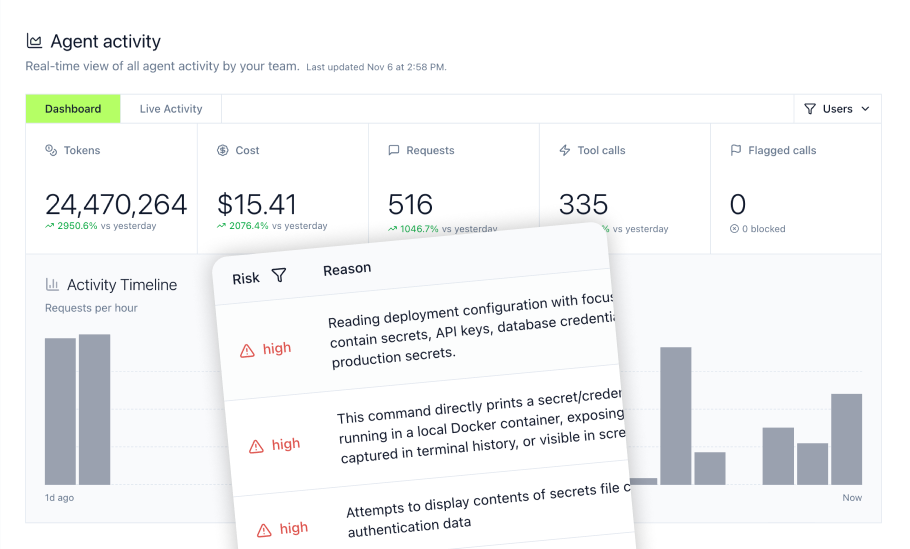
Reported AI-related incidents rose 56.4% year-over-year in 2024, while a study of 36 LLMs found that 56% of 144 prompt-injection tests succeeded. Enterprise teams deploying AI agents across Claude, Cursor, ChatGPT, and Copilot face a fundamental governance gap: visibility into what agents do, controls over what they can access, and audit trails for compliance.
The right AI guardrails platform transforms AI agent deployment from a security liability into governed, production-ready infrastructure. With the EU AI Act's transparency obligations taking effect August 2, 2026, and only 21% of surveyed enterprises reporting a mature governance model for agentic AI, choosing the right guardrails solution becomes critical for enterprises balancing innovation with risk management. This guide covers 10 AI guardrails tools and platforms, spanning runtime enforcement, governance frameworks, open-source options, and specialized security solutions.
Key takeaways
- MintMCP Guardrails provides three-layer runtime protection with Mint Guard managed detection, declarative Rules, and custom Gateway Middleware for DLP integration, all built into MCP Gateway and Agent Gateway infrastructure for agent-to-tool governance
- Gateway-level platforms enforce policies at a centralized infrastructure layer, either for LLM model traffic or for MCP tool traffic, reducing per-application configuration
- Cloud-native services from AWS and Azure offer managed guardrails for organizations already standardized on those ecosystems, with consumption-based pricing models
- Open-source frameworks provide programmable control for teams with DevOps capabilities and full infrastructure ownership requirements
- Governance platforms now combine compliance documentation with runtime enforcement, addressing both auditor requirements and production protection
- Agent-native solutions inspect tool call parameters and multi-turn context rather than treating each message as an isolated text string
1. MintMCP Guardrails: Runtime protection for enterprise AI agents
MintMCP Guardrails provides runtime policy and security controls at the agent-to-tool interaction layer. The platform screens every gateway tool call on both the arguments agents send and the results connectors return, with three coexisting enforcement layers.
Core capabilities
Mint Guard delivers managed detection policies for:
- Prompt injection attempts
- Credentials and secrets exposure
- PII and sensitive data
- Harmful content patterns
Organizations can run detection in monitoring mode to observe patterns before switching to enforcement mode for active blocking at high confidence.
Rules provide declarative matching and enforcement on:
- Tool names and invocation patterns
- Argument patterns via regex
- Content filtering with configurable actions
Supported actions include flagging, blocking, asking users, masking sensitive data, and sending Slack notifications.
Gateway Middleware runs customer-authored JavaScript in a sandboxed environment for:
- Content transformation and redaction
- Data rewriting before tool execution
- Integration with external classifiers and DLP systems
Built-in templates support AWS Bedrock Guardrails, Google Cloud Model Armor, OpenAI moderation, and Teleskope integration.
What makes MintMCP Guardrails different
MintMCP's guardrails architecture connects directly to its MCP Gateway and Agent Gateway infrastructure. This means guardrail policies apply across all governed tool connections with unified audit trails, rather than requiring separate guardrail configuration for each AI client or connector.
The platform addresses the reality that, among organizations reporting breaches involving AI models or applications, 97% lacked proper AI access controls. Organizations with high levels of shadow AI also saw breach costs averaging $670,000 more than organizations with low or no shadow AI.
Integration with governance infrastructure
- SSO and SCIM drive access policies through directory groups
- Virtual MCPs bundle approved connectors behind governed endpoints with curated tool surfaces
- Agent identities provide non-human principals with scoped permissions and independent audit trails
- Agent Monitor extends visibility to prompts, file access, commands, and MCP tool calls across Claude Code, Cursor, and other coding agents
Deployment and compliance
- SOC 2 Type II audited
- Compliant with HIPAA standards (BAA available)
- Managed cloud service; contact MintMCP to discuss on-premises or self-hosted requirements
- Mint Guard is available on the Enterprise plan
2. Bifrost (Maxim AI)
Bifrost provides an open-source AI gateway with guardrail capabilities enforced at the infrastructure layer. The platform routes all LLM traffic through a single control point where organizations apply unified policies across multiple providers.
Core approach
The gateway approach means one policy configuration applies to OpenAI, Anthropic, AWS Bedrock, Azure AI, and Google Vertex uniformly. Organizations define input validation rules, output filtering, and compliance checks once rather than reimplementing per application.
Key capabilities
- CEL-based rule engine with dual-stage validation for inputs and outputs
- Multi-provider guardrail integration supporting AWS Bedrock, Azure Content Safety, and Google Model Armor
- Performance benchmarks showing 11 microseconds overhead at 5,000 requests per second
- VPC, on-premises, and air-gapped deployment options
Deployment model
Open-source core with an Enterprise edition that adds governance, clustering, alerts, audit logs, vault integration, guardrails, and private deployment options including VPC, on-premises, and air-gapped environments.
3. AWS Bedrock Guardrails
AWS Bedrock Guardrails provides managed content filtering and policy enforcement for applications built on Amazon Bedrock. The service integrates natively with CloudWatch, IAM, and KMS for deployment within AWS environments.
Core approach
The managed service includes pre-trained content classifiers for hate speech, insults, sexual content, violence, misconduct, and prompt attacks. Sensitive information filters support 31 built-in PII entity types plus custom regex patterns.
Key capabilities
- Contextual grounding checks for RAG applications validating response relevance
- Centralized policy management across multi-account AWS deployments
- Usage-based Guardrails pricing, with charges determined by the policies evaluated
- GDPR and HIPAA compliance through AWS compliance programs
Deployment model
Managed AWS service. The ApplyGuardrail API can also evaluate inputs and outputs for third-party or self-hosted models outside Amazon Bedrock.
4. Azure AI Content Safety
Azure AI Content Safety provides content moderation and prompt protection for applications using Azure OpenAI Service. The platform includes Prompt Shields technology for detecting jailbreak attempts and indirect prompt injection.
Core approach
The service analyzes text and images with severity thresholds from 0 to 6, allowing organizations to tune sensitivity for their specific use cases. Groundedness Detection returns a boolean result plus an ungrounded-content proportion from 0 to 1; Microsoft notes that the percentage is not a confidence score.
Key capabilities
- Multi-modal content analysis across text and images
- Custom content categories for organization-specific policies
- Native integration with Azure Defender and Azure OpenAI Service
- Latency varies by feature, configuration, and deployment and should be benchmarked against the application's performance requirements
Deployment model
Azure consumption-based pricing. Microsoft also offers a Prompt Shields container in preview for customer-managed deployment scenarios; applicable compliance coverage depends on the specific Azure service and deployment.
5. NVIDIA NeMo Guardrails
NVIDIA NeMo Guardrails provides an open-source framework for programmable dialogue control using Colang, a domain-specific language for defining conversation policies.
Core approach
The framework organizes guardrails into input, retrieval, dialog, execution, and output rails. Jailbreak protection is implemented through guardrail flows and safety models rather than as a sixth rail type. Policies can be defined with YAML and Colang and execute at runtime.
Key capabilities
- Apache 2.0 licensing with full source code access
- Native integration with LangChain, LangGraph, and LlamaIndex
- CPU-capable library deployment, with external safety or language models carrying their own hardware and latency requirements
- Five pipeline stages for granular policy placement
Deployment model
Self-managed Python deployment runs on Windows, Linux, or macOS and can run on CPU; external models may have separate GPU requirements. NVIDIA also provides containerized deployment options.
6. Check Point AI Guardrails (Lakera Guard)
Check Point AI Guardrails, formerly Lakera Guard, provides real-time prompt injection detection and content filtering through its Guard API. The platform focuses on speed and simplicity for customer-facing AI applications requiring low latency.
Core approach
The service detects prompt injection attempts, jailbreaks, PII exposure, and harmful content with sub-200ms latency. Configuration uses JSON policy definitions that can be deployed without code changes.
Key capabilities
- Single API integration for all detection categories
- Self-hosted deployment option with customer-managed infrastructure
- Active security research informed by adversarial data collected through the Gandalf security platform
- SOC 2 Type II compliance
Deployment model
Available as a cloud-hosted SaaS service or self-hosted deployment; current commercial terms should be verified with Check Point.
7. Guardrails AI
Guardrails AI provides an open-source Python validation framework with 50+ pre-built validators through the Guardrails Hub. The library integrates naturally with ML engineering workflows using Pydantic for type enforcement.
Core approach
Developers define validation rules in Python code alongside their application logic. The framework validates LLM outputs against schemas, constraints, and custom functions before returning results to users.
Key capabilities
- Streaming validation for incremental output checking
- Pydantic integration for strict type enforcement
- Community-driven validator ecosystem on Guardrails Hub
- Zero licensing costs with full infrastructure control
Deployment model
Open-source with self-hosted deployment, including a standalone Guardrails Server. Confident AI is a separate vendor built around DeepEval and is not Guardrails AI's enterprise management layer.
8. F5 AI Guardrails and AI Red Team
F5 acquired CalypsoAI in 2025 and now delivers its runtime enforcement and security-testing technology through F5 AI Guardrails and F5 AI Red Team. The platform provides enterprise AI security with automated red-team to runtime remediation.
Core approach
The LLM proxy/gateway centralizes all model traffic for consistent policy application across providers. CASI scoring quantifies AI security posture for executive reporting.
Key capabilities
- Runtime controls for prompt injection, data leakage, excessive agency, and other AI security risks
- Policy-driven guardrails configurable by use case, region, and organizational requirements
- Automated adversarial testing through F5 AI Red Team
- Red-team findings that can feed into F5 AI Guardrails for runtime remediation
Deployment model
Enterprise offering through F5, with deployment support across different cloud and enterprise environments.
9. Credo AI
Credo AI provides governance program management for AI systems with pre-built regulatory mapping, risk workflows, and compliance tooling. In July 2026, Credo AI also launched Agent Governor in Research Preview, adding runtime governance for agent actions in supported agent harnesses.
Core approach
Policy Intelligence Packs map controls to EU AI Act, NIST AI RMF, ISO 42001, and SOC 2 requirements. GAIA (Governance AI Assistant) provides agentic oversight for autonomous AI systems.
Key capabilities
- AI Registry with vendor risk assessment and agent inventory
- Automated compliance documentation and model card generation
- Approval workflows for new AI system deployments
- Agent Governor in Research Preview for runtime governance in supported harnesses
Deployment model
Enterprise SaaS with AWS and Microsoft marketplace availability, combining governance workflows with runtime enforcement capabilities.
10. Cisco AI Defense
Cisco acquired Robust Intelligence in September 2024 and integrated its technology into Cisco's AI security portfolio. Cisco AI Defense combines AI asset discovery, pre-deployment validation, algorithmic red teaming, and runtime protection for AI applications and agents.
Core approach
Tree of Attacks with Pruning (TAP) methodology stress-tests models for vulnerabilities. AI Firewall auto-generates blocking rules from discovered vulnerabilities.
Key capabilities
- Multi-modal AI support covering text, images, and structured data
- Pre-deployment validation identifying vulnerabilities before production
- Runtime firewall blocking attacks discovered in testing
- Connectors for SageMaker, Vertex AI, DataRobot, and Databricks
Deployment model
Enterprise offering with deployment support across cloud and on-premises environments.
Building enterprise AI governance with MintMCP
For organizations deploying AI agents across Claude, Cursor, ChatGPT, Gemini, and Copilot, MintMCP provides the governance infrastructure that makes those agents deployable, governed, measurable, and swappable. MintMCP's unique positioning focuses on the agent-to-tool interaction layer, where AI systems connect to enterprise data sources, APIs, and internal systems through the Model Context Protocol.
MintMCP's Guardrails connect directly to the platform's MCP Gateway and Agent Gateway, meaning runtime protection applies across all governed tool connections with unified audit trails rather than requiring separate configuration for each AI client. Mint Guard screens for prompt injection, secrets, PII, and harmful content with managed detection policies that require no custom authoring. Rules provide declarative pattern matching for organization-specific requirements like restricting file system access or blocking specific tool combinations. Gateway Middleware enables custom JavaScript logic for DLP integration, external classifier calls, and data transformation before tool execution.
The platform's Agent Monitor extends visibility beyond gateway traffic to prompts, file access, commands, and MCP tool calls across coding agents. Combined with agent identities that provide non-human principals with scoped permissions and independent audit trails, MintMCP delivers the complete governance layer enterprises need as AI agent adoption accelerates. Organizations gain centralized policy enforcement, unified logging for compliance, and the infrastructure to confidently deploy AI agents that interact with sensitive enterprise systems.
Frequently asked questions
What is the difference between AI guardrails and AI governance platforms?
AI guardrails provide runtime detection and blocking of risky inputs and outputs, including prompt injection, PII exposure, harmful content, and policy violations. Governance platforms focus on documentation, risk assessment workflows, regulatory mapping, and compliance artifact generation. Most enterprises need both capabilities: guardrails to prevent incidents in production, and governance frameworks to satisfy auditor and regulator requirements for oversight and documentation.
How do AI guardrails protect against prompt injection attacks?
Guardrails platforms use pattern detection, machine learning classifiers, and contextual analysis at different stages of an AI workflow. Pre-execution checks can block risky tool calls, while input and output checks can detect or filter malicious content at other enforcement points. MintMCP screens governed gateway tool arguments and connector results for runtime protection, preventing malicious inputs from reaching enterprise systems through tool calls.
Can AI guardrails help with EU AI Act compliance?
Runtime guardrails can support an organization's AI Act risk-management and technical-control program by enforcing policies, logging decisions, and reducing unsafe behavior. They do not by themselves establish compliance with human-oversight, transparency, documentation, conformity-assessment, or other legal obligations. Organizations should map technical and governance controls to the AI Act requirements that apply to each system, combining runtime enforcement with governance documentation.
What latency do AI guardrails add to LLM applications?
Latency varies significantly by architecture and detector. Bifrost reports gateway overhead in microseconds in a specific infrastructure benchmark, while model-based classifiers and evaluators can operate on very different millisecond-scale timelines. These measurements are not directly interchangeable, so teams should benchmark each platform against their own workload and performance budget. Customer-facing applications with strict latency requirements should evaluate specific platforms under production-like conditions.
Should enterprises use open-source or managed AI guardrails?
Open-source frameworks like NVIDIA NeMo Guardrails and Guardrails AI provide full control and zero licensing costs but require operational investment in deployment, updates, and monitoring. Managed platforms handle infrastructure and compliance certifications while introducing vendor dependency. Teams with DevOps capabilities and specific customization needs may prefer open-source flexibility and transparency. Organizations prioritizing operational simplicity and compliance attestation typically choose managed solutions with SLAs and support.