Traditional API gateways have served microservices architectures well for over a decade, routing stateless HTTP requests, enforcing rate limits, and managing authentication. But AI agents operate fundamentally differently. They maintain state across multi-step workflows, invoke tools autonomously, and communicate through protocols like Model Context Protocol (MCP) that bear little resemblance to REST APIs. Organizations deploying Claude, Cursor, ChatGPT, Gemini, or Copilot are discovering that their existing API infrastructure cannot provide the governance these autonomous systems require. This gap has given rise to a new category: the Agent Gateway, purpose-built infrastructure for securing and managing AI agent operations at enterprise scale.
This article examines why microservice patterns fail to govern agents, how Agent Gateways address these limitations, and what organizations should consider when implementing governance for their AI infrastructure.
Key Takeaways
- API gateways handle stateless HTTP requests; agents require stateful session management across multi-step workflows with persistent context
- Agent Gateways need protocol-aware handling for MCP and emerging agent communication patterns, including JSON-RPC messages, streaming responses, server notifications, and stateful tool sessions
- Per-agent identity with scoped credentials enables audit attribution and independent credential rotation, eliminating shared service account risks
- Custom policy enforcement at the tool-call level allows inline DLP integration and real-time blocking of prompt injection, PII exposure, and risky commands
- Shadow AI detection identifies off-gateway agent activity in developer tools, addressing a visibility gap that gateway-only solutions cannot close
- Bundle-based governance packages tool access, policy rules, and audit trails into single units, reducing configuration complexity
The API Gateway Paradigm: A Brief Overview
API gateways emerged as the traffic control layer for microservices, sitting between external clients and backend services to handle cross-cutting concerns. They excel at routing requests, load balancing, rate limiting, and authentication for stateless HTTP traffic.
In a typical microservices architecture, the API gateway receives an inbound request, validates credentials, applies rate limits, routes to the appropriate service, and returns a response. Each request is independent. The gateway maintains no memory of previous interactions and makes no assumptions about what comes next.
This model works because microservices communicate through well-defined REST or GraphQL interfaces with predictable request-response patterns. The gateway can inspect headers, validate tokens, and enforce policies without understanding the business logic of each call.
Limitations in Agentic AI Contexts
AI agents break these assumptions in three fundamental ways:
- Stateful sessions: Agents maintain context across multi-step workflows. A database analysis agent might query schema metadata, generate SQL, execute the query, and format results across four or more sequential tool calls, each dependent on the last.
- Autonomous tool invocation: Agents decide which tools to call and in what order. Unlike microservices receiving explicit instructions, agents interpret natural language and choose actions dynamically.
- Protocol-aware communication: MCP uses JSON-RPC 2.0 messages over transports such as stdio and Streamable HTTP, with optional streaming behavior for server messages. Traditional API gateways are usually optimized for request-response API traffic, not agent tool sessions with protocol-specific state, notifications, and streaming patterns.
These differences mean API gateways cannot provide the session affinity, protocol translation, or workflow-aware policy enforcement that agent governance requires.
Beyond REST: Introducing Agent Gateways for Model Context Protocol
Agent Gateways represent specialized infrastructure designed for autonomous AI systems. Unlike API gateways routing stateless requests or AI gateways managing LLM traffic, Agent Gateways are designed to govern agent identities, permissions, memory, monitoring, and stateful tool workflows across autonomous agent operations.
The Model Context Protocol has become a common interface between AI systems and the tools they access. MCP enables agents to connect to databases, APIs, file systems, and SaaS applications through a unified protocol specification. Adoption is growing across the AI tools enterprises already use, including Claude, Cursor, ChatGPT, Gemini, and Copilot.
Key Characteristics of an Agent Gateway
Agent Gateways provide capabilities that traditional infrastructure cannot:
- Session state management: Persistent context across tool calls, enabling agents to maintain workflow continuity
- Protocol-native handling: Direct support for MCP and emerging agent protocols without translation layers
- Tool-level authorization: Granular control over which agents can access which tools, with read/write distinctions
- Credential isolation: Per-agent credentials rather than shared service accounts, following NIST Zero Trust principles
- Workflow observability: End-to-end tracing of agent decision chains, not just individual API calls
MintMCP's system architecture implements these principles through a gateway that manages MCP servers with enterprise authentication and access controls, enabling organizations to deploy AI agents with centralized security and observability.
Identity and Authentication: Per-Agent Credentials
API gateways authenticate requests, but they authenticate the caller, not the agent. When multiple agents share a service account, audit logs cannot distinguish which agent accessed sensitive data or triggered a destructive action.
Agent Gateways solve this through per-agent identity. Each deployed agent receives its own persistent identity with scoped credentials that can be rotated independently. This approach delivers three critical benefits:
- Audit attribution: Every tool call traces back to a specific agent, enabling forensic investigation
- Credential hygiene: Rotating one agent's credentials does not affect others
- Least-privilege access: Each agent's permissions match its specific function, not a superset of all agent needs
MintMCP implements this through Agent Bundles, which provide bearer API keys plus OAuth 2.0 client-credentials per agent. The "act as agent" admin flow handles connectors requiring per-agent OAuth, and rotation or revocation operates independently of human user accounts.
This matters because per-agent credentials make agent access easier to attribute, rotate, and constrain without relying on broad shared service accounts.
Granular Policy Enforcement: Custom Logic for Agent Guardrails
API gateways enforce policies through declarative rules: rate limits, IP allowlists, header requirements. These rules work for predictable API traffic but cannot address the dynamic, context-dependent decisions agents make.
Agent governance requires policy enforcement that evaluates each tool call against business rules, security constraints, and data protection requirements. This means:
- Inline DLP integration: Scanning tool inputs and outputs for PII, credentials, or sensitive patterns before they reach external services
- Prompt injection detection: Identifying and blocking attempts to manipulate agent behavior through malicious inputs
- Command filtering: Blocking risky bash commands, destructive database operations, or file system modifications based on context
MintMCP enables custom policy execution on every tool call through a JS sandbox with allowed-domains fetch, secret injection, and built-in templates for common security patterns. This middleware layer integrates with AWS Bedrock Guardrails, Google Cloud DLP, Microsoft Purview, Nightfall, and Skyflow for enterprises with existing DLP investments.
The difference from API gateway policies is fundamental. API gateways ask "is this request allowed?" Agent Gateways ask "given this agent's identity, this tool's sensitivity, this data's classification, and this workflow's context, should this action proceed?"
Shadow AI Detection: Monitoring Beyond the Gateway
Even the most comprehensive gateway cannot govern what it cannot see. Developers using Cursor, Claude Code, or similar tools often run agents locally, bypassing centralized infrastructure entirely. This "shadow AI" creates blind spots in security posture and compliance reporting.
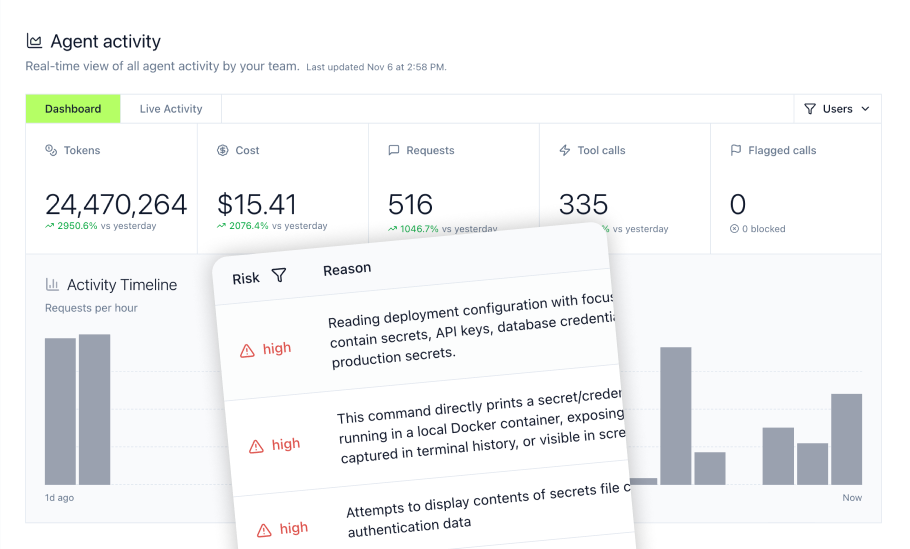
MintMCP's Agent Monitor addresses this gap by tracking agent activity across the organization, including MCP calls made outside the gateway. Through hooks in developer tools, Agent Monitor detects:
- PII exposure: Sensitive data patterns in agent prompts or responses
- Credential leakage: API keys, tokens, or passwords appearing in agent context
- Risky commands: Bash operations that could damage systems or exfiltrate data
- Prompt injection attempts: Patterns indicating manipulation of agent behavior
MDM integration enables push of detect-only or enforce-mode configurations to developer machines, ensuring consistent policy application whether agents run through the gateway or locally. This two-layer architecture, with Gateway covering centralized MCP traffic and Agent Monitor covering local activity, provides visibility that gateway-only solutions cannot match.
Bundle Simplicity: Streamlining Agent Governance
Governing AI agents at scale requires managing tool access, policy rules, audit trails, and user permissions across potentially hundreds of agent deployments. Configuration complexity becomes a barrier to adoption and a source of security gaps.
MintMCP's Bundle architecture addresses this through a single governance primitive. Each Bundle (Virtual MCP) packages:
- Curated tool list: Which MCP servers and tools are accessible
- SCIM-driven membership: Which users or groups can access the Bundle
- Policy rules: What security constraints apply
- Isolated audit trail: What actions occurred within this scope
One endpoint per role or use case, with configuration inherited from organizational defaults and customized per team need. The same primitive applies to human teams and agent identities, creating consistent governance across the organization.
This approach contrasts with multi-object configuration models requiring separate management of plugins, access rules, and agent accounts. The Virtual MCP abstraction reduces governance complexity by packaging access, policy, and audit scope into a single unit that teams can manage more consistently.
Observability and Compliance: Logging Every Step
Compliance frameworks require audit trails demonstrating who accessed what data and when. For AI agents, this means capturing every tool call, every LLM interaction, and every data flow in a format suitable for security review and regulatory examination.
Agent Gateways must provide:
- Conversation-level logging: Full context of agent sessions, not just individual requests
- Per-user attribution: Clear mapping of actions to the responsible human or agent identity
- Immutable records: Tamper-resistant storage for compliance investigations
- SIEM export: Integration with Sentinel, Splunk, or S3 for centralized security monitoring
MintMCP captures prompts, tool calls, responses, and context with configurable retention and export capabilities. The platform is SOC 2 Type II audited with continuous compliance monitoring. MintMCP is compliant with HIPAA standards, customers handling protected health information can request HIPAA documentation, and MintMCP signs BAAs.
Understanding the MCP data risk framework helps organizations map audit requirements to tool-level access controls, ensuring compliance posture scales with agent deployment.
Ecosystem Integration: Connecting Agents to Enterprise Systems
AI agents create value by accessing enterprise data and systems. MCP Gateway platforms provide the connectors and infrastructure to make this access governed rather than ad-hoc.
MintMCP offers multiple integration paths:
- Pre-configured connectors: Activation for common enterprise systems across CRM, code, collaboration, support, productivity, payments, and data workflows
- Custom MCP server hosting: Upload STDIO-based MCP servers from the community ecosystem; MintMCP handles scaling, isolation, and OAuth wrapping
- OpenAPI transformation: Convert existing REST APIs into MCP-compatible tools by uploading OpenAPI specs
The platform supports Claude and ChatGPT, Gemini, Cursor, Windsurf, GitHub Copilot, Replit, and other MCP-compatible clients. REST APIs and SDKs enable programmatic management for CI/CD integration and infrastructure-as-code workflows.
For organizations with existing security investments, middleware hooks support custom DLP pipeline integration, routing agent traffic through established data protection infrastructure.
Why MintMCP Fits Enterprise Agent Governance
Organizations deploying AI agents at scale need infrastructure that addresses the full spectrum of governance challenges: protocol-native MCP handling, per-agent identity, policy enforcement across tool calls, shadow AI visibility, audit compliance, and ecosystem integration. MintMCP brings these capabilities together through its MCP Gateway foundation, Agent Gateway model, and Agent Monitor coverage.
What sets MintMCP apart:
MintMCP provides both centralized gateway control and distributed endpoint monitoring, closing the visibility gap that gateway-only solutions leave open. The Agent Monitor detects shadow AI activity in developer tools, surfacing PII exposure, credential leakage, and risky commands across every MCP-enabled application, whether traffic flows through the gateway or runs locally on developer machines.
The Bundle architecture simplifies governance at scale. Unlike platforms requiring separate management of plugins, access rules, and agent accounts, MintMCP packages tool access, policy rules, SCIM-driven membership, and isolated audit trails into single governance units. This reduces configuration complexity while maintaining the granular control enterprises need.
MintMCP's custom policy engine executes security logic on every tool call through a JS sandbox, with built-in templates for prompt injection detection, PII scanning, and command filtering. Enterprises with existing DLP investments can integrate AWS Bedrock Guardrails, Google Cloud DLP, Microsoft Purview, Nightfall, and Skyflow through middleware hooks, preserving prior security investments while extending governance to agent workflows.
The platform scales with enterprise requirements: pre-configured connectors for common SaaS applications, hosted custom MCP servers with automatic scaling and isolation, OpenAPI-to-MCP transformation for existing REST APIs, and REST APIs plus SDKs for infrastructure-as-code workflows. SOC 2 Type II audited operations, HIPAA compliance with BAA availability, and configurable SIEM export ensure MintMCP meets regulatory and security audit requirements.
Organizations choosing MintMCP gain the infrastructure foundation to deploy AI agents with the security, compliance, and observability their risk posture requires, without building gateway and monitoring capabilities from scratch.
Frequently Asked Questions
How do Agent Gateways integrate with existing identity providers?
Enterprise Agent Gateways typically support OAuth 2.0, OIDC, and SAML integration with major identity providers including Okta, Azure AD, and Google Workspace. SCIM-based group synchronization enables automatic permission updates when employees change roles or leave the organization. MintMCP's Bundle model ties directly to SCIM group membership, so access policies update automatically as directory changes occur.
What happens when an MCP server fails during a multi-step workflow?
Agent Gateways can help preserve context around mid-workflow failures by logging the affected session, tool call, and connector involved. MintMCP's hosted runtime provides auto-scaling and isolation per connector, reducing operational burden for the connector layer. Observability logs help teams identify the failure point for debugging and policy review.
How do enterprises handle agent governance during initial testing versus production?
Most organizations start with detect-only mode, logging agent activity without enforcing blocks. This surfaces policy violations and shadow AI usage without disrupting developer workflows. Once baseline behavior is understood, teams enable enforce-mode incrementally, starting with high-risk tools or sensitive data sources. MintMCP's Agent Monitor supports both modes with MDM push for consistent rollout across developer machines.
What training do teams need to implement Agent Gateway infrastructure?
Platform engineering teams with Kubernetes and OAuth experience are better prepared for self-hosted gateway deployments, while managed SaaS options can reduce infrastructure setup work. Security teams need training on MCP-specific risks, including tool poisoning, prompt injection, and credential exposure patterns. MintMCP provides documentation, guides, and enterprise support to accelerate onboarding. Organizations often find that the bigger challenge is defining governance policies, not just deploying the technology.