AI agents operating with static API keys represent one of the most significant security blind spots in enterprise environments today. With identity-based attacks accounting for 60% of cyber incidents in 2024, organizations deploying AI agents face a critical challenge: traditional authentication systems designed for human users fail to address the unique requirements of autonomous AI systems. The combination of OAuth 2.1 and Model Context Protocol (MCP) provides the security framework enterprises need, and platforms like MCP Gateway make implementation practical by adding OAuth protection automatically to any MCP server.
This article provides actionable guidance for implementing OAuth-based authentication for AI agents, covering identity management fundamentals, implementation strategies, compliance requirements, and ongoing monitoring to ensure both security and operational efficiency.
Key Takeaways
- AI agents require distinct identities, not shared service accounts—treating them as first-class digital identities enables proper auditability and governance
- OAuth 2.1 requires PKCE for all clients using the Authorization Code flow
- Token Exchange (RFC 8693) enables agents to act "on behalf of" human users while maintaining distinct audit trails showing both delegator and actor
- Protected Resource Metadata discovery allows agents to dynamically locate authorization servers without hardcoded configuration
- Implementation timeline spans 2-8 weeks for initial deployment, with managed platforms enabling faster market entry than self-hosted solutions
- Average data breach costs reach $4.4M—per IBM's report—proper OAuth implementation for AI agents directly reduces this risk through time-bounded credentials and granular permissions
The Evolution of Authentication: From Humans to AI Agents
Traditional identity and access management (IAM) systems assume users are humans who authenticate occasionally, maintain stable roles, and operate during predictable hours. AI agents break every one of these assumptions. They authenticate continuously, assume different permission sets per task, operate around the clock, and communicate with other systems autonomously.
The shift from human-centric to agent-centric authentication creates several new requirements:
- Dynamic identity provisioning: Agents are created and destroyed frequently, requiring automated registration rather than manual IT provisioning
- Ephemeral credentials: Unlike annual access reviews for employees, agents need tokens that expire in minutes or hours
- Delegation transparency: When an agent acts on behalf of a user, audit logs must distinguish between human actions and agent actions
- Machine-to-machine communication: Agents interact with APIs, databases, and other agents without human involvement in each transaction
MintMCP's authentication models support both shared and per-user authentication patterns, enabling organizations to configure service accounts at the admin level or enable individual OAuth flows depending on the use case.
Why Machine Identities Differ from Human Identities
Human authentication relies on factors like passwords, biometrics, and one-time codes. AI agents need cryptographic credentials that prove identity without human intervention.
The OAuth ecosystem (OAuth 2.1 plus widely-used extensions) addresses this through::
- Client Credentials grant (OAuth 2.x core): Agents authenticate without user interaction using client credentials (e.g., secret or other supported client authentication)
- Dynamic Client Registration (RFC 7591): Clients can register with authorization servers in environments where DCR is enabled
- Client ID Metadata Documents (Internet-Draft): Clients can publish metadata at a URL-based client_id in ecosystems that support CIMD
Why Traditional Authentication Falls Short for AI Agents
Static API keys—the default authentication method for most AI integrations—create substantial security vulnerabilities when applied to autonomous agents.
The API Key Problem
API keys suffer from fundamental design limitations:
- No expiration by default: Keys remain valid until manually revoked, creating permanent access if leaked
- No identity attribution: A leaked key provides no information about who created it or which agent used it
- No scope enforcement: Most API key implementations grant full access rather than granular permissions
- No delegation tracking: Keys cannot distinguish between a user taking action directly versus an agent acting on their behalf
Privilege Escalation Risks
Without proper token scoping, AI agents inherit their operator's full permissions. Consider this scenario: a marketing analyst grants their AI assistant access to generate reports. If the analyst has database delete permissions they never use, the agent now has those same permissions—and may exercise them if it misinterprets a prompt.
Centralized governance through an MCP gateway addresses this by:
- Enforcing granular tool access control by role
- Enabling read-only operations while excluding write tools
- Requiring step-up authentication for high-risk operations
- Maintaining complete audit trails of every MCP interaction
Session Management Challenges
Human sessions assume reasonable duration—a few hours of active use followed by logout. AI agents operate continuously, making traditional session timeouts problematic. The solution requires:
- Refresh token rotation (where supported): each refresh returns a new refresh token and invalidates the previous refresh token (one-time use)
- Audience binding: Tokens are restricted to specific resources, preventing use across unintended systems
- Time-bounded permissions: High-risk scopes expire faster than low-risk scopes
Leveraging OAuth 2.1 for Secure AI Agent Deployment
OAuth 2.1 consolidates security best practices that were optional in OAuth 2.0 into mandatory requirements. For AI agent deployments, these changes address critical vulnerabilities.
Mandatory PKCE Protection
OAuth 2.1 requires PKCE for all authorization code flows. PKCE prevents authorization code interception attacks by binding each authorization request to a cryptographic proof that only the legitimate client can provide.
The flow works as follows:
- Agent generates a random
code_verifierstring - Agent creates a
code_challengeby hashing the verifier using SHA-256 - Agent sends
code_challengewith authorization request - Authorization server returns authorization code
- Agent exchanges code for token, including original
code_verifier - Server validates that hash of
code_verifiermatches originalcode_challenge
Without PKCE, an attacker intercepting the authorization code could exchange it for tokens. With PKCE, the attacker cannot generate the correct code_verifier.
Token Exchange for Delegation
RFC 8693 Token Exchange enables agents to act on behalf of users while maintaining identity separation. The resulting tokens can include both:
sub(subject): The human user who delegated accessact(actor): The AI agent performing the action
This pattern allows audit logs to show "Marketing Agent acting for Jane Smith accessed customer database" rather than simply "Jane Smith accessed customer database."
Protected Resource Metadata Discovery
MCP servers can advertise their authorization requirements at /.well-known/oauth-protected-resource, including:
- Trusted authorization server URLs
- Required scopes for different operations
- Token validation endpoints
When an agent receives a 401 response, it fetches this metadata to determine where to authenticate and what permissions to request—eliminating hardcoded authorization server URLs.
Building Robust Access Control with OAuth for AI Agents
Effective AI agent access control extends beyond authentication to authorization—determining what authenticated agents can do.
Role-Based Access Control for Agents
Different agent types require different permission sets. Defining agent roles that map to OAuth scopes:
Data Analysis Agent:
database:read- Query access to specified tablesanalytics:execute- Permission to run aggregation queries- Denied:
database:write,database:delete
Customer Support Agent:
crm:read- Access to customer recordstickets:read,tickets:update- View and modify support tickets- Denied:
crm:delete,billing:modify
MintMCP's Snowflake connector demonstrates this pattern by enabling natural language queries against data warehouses while enforcing role-based access at the MCP gateway level.
Attribute-Based Access Control
Beyond roles, context-aware access control considers:
- Time restrictions: Agent can only access data during business hours
- Location constraints: Agent can only query data for customers in assigned regions
- Relationship requirements: Agent can only edit documents where the delegating user is the owner
Rich Authorization Requests (RAR) enable these granular permissions. Instead of broad scopes like purchase:execute, RAR allows specifications like "purchase flights from Chicago to Beijing on Jan 15 with $800 limit."
Just-in-Time Access Provisioning
Security best practices recommend Just-in-Time (JIT) access for elevated permissions:
- Agent normally operates with minimal scopes
- When a high-risk operation is needed, agent requests elevated access
- User receives notification and approves (or denies) the request
- Elevated access automatically revokes after a short window (5-15 minutes)
Implementing OAuth for AI Agents: A Practical Guide
Implementation follows a phased approach, with timeline varying based on organizational complexity and chosen platform.
Phase 1: Authorization Server Setup
Choose your approach:
- Managed Platform: 3-5 days setup, best for fastest time-to-market
- Self-Hosted: timeline varies based on IAM maturity and integration scope; best when you need maximum control
Configure core components:
- Deploy authorization server with modern TLS (e.g., TLS 1.2+; TLS 1.3 preferred where available)
- Configure JSON Web Key Set (JWKS) for token signing
- Establish .well-known/oauth-authorization-server metadata endpoint
- Define initial scope catalog
Phase 2: MCP Server Configuration
Implement Protected Resource Metadata at /.well-known/oauth-protected-resource endpoint:
{

  "authorization_servers": ["https://auth.company.com"],

  "scopes_supported": ["database:read", "analytics:execute"],

  "bearer_methods_supported": ["header"]

}
Enable audience binding: Configure authorization server to include aud claim in tokens, restricting each token to specific MCP server URIs.
Phase 3: Agent Identity Implementation
Select registration method:
- Client ID Metadata Documents (CIMD): Agents host HTTPS JSON files—recommended for dynamic scenarios
- Pre-registration: Manually create OAuth client IDs—simpler but less scalable
- Dynamic Client Registration (DCR): Agents auto-register on first connection
Deploy first agent with OAuth flow:
- Agent discovers MCP server and receives 401 response
- Agent fetches metadata to identify authorization server
- Agent initiates authorization code flow with PKCE
- User approves scopes on consent screen
- Agent exchanges code for short-lived access token
- Agent calls MCP server with
Authorization: Bearer <token>
Phase 4: Production Rollout
- Pilot with 3-5 read-only agents for 1-2 weeks
- Monitor for security incidents and verify audit log completeness
- Expand to remaining agents incrementally (10-25% per week)
- Implement kill switch for instant token revocation
- Deprecate legacy API keys
Monitoring and Auditing AI Agent Activities with OAuth
Continuous monitoring transforms OAuth from an authentication mechanism into a governance platform.
Real-Time Activity Tracking
Effective monitoring captures:
- Token lifecycle events: Issuance, refresh, revocation with timestamps
- Scope usage patterns: Which permissions agents actually use vs. what they're granted
- Anomaly indicators: Unusual access times, unexpected scope requests, high-frequency token generation
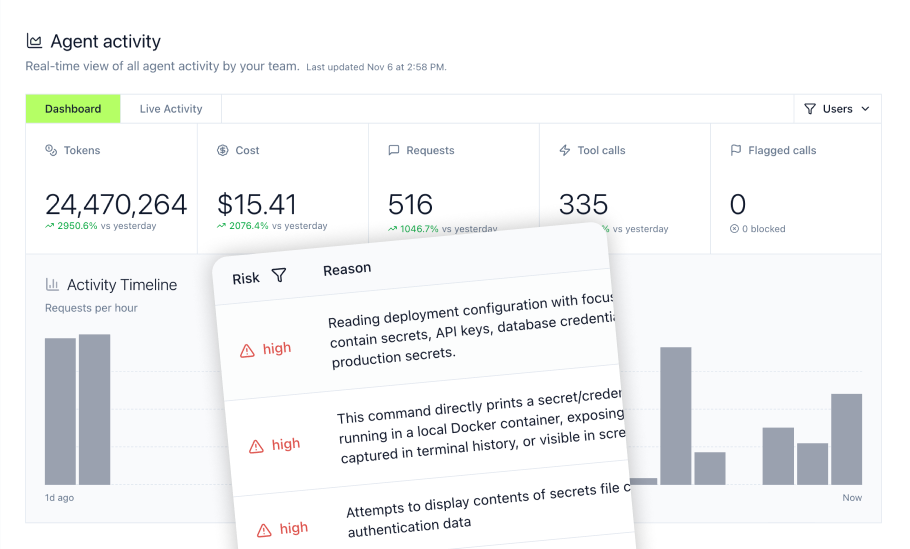
The MintMCP LLM Proxy provides visibility into coding agent operations, monitoring every MCP tool invocation, bash command, and file operation across development tools.
Audit Log Requirements
Compliance-ready audit logs include:
- Immutability: Append-only storage preventing log modification
- Completeness: Every authenticated action recorded without gaps
- Attribution: Both human delegator and agent actor identified
- Retention: 7+ years for regulated industries
Sample audit log entry:
{

  "timestamp": "2025-01-15T14:32:00Z",

  "sub": "user_12345",

  "act": "agent_67890",

  "action": "database:read",

  "resource": "customers_table",

  "decision": "allow",

  "token_id": "tok_abc123",

  "scopes_used": ["database:read"]

}
Security Alerting
Configure alerts for:
- Agent accessing scopes outside normal patterns
- Token refresh failures indicating possible compromise
- High-frequency authorization requests suggesting credential stuffing
- Access attempts to sensitive resources after hours
Balancing Autonomy and Control in Agentic AI Systems
Agentic AI systems operate autonomously, making decisions without constant human oversight. This autonomy creates tension with traditional authentication models that assume human-in-the-loop verification.
Controlled Autonomy Through OAuth
OAuth 2.1 enables controlled autonomy through:
- Pre-authorized scope boundaries: Agents operate freely within defined permissions
- Automatic token expiration: Autonomy is time-bounded
- Step-up authentication: High-risk operations pause for human approval
- Delegation chains: Autonomous actions remain traceable to human authorization
Defining Trust Boundaries
Establish explicit trust boundaries for different operation types:
Low-Risk (Auto-Approve):
- Read-only data access
- Analytics queries
- Report generation
Medium-Risk (Notification):
- Data modification within user's scope
- External API calls
- File uploads
High-Risk (Human Approval Required):
- Bulk data operations
- Production system changes
- Financial transactions
- Credential access
Declarative Policy Enforcement
Rather than embedding access logic in agent code, declare policies separately:
allow(agent, "database:write", resource) if
agent.role == "data_analyst" and
resource.sensitivity != "high" and
current_time.is_business_hours()
This approach enables policy changes without agent redeployment.
Future-Proofing AI Agent Security with Advanced OAuth Patterns
As AI agent deployments scale, advanced security patterns become necessary.
Zero Trust Architecture
OAuth 2.1 aligns with NIST Zero Trust principles:
- Never trust, always verify: Every request requires valid token
- Minimal access: Tokens grant only necessary scopes
- Continuous validation: Short token lifetimes force re-authentication
- Assume breach: Audit trails enable rapid incident response
Fine-Grained Authorization Evolution
Emerging standards extend OAuth capabilities:
- Transaction tokens: Single-use tokens for specific operations
- Bound tokens: Cryptographically tied to specific clients
- Contextual tokens: Permissions vary based on request context
The MintMCP LLM Proxy already implements security guardrails that block dangerous commands in real-time and protect sensitive files from access—a foundation for more sophisticated AI-driven security.
Implementing OAuth for AI Agents with MintMCP
MintMCP Gateway addresses the complex integration challenges of OAuth 2.1 for AI agents by providing managed OAuth integration that works with any MCP server. The platform automatically adds OAuth protection to your MCP servers, enforces granular tool access control by role, and maintains immutable audit logs of every interaction—eliminating the need to implement OAuth flows in every individual agent.
For development workflows, the MintMCP LLM Proxy extends security to coding assistants like Cursor and Claude Code, tracking every file access, bash command, and tool invocation. The proxy's real-time guardrails block risky commands before execution while maintaining detailed logs for compliance. Integration with Snowflake, GitHub, Slack, and other enterprise data sources happens through pre-built connectors that inherit the same OAuth protection and access controls.
MintMCP's managed platform approach enables teams to deploy secure AI agents in weeks rather than months, with confidence that both current compliance needs and future security standards are met.
Frequently Asked Questions
What happens if an AI agent's OAuth token is compromised?
Short-lived tokens limit blast radius to minutes rather than months. With 5-minute token lifetimes, compromised credentials become invalid before attackers can cause significant damage. Token refresh rotation means each new token invalidates the previous one—if an attacker uses a stolen refresh token, the legitimate agent's next refresh attempt fails, triggering an alert. Organizations should implement kill switches enabling instant revocation of all tokens associated with a specific agent or user.
How do I handle OAuth for agents that need to communicate with each other?
Agent-to-agent (A2A) communication requires token exchange defined in RFC 8693. When Agent A needs to call Agent B, Agent A presents its own token to the authorization server requesting a new token with Agent B's audience. The resulting token contains claims identifying both the original human delegator, Agent A (the first actor), and the permissions appropriate for Agent B's resources.
Can I implement OAuth for AI agents incrementally alongside existing API keys?
Yes, a dual-run migration strategy allows gradual transition. Configure MCP servers to accept both token types during a 2-4 week overlap period. Start by migrating 10-25% of agents per week, beginning with new agents and lowest-risk existing agents. Monitor for authentication failures during the transition. Once all agents successfully authenticate with OAuth, disable API key authentication and revoke remaining keys.
How does OAuth 2.1 differ from OAuth 2.0 for AI agent use cases?
OAuth 2.1 makes several optional OAuth 2.0 security practices mandatory. PKCE is required for all authorization code flows, not just public clients—this prevents authorization code interception. The implicit grant flow is entirely deprecated, eliminating a common vulnerability. Refresh token rotation is mandatory for public clients (which most AI agents are), ensuring leaked refresh tokens quickly become invalid.