The Model Context Protocol has become the industry standard for connecting AI assistants to enterprise data and tools, with support from Anthropic, OpenAI, Google, and Microsoft. Yet most organizations struggle with a fundamental challenge: discovering which MCP servers exist, deploying them securely, and maintaining governance across hundreds of AI-to-data connections. According to a 2023 Gartner report, 55% of organizations are piloting or deploying generative AI, creating urgent demand for systematic MCP deployment that balances developer velocity with security requirements.
This article explains how enterprise teams can use MintMCP's MCP Gateway and comprehensive registry to discover, deploy, and govern MCP servers at scale, covering discovery workflows, deployment automation, security hardening, compliance requirements, and practical business applications.
Key Takeaways
- MintMCP's registry of 10,000+ servers includes filtering by authentication type, tool count, and download metrics, enabling IT teams to identify relevant MCP servers in minutes rather than hours of research
- One-click deployment transforms local STDIO-based MCP servers into production-ready services with automatic hosting, OAuth protection, and lifecycle management, reducing manual DevOps configuration
- Virtual MCP Bundles provide role-based tool collections where sales teams access CRM connectors while engineering teams access code repositories, supporting least-privilege access without manual permission management
- Enterprise authentication wrapping adds OAuth 2.0, SAML, and SSO to MCP servers, allowing security teams to enforce identity policies across AI tool connections
- Managed deployment reduces the infrastructure work required to move MCP servers from local experimentation to governed production access
- Complete audit trails capture every MCP tool invocation, giving security and compliance teams a searchable record of AI-to-data activity without custom logging infrastructure
The Challenge: Navigating MCP Server Deployment in the Enterprise Today
Enterprise AI adoption has reached a tipping point. However, the rapid pace of adoption has outstripped governance capabilities in many organizations. This gap creates significant operational and security risks as employees connect AI assistants to company data without IT oversight.
Understanding the Shadow AI Problem
Shadow AI emerges when employees bypass IT-approved channels to connect their AI tools directly to company systems. A developer might configure Claude Desktop to access production databases. A sales representative might connect ChatGPT to the CRM through an unofficial MCP server. According to the U.S. Government Accountability Office, shadow IT implementations create security vulnerabilities, compliance gaps, and data governance blind spots that require systematic oversight.
The proliferation of MCP servers compounds this challenge. With thousands of community-developed servers available across GitHub repositories and package managers, teams often deploy unvetted integrations without security review. These servers may request excessive permissions, lack proper authentication, or contain vulnerabilities that expose sensitive data.
Why Traditional MCP Deployment Falls Short
Self-hosted MCP deployment requires significant infrastructure investment. Teams must containerize servers, configure orchestration, implement authentication layers, build audit logging, and maintain ongoing security patches. This process can take months before the first production deployment, depending on infrastructure, security, and compliance requirements.
The complexity scales with each additional MCP server. Every new integration requires:
- Security review of the server codebase
- Authentication configuration for the target system
- Permission mapping to enterprise identity groups
- Monitoring and alerting setup
- Ongoing maintenance and version updates
Most organizations lack the specialized expertise to execute this process efficiently, leading to either deployment bottlenecks that frustrate developers or security shortcuts that expose the organization to risk.
Discovering Available MCP Servers with Centralized Registries
Effective MCP deployment begins with discovery. Teams need visibility into which servers exist, what capabilities they provide, and whether they meet enterprise security requirements.
Streamlining Discovery Processes
MintMCP maintains a registry of 10,000+ servers, including MCP servers and connectors across common enterprise systems. The registry surfaces critical metadata for each server:
- Authentication requirements: OAuth, API key, or open access
- Tool inventory: Specific capabilities the server exposes
- Download metrics: Community adoption and usage patterns
- Featured listings: Highlighted servers that help teams start discovery from commonly used options
IT teams can filter servers by authentication type to prioritize OAuth-enabled integrations that support enterprise SSO. Security teams can review tool lists to understand what data access each server requires. Platform teams can use download metrics as one signal of community adoption.
Benefits of a Unified MCP Catalog
Centralized discovery eliminates the fragmented research process where developers search GitHub, npm, and vendor documentation independently. Instead of spending hours evaluating options, teams browse a catalog with consistent metadata.
The registry highlights 77 featured servers, including integrations for Notion, Linear, Slack, Salesforce, Snowflake, and GitHub. These featured connectors provide a starting point for teams evaluating common MCP use cases.
For specialized needs, the full catalog includes servers for databases such as PostgreSQL, MongoDB, and Redis, productivity tools such as Google Calendar and Outlook, development platforms such as Jira and GitLab, and industry-specific systems. Learn more about MCP gateways for AI infrastructure.
One-Click Deployment and Lifecycle Management for STDIO Servers
Discovery addresses what to deploy. The next challenge is how to deploy it quickly and securely.
Automating STDIO Server Provisioning
Most MCP servers use STDIO, or standard input/output transport, designed for local execution on developer machines. Running these servers in production requires containerization, hosting infrastructure, and network configuration that typically demands DevOps expertise.
MintMCP's one-click deployment handles this complexity automatically. When teams select a STDIO-based server from the registry, the platform:
- Provisions containerized hosting with auto-scaling
- Configures network endpoints accessible to AI clients
- Wraps the server with OAuth authentication
- Enables audit logging for all tool invocations
- Adds monitoring and audit visibility for MCP activity
This process helps developers move from local experimentation to production-ready MCP endpoints without managing containers, configurations, or cloud networking.
Managing Virtual Servers for Teams
Virtual MCP Bundles extend deployment automation with role-based access control. Rather than exposing raw MCP servers to all users, administrators create bundles that combine specific servers with permission policies.
Example bundle configurations:
- Sales Bundle: Salesforce CRM, Gmail, Google Calendar with read/write access
- Engineering Bundle: GitHub, Jira, Confluence with full tool access
- Analytics Bundle: Snowflake, BigQuery with read-only query permissions
- Support Bundle: Zendesk, internal knowledge base with customer data filters
Each bundle creates a single MCP endpoint that users connect to their AI assistants. The endpoint enforces tool-level permissions based on the user's identity group, ensuring analysts cannot modify production data and support agents cannot access engineering systems.
Fortifying Enterprise MCP Deployments with Robust Security
Security teams require confidence that MCP connections meet enterprise standards before approving widespread deployment.
Implementing Unified Authentication and SSO
MintMCP's gateway adds enterprise authentication to MCP servers, regardless of how the upstream server handles identity. This authentication wrapping supports:
- OAuth 2.0: Standard token-based authentication with refresh handling
- SAML: Integration with enterprise identity providers like Okta and Azure AD
- SSO enforcement: Single sign-on requirement for MCP access
- SCIM-driven access: Group-based membership for role-based MCP access
When employees connect AI assistants to MCP endpoints, they authenticate through their existing corporate identity. The gateway validates tokens, checks group membership, and enforces session policies before forwarding requests to upstream servers.
This approach means teams can deploy community MCP servers that lack native enterprise authentication. The gateway handles identity verification at the perimeter, transforming open-access servers into SSO-protected resources. The LLM Proxy extends this protection to monitor tool calls, bash commands, and file operations from coding agents.
Granular Access Controls and Data Protection
Beyond authentication, enterprises need fine-grained control over what actions users can perform. MintMCP's tool-level governance enables:
- Tool allowlisting: Enable specific capabilities while blocking others, such as allowing query tools while blocking delete tools
- Parameter filtering: Mask sensitive values in tool inputs and outputs
- Rate limiting: Prevent excessive API calls that could indicate misuse
- Content policies: Block requests containing specific patterns or PII
Security teams configure these policies through the administrative console or programmatically via the Admin MCP interface. Policies apply consistently across all connected AI clients, whether users access MCP through Claude, Cursor, ChatGPT, Gemini, or Copilot.
Ensuring Compliance and Observability for AI Interactions at Scale
Regulated industries face additional requirements beyond access control. Audit trails, data residency options, and compliance reporting become essential for AI deployments handling sensitive information.
Achieving Compliance Readiness with Comprehensive Audit Trails
Every MCP tool invocation passes through the gateway, creating a complete record of AI-to-data interactions. Audit logs capture:
- User identity and authentication method
- Timestamp and duration of each request
- Tool name and input parameters
- Response content and status codes
- Source AI client and session context
These logs support compliance reviews by showing how AI tools accessed enterprise systems and data. Security teams can demonstrate exactly which users accessed what data through AI tools, satisfying auditor requirements for access documentation.
MintMCP is SOC 2 Type II audited, with continuous compliance monitoring via Drata. Customers handling protected health information can request HIPAA documentation, and MintMCP signs BAAs. The Trust Center provides detailed security documentation for compliance reviews.
Monitoring Usage and Performance Across Teams
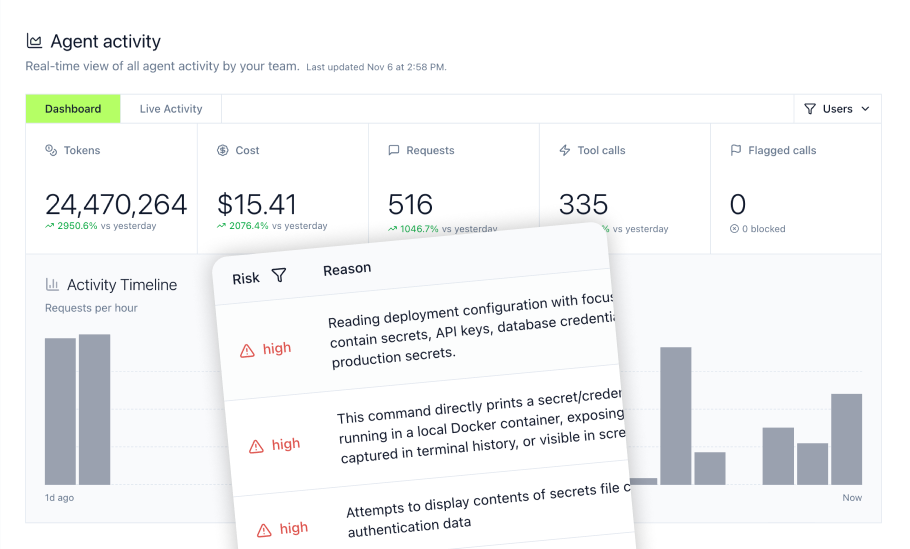
Observability extends beyond compliance to operational intelligence. Real-time dashboards display:
- Usage patterns: Which teams use which MCP servers most frequently
- Error rates: Integration issues requiring attention
- Performance metrics: Response times and throughput by endpoint
- Cost allocation: Token consumption and API usage by team or project
Platform teams use this data to identify underutilized servers for deprecation, detect performance degradation before users report issues, and allocate AI infrastructure costs to appropriate business units.
Building AI-Powered Business Applications with Integrated MCP Servers
MCP servers enable practical business applications that connect AI assistants to operational systems.
Empowering Data Analysis with AI Agents
The Snowflake MCP connector enables natural language queries against data warehouses. Analysts describe what they need in plain English, and AI assistants generate and execute SQL queries against governed data views.
Business applications include:
- Product analytics: Query user engagement metrics and feature adoption rates through conversational interfaces
- Financial reporting: Automate revenue analysis and budget variance calculations without manual SQL writing
- Executive intelligence: Generate real-time dashboards from warehouse data without technical intermediaries
Similarly, the Elasticsearch connector powers AI-accessible search across enterprise knowledge bases. HR teams build employee assistance systems that answer policy questions instantly. Product teams enable contextual help systems that search documentation automatically.
Automating Customer Support and Internal Workflows
The Gmail MCP connector enables AI-driven email automation within approved workflows. Support teams use AI assistants to:
- Search historical conversations for context
- Draft responses using approved templates
- Route messages based on content classification
- Aggregate feedback for product teams
According to the IBM Institute for Business Value, AI-powered customer service can reduce operational costs while maintaining quality. These integrations can support efficiency gains across approved customer support workflows.
Seamless Integration with Leading AI Clients and Developer Tools
MCP servers provide value only when connected to the AI assistants employees actually use.
Connecting to Popular LLM Clients
MintMCP's gateway works with the full ecosystem of MCP-compatible clients:
- Claude Desktop and Claude Code: Anthropic's native MCP support
- ChatGPT: AI assistant workflows connected through governed MCP endpoints
- Microsoft Copilot: Enterprise AI assistant integration
- Cursor: AI-powered code editor with MCP tool access
- Gemini: Google AI assistant workflows connected through governed MCP endpoints
- Goose, LibreChat, Open WebUI, Windsurf: Open-source and alternative clients
This broad compatibility means enterprises can standardize on a single MCP governance layer regardless of which AI tools different teams prefer. The gateway handles authentication and policy enforcement uniformly, presenting consistent endpoints to all connected clients.
Enhancing Developer Workflows with AI Agents
Developers represent early adopters of MCP technology, connecting coding assistants to repositories, issue trackers, and CI/CD systems. MintMCP supports these workflows through connectors for GitHub, GitLab, Jira, Linear, and internal development tools.
Engineering teams report 30% time savings on information gathering tasks and 40% faster debugging through integrated documentation and codebase context. These productivity gains compound as teams connect additional systems to their AI workflows. Review the deployment guide for implementation details.
Transforming Local MCPs into Production-Grade Infrastructure
The final challenge is transitioning from pilot deployments to enterprise-scale production systems.
Moving Local MCP Servers onto Managed Infrastructure
Production MCP deployments require infrastructure capabilities that local development servers cannot provide:
- Auto-scaling: Handle usage spikes during peak business hours
- Managed operations: Reduce the operational burden of maintaining connector infrastructure
- Monitoring visibility: Track MCP activity and operational issues from a centralized platform
- Data residency options: Align deployment preferences with available regional hosting options
MintMCP operates managed infrastructure with US and EU options, with data residency options available for enterprise deployment planning. The platform helps reduce the operational burden of hosting, scaling, and monitoring MCP connector infrastructure.
Accelerating Deployment to Production
Managed deployment reduces the infrastructure work required to move MCP servers from local experimentation to governed production access. The implementation timeline typically follows:
Pilot Phase:
- Select 1-2 low-risk MCP servers from the registry
- Deploy to a pilot team with SSO integration
- Validate audit logging and policy enforcement
- Document lessons learned for broader rollout
Production Phase:
- Expand server catalog based on business requirements
- Configure Virtual Bundles for each team or role
- Integrate with identity provider groups for access control
- Establish monitoring dashboards and alerting thresholds
Organizations can use governed MCP deployment to reduce manual infrastructure work, improve visibility into AI tool usage, and give security teams a clearer path to approving production access. The quickstart guide provides step-by-step implementation instructions.
Adopting a Governed MCP Strategy
Enterprise teams that successfully deploy MCP at scale share a common approach: they treat AI tool connectivity as critical infrastructure requiring the same governance rigor as API gateways, identity management, and data access layers. MintMCP's platform enables this shift by providing discovery, deployment, security, and observability capabilities in a unified control plane.
The combination of centralized server discovery, one-click provisioning, enterprise authentication, and comprehensive audit trails addresses the fundamental challenges that prevent many organizations from scaling AI adoption safely. Rather than forcing security teams to choose between developer velocity and risk management, MintMCP enables both through automated policy enforcement and role-based access controls.
Organizations implementing governed MCP strategies can centralize discovery, access control, and audit visibility instead of allowing AI tool connections to spread across unmanaged local setups. Platform teams gain visibility into which AI tools connect to which data sources, reducing blind spots that create operational and compliance risk. Developers maintain the flexibility to adopt new AI assistants and integrations through governed workflows instead of disconnected local setups.
The managed infrastructure model further accelerates adoption by reducing the specialized DevOps work required for self-hosted deployments. Teams that would otherwise spend months building container orchestration, authentication layers, and monitoring systems can instead focus on identifying high-value use cases and rolling out AI-powered workflows to end users.
As AI assistants become embedded in daily work across sales, support, engineering, and analytics functions, the MCP governance foundation becomes increasingly critical. The investment in discovery, deployment automation, and security controls today helps prevent the technical debt and security remediation costs that accumulate when organizations scale AI adoption without proper infrastructure.
Frequently Asked Questions
How does MintMCP handle custom MCP servers developed internally?
Organizations can deploy proprietary MCP servers through hosted infrastructure without exposing source code. The platform accepts custom Docker images or STDIO-based servers through CLI tools, applying the same authentication wrapping, audit logging, and policy enforcement as pre-built connectors. Internal servers appear in the organization's private registry section alongside public integrations.
What happens when upstream MCP servers add new tools or capabilities?
Tool-update policies control how the gateway handles capability changes. Administrators can configure automatic enablement of new upstream tools or require explicit approval before exposing new capabilities to users. This prevents silent expansion of agent permissions when MCP server maintainers add features without enterprise notification.
Can teams migrate from self-hosted MCP infrastructure to MintMCP?
Migration involves exporting tool definitions and permission configurations from existing infrastructure, then recreating Virtual Bundles with equivalent access policies. The timeline depends on the complexity of the existing deployment, the number of MCP servers involved, and the validation requirements for each team. Audit logs from previous systems do not transfer directly but can be archived alongside new MintMCP logs for historical completeness.
How does pricing work for enterprise MCP deployments?
MintMCP operates on custom enterprise pricing based on organizational requirements and usage patterns. The managed service model helps reduce hidden costs associated with self-hosted deployments, including DevOps labor, infrastructure maintenance, and compliance review work. Contact the sales team for detailed information.
What support options exist for implementation and ongoing operations?
Enterprise customers receive dedicated implementation support including SSO configuration assistance, Virtual Bundle design consultation, and compliance documentation review. Ongoing support includes priority response for production issues and access to the Admin MCP interface for conversational platform management.