When evaluating Pipedream MCP alternatives, organizations face evolving choices beyond the traditional workflow-automation-versus-governance divide. Pipedream now positions itself as an integration layer for AI agents with an early-access Conduit gateway that adds SSO, access policies, and audit logging. Meanwhile, Workday announced its agreement to acquire Pipedream in November 2025 and later completed the acquisition. This shift prompts many organizations to reassess their MCP strategy, particularly around requirements for agent identity, comprehensive audit trails, and governance controls that extend beyond workflow automation.
This guide examines Pipedream alternatives with particular emphasis on how MintMCP differs for enterprise AI governance. The analysis covers platforms offering MCP gateway capabilities, agent identity management, runtime guardrails, and compliance infrastructure. Organizations seeking to govern AI clients and autonomous agents across Claude, Cursor, ChatGPT, Gemini, and Copilot will find material differences in architecture, access control models, and audit depth across these options.
Key takeaways
- MintMCP is positioned for enterprise AI governance with data-permissions-first architecture, Virtual MCPs for role-based access, and first-class agent identities with independent credentials
- Virtual MCPs are a core MintMCP abstraction, bundling approved connectors behind governed endpoints with SCIM-driven membership, curated tools, and access policies in a single abstraction
- Agent identity matters for autonomous agents, and MintMCP's Agent Gateway treats agents as first-class non-human principals with their own credentials, scoped permissions, and audit trails
- Credit consumption affects usage costs, because Pipedream uses a credit-based model with plan-specific monthly allowances
- Runtime guardrails separate monitoring from prevention: MintMCP's Mint Guard, Rules, and Gateway Middleware enable real-time policy enforcement, not just after-the-fact logging
- Pipedream combines workflow automation and agent integration infrastructure with 3,000+ APIs and 10,000+ tools; its early-access Conduit gateway adds SSO, access policies, audit logs, and observability, while current public materials do not document MintMCP-style first-class non-human agent identities
Understanding Pipedream: integration infrastructure for AI agents and workflow automation
Pipedream now positions itself as an integration layer for AI agents while retaining its event-driven workflow automation capabilities. Its Connect product provides managed authentication and tools across thousands of APIs, while Conduit adds an early-access governance gateway for employee AI assistants. The platform serves customers across workflow automation and agent integration use cases.
Key Pipedream capabilities
- Connector catalog with 3,000+ APIs and 10,000+ tools
- Visual workflow builder with low-code option for workflow automation
- Event-driven automation with pre-built actions
- Built-in OAuth management for user authentication
- Conduit gateway (early access) with SSO, connector and tool-level access policies, audit logs, usage analytics, and OpenTelemetry export
- Free tier for initial testing with a monthly workflow-credit allowance
Enterprise governance considerations
- Current public materials emphasize per-user identity and connected-account credentials rather than MintMCP-style first-class non-human agent identities with independently managed agent credentials
- Pipedream uses credit-based usage, but current plan allowances are monthly rather than based on a universal daily reset
- Conduit adds audit logs, usage analytics, access policies, and OpenTelemetry export, but is currently described as early access
- Conduit provides connector and tool-level access policies, but does not document MintMCP's Virtual MCP abstraction of separate governed endpoints for a team, role, use case, or agent
With pricing starting at $29/month for the Basic tier and scaling to $99/month for Connect plans supporting 10,000 credits and 100 external users, Pipedream offers accessibility for workflow automation use cases. Organizations requiring enterprise AI governance with per-agent identity, comprehensive audit trails, and runtime guardrails will find different architectural approaches across the alternatives examined below.
1. MintMCP: enterprise AI governance and agent control
MintMCP provides enterprise infrastructure for governing AI clients and autonomous agents across the Model Context Protocol (MCP) ecosystem. The platform helps organizations make AI systems deployable, governed, measurable, and swappable by centralizing tool access, agent identity, credentials, permissions, monitoring, guardrails, and auditability.
Key MintMCP capabilities
- Data-permissions-first architecture: Governance begins with controlled system access, not post-hoc restrictions on broad agent permissions
- Virtual MCPs (VMCPs): Role-based endpoints with SCIM-driven membership, curated tools, and access policies bundled behind a single governed endpoint
- First-class agent identities: Autonomous agents receive independent credentials with scoped MCP access and attributable audit trails
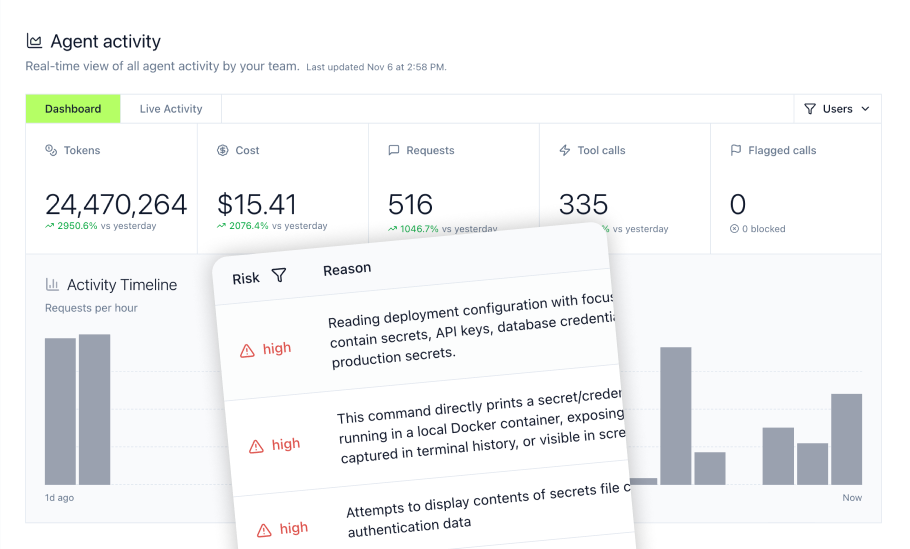
- Real-time Agent Monitor: Visibility into prompts, commands, file access, MCP tool calls, usage, and token costs across supported AI clients
- Runtime guardrails: Mint Guard managed detection, declarative Rules, and customer-authored Gateway Middleware for DLP integration
- Coworker Agents: Long-running autonomous agents with company-owned memory, Slack triggers, and sandboxed execution
Enterprise security and compliance
- SOC 2 Type II audited with continuous compliance monitoring through Drata
- Compliant with HIPAA standards with BAA available
- Tamper-evident access history where supported, including access-grant history signed at write time
- SIEM export via OTLP or Splunk HEC
- SSO and SCIM integration with Okta, Entra ID, and Google
MCP Gateway capabilities
MintMCP's MCP Gateway serves as the single governed entrypoint between AI clients and enterprise tools. Key capabilities include:
- Hosted, remote, custom, and STDIO connector support
- Centralized authentication and credential brokering
- Per-user OAuth where applicable
- Tool-level curation and RBAC
- Private network connectivity for on-prem systems
- OAuth brokering for STDIO MCP servers without rebuilding each server
Agent Gateway for autonomous agents
MintMCP's Agent Gateway builds on the MCP Gateway foundation by extending governed data and tool access to first-class agent identities, scoped permissions, credentials, and monitoring. Authentication mechanisms include:
- Bearer keys with name, expiry, and individual revocation
- M2M tokens through OAuth client-credentials exchange
- Workload identity federation where the agent's own infrastructure mints short-lived OIDC tokens
Guardrails and runtime controls
MintMCP applies runtime controls at the agent/tool interaction layer through three complementary mechanisms:
- Mint Guard: Managed detection policies for prompt injection, secrets, PII, and harmful content
- Rules: Declarative matching on tool names, arguments, or content with flag, block, ask, mask, or notify actions
- Gateway Middleware: Customer-authored JavaScript in a sandbox for DLP integrations, external classifiers, and custom policy enforcement
2. Composio: developer-facing integration and MCP governance
Composio positions itself as developer-focused infrastructure for building AI agent integrations, with a hosted MCP Gateway, managed authentication, and policy enforcement. Its primary orientation remains developer and AI engineering teams building agentic products rather than MintMCP's emphasis on internal IT and security governance.
Key Composio capabilities
- Agent-native tools built specifically for AI agents rather than workflow automation connectors
- 1,500+ toolkits available through its integration and MCP infrastructure
- Developer community with active open-source presence
- Managed OAuth for integration authentication
Positioning differences to consider
- Composio uses its own MCP Gateway and policy model rather than MintMCP's Virtual MCP abstraction
- Current public materials document SAML/OIDC, SCIM 2.0, action-level access controls, and audit logging for enterprise governance
- Public Free and Pro pricing is available, with custom Enterprise pricing
- Composio documents SOC 2 Type II and ISO 27001 controls, with BAA support available as a paid feature
- Its primary product orientation is developer-facing agent integration and tool execution rather than MintMCP's internal IT and security governance model
3. Workato: enterprise MCP within broader iPaaS
Workato offers Enterprise MCP capabilities as part of its broader iPaaS and AI control plane, and currently reports 25,000+ customers. The platform combines workflow automation, integration orchestration, and AI governance in a single enterprise suite.
Key Workato capabilities
- Platform with Model Gateway, MCP Gateway, Agent Gateway, and API Gateway
- ISO/IEC 42001 certification alongside SOC 2, PCI, and HIPAA
- Verified User Access (VUA) running actions under the requesting user's identity
- MCP Registry for governed catalog of MCP servers
- 1,200+ connectors with full CRUD and real-time triggers
Positioning differences to consider
- Custom enterprise pricing
- Full iPaaS platform complexity may extend beyond MCP-only governance needs
- Not a warehouse for cross-source SQL or analytical workloads
- Learning curve for teams that only need MCP governance without broader iPaaS
4. Nango: developer-controlled integration infrastructure
Nango provides developer-controlled integration infrastructure with an open-source option, currently covering 1,000+ APIs and 7,000+ ready-made tools. Its platform includes managed authentication, code-first integrations, tool execution, data syncs, triggers, and a built-in MCP server.
Key Nango capabilities
- Open-source option for self-hosted deployments
- Pre-built integration templates accelerating development
- Code-first integrations with managed authentication, tools, syncs, triggers, and MCP exposure
- Developer-controlled architecture without vendor lock-in
Positioning differences to consider
- MCP is now a first-class part of Nango's platform, including a built-in MCP server for agent tool access
- Current public materials do not document MintMCP's specific SCIM-driven Virtual MCP or first-class non-human agent identity model
- Nango primarily focuses on product and API integration infrastructure rather than internal employee and agent governance
5. Arcade.dev: MCP runtime with per-action authorization
Arcade.dev provides an MCP runtime focused on per-action authorization for AI agents, targeting developers building agentic applications with fine-grained permission controls.
Key Arcade.dev capabilities
- Per-action authorization model for granular access control
- MCP runtime designed for agent integrations
- Developer-focused tooling and SDK
Positioning differences to consider
- Arcade documents centralized access policies, fine-grained audit logs, SIEM export through OpenTelemetry, and multiple enterprise deployment models
- Its public positioning centers on an MCP action runtime and execution-time authorization rather than MintMCP's Virtual MCP and internal employee and agent governance model
6. Open-source MCP servers: self-managed infrastructure
Organizations can deploy open-source MCP servers directly, managing their own infrastructure, authentication, and governance. This approach offers control but requires operational investment.
Key open-source capabilities
- Control over implementation and deployment
- No vendor lock-in or subscription costs
- Customizable to exact requirements
- Community contributions and transparency
Enterprise governance considerations
- Authentication, RBAC, audit logging, agent identity, and guardrail capabilities vary by project
- Self-managed deployments place hosting, scaling, upgrades, and operational maintenance on the organization
- Security patches and dependency updates remain the operator's responsibility
- Teams may need to assemble multiple projects or custom components to achieve the same governance coverage as a managed platform
MintMCP addresses this gap with OAuth brokering for STDIO MCP servers, allowing organizations to add enterprise authentication to existing open-source servers without rebuilding each one.
Why organizations choose MintMCP for enterprise AI governance
MintMCP is designed for enterprise AI governance, combining Virtual MCPs for role-based access, first-class agent identities with independent credentials, runtime guardrails for preventing dangerous actions, and comprehensive audit trails for compliance. The platform's data-permissions-first architecture ensures governance is the foundation rather than an afterthought.
Core MintMCP differentiators
- Virtual MCPs eliminate per-user MCP sprawl: Instead of configuring local MCP servers for every employee, IT teams deploy Virtual MCPs with SCIM-driven membership, curated tools, and access policies. Each VMCP serves as the unit of deployment, access control, and audit regardless of which AI client connects.
- First-class agent identities enable autonomous operations: MintMCP's Agent Gateway treats autonomous agents as non-human principals with their own credentials, scoped permissions, and audit trails. Authentication includes bearer keys, M2M tokens, or workload identity federation. Each agent's credentials can be rotated or revoked independently.
- Runtime guardrails prevent risky actions: Three layers of runtime controls work together: Mint Guard for managed detection of prompt injection, secrets, PII, and harmful content; Rules for declarative matching and enforcement; and Gateway Middleware for customer-authored JavaScript that integrates external DLP systems and custom policies.
- Comprehensive audit trails support compliance: SOC 2 Type II audited and compliant with HIPAA standards, MintMCP provides tamper-evident access history where supported, SIEM export via OTLP or Splunk HEC, and comprehensive logging of tool calls, credential lifecycle events, and access-policy changes.
- Centralized governed access reduces operational burden: MintMCP can operate supported hosted connectors while also governing remote, custom, and STDIO connectors. OAuth brokering can simplify authentication for supported hosted or STDIO environments.
For teams governing AI deployments across Claude, Cursor, ChatGPT, Gemini, and Copilot, requiring per-agent identity management, or needing real-time visibility into agent activity, MintMCP provides an enterprise control layer that extends beyond workflow automation into agent identity, runtime guardrails, and cross-client monitoring.
Start governing your AI agents today with MintMCP's enterprise platform.
Frequently asked questions
What is the primary difference between MintMCP and workflow automation platforms for enterprise AI governance?
MintMCP is purpose-built for enterprise AI governance with a data-permissions-first architecture, Virtual MCPs for role-based access, and first-class agent identities. Workflow automation platforms add MCP capabilities as a feature. The core difference is that MintMCP treats governance as the foundation and enables agents on top, while workflow platforms treat MCP as an extension of their workflow automation capabilities.
Can MintMCP govern AI agents across multiple clients like Claude, Cursor, and ChatGPT?
Yes. MintMCP provides governed endpoints that work across Claude, Cursor, ChatGPT, Gemini, Copilot, and custom agents. Virtual MCPs serve as the unit of deployment, access control, and audit regardless of which AI client connects to them. This vendor-neutral approach means organizations do not need to rebuild their governance layer when changing AI tools.
How does MintMCP handle agent identity differently from other platforms?
MintMCP's Agent Gateway treats autonomous agents as first-class non-human principals with their own credentials, scoped permissions, and audit trails. Authentication can include bearer keys, M2M tokens, or workload identity federation. Each agent can have its credentials rotated or revoked independently without affecting human users or other agents.
What runtime guardrails does MintMCP provide for preventing dangerous agent actions?
MintMCP offers three layers of runtime controls: Mint Guard for managed detection of prompt injection, secrets, PII, and harmful content; Rules for declarative matching and enforcement on tools, arguments, or content; and Gateway Middleware for customer-authored JavaScript that can integrate external DLP systems, classifiers, and custom policies. These work together to prevent risky actions before they execute rather than just logging them after the fact.
Does MintMCP support compliance requirements like SOC 2 and HIPAA?
Yes. MintMCP is SOC 2 Type II audited and compliant with HIPAA standards with BAA available. The platform provides tamper-evident access history where supported, SIEM export via OTLP or Splunk HEC, and comprehensive logging of tool calls, credential lifecycle events, and access-policy changes. This audit infrastructure can support SOC 2, HIPAA, and internal compliance workflows.