When evaluating MCP Manager alternatives, the choice depends on your organization's governance requirements, deployment preferences, and technical capacity. MCP Manager provides an MCP gateway with a private registry, audit logging, RBAC, tool provisioning, sensitive-data filtering, monitoring, and OAuth enforcement. Enterprise teams should compare those capabilities with alternatives based on requirements such as agent identity, managed connectors, runtime controls, deployment architecture, and cross-platform agent visibility.
The Model Context Protocol has expanded rapidly. The official MCP project reported more than 97 million monthly SDK downloads and 10,000 active servers in December 2025, while enterprises increasingly deploy AI agents across multiple platforms simultaneously. That growth creates new governance requirements around identity, access, credentials, and auditability. This guide examines the leading enterprise MCP gateway options and compares their approaches to enterprise AI governance.
Key takeaways
- MintMCP combines enterprise governance controls with Virtual MCPs for per-team tool curation, first-class agent identities, Agent Monitor visibility, and 50+ managed connectors, alongside SOC 2 Type II audited status and compliance with HIPAA standards with BAAs available
- Virtual MCPs bundle multiple connectors behind a single governed endpoint with curated tools, SCIM-driven membership, and access policies in one governed bundle
- Agent identity management treats autonomous agents as first-class non-human principals with independent credentials and audit trails
- Deployment models vary significantly from managed SaaS to open-source self-hosted to hybrid options
- Security and compliance requirements influence fit: regulated industries often prioritize documented audit, identity, access-control, and BAA capabilities, while developer-focused teams may prioritize open-source deployment flexibility
- The NIST AI Risk Management Framework provides guidance on governance, accountability, and risk management for AI systems in enterprise environments
Understanding the enterprise need for MCP gateways in 2026
Teams are adopting Claude, Cursor, ChatGPT, Gemini, Copilot, and custom agents faster than security and platform teams can govern what those systems access, whose credentials they use, what actions they take, and how those actions are attributed.
What enterprises face without proper MCP governance:
- No telemetry: Organizations don't know which tools agents are calling or what data they read and wrote
- Scattered credentials: API keys end up on developer laptops where one leak exposes everything
- Missing access control: Agents reach any connected system with no oversight
- Audit trail gaps: Cannot satisfy SOC 2, HIPAA, or internal risk reporting requirements
- Configuration sprawl: Every developer configures every MCP server locally, creating N installs, N auth flows, and N points of failure
- AI unpredictability: Agents decide which tools to call at runtime, and tools can appear, change, or disappear via
list_toolscalls
An MCP gateway sits between AI clients and the MCP servers they call, providing a single governed entrypoint where authentication, authorization, credential management, and audit logging happen consistently across every tool call.
1. MintMCP: Enterprise MCP and agent governance
MintMCP provides an enterprise control layer for AI clients and autonomous agents. Built on a data-permissions-first architecture, MintMCP starts from governed access to enterprise data and tools, then extends that foundation to autonomous agents with first-class identities, scoped permissions, and complete audit trails.
Key MintMCP capabilities for enterprise deployment
- Virtual MCPs (VMCPs): The platform's key abstraction bundles connectors and curated tool surfaces behind one governed endpoint per team, role, use case, or agent. SCIM-driven group membership means directory groups automatically drive access without per-user configuration.
- 50+ Managed Connectors: MintMCP operates hosted connectors for Salesforce, GitHub, Slack, Snowflake, Elasticsearch, and dozens more, so customers deploy and govern connector access without managing the runtime themselves.
- Agent Gateway with Non-Human Identities: Every autonomous agent gets its own identity, its own credentials, and its own audit trail through Agent Identities. Authentication supports bearer keys, OAuth client-credentials/M2M tokens, and workload identity federation.
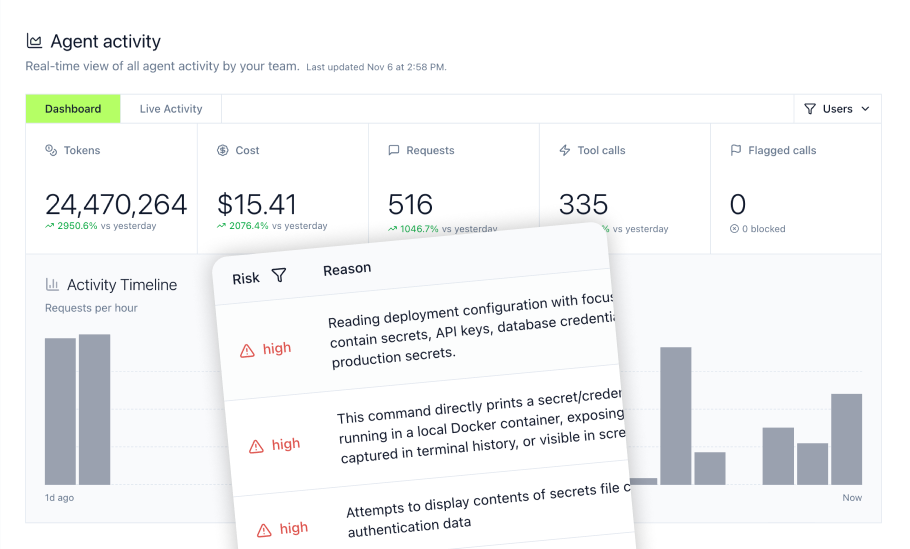
- Agent Monitor: Can provide visibility into supported agent activity outside the gateway path, including prompts, commands, file access, MCP tool calls, usage, and token costs across Claude Code, Cursor, and other platforms.
- Guardrails: Mint Guard provides managed detection for prompt injection, secrets, PII, and harmful content. Declarative Rules enable pattern matching. Gateway Middleware allows customer-authored JavaScript for DLP integrations and custom policy enforcement.
MintMCP capabilities overview
- Virtual MCPs: Per-use-case endpoints with curated tools, SCIM membership, access policy
- Hosted Connectors: MintMCP operates the connector runtime; reduces connector runtime management
- Agent Identities: First-class non-human principals with independent credential rotation
- Agent Monitor: Can provide visibility into supported local agent activity beyond gateway traffic
- Mint Guard: Managed detection policies with one toggle, nothing to author
- SOC 2 Type II + HIPAA/BAA: SOC 2 Type II audited; compliant with HIPAA standards; BAAs available
Compliance and security
MintMCP maintains SOC 2 Type II audited status and compliant with HIPAA standards with BAA availability. The platform uses continuous compliance monitoring, enterprise SSO, tamper-evident audit trails, and role-based access controls. Data encryption in transit and at rest plus data residency options address enterprise security requirements. The HHS HIPAA Security Rule provides technical safeguards that MintMCP's architecture supports.
Pricing
MintMCP offers a 7-day free trial with full access and no credit card required. Pricing is tailored to team size and requirements, with per-user licensing based on active AI agent users and platform fees that scale with usage and team size. Enterprise SLAs and dedicated support are available.
Getting started
The product tour demonstrates MintMCP's MCP Gateway, enterprise governance controls, and managed deployment experience.
2. Bifrost by Maxim AI: Performance-first open-source gateway
Bifrost positions itself as an ultra-low-latency MCP gateway with an open-source foundation. The platform reports 11 microseconds of gateway overhead at 5,000 requests per second.
Key Bifrost capabilities
- Apache 2.0 License: Free open-source with no licensing costs for the core gateway
- Unified LLM + MCP Gateway: Routes both LLM traffic and MCP tool calls through a single platform
- 30-Second Setup: Deploy via NPX for rapid proof-of-concept work
- Flexible Deployment: Supports self-hosted, VPC, on-premise, air-gapped, and edge/single-node deployment options
- Virtual MCP servers / MCP Tool Groups: Aggregate tools from multiple underlying servers
Strengths and considerations
Strengths:
- Exceptional claimed performance (11µs overhead, vendor-reported)
- No licensing costs for open-source tier
- Fast deployment for technical teams
- Combined LLM routing and MCP capabilities
Considerations:
- Bifrost is self-hosted, with deployment options including VPC, on-premise, air-gapped, and edge/single-node environments
- Governance features like SAML SSO, RBAC, and guardrails are in the Enterprise tier
- Custom MCP servers must be self-deployed
Pricing
Free open-source (Apache 2.0) for core features. Enterprise tier available with 14-day trial for SAML SSO, RBAC, VPC deployment, vault integration, and guardrails.
3. TrueFoundry: Unified AI platform with MCP capabilities
TrueFoundry offers MCP gateway functionality as part of a broader AI infrastructure platform covering LLM routing, model serving, and MLOps. Organizations needing more than just MCP governance may find value in the unified approach.
Key TrueFoundry capabilities
- Unified AI Platform: MCP gateway alongside LLM routing, model deployment, and MLOps tooling
- Multi-Deployment Options: SaaS, hybrid, VPC, and air-gapped deployments
- Compliance Certifications: SOC 2, ISO 27001, GDPR, HIPAA support
- Platform Integrations: Connects with broader ML infrastructure
- Virtual MCP Servers: Can aggregate selected tools from multiple underlying MCP servers behind a single governed endpoint
Strengths and considerations
Strengths:
- Broader AI infrastructure beyond MCP alone
- Multiple deployment architectures for enterprise requirements
- Strong compliance certifications
- Useful for organizations already invested in MLOps tooling
Considerations:
- TrueFoundry is a broader AI platform spanning AI Gateway, MCP Gateway, agent infrastructure, model deployment, and MLOps
- Custom MCP servers can be deployed within Kubernetes or cloud-native environments depending on the deployment model
- Virtual MCP Servers can aggregate selected tools from multiple underlying MCP servers behind a single governed endpoint
Pricing
Custom enterprise pricing with trial available.
4. Kong AI Gateway: API management extended to MCP
Kong AI Gateway adds MCP capabilities to Kong's established API management platform. Organizations already standardized on Kong infrastructure can extend their existing investment to cover MCP traffic.
Key Kong AI Gateway capabilities
- API-to-MCP Generation: Automatically generate MCP servers from existing REST APIs
- Unified API + MCP Governance: Single control plane for both API and MCP traffic
- Konnect Platform: Managed control plane with self-hosted data plane options
- Plugin Ecosystem: Extend functionality through Kong's plugin architecture
Strengths and considerations
Strengths:
- Leverages existing Kong infrastructure investments
- REST API to MCP server transformation
- Established enterprise vendor with mature platform
- Unified governance for API and MCP traffic
Considerations:
- Kong exposes first-class AI MCP Server entities in Konnect, while self-hosted Kong Gateway delivers equivalent MCP capabilities through the AI MCP Proxy plugin
- MCP functionality may introduce complexity for MCP-only use cases
Pricing
Kong offers self-service Konnect pricing alongside custom Enterprise pricing. Deployment options include Konnect-managed control plane architectures and self-hosted Kong Gateway configurations.
5. IBM ContextForge: Multi-protocol open-source federation
IBM ContextForge provides open-source MCP gateway functionality with multi-protocol federation supporting MCP, A2A, REST, and gRPC. Large enterprises with complex protocol requirements may benefit from the federation approach.
Key IBM ContextForge capabilities
- Multi-Protocol Support: Federate MCP, A2A (Agent-to-Agent), REST, and gRPC
- Apache 2.0 License: Open-source under the Apache License 2.0
- Air-Gap Capable: Supports fully disconnected deployments
- Virtual Servers: Create virtual MCP server configurations
Strengths and considerations
Strengths:
- Protocol federation for complex enterprise environments
- IBM enterprise backing with open-source flexibility
- Air-gapped deployment support
- No licensing costs
Considerations:
- Performance depends on transport, plugins, authentication, deployment topology, and the upstream services being federated
- Significant operational burden for setup and maintenance
- Admin UI and Admin API must be disabled in production
- Requires substantial infrastructure expertise
Pricing
Free open-source under Apache 2.0. ContextForge's security policy states that the project is provided as-is with no official support from IBM or its affiliates.
6. Composio: Developer-focused tool integration
Composio focuses on providing tool integrations for developers building agentic AI applications. The platform emphasizes quick setup and broad connector availability for product development use cases.
Key Composio capabilities
- Pre-Built Tool Integrations: Broad catalog of ready-to-use connectors
- Managed SaaS: Cloud-hosted with VPC/on-prem options on Enterprise tier
- Developer Experience: Designed for rapid integration into AI applications
- Auth Management: Handles OAuth and credential flows for connected tools
Strengths and considerations
Strengths:
- Developer-friendly setup and documentation
- Broad connector catalog for common tools
- Managed infrastructure reduces operational overhead
- Designed for building AI applications
Considerations:
- Composio primarily targets developers and AI engineering teams building agentic applications, including customer-facing products
- Enterprise deployment options extend beyond the default managed SaaS model
- Composio documents SOC 2 Type II and ISO 27001 controls alongside enterprise authentication, governance, and audit capabilities
Pricing
Managed SaaS with free tier available. Enterprise tier required for VPC/on-prem deployment.
7. Runlayer: Emerging enterprise governance platform
Runlayer provides MCP and agent governance capabilities targeting IT, Security, and AI Operations teams. The platform supports hybrid deployment with managed SaaS plus self-hosted options.
Key Runlayer capabilities
- Hybrid Deployment: Managed SaaS plus self-hosted on customer infrastructure
- Internal Governance Focus: Designed for employee and agent governance
- IT-Sec-AIOps Buyer: Targets platform and security teams
Strengths and considerations
Strengths:
- Hybrid deployment flexibility
- Enterprise governance positioning
- Self-hosted option for data sovereignty requirements
Considerations:
- Runlayer combines MCP Gateway, shadow AI discovery, runtime security, identity-aware policy, audit and observability, and a hosted agent runtime
- Depending on setup, agent workloads can run on Runlayer-managed, single-tenant, or customer-hosted infrastructure
Pricing
Contact vendor for current pricing and availability.
Security and compliance considerations
Enterprise MCP deployments require attention to security and compliance requirements that basic gateways may not address.
Authentication and identity
MintMCP supports SSO through Okta, Entra ID, and Google, with SCIM for directory-driven access. Agent identity capabilities enable first-class non-human principals with bearer keys, M2M tokens, and workload identity federation.
Audit and observability
Complete audit trails capture every tool call, credential lifecycle event, and access policy change. MintMCP provides tamper-evident access-grant history signed at write time and verifiable offline via published JWKS. SIEM export through OTLP or Splunk HEC enables integration with existing security tooling.
Runtime controls
The guardrails architecture provides three layers:
- Mint Guard for managed detection policies
- Rules for declarative pattern matching
- Gateway Middleware for customer-authored logic and DLP integrations
Operational controls
Enterprise features include:
- Org-wide kill switch
- Per-VMCP and per-tool disable
- Connector restart capabilities
- Credential rotation
- Configuration as code for declarative management
MintMCP for enterprise AI governance
Selecting the right MCP Manager alternative depends on governance requirements, technical capacity, and deployment preferences. For organizations prioritizing internal AI governance, MintMCP combines Virtual MCPs for per-use-case access control, agent identities for non-human principals, managed connectors that reduce connector runtime management, and built-in security and audit controls.
The platform's data-permissions-first architecture means governance is the foundation, not an afterthought. Key capabilities that support enterprise deployment include:
- Virtual MCPs with SCIM-driven membership, curated tool surfaces, and per-endpoint access policies that eliminate per-user configuration overhead
- First-class agent identities with independent credential rotation, scoped permissions, and attributable audit trails that treat autonomous agents as non-human principals
- 50+ managed connectors for Salesforce, GitHub, Slack, Snowflake, and other enterprise tools, with connector runtime management handled by MintMCP
- Agent Monitor visibility into supported local agent activity across Claude Code, Cursor, and other coding agents beyond gateway traffic alone
- Mint Guard guardrails for managed detection of prompt injection, secrets, PII, and harmful content, plus declarative Rules and Gateway Middleware for custom policy enforcement
- SOC 2 Type II audited status and compliance with HIPAA standards with BAAs available, continuous compliance monitoring, and tamper-evident audit trails
Whether rolling out Claude, Cursor, ChatGPT, Gemini, or Copilot, MintMCP provides the centralized control layer that makes AI agents deployable, governed, measurable, and swappable. Start with the free trial to explore MintMCP's MCP Gateway, enterprise governance features, and audit controls with full access and no credit card required.
Frequently asked questions
What is the primary difference between a traditional API Gateway and an MCP Gateway for AI?
Traditional API gateways manage HTTP traffic for REST and GraphQL endpoints with rate limiting, authentication, and routing. An MCP gateway specifically governs Model Context Protocol traffic between AI clients and the tools they call, handling AI-specific concerns like tool curation per role, agent identity, runtime guardrails for prompt injection and PII, and audit trails that attribute actions to specific agents or users. The agent gateway approach extends this to treat autonomous agents as first-class principals rather than anonymous API consumers.
How does an enterprise MCP Gateway address Shadow AI concerns?
Shadow AI emerges when employees and teams deploy AI agents without IT visibility. An MCP gateway centralizes tool access through governed endpoints, while Agent Monitor can provide visibility into supported agent activity outside the gateway path. This two-layer model combines governed MCP traffic with supported local agent activity such as prompts, commands, file access, MCP tool calls, usage, and cost.
Can autonomous agents have their own distinct identities and permissions?
Yes. MintMCP's Agent Gateway enables every autonomous agent to receive its own non-human identity with scoped permissions, independent credentials (bearer keys, M2M tokens, or workload identity federation), and an attributable audit trail. This means credentials can be rotated or revoked independently without affecting human users or other agents, and every action is logged to the specific agent that performed it.
What kind of runtime controls can an MCP Gateway provide for AI interactions?
Enterprise MCP gateways can screen every tool call on both arguments and results. MintMCP provides three coexisting layers: Mint Guard for managed detection of prompt injection, secrets, PII, and harmful content; declarative Rules for pattern matching on tool names, arguments, and content; and Gateway Middleware for customer-authored JavaScript logic enabling DLP integrations, external classifier calls, and custom policy enforcement.
Is SOC 2 Type II a standard expectation for enterprise MCP Gateway providers?
SOC 2 Type II represents baseline enterprise assurance rather than a differentiator. Organizations evaluating MCP gateways for regulated workloads should verify current attestation status and request documentation directly. MintMCP maintains SOC 2 Type II audited status with continuous compliance monitoring. For healthcare workloads, verify HIPAA support and BAA availability with each vendor.