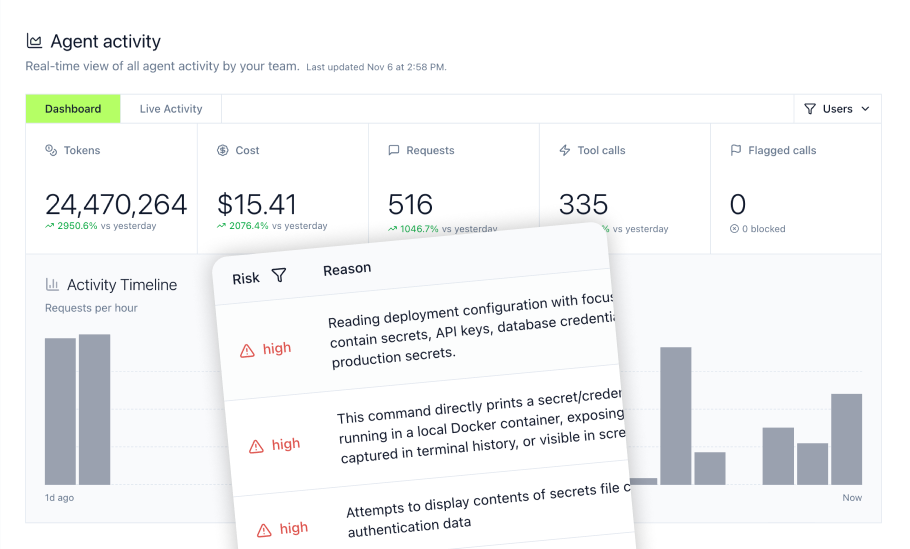
Selecting the right MCP server hosting platform determines whether AI agents run as secure, governed production systems or remain scattered experiments across developer laptops. As organizations deploy Claude, Cursor, ChatGPT, and custom agents faster than security teams can govern them, the hosting platform shapes everything from authentication to audit trails to operational control.
The Model Context Protocol has become the connective tissue for enterprise AI, enabling agents to access databases, collaboration tools, and internal systems according to the MCP specification. MCP servers running locally create credential sprawl, zero visibility into tool calls, and no unified access control. The right MCP Gateway transforms these fragmented connections into governed infrastructure with centralized authentication, real-time monitoring, and compliance-ready audit logs. This guide covers 10 MCP server hosting and infrastructure platforms for 2026, including managed runtimes, developer deployment platforms, and MCP gateways, evaluating each on MCP-native features, enterprise readiness, deployment ease, pricing transparency, and market presence.
Key takeaways
- MintMCP provides enterprise MCP governance through Virtual MCPs that bundle approved connectors behind team-specific endpoints with SCIM-driven membership and unified audit trails
- Agent identities give autonomous agents first-class non-human principals with dedicated credentials, scoped MCP access, and independent rotation
- Mint Guard screens every MCP tool call through the gateway for prompt injection, credentials and secrets, PII, and harmful content
- MintMCP's OAuth brokering adds enterprise authentication to STDIO and hosted MCP servers following OAuth 2.0 security best practices
- MCP hosting platforms range from managed SaaS offerings to self-managed Kubernetes infrastructure with varying governance capabilities
- Enterprise MCP deployments require centralized credential management, role-based access control, and audit logging aligned with frameworks like the NIST AI RMF
- Production MCP infrastructure needs authentication mechanisms, runtime monitoring, and policy enforcement beyond basic hosting
1. MintMCP
MintMCP provides enterprise infrastructure for governing AI clients and autonomous agents across the Model Context Protocol ecosystem. The platform makes AI systems deployable, governed, measurable, and swappable by centralizing tool access, agent identity, credentials, permissions, monitoring, guardrails, and auditability.
Data-permissions-first architecture
MintMCP's architecture starts with governed data and tool connections, then extends the same identity, permission, audit, and policy foundation to autonomous agents. The core abstraction is the Virtual MCP, which bundles approved connectors and a curated tool surface behind one governed endpoint for a particular team, role, use case, or agent.
Key architectural elements include:
- Virtual MCPs that bundle connectors behind team-specific endpoints with curated tool surfaces and SCIM-driven membership
- Hosted connectors that run in MintMCP's managed data plane with centralized credential injection
- OAuth brokering that adds enterprise authentication to STDIO and hosted MCP servers
- Gateway middleware that runs customer-authored JavaScript in a sandbox for external DLP and guardrails integrations
Agent Gateway capabilities
The Agent Gateway treats autonomous agents as first-class principals. Each agent can have its own identity, credentials, scoped MCP access, independent credential rotation, and an attributable audit trail.
Authentication mechanisms include:
- Bearer keys for static credentials
- M2M tokens for OAuth client-credentials exchange
- Workload identity federation where the agent's infrastructure mints short-lived OIDC tokens
Security and compliance
MintMCP is SOC 2 Type II audited and compliant with HIPAA standards. The platform includes:
- Penetration testing and data encryption in transit and at rest
- Uptime SLA
- Tamper-evident access-grant history signed at write time
- SIEM integration through OTLP or Splunk HEC for audit data export
Enterprise integrations
MintMCP supports hosted connectors including:
- Snowflake data warehouse access
- GitHub repository integration
- Slack collaboration
- Salesforce CRM connectivity
The platform can govern Claude, Cursor, ChatGPT, Gemini, and Copilot through centralized MCP access, while Agent Monitor provides broader activity visibility in supported agent environments.
Deployment and pricing
MintMCP provides managed SaaS-first delivery with:
- US and EU availability
- Hosted MCP connectors and pre-configured policies
- Self-service access for developers
- VPC and self-hosted deployment available on request for enterprise customers
Contact MintMCP for enterprise demonstration and pricing.
2. CreateOS
CreateOS operates as the application layer of the NodeOps DePIN network, providing MCP server hosting with a $0 tier that requires no credit card.
Free-tier production capabilities
The platform provides:
- Native MCP auto-discovery via
mcp-tool.json, eliminating manual nginx configuration - Persistent storage that survives restarts without external database requirements
- Persistent compute for long-running workloads rather than short-lived serverless function execution
- Day-one monetization through the Skills marketplace with 80% revenue share for creators
- 150+ production-ready templates in the marketplace
- 25+ MCP server templates available for rapid deployment
Platform scope
CreateOS emphasizes persistent compute for workloads requiring consistent latency. Organizations evaluating CreateOS should assess whether they need enterprise governance features such as SSO, SCIM-driven RBAC, audit logs, and agent identity management beyond the hosting layer.
3. Fastio
Fastio provides agent-focused MCP hosting with emphasis on persistent file storage and multi-agent coordination capabilities.
File-heavy workflow features
The platform consolidates 19 built-in MCP tools with agent-ready capabilities:
- Multi-agent file locks for coordinated document workflows
- Semantic search and RAG indexing as core features
- Webhooks for event-driven automation
- Video HLS previews that Fastio reports as 50-60% faster than progressive downloads
- Streamable HTTP/SSE support for Claude, Cursor, and other MCP clients
Pricing structure
Fastio currently offers 14-day trials on Starter, Business, and Growth rather than a permanent free tier. Monthly pricing starts at $29 for Starter, $99 for Business, and $299 for Growth, and the trial requires a credit card.
Platform scope
Fastio targets teams building AI agents that require persistent file storage, multi-agent coordination, and built-in RAG capabilities. Organizations should evaluate whether they also need enterprise governance primitives such as Virtual MCP Bundles, agent identity, and centralized audit logging.
4. AWS Bedrock AgentCore
Amazon's Bedrock AgentCore serves as enterprise MCP-based orchestration within the AWS ecosystem.
AWS-native enterprise capabilities
AgentCore provides:
- Model-agnostic runtime support for foundation models in and outside Amazon Bedrock
- Zero infrastructure management within AWS environment
- Granular IAM policies for access control
- Managed agent runtime and MCP gateway connectivity
- High-security parameters aligned with AWS compliance standards
Pricing structure
Amazon Bedrock AgentCore uses consumption-based pricing by service:
- Runtime billed for compute consumption
- Gateway and Identity components have separate usage charges
- Model inference priced separately
Platform scope
Bedrock AgentCore fits organizations already committed to AWS infrastructure that want managed scalability and native AWS integration. Teams should evaluate whether an infrastructure-centric approach meets their needs for MCP-specific governance such as Virtual MCPs, tool curation, and agent identity management.
5. Prefect Horizon
Prefect Horizon is a full-stack MCP platform covering deployment, registry, gateway, governance, and agent management in a single offering.
Full lifecycle capabilities
The platform was built by the FastMCP team; Prefect reports that FastMCP powers roughly 70% of MCP servers across languages. Horizon provides:
- CI/CD integration from GitHub with branch previews and rollback capabilities
- RBAC down to individual tools with authentication controls
- Four pillar coverage including Deploy, Registry, Gateway, and Agents
- Built-in FastMCP SDK integration as a native advantage for Python-based MCP development
Pricing structure
Pricing includes:
- Personal free tier
- Developer at $35 per developer per month plus usage
- Enterprise pricing is custom
Platform scope
Prefect Horizon targets teams wanting single-vendor MCP lifecycle management from development through production. The platform emphasizes its FastMCP SDK integration for Python-based workflows.
6. Cloudflare Workers
Cloudflare Workers extends its edge computing platform to support remote MCP server hosting with global distribution.
Edge hosting capabilities
The platform provides:
- Global distribution through Cloudflare's Workers network with startup performance varying by runtime, bundle size, and workload
- 100K requests per day Workers Free allowance
- Durable Objects for persistent application state when needed
- Usage-based pricing for requests and CPU time on Workers Paid
- $5/month minimum for Workers Paid, with contract-based Enterprise pricing
- First-party Agents SDK support for remote MCP servers
Platform scope
Cloudflare Workers fits teams needing globally distributed MCP tools with the Cloudflare ecosystem. Organizations should evaluate whether edge hosting meets their needs for persistent state and enterprise governance features.
7. TrueFoundry
TrueFoundry provides AI infrastructure platform capabilities with an MCP gateway component.
AI infrastructure features
TrueFoundry's recent MCP Gateway benchmark reports:
- Roughly 7-12ms of gateway overhead at about 200-370 requests per second on a 1 vCPU, 1 GB pod, depending on load and tracing
- OAuth 2.0 identity injection for user-specific actions
- VPC and on-premises deployment support
- Part of broader AI infrastructure platform including LLMOps and model serving
TrueFoundry states that its platform meets SOC 2 and HIPAA compliance requirements.
Pricing structure
TrueFoundry offers a Pro tier at $499 per month with enterprise pricing available on request.
Platform scope
TrueFoundry targets organizations wanting unified AI infrastructure with transparent pricing. The platform positions itself within the broader LLMOps category rather than as a dedicated MCP governance solution.
8. Composio
Composio aggregates pre-built MCP server integrations with a focus on rapid deployment and configurable data-retention controls.
Pre-built integration access
The platform provides:
- 1,000+ pre-authenticated app and toolkit integrations available through managed MCP and session-based access
- SOC 2 Type II compliance with configurable controls for tool-call payload retentio
- Action-level controls and dynamic tool routing to reduce context pressure when agents have access to large tool catalogs
- Free tier of 20K tool calls per month
- Published paid plans at $29/month for 200K calls and $229/month for 2M calls
Platform scope
The platform emphasizes developer-facing integration infrastructure, with managed authentication, hosted MCP access, fine-grained RBAC, and audit trails alongside its connector catalog.
9. Vercel
Vercel extends its serverless edge platform with MCP hosting capabilities for web-focused development teams.
Web-focused capabilities
The platform uses:
- Vercel Functions with Fluid Compute, global CDN routing, and regional execution to reduce cold-start frequency and scale MCP workloads dynamically
- Vercel Blob for persistent object storage with selectable regions and CDN-backed delivery
- AI SDK integration for development workflows
- Hobby free tier with 1M Edge requests per month
- Pro published pricing with usage-based billing
Platform scope
Vercel fits web-focused teams already using the platform for Next.js and serverless deployments. Organizations should evaluate whether web-focused infrastructure meets their needs for MCP-specific governance and agent identity management.
10. Microsoft MCP Gateway
Microsoft MCP Gateway provides open-source, Kubernetes-native MCP infrastructure for self-managed deployments.
Kubernetes-native design
The open-source project offers:
- Kubernetes-native design with health probes and rollout strategies
- Azure Entra ID integration for authentication
- Session-aware stateful routing
- Open-source with no licensing costs
- Infrastructure costs apply based on Kubernetes environment
Platform scope
Because the project is self-managed, customers operate the Kubernetes environment and gateway deployment themselves, while the project provides session-aware routing, authorization, and MCP server lifecycle management. Microsoft MCP Gateway targets platform engineering teams wanting open-source, self-managed MCP infrastructure with Kubernetes expertise.
Enterprise MCP governance for production AI
As organizations move MCP deployments from local experimentation into production, scattered credentials, inconsistent access controls, and missing audit trails become harder to manage.
MintMCP provides a governance layer for centrally managing MCP access across AI clients and autonomous agents. Its core capabilities include:
- Virtual MCPs: Bundle approved connectors and curated tools behind governed endpoints for specific teams, roles, use cases, or agents. Directory groups can drive access through SCIM.
- Agent identities: Give autonomous agents their own credentials, scoped MCP access, independent revocation, and attributable audit trails instead of relying on human or shared credentials.
- Mint Guard: Applies managed detection policies for prompt injection, credentials and secrets, PII, and harmful content, with monitoring and enforcement modes where supported.
- Gateway Middleware and Rules: Add customer-authored and declarative runtime controls for tool calls, arguments, transformations, redaction, and policy enforcement.
MintMCP also provides enterprise security and operational controls, including:
- SOC 2 Type II audited and compliant with HIPAA standards
- Penetration testing and encryption in transit and at rest
- SSO, SCIM, and role-based access control
- Tamper-evident access history and audit trails
- SIEM export and operational shutdown controls
For organizations using Claude, Cursor, ChatGPT, Gemini, and Copilot, MintMCP centralizes tool access, credentials, permissions, and policy enforcement so MCP deployments can move into production without recreating governance for each AI client.
Visit MintMCP to deploy governed MCP access across your organization.
Frequently asked questions
What is MCP server hosting and why does it matter?
MCP server hosting provides the infrastructure to run Model Context Protocol servers that connect AI agents to enterprise tools and data. Without proper hosting, MCP servers run locally with scattered credentials, no audit trails, and zero centralized access control. Enterprise MCP hosting platforms add authentication, monitoring, and governance to transform fragmented connections into production-ready infrastructure.
How do Virtual MCPs improve management?
Virtual MCPs bundle multiple connectors and a curated tool surface behind a single governed endpoint. Teams connect once to a VMCP that provides centralized authentication, role-based access control through SCIM directory groups, tool curation to reduce context window bloat, and unified audit logging. This abstraction makes MCP deployment manageable at scale while enforcing least-privilege access policies.
What is agent identity?
Agent identity treats autonomous agents as first-class non-human principals rather than extensions of human credentials. Each agent receives its own identity, scoped permissions, dedicated credentials, and attributable audit trail. This separation prevents agents from inheriting overprivileged access from human accounts and enables independent credential rotation without affecting users or other agents.
How does MintMCP handle security and compliance?
MintMCP provides multiple security layers including SSO and SCIM integration for identity management, role-based access control for tool-level permissions, and audit logging for compliance reporting. MintMCP is SOC 2 Type II audited and compliant with HIPAA standards with tamper-evident audit logs, prompt injection detection through Mint Guard, and operational controls including org-wide kill switches.
Can MintMCP work with multiple AI clients?
MintMCP provides a unified governance layer across multiple AI clients. The platform can govern Claude, Cursor, ChatGPT, Gemini, and Copilot through centralized MCP access and Agent Monitor coverage in supported agent environments. This approach means organizations can change AI models or clients without rebuilding their identity, permissions, audit, monitoring, or data governance infrastructure.