When evaluating ToolHive alternatives for enterprise MCP server management, the decision centers on a fundamental trade-off: operational control versus deployment speed. While ToolHive delivers container isolation and open-source transparency through its Apache 2.0 license, many organizations prefer managed infrastructure that reduces Kubernetes operational overhead and supports enterprise security reviews. This guide examines seven ToolHive alternatives, with particular emphasis on how MintMCP supports governed AI agent deployment through managed MCP connectivity, agent identity, monitoring, and runtime controls.
Key Takeaways
- MintMCP provides managed MCP governance without requiring customers to operate Kubernetes infrastructure, with hosted connectors, Virtual MCPs, first-class agent identities, and compliance with HIPAA standards
- ToolHive supports desktop, CLI, and Kubernetes deployments, with its Kubernetes Operator designed for teams managing MCP servers at enterprise scale
- Deployment effort varies by operating model: MintMCP manages supported connector runtimes, while self-hosted implementations require teams to plan and operate their own infrastructure
- Virtual MCP Bundles provide per-role, per-team, or per-agent endpoints with SCIM-driven membership and curated tool surfaces
- Agent identity becomes critical at scale: MintMCP treats autonomous agents as first-class non-human principals with independent credentials and audit trails
- MintMCP emphasizes managed connector operations and centralized agent governance, while ToolHive emphasizes open-source infrastructure control and self-hosted deployment
Understanding ToolHive: Open-Source MCP Management with Kubernetes Options
ToolHive, developed by Stacklok and founded by Kubernetes co-founder Craig McLuckie, positions itself as an open-source MCP gateway with strong supply chain security credentials. The platform uses Apache 2.0 licensing and provides container isolation that separates each MCP server into individual containers with minimal permissions.
Key ToolHive Strengths
- Open-source transparency with full GitHub auditability
- Supply chain provenance attestation with cryptographically verifiable server images
- Per-server container isolation with configurable permissions and network access controls
- MCP Optimizer integrated into virtual MCP workflows, with Stacklok reporting 60-85% token reductions per request in its evaluations
- Native Kubernetes Operator for organizations already running K8s infrastructure
- Desktop and CLI deployment options for lighter-weight implementations
Significant Limitations
- Full enterprise feature set with Kubernetes Operator creates operational complexity for non-K8s teams
- Self-hosted deployment requires teams to deploy, scale, and monitor MCP servers themselves
- Organizations must build compliance documentation independently
- DIY connector runtime management adds operational burden
ToolHive serves organizations with platform engineering expertise and strict no-SaaS data policies. However, teams prioritizing deployment speed or managed operations need alternatives that eliminate infrastructure overhead while maintaining enterprise governance.
1. MintMCP: Enterprise MCP Governance Through Managed Infrastructure
MintMCP delivers enterprise MCP infrastructure through a managed SaaS-first model that reduces Kubernetes operational requirements while providing comprehensive governance for AI clients and autonomous agents. The platform serves organizations including Coursera, Stability AI, Modern Treasury, Workstream, and Deerfield Group.
Why Organizations Choose MintMCP
- Managed SaaS deployment reduces infrastructure operations, with VPC and self-hosted options available on request
- SOC 2 Type II audited and compliant with HIPAA standards, with BAA availability for applicable customer requirements
- Hosted MCP connectors operated by MintMCP, reducing connector runtime management for customer teams
- Virtual MCP Bundles provide per-use-case endpoints with SCIM-driven membership and curated tool surfaces
- Managed connector operations help teams move from MCP pilots to governed production without building and maintaining every connector runtime themselves
MCP Gateway Capabilities
MintMCP's MCP Gateway serves as the governed entrypoint between AI clients and enterprise tools. The core abstraction is the Virtual MCP, which bundles approved connectors behind one endpoint for a specific team, role, or use case.
- Centralized authentication through SSO with Okta, Entra ID, and Google Workspace
- Credential injection without long-lived secrets on connectors
- Tool curation to reduce context-window bloat and enforce least-privilege access
- Private network tunnel for on-prem connector access without public exposure
- Full audit logging of every tool call, credential lifecycle event, and access-policy change
Agent Gateway for Non-Human Identities
The Agent Gateway extends governance to autonomous agents by treating them as first-class principals. Each agent receives its own identity with dedicated credentials, scoped MCP access limited to purpose-built tool sets, independent credential rotation and revocation, authentication via bearer keys, M2M OAuth tokens, or workload identity federation, and attributable audit trails separate from human user activity.
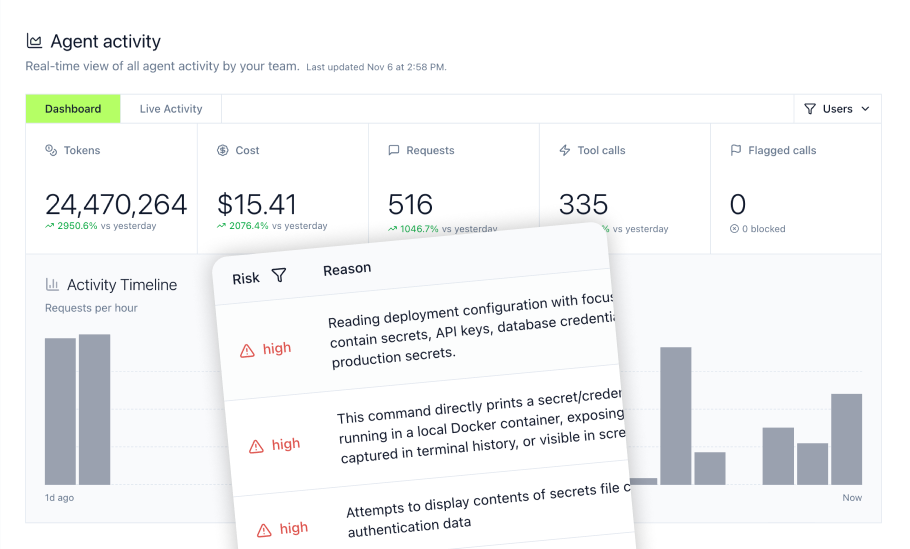
Agent Monitor for Activity Visibility
Agent Monitor extends visibility beyond gateway traffic by tracking supported agent activity, including prompts, commands, file access, MCP tool calls, usage metrics, and token costs. Coverage varies by AI client, agent, and supported integration.
Guardrails and Runtime Controls
MintMCP's guardrails architecture includes three layers:
- Mint Guard: Managed detection policies for prompt injection, secrets, PII, and harmful content
- Rules: Declarative matching on tool names, arguments, and content with flag, block, mask, or notify actions
- Gateway Middleware: Customer-authored JavaScript in a sandboxed environment for DLP integrations and custom policy enforcement
Primary Audience
IT, Security, and AI Operations teams that need governed MCP access for employees and internal agents across Claude, Cursor, ChatGPT, Gemini, and Copilot. Organizations in regulated industries requiring enterprise security controls. Teams without Kubernetes expertise who want enterprise governance without infrastructure operations.
2. TrueFoundry
TrueFoundry operates as a unified AI infrastructure platform combining LLM routing, MCP gateway, and model serving in a single control plane. The platform targets platform engineering and ML teams managing comprehensive AI infrastructure.
Key TrueFoundry Capabilities
- Unified platform consolidating multiple AI infrastructure components
- Cloud, VPC, on-prem, and air-gapped deployment support
- Vendor-published benchmarks reporting approximately 7-12ms of gateway overhead at 200-370 requests per second on 1 vCPU, depending on load and tracing configuration
- OAuth 2.0 authentication and JWT-based access control
- Virtual servers for MCP endpoint management
- Kubernetes-based MCP deployments require infrastructure management, although TrueFoundry also provides hosted stdio MCP server execution
Deployment Considerations
TrueFoundry supports flexible deployment across cloud-managed, customer VPC, and fully air-gapped environments. The platform requires infrastructure or platform engineering expertise for deployment and ongoing operations.
Limitations to Consider
- MCP gateway is one component of a broader platform, potentially over-engineered for teams only needing MCP governance
- Platform complexity requires existing infrastructure expertise
- Broader scope may introduce unnecessary overhead for MCP-focused use cases
Primary Audience
TrueFoundry primarily targets platform engineering and ML infrastructure teams managing AI gateways, model serving, and MCP governance.
3. Composio
Composio positions itself as a developer integration platform with an extensive catalog of pre-built MCP and API integrations. The platform targets AI engineering teams building agentic applications with broad SaaS connectivity needs.
Key Composio Capabilities
- 1,500+ pre-built app integrations available through MCP and API-based workflows
- Free tier with substantial monthly call volume for development and testing
- SDK-first development approach for code-native workflows
- Managed authentication handling across connected services
- Agent authentication centers on connected accounts and unattended agent accounts rather than MintMCP's dedicated Agent Gateway identity and scoped MCP access model
Limitations to Consider
- Enterprise controls including VPC and on-prem deployment gated behind higher pricing tiers
- Platform primarily designed for app integrations rather than dedicated MCP-specific governance
Primary Audience
Composio focuses on developer-facing agent integrations, managed authentication, and SDK-based connectivity across SaaS applications.
4. Obot
Obot provides open-source agent orchestration under MIT license, targeting infrastructure teams seeking MCP management with deployment flexibility. The platform launched Obot Cloud in May 2026 alongside its self-hosted options.
Key Obot Capabilities
- MIT license with full open-source transparency
- Obot supports open-source self-hosting through Docker or Kubernetes, alongside Obot Cloud for managed MCP gateway deployment
- Pod-level container isolation for MCP servers
- Enterprise tier available with Okta and Entra ID integration
- SCIM support for directory-driven access control in Enterprise tier
Limitations to Consider
- Self-hosted deployments require customers to operate their own infrastructure
- Enterprise authentication, provisioning, and administration capabilities vary by edition
- Hosted deployment reduces infrastructure operations, while self-hosted teams remain responsible for runtime management
- Compliance responsibilities depend on deployment architecture and the services included
Primary Audience
Obot serves infrastructure and platform engineering teams through open-source MCP management, enterprise controls, and hosted deployment options.
5. Runlayer
Runlayer targets security-first organizations with ML-based threat detection and flexible deployment options. The platform emphasizes runtime security controls for MCP tool calls.
Key Runlayer Capabilities
- ToolGuard and ListGuard with approximately 95% accuracy for tool poisoning and command injection detection
- Access to a catalog of 18,000+ MCP servers, with governance controls for approved connections
- Shadow MCP discovery via RunLayer Watch for detecting unauthorized MCP usage
- Agent Accounts providing per-agent identity separation
- Managed and customer-hosted deployment options, including single-tenant infrastructure configurations
Deployment Model
Runlayer supports managed and self-hosted deployment models. Organizations can evaluate managed infrastructure or customer-hosted environments according to security, data residency, and operational requirements.
Limitations to Consider
- Deployment architecture and supported cloud environments should be confirmed for the selected configuration
- Managed and self-hosted options have different infrastructure and operational requirements
- Security assurance documentation should be reviewed against the organization's compliance requirements
- Enterprise pricing and deployment terms require confirmation for the intended use case
Primary Audience
Runlayer targets IT, security, AI operations, and platform engineering teams with MCP access governance, threat detection, identity controls, and managed or self-hosted deployment options.
Use Case Mapping by Industry
Regulated Industries
Organizations in healthcare and financial services must evaluate AI infrastructure against applicable security requirements, including the HIPAA Security Rule where relevant. MintMCP is SOC 2 Type II audited and compliant with HIPAA standards, with BAA availability and enterprise audit controls that can support customer security reviews.
Enterprise Engineering Teams
Platform engineering teams managing AI infrastructure across multiple business units benefit from Virtual MCP Bundles that provide per-team governance without duplicating connector deployments. SCIM-driven access control automatically provisions tool access as directory group membership changes.
Security-First Organizations
Teams prioritizing agent security need runtime controls that prevent dangerous tool calls before execution. MintMCP's Mint Guard provides managed detection policies, while Gateway Middleware enables custom DLP integration for organization-specific requirements.
Multi-Client Environments
Organizations running Claude, Cursor, ChatGPT, Gemini, and Copilot simultaneously need vendor-neutral governance. MintMCP's cross-client support provides unified identity, policy, and audit across heterogeneous AI tool environments.
Why MintMCP for Enterprise MCP Governance
MintMCP addresses the core enterprise challenge of governing MCP access at scale through three integrated capabilities: managed connectivity, agent-specific identity, and runtime visibility. The platform's Virtual MCP architecture enables organizations to create purpose-built endpoints for specific teams, roles, or use cases while maintaining centralized policy enforcement and audit trails.
Unlike self-hosted alternatives that require platform engineering teams to build and operate connector infrastructure, MintMCP manages the operational burden of hosting connectors, rotating credentials, and maintaining runtime availability. The Agent Gateway extends this model to autonomous agents by treating them as first-class non-human principals with independent credentials and scoped access policies.
According to Gartner research, 90% of enterprise software engineers are expected to use AI code assistants by 2028, highlighting the growing importance of governance as AI adoption expands across engineering teams. Organizations gain centralized visibility through Agent Monitor, which tracks gateway-routed activity and supported local agent activity through configured integrations and hooks. This combination of managed operations, agent-specific governance, and runtime visibility enables enterprises to move from MCP pilots to production deployment while maintaining the security controls and audit trails required for regulated environments.
Frequently Asked Questions
What are the key differences between MintMCP and ToolHive for enterprise MCP governance?
MintMCP provides managed SaaS deployment with hosted connectors, SOC 2 Type II audited controls, and compliance with HIPAA standards. ToolHive offers Apache 2.0 open-source transparency, container isolation, and self-hosted infrastructure, with Kubernetes available for enterprise-scale deployments. MintMCP reduces the need to operate connector runtimes, while ToolHive provides greater direct control over infrastructure.
How does MintMCP address shadow AI and unauthorized MCP usage in enterprise environments?
MintMCP's Agent Monitor provides visibility into supported AI agent activity beyond gateway traffic, including prompts, commands, file access, and MCP tool calls. The platform can detect MCP usage patterns to help security teams identify unauthorized AI tool deployment across the organization while maintaining governance over approved connections.
Can MintMCP integrate with existing enterprise security infrastructure like SIEM and DLP?
Yes. MintMCP supports SIEM export through OTLP and Splunk HEC, delivering tool calls, prompt submissions, gateway requests, and access-policy changes to existing security infrastructure. Gateway Middleware provides integration templates for DLP services, enabling custom policy enforcement using existing security tooling for organization-specific data protection requirements.
What specific features does MintMCP offer for managing autonomous agent identity and permissions?
MintMCP's Agent Gateway treats autonomous agents as first-class non-human principals. Each agent receives its own identity with dedicated credentials, scoped MCP access limited to purpose-built tool sets, and independent credential rotation. Authentication supports bearer keys, M2M OAuth tokens, and workload identity federation. All agent actions appear in attributable audit trails separately from human user activity.
What visibility does MintMCP provide into agent activity, usage, and resource consumption?
Agent Monitor captures file reads, commands, MCP tool calls, prompts, and session activity across supported AI clients. Usage and cost tracking provides token spend breakdowns by model, user, agent, and session with human versus agent attribution. Cache-hit rate visibility and reporting support cost allocation across business units and projects for financial governance.