Healthcare organizations deploying AI agents face a critical governance challenge. According to Gartner, over 40% of agentic AI projects will be canceled by the end of 2027 due to escalating costs, unclear business value, or inadequate risk controls. For healthcare IT leaders, the stakes are even higher: HIPAA compliance requirements, protected health information handling, and clinical workflow integration demand specialized solutions that general-purpose platforms cannot provide.
With major providers like OpenAI, Anthropic, Google, and Microsoft supporting the Model Context Protocol, agent gateways have evolved from optional middleware to essential healthcare infrastructure. The right MCP gateway helps govern point-to-point agent connections for HIPAA-regulated workloads that satisfy both clinical teams and compliance officers.
This guide evaluates the top agent gateway platforms for healthcare organizations in 2026, with a focus on HIPAA compliance, PHI protection, EHR integration capabilities, and enterprise security features that regulated healthcare environments require.
Key Takeaways
- MintMCP Gateway provides enterprise MCP governance with data-permissions-first architecture, compliance with HIPAA standards with BAA availability, SSO and SCIM-driven RBAC, Virtual MCP Bundles, Agent Bundles for per-agent identity, and hosted connectors for general data platforms used in healthcare workflows
- MintMCP Agent Gateway builds on the MCP Gateway foundation to provide identities, permissions, memory, and monitoring for agents that work alongside healthcare teams
- Healthcare organizations evaluating agent gateways should prioritize HIPAA compliance documentation, audit trail capabilities, PHI protection features, and EHR integration readiness
- Agent gateway governance addresses the credential sprawl, visibility gaps, and compliance risks that emerge when AI agents connect directly to clinical systems
- Role-based access controls and per-agent identity enable least-privilege architectures that limit PHI exposure
1. MintMCP Gateway: Healthcare-Ready MCP Infrastructure
MintMCP Gateway provides an enterprise gateway for Model Context Protocol focused on authentication, tool-level access control, credential management, logging, rule-based policy, and agent governance. Its data-permissions-first architecture starts with SSO, SCIM-driven RBAC, IdP groups, Virtual MCP Bundles, tool-level policy, and audit logs, then enables agents on top.
For healthcare organizations, MintMCP addresses the fundamental compliance challenge: connecting AI agents to clinical systems and patient data while supporting the controls and audit documentation required for HIPAA-regulated workflows.
What Makes MintMCP Different for Healthcare
Healthcare organizations typically face fragmented security policies across dozens of individual MCP servers, zero visibility into which agents access which tools, and inconsistent logging that fails compliance audits. MintMCP solves this by wrapping stdio, hosted, HTTP-streamable, and SSE MCP servers behind SSO-fronted remote MCP endpoints with OAuth brokering, SCIM-driven membership, and rule-based policy.
The platform's architecture directly addresses the security and compliance concerns that healthcare IT leaders prioritize, providing complete audit trails for HIPAA compliance investigations.
Core Healthcare Capabilities
HIPAA-Ready Compliance Infrastructure
MintMCP is SOC 2 Type II audited and compliant with HIPAA standards. The company signs BAAs for healthcare customers. Every agent action is logged with full context: who initiated it, which tools were called, what data flowed through, and when. This creates detailed audit records that healthcare compliance teams can use for regulatory investigations.
Virtual MCP Bundles for Clinical Role-Based Access
Create team-specific, per-use-case endpoints that expose only the minimum required tools with SCIM-driven membership. A clinical research team might access data warehouse queries with read-only permissions, while administrative staff access scheduling systems without clinical data exposure.
Agent Bundles for Per-Agent Identity
Each AI agent receives its own credential set scoped to the tools it needs. Rotate or revoke one agent's access without touching user credentials or other agents. This addresses the credential hygiene requirements that healthcare security teams demand for PHI access.
MintMCP Agent Gateway builds on this MCP Gateway foundation to provide identities, permissions, memory, and monitoring for agents that work alongside healthcare teams. This extends governance from tool connections to the agents themselves.
DLP and Guardrails Integration
Custom policy code executes on every tool call, enabling inline DLP integration with AWS Bedrock Guardrails, GCP DLP, Microsoft Purview, Nightfall, and Skyflow. When agents attempt to access PII or credentials, healthcare organizations get real-time alerts and automatic blocking.
Shadow AI Detection
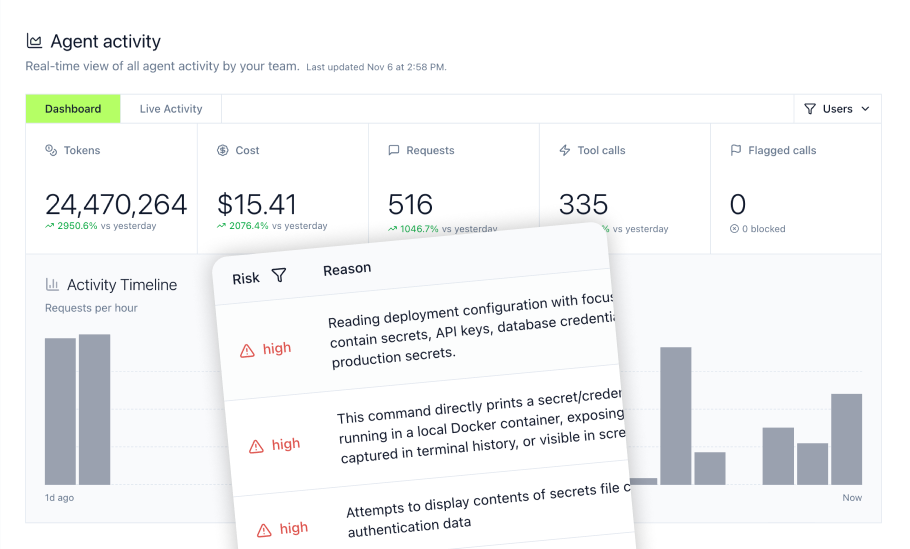
Agent Monitor tracks agent activity in real-time across the organization, including MCP calls made outside the gateway through hooks in Cursor and Claude Code. This detects unsanctioned AI tool usage that could expose PHI through ungoverned channels.
Data Platform Integrations for Healthcare Use Cases
- Snowflake data warehouse access for clinical analytics and population health queries
- Elasticsearch knowledge base search for clinical documentation and medical records
- PostgreSQL and MySQL database connections for healthcare application backends
- Custom MCP server deployment for EHR systems and clinical APIs
Security and Compliance
- SOC 2 Type II audited with continuous Drata monitoring
- Compliant with HIPAA standards with BAA availability
- Penetration tested infrastructure
- Data encrypted in transit and at rest
Deployment
Managed SaaS-first delivery with US and EU availability. VPC and self-hosted deployment available on request for healthcare organizations with strict data residency requirements.
Getting Started
Visit mintmcp.com/mcp-gateway for healthcare deployment guides and compliance documentation.
2. TrueFoundry
TrueFoundry provides an enterprise AI gateway and MLOps platform with centralized MCP registry architecture. The platform addresses the M×N integration problem where every new agent requires individual connections to tools, databases, and APIs.
TrueFoundry's Primary Focus
TrueFoundry functions as a centralized traffic controller for agentic workflows, providing a single MCP endpoint architecture that eliminates per-agent configuration overhead. The platform targets enterprise ML platform teams building internal AI tooling.
Healthcare-Relevant Features
Governance Framework
TrueFoundry supports SOC 2, HIPAA, and GDPR compliance for regulated industries. The platform provides enterprise authentication and authorization controls suitable for healthcare data access governance.
Performance Characteristics
Published benchmarks indicate approximately 3-4ms of gateway overhead at up to about 350 RPS on 1 vCPU. This does not represent end-to-end model or clinical workflow latency.
Unified Control Plane
Model and tool traffic share governance through a unified AI and MCP control plane, simplifying policy management for healthcare organizations running multiple AI services.
Where TrueFoundry Fits
Healthcare organizations with existing ML platform teams seeking unified governance across model serving and MCP connections. Organizations that prioritize centralized registry architecture for managing agent-to-tool integrations at scale.
3. AWS Bedrock AgentCore Gateway
AWS Bedrock AgentCore Gateway provides cloud-native AI agent infrastructure as part of the AWS healthcare ecosystem. The platform offers automatic API-to-MCP conversion and native integration with AWS security and monitoring services.
AWS Healthcare Infrastructure
HIPAA-Eligible Services
AWS Bedrock operates within AWS's HIPAA-eligible services portfolio, enabling healthcare organizations to sign BAAs and deploy AI agents that access protected health information within compliant infrastructure.
Healthcare MCP Partnership
Innovaccer is building Healthcare MCP (HMCP) on AgentCore Gateway. Innovaccer CEO Abhinav Shashank stated: "AI has massive potential in healthcare, but getting the foundation right is key. That's why we're building HMCP on Amazon Bedrock AgentCore Gateway."
Native AWS Integration
CloudWatch and CloudTrail integration provides the audit trail capabilities that healthcare compliance teams require. Organizations already on AWS can extend existing security and monitoring infrastructure to AI agent workloads.
Healthcare-Relevant Features
- Automatic API-to-MCP conversion reducing integration overhead for legacy healthcare systems
- FedRAMP compliance is still in progress, so government healthcare organizations should confirm current service scope before deployment
- PCI DSS compliance for healthcare payment processing workflows
- Fully managed infrastructure eliminating operational burden for clinical IT teams
Where AWS Bedrock Fits
Healthcare organizations standardized on AWS infrastructure seeking native cloud integration for AI agent deployments. Organizations prioritizing managed services over self-hosted infrastructure.
4. Bifrost (Maxim AI)
Bifrost provides an open-source AI gateway built in Go, emphasizing performance and self-hosted deployment flexibility. The platform unifies LLM and MCP traffic in a single binary with minimal latency overhead.
Performance-Focused Architecture
Low-Latency Processing
Bifrost benchmarks indicate approximately 11 microseconds of gateway overhead at 5,000 requests per second. This benchmark reflects gateway overhead under vendor test conditions, not end-to-end model response time or suitability for clinical decision support.
Code Mode Optimization
"Code Mode" reduces tool-description overhead by 50%+ when multiple MCP servers are connected, improving efficiency for healthcare organizations with extensive tool catalogs.
Healthcare Deployment Options
In-VPC and Air-Gapped Deployment
Bifrost supports in-VPC deployment with air-gapped options for regulated industries. Healthcare organizations with strict data residency requirements can maintain complete control over infrastructure.
Open-Source Foundation
Apache 2.0 licensing provides transparency and audit capability for healthcare security teams evaluating gateway infrastructure.
Where Bifrost Fits
Large health systems with infrastructure engineering teams seeking high-performance, self-hosted MCP gateway capabilities. Organizations with strict data residency requirements that preclude managed SaaS deployment.
5. Google Vertex AI Agent Builder
Google Vertex AI Agent Builder offers FHIR-store connectivity through Agent Search, although Google plans to retire the healthcare search capability after May 15, 2027. The solution integrates with Google Cloud's healthcare platform.
Google Cloud Healthcare Integration
Healthcare API Connectivity
Vertex AI Agent Search can import healthcare data from Cloud Healthcare API FHIR stores. However, Google has deprecated Agent Search for healthcare and says the capability will be unavailable after May 15, 2027.
BigQuery for Healthcare Analytics
Google Cloud Healthcare API can stream FHIR resources to BigQuery for healthcare analytics. This is a separate Google Cloud data workflow rather than a Vertex AI Agent Builder integration.
HIPAA-Eligible Infrastructure
Google Cloud offers HIPAA-eligible services with BAA availability through GCP's compliance program.
Healthcare-Relevant Features
- VPC Service Controls for network-level isolation of healthcare data
- Organization Policies for cross-project governance
- Gemini model integration for permitted non-clinical healthcare research, scheduling, and administrative workflows
- Native FHIR store connectivity for standards-based health data exchange (until May 2027 deprecation)
Where Google Vertex AI Fits
Healthcare organizations standardized on Google Cloud seeking FHIR search for permitted non-clinical research, scheduling, and administrative workflows. Organizations should evaluate the impact of the planned Agent Search healthcare deprecation on their roadmap.
6. Kong AI Gateway
Kong extends its established API gateway platform with AI and MCP protocol support. The solution targets organizations already using Kong for API management who want unified governance across traditional APIs and AI agent traffic.
API Gateway Heritage
Unified Governance
Kong provides unified governance for API and AI traffic from a single platform, reducing operational complexity for healthcare IT teams managing multiple gateway solutions.
Hybrid Deployment
Konnect SaaS control plane with self-hosted data plane supports healthcare organizations requiring on-premises data processing with cloud-based management.
A2A Protocol Support
Agent-to-agent communication support enables complex clinical workflows involving multiple AI agents coordinating patient care tasks.
Healthcare-Relevant Features
- Established enterprise API gateway with existing healthcare deployments
- Semantic caching for LLM response optimization reducing costs
- Kong plugin ecosystem extends to AI governance features
- Hybrid deployment maintains healthcare data on-premises
Where Kong Fits
Healthcare organizations with existing Kong API gateway deployments seeking to extend current infrastructure to AI agent workloads without deploying separate gateway solutions.
7. Gravitee Agent Gateway
Gravitee provides an event-native API and agent management platform. The solution emphasizes real-time event streaming alongside traditional API and agent management.
Event-Native Architecture
Real-Time Healthcare Data Streams
Event-native architecture supports real-time healthcare data including patient monitoring, clinical alerts, and time-sensitive clinical decision support. Healthcare workflows requiring immediate response benefit from Gravitee's streaming-first design.
Gartner Recognition
Gravitee was named a Leader in the Gartner 2025 Magic Quadrant for API Management for the second consecutive year, validating enterprise maturity for healthcare IT deployments.
Healthcare-Relevant Features
- Agent Mesh for governed agent-to-agent communication in clinical workflows
- Shared Policy Groups for AI flows including rate limiting and prompt templating
- Unified API, event, and agent management in single platform
- Real-time event processing for patient monitoring and clinical alerting
Where Gravitee Fits
Healthcare organizations with real-time data requirements including patient monitoring, clinical alerting, and event-driven clinical workflows that benefit from streaming-first architecture.
8. Portkey
Portkey provides an AI gateway and LLMOps platform with broad language model provider access. Palo Alto Networks completed its acquisition of Portkey in May 2026 and plans to integrate Portkey's AI Gateway into Prisma AIRS.
LLM Provider Breadth
Extensive Model Catalog
Unified access to thousands of LLMs through a single API enables healthcare AI research teams to experiment with multiple models for clinical AI development without managing individual provider integrations.
Scale Validation
Portkey processes over 1 trillion tokens daily across 3,000+ GenAI teams, demonstrating production readiness for healthcare organizations with high-volume AI workloads.
Healthcare-Relevant Features
- Fine-grained OAuth 2.1 authentication at org/team/user levels
- Apache 2.0 open-source core with enterprise tier
- VPC deployment options for healthcare data residency
- Planned integration with Palo Alto Networks Prisma AIRS following the acquisition
Where Portkey Fits
Healthcare research institutions and clinical AI teams requiring access to multiple LLM providers for medical AI experimentation and clinical decision support development.
9. Lasso Security
Lasso Security provides a security-first MCP gateway focused on protecting agentic workflows from advanced threats. The platform was named a 2024 Gartner Cool Vendor for AI Security.
Security-First Design
Prompt Injection Protection
Real-time prompt injection detection and blocking protects healthcare AI systems from manipulation attacks that could expose patient data or generate incorrect clinical guidance.
PHI Exposure Prevention
Detection capabilities identify when AI agents attempt to access or transmit protected health information through unauthorized channels.
Tool Reputation System
Tool authorization with parameter validation and reputation analysis prevents compromised MCP server connections that could introduce malicious capabilities.
Healthcare-Relevant Features
- Three-layer protection covering AI, MCP, and API layers
- Credential encryption and secure secret management
- Network filtering and allowlisting for MCP destinations
- Comprehensive audit trails for security events
Where Lasso Security Fits
Healthcare organizations prioritizing advanced threat protection for AI agent deployments, particularly those handling sensitive patient data requiring defense-in-depth security architecture.
10. Tigera Lynx
Tigera Lynx provides Kubernetes-native agent security with cryptographic identity for containerized infrastructure. The platform builds on Tigera's established Calico network security foundation.
Kubernetes-Native Security
Cryptographic Agent Identity
SPIFFE/SPIRE integration provides cryptographic identity for each agent, enabling zero-trust verification essential for healthcare environments with strict access control requirements.
Sandbox Environments
Safe agent experimentation capabilities allow healthcare AI teams to test new agents and tools without production risk exposure.
Healthcare-Relevant Features
- Unified control plane for Kubernetes-native AI agents
- In-path authentication, authorization, and mediation for every agent call
- Integration with EntraID and Okta for healthcare identity providers
- Open standards foundation (SPIFFE/SPIRE) prevents vendor lock-in
Where Tigera Lynx Fits
Large healthcare systems running containerized infrastructure on Kubernetes seeking native agent security with cryptographic identity and zero-trust architecture.
Selecting the Right Healthcare Agent Gateway
Healthcare organizations face unique requirements when deploying AI agents. Beyond standard enterprise considerations, healthcare IT leaders must evaluate HIPAA compliance documentation, BAA availability, PHI handling capabilities, and EHR integration requirements.
Healthcare Compliance Requirements
In the cited enterprise survey, 53% of enterprise leaders and 62% of practitioners identified security concerns as a top challenge in developing and deploying AI agents. For healthcare, add HIPAA requirements per HHS guidance, and the compliance burden intensifies. Evaluate whether your gateway provides SOC 2 Type II attestation, HIPAA documentation, and BAA signing capability.
Clinical Workflow Integration
In the cited enterprise survey, 42% of respondents said successful AI agent deployment requires access to eight or more data sources. Consider whether your gateway provides pre-built integrations for EHR systems, clinical data warehouses, and healthcare-specific APIs, or requires custom development for each connection.
Audit Trail Requirements
HIPAA requires reasonable and appropriate audit controls that record and examine activity in systems containing or using electronic protected health information. Evaluate whether your gateway provides complete audit records with full context including user attribution, tool invocation details, and data flow tracking.
PHI Protection
Healthcare gateways must detect and prevent unauthorized PHI access. Consider whether your gateway provides real-time PII detection, credential leakage prevention, and automatic blocking when agents attempt to access protected information through ungoverned channels.
Deployment Flexibility
Healthcare organizations often have strict data residency requirements. Evaluate whether your gateway supports VPC deployment, self-hosted options, or air-gapped configurations for the most sensitive clinical environments.
Healthcare AI Agent Governance with MintMCP
For healthcare organizations seeking governed AI agent deployment, MintMCP Gateway provides the compliance infrastructure that clinical environments require. Compliance with HIPAA standards and BAA availability, per-agent identity with independent credential rotation, and real-time audit logging create the foundation for compliant AI deployment.
The data-permissions-first architecture means governance is built in from the start. SSO, SCIM-driven RBAC, Virtual MCP Bundles, and tool-level policies ensure that AI agents operate within the boundaries that healthcare compliance teams define.
MintMCP Agent Gateway extends this foundation with identities, permissions, memory, and monitoring for agents that work alongside healthcare teams. This bridges MCP Gateway's governed tool connections with agent-specific governance, enabling healthcare organizations to deploy both traditional AI assistants and emerging coworker agents under unified control.
Agent Monitor extends visibility beyond the gateway to detect shadow AI usage in tools like Cursor and Claude Code, addressing the ungoverned AI access that creates compliance risk in healthcare organizations. By combining gateway visibility with monitoring of supported off-gateway activity from configured coding-agent clients, MintMCP helps healthcare IT teams identify additional AI activity and apply governance policies more consistently.
Visit mintmcp.com to explore healthcare deployment options and request compliance documentation.
Frequently Asked Questions
What is an AI agent gateway and why is it critical for healthcare organizations?
An AI agent gateway provides centralized governance for AI agents connecting to tools, databases, and APIs. For healthcare organizations, agent gateways support AI deployments subject to HIPAA requirements by providing authentication, authorization, audit trails, and policy enforcement for every agent interaction with clinical systems and patient data. Without gateway governance, healthcare organizations face fragmented security policies, zero visibility into agent activity, and compliance gaps that create regulatory risk.
How can AI agent gateways support HIPAA-regulated deployments and protect patient data?
Healthcare-focused agent gateways can provide controls that support an organization's broader HIPAA compliance program: SOC 2 Type II attestation demonstrating security controls, BAA signing availability for covered entity relationships, comprehensive audit logging capturing every agent action for compliance investigations, role-based access controls limiting agent access to minimum necessary data, and real-time detection of PHI exposure attempts. The audit trail creates complete records showing who initiated actions, which tools were called, what data flowed through, and when.
Can AI agent gateways help automate routine healthcare tasks and improve efficiency?
Yes. Agent gateways enable healthcare organizations to deploy AI agents for clinical documentation assistance, administrative workflow automation, patient communication management, and data analysis tasks. By providing governed access to healthcare data systems, gateways remove the security barriers that otherwise prevent AI agent deployment. Healthcare teams using governed AI agents report significant time savings on routine administrative tasks.
What specific security features should healthcare organizations look for in an AI agent gateway?
Healthcare organizations should evaluate: HIPAA compliance documentation and BAA availability, SOC 2 Type II attestation, per-agent identity with independent credential rotation, real-time PII and credential leakage detection, prompt injection protection, comprehensive audit trails with user attribution, DLP integration capabilities for existing security tools, and shadow AI detection for ungoverned agent usage.
How does an AI agent gateway prevent shadow AI and maintain control over agent usage?
Agent gateways transform shadow AI into governed AI by requiring all agent connections to route through centralized infrastructure. The gateway catalogs approved MCP servers, enforces role-based access controls, maintains audit trails of every tool invocation, and blocks unauthorized server connections. Advanced gateways like MintMCP extend visibility beyond the gateway through Agent Monitor, detecting off-gateway MCP usage in developer tools and enabling enforcement through MDM integration.
What are the benefits of Virtual MCP Bundles for managing AI agents in healthcare settings?
Virtual MCP Bundles create team-specific, per-use-case endpoints with curated tool access and SCIM-driven group membership. For healthcare organizations, this enables role-based governance: clinical research teams access data warehouse queries while administrative staff access scheduling systems. Each Bundle enforces least-privilege access, automatically syncs with identity provider group changes, and maintains isolated audit trails for compliance reporting.