When your AI coding agent accesses customer data at 2 AM and you can't prove it was authorized, you don't have a technical problem—you have a governance crisis. AI coding agents operate with extensive system access—reading files, executing commands, and connecting to production systems through MCP tools. Without proper logging, organizations face 8+ hour incident response times trying to reconstruct what went wrong. The solution isn't limiting AI capabilities; it's building comprehensive audit trails through an MCP Gateway that centralizes control, captures every action, and supports audit-ready documentation without disrupting developer workflows.
Key Takeaways
- AI coding agents without audit trails can dramatically slow incident response—what takes 45 minutes with proper logging can take 8+ hours without it
- The EU AI Act requires automatic logging and traceability for high-risk AI systems, but it does not impose a blanket 6+ years of audit log retention across all cases, with the August 2026 deadline approaching
- The EU AI Act requires automatic logging and traceability for high-risk AI systems, with key high-risk obligations taking effect on August 2, 2026, but it does not impose a blanket 6+ years of audit log retention across all cases
- MCP Gateway architecture centralizes authentication and logging for all AI agent tool calls through a single governance layer
- Identity-bound logging—linking every action to authenticated users—forms the foundation of defensible audit trails
- Compliance teams can save significant review time when audit data exports cleanly for SOC 2, HIPAA, and GDPR workflows
- Implementation costs range from free (open-source tools) to $10K-50K for custom builds, with enterprise gateways offering turnkey compliance
Understanding the Need for Audit Trails in AI Coding Agents
AI coding agents—Claude Code, Cursor, Windsurf, and similar tools—have fundamentally changed how developers work. These agents read files, execute bash commands, query databases, and access production systems through MCP (Model Context Protocol) connections. The productivity gains are substantial, but so are the risks.
Without monitoring, organizations cannot see what agents access or control their actions. This creates three critical problems:
- Zero telemetry: No visibility into which files agents read, what commands they execute, or what data they access
- No request history: When something breaks, teams spend hours manually reconstructing agent activity
- Uncontrolled access: Agents may access sensitive credentials, production databases, or customer data without authorization checks
The business impact is measurable. Organizations report 70-90% reductions in incident diagnosis after implementing proper audit trails. A deployment issue that previously required 8 hours of forensic reconstruction drops to 45 minutes with comprehensive logging.
Understanding MCP data risks helps organizations identify where uncontrolled AI access creates compliance gaps and security vulnerabilities.
What is an MCP Gateway and How Does it Facilitate Audit Trails?
An MCP Gateway sits between AI coding agents and the tools they access, intercepting every request to provide centralized authentication, logging, and governance. Instead of agents connecting directly to MCP servers, they connect through the gateway—which validates permissions, records actions, and enforces policies before forwarding requests.
The gateway approach solves the fundamental challenge of distributed logging: rather than collecting scattered logs from dozens of developer machines and MCP servers, all audit data flows through a single control point.
How MCP Gateways Create Audit Trails:
- Intercept all tool calls: Every file read, database query, and command execution passes through the gateway
- Authenticate users via SSO: Link actions to specific identities through OAuth 2.0, SAML, or OIDC integration
- Log with full context: Capture what was accessed, who authorized it, when it occurred, and why
- Enforce policies in real-time: Block unauthorized actions before they execute
- Export audit reports: Generate documentation that supports SOC 2, GDPR, and internal compliance review workflows
This architecture transforms AI coding agents from black boxes into fully observable, governed tools. Teams gain the productivity benefits while maintaining the security controls enterprises require.
For organizations running multiple AI clients—Claude, ChatGPT, Cursor, and others—the gateway provides a unified governance layer that works across all MCP-compatible agents without requiring changes to individual tools.
Real-time Monitoring and Tool Call Tracking with MCP Gateway
Effective audit trails require capturing specific data elements for every AI agent action. The six essential elements framework provides a comprehensive checklist:
- Input: What prompt or instruction triggered the action
- Output: What the agent generated or modified
- Data accessed: Which files, databases, or APIs the agent touched
- Model identity: Which AI model and version performed the action
- User identity: Who authorized or initiated the action
- Timestamp: Precise timing for correlation and sequencing
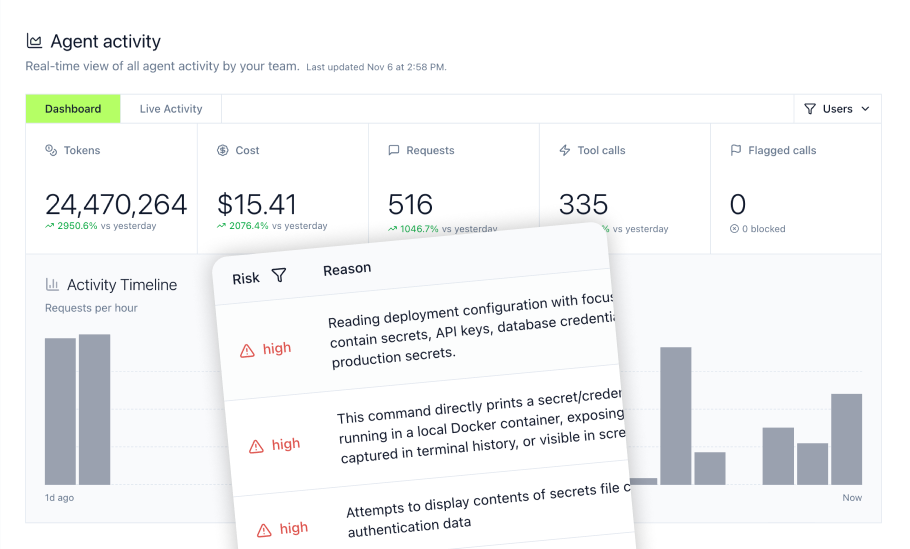
An LLM Proxy extends monitoring to the model layer itself, tracking not just MCP tool calls but also the prompts and responses flowing between developers and AI systems. This provides complete visibility into tool invocations, bash commands, file operations, MCP inventory, and usage patterns.
Real-time monitoring means security teams see anomalies as they happen—not hours or days later. When an agent attempts to access .env files, SSH keys, or production credentials, alerts fire immediately.
Ensuring Compliance with Comprehensive Audit Logs: SOC 2, HIPAA, GDPR
Regulatory frameworks increasingly require demonstrable AI governance. The EU AI Act mandates automatic logging of events for high-risk AI systems. Non-compliance penalties reach €35 million or 7% of revenue—whichever is higher.
Framework-Specific Requirements:
| Framework | Key Logging Requirements | Retention Period |
|---|---|---|
| SOC 2 | Access controls, change management, incident response documentation | Defined by organization's policy (1-year minimum common) |
| HIPAA | ePHI access tracking per §164.312(b), audit controls, integrity verification | 6 years |
| GDPR | Data access logs, consent records, processing activity documentation | Duration of processing + reasonable period |
| EU AI Act | Automatic event logging, human oversight records, performance monitoring | Per system risk classification |
The gateway approach simplifies compliance by centralizing audit data in formats auditors expect. Rather than scrambling to compile logs from multiple systems before an audit, teams export pre-formatted reports that map directly to compliance frameworks.
MintMCP's audit observability documentation details how complete audit trails support SOC 2 Type II attestation workflows, HIPAA audit requirements, and broader GDPR accountability.
Implementing Security Guardrails and Sensitive File Protection
Audit trails serve two purposes: forensic reconstruction after incidents and real-time prevention of unauthorized actions. The gateway approach enables both through policy enforcement at the point of access.
Critical Security Guardrails:
- Sensitive file protection: Block agent access to
.envfiles, SSH keys, AWS credentials, and other secrets - Command restrictions: Prevent execution of dangerous commands like
rm -rf, database drops, or production deployments - Rate limiting: Throttle excessive API calls that might indicate runaway agents or misuse
- Data exfiltration prevention: Monitor for patterns suggesting unauthorized data extraction
- Network boundaries: Restrict which external services agents can contact
The tool governance framework allows administrators to configure granular permissions by role. Engineering teams might have full access to development databases while being blocked from production systems. Support teams might query customer records but not modify them.
This approach addresses a finding from Gryph deployments: teams discovered AI agents had been accessing AWS credentials without developers' knowledge—agents read .aws/credentials for context during code analysis. With guardrails, such access triggers alerts or blocks entirely.
Centralized Governance: OAuth, SSO, and Role-Based Access Control
Identity-bound logging forms the foundation of defensible audit trails. Every action must link to an authenticated user or agent identity with clear authorization context. Without identity binding, logs show what happened but not who was responsible—making incident investigation and access reviews nearly impossible.
Authentication Integration Options:
- SAML 2.0: Enterprise identity providers like Okta, Azure AD, and Google Workspace
- OIDC: Modern authentication via Auth0, Keycloak, or custom identity systems
- OAuth 2.0: API-level authorization with scoped permissions
- Service accounts: Shared credentials for automated workflows with audit attribution
The authentication models documentation explains how MCP Gateway supports both shared and per-user authentication—flexibility to configure service accounts at the admin level or enable individual OAuth flows where appropriate.
Role-Based Access Control in Practice:
A financial services firm deploying AI agents to 200 analysts might configure roles like:
- Analyst - Standard: Query anonymized datasets, generate reports, no PII access
- Analyst - Elevated: Access customer records with justification logging
- Engineering: Full development environment access, blocked from production
- Compliance: Read-only access to all audit logs, no operational permissions
Each user receives a custom MCP endpoint URL with their permitted tools pre-configured. The gateway validates role membership on every request, ensuring permissions stay current even as team assignments change.
Integrating AI Agents with Enterprise Data Sources
MCP connectors enable AI agents to interact with enterprise systems—databases, email, project management tools, and more. Each integration creates audit trail requirements as agents access sensitive business data.
Common Integration Patterns:
The Elasticsearch MCP Server enables AI agents to query knowledge bases, search support tickets, and analyze logs. Audit trails capture every search query, which indices were accessed, and what results were returned.
The Snowflake MCP Server connects AI agents to data warehouses for natural language analytics. Audit logs record every SQL query generated, which tables were touched, and row counts returned—critical for data governance.
The Gmail MCP Server allows AI assistants to search, draft, and send email within approved workflows. Complete audit trails track message access, draft creation, and sending events with full security oversight.
Use Case: Product Analytics Team
A product team uses Claude Code to analyze user behavior data in Snowflake. The MCP Gateway logs every natural language query submitted, the SQL generated, which tables and columns were accessed, row counts and execution times, and the user who initiated each query.
When auditors ask "who accessed customer data and when?" the team generates a report in minutes rather than manually reconstructing activity from scattered logs.
Enterprise AI agents multiply workforce productivity when deployed with proper governance. The gateway ensures these productivity gains don't come at the cost of security or compliance.
Rapid Deployment and Bridging Shadow AI to Sanctioned AI
Most MCP servers are STDIO-based and difficult to deploy. They require local installation, lack authentication, and scatter credentials across developer machines. This creates the shadow AI problem—teams use AI tools without IT knowledge because sanctioned alternatives seem too complex.
The gateway approach transforms this dynamic by providing one-click deployment for STDIO-based MCP servers. Instead of running servers locally, the gateway hosts them in managed infrastructure with automatic OAuth protection and monitoring.
Deployment Comparison:
| Approach | Setup Time | Authentication | Centralized Logging | Compliance Ready |
|---|---|---|---|---|
| Local MCP servers | Hours per developer | None (or manual) | No | No |
| MCP Gateway | Minutes total | Automatic SSO | Yes | Yes |
| Custom infrastructure | Weeks to months | Custom build | Requires integration | Requires configuration |
The practical path forward: identify which AI tools teams already use, then provide a governed alternative that's actually easier. When connecting to MCP servers through the gateway is simpler than running them locally—and provides better features—adoption follows naturally.
This transforms shadow AI into sanctioned AI. Teams gain visibility into AI usage patterns, security teams get audit trails, and compliance officers have documentation—all without slowing developers or restricting legitimate use.
Implementation Roadmap
Building audit trails for AI coding agents requires a phased approach that balances quick wins with long-term governance infrastructure.
Week 1: Assessment and Foundation
- Inventory existing AI tools: Document which AI coding agents developers use, which MCP servers they connect to, and what data they access
- Map compliance requirements: Identify which frameworks apply (SOC 2, HIPAA, GDPR, EU AI Act) and their specific logging requirements
- Define sensitive resources: List files, databases, and systems that require audit trails and access controls
- Select gateway approach: Evaluate tools based on team size and compliance needs
Week 2: Initial Deployment
- Configure SSO integration: Connect gateway to identity provider
- Define initial roles: Create 3-5 role definitions covering primary use cases
- Enable basic logging: Turn on audit trails for high-priority integrations first
- Test with pilot group: Deploy to 5-10 users to validate configuration
Week 3: Policy Refinement
- Review initial logs: Analyze what agents actually access versus expected patterns
- Tune guardrails: Adjust file protection and command restrictions based on legitimate usage
- Configure alerts: Set up notifications for high-risk actions
- Document procedures: Create runbooks for common audit queries
Week 4: Production Rollout
- Expand to full team: Deploy gateway access to all AI coding agent users
- Enable self-service: Configure developer-friendly access request flows
- Schedule exports: Set up automated report generation for audit cycles
- Establish review cadence: Monthly access reviews and quarterly policy assessments
The 4-stage implementation framework from Prefactor—Foundation, Execution, Compliance, Operational—provides detailed checklists for each phase.
Deploying MintMCP for Production-Ready Audit Trails
MintMCP delivers the infrastructure enterprises need to deploy AI coding agents with comprehensive audit trails from day one. Rather than building custom logging pipelines or managing scattered local tools, MintMCP offers a turnkey gateway solution that handles the complexity.
MintMCP provides SOC 2 Type II attestation with complete audit logs that support audit readiness and regulated-environment reviews. The platform offers one-click deployment for STDIO-based MCP servers—host them on MintMCP infrastructure instead of running locally. OAuth and SSO enforcement automatically wraps every MCP endpoint with enterprise authentication. Real-time monitoring dashboards show server health, usage patterns, and security alerts. Granular tool access control configures permissions by role—enable read-only operations while excluding write tools.
The platform supports 10,000+ MCP servers through its registry, with pre-built connectors for databases, email, project management, and cloud services. Each connector inherits gateway-level audit logging without additional configuration. For teams using Claude Code, Cursor, Windsurf, or other MCP-compatible agents, MintMCP provides a single governance layer that works across all clients.
The LLM Proxy extends visibility to the model layer—tracking prompts, responses, and tool calls from AI coding agents with complete audit trails for security review. Combined with guardrails that block dangerous commands and protect sensitive files, teams gain comprehensive control over AI agent behavior. High availability with enterprise SLAs and automatic failover ensures continuous operation.
Deploy in minutes, not months. Book a demo at enterprise@mintmcp.com to see how MintMCP transforms AI coding agent governance.
Frequently Asked Questions
Why are audit trails particularly important for AI coding agents?
AI coding agents operate with extensive system access—reading files, executing commands, querying databases, and connecting to production systems through MCP tools. Unlike traditional software that follows predetermined paths, AI agents make contextual decisions that can access sensitive data unexpectedly. Without audit trails, organizations have no visibility into what agents access or control over their actions. When incidents occur, teams face 8+ hour reconstruction efforts manually piecing together agent activity. Audit trails reduce this to minutes while providing the documentation compliance frameworks require.
What kind of information does an MCP Gateway capture for audit trails?
A comprehensive MCP Gateway captures the six essential elements for every action: the input prompt or instruction, the output generated, all data accessed (files, databases, APIs), the model identity and version, the authenticated user identity, and precise timestamps. Beyond basic logging, gateways record tool call parameters, return values, command exit codes, file modifications with before/after diffs, and policy evaluation outcomes. This provides full forensic capability to reconstruct exactly what happened during any agent session.
How does an MCP Gateway help with compliance frameworks like SOC 2 and HIPAA?
MCP Gateways centralize audit data in formats auditors expect, eliminating the scramble to compile logs from multiple systems before audits. For SOC 2 Type II attestation, gateways provide access control documentation, change management records, and incident response logs. For HIPAA, they can help centralize ePHI access logging under §164.312(b) requirements with authentication and integrity verification, but covered entities still need their own control mapping and retention policies. The EU AI Act requires automatic logging for high-risk AI systems, but not a blanket 6+ years of log retention across all cases.
Can an MCP Gateway restrict what AI coding agents can do and access?
Yes—policy enforcement at the gateway level allows administrators to configure granular tool access by role. Common restrictions include blocking access to sensitive files (.env, SSH keys, credentials), preventing dangerous command execution, rate limiting API calls, restricting database access to specific tables or read-only operations, and controlling which external services agents can contact. These guardrails operate in real-time, blocking unauthorized actions before they execute rather than just logging them afterward.
Does MCP Gateway support popular AI clients like Claude and ChatGPT?
MCP Gateways work with any MCP-compatible client including Claude Desktop, Claude Code, ChatGPT via Custom GPTs, Cursor, Windsurf, Gemini, LibreChat, and Open WebUI. The gateway provides a standard MCP endpoint that clients connect to—no modifications to individual agents required. This means organizations can standardize on a single governance layer while supporting whatever AI tools teams prefer. Configuration typically involves updating the agent's MCP server URL to point to the gateway instead of local servers.
How can an MCP Gateway help my organization transition from shadow AI to sanctioned AI practices?
Shadow AI grows when sanctioned alternatives seem too complex. MCP Gateways address this by making governed AI access easier than ungoverned—one-click server deployment, automatic authentication, and centralized configuration beat manual local setups. Once the gateway provides a superior developer experience, adoption follows naturally. IT gains visibility into which AI tools teams actually use, security teams get complete audit trails, and compliance officers have documentation—all without restricting legitimate productivity. The key is positioning governance as an enabler rather than a blocker.