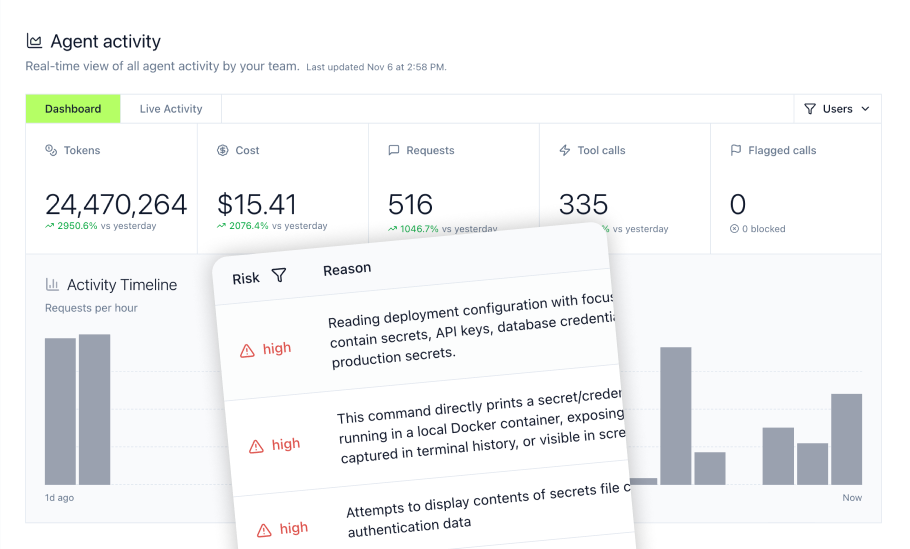
The global AI agent market is on track to reach $182.9 billion by 2033, yet most enterprises still cannot clearly attribute their AI spend to measurable business outcomes. While per-token costs have dropped 98% since early 2024, enterprise AI bills continue climbing because the real cost driver is not the model you choose. It is how agents consume tokens through context management, multi-step orchestration, and operational overhead. Organizations using an MCP Gateway can centralize governed tool and data access. MintMCP's Agent Gateway builds on that foundation with agent identities, permissions, memory, and monitoring, giving teams a clearer control layer for usage and risk.
This article breaks down estimated AI agent costs by model, use case, and deployment scenario, providing the data you need to budget accurately and reduce the cost, business-value, and risk-control problems Gartner says will contribute to over 40% of agentic AI projects being canceled by the end of 2027.
Key Takeaways
- Agentic workflows can consume substantially more tokens than single-turn chatbot queries, but the multiplier varies by task, model, context size, tool usage, and retry behavior
- Repeatedly supplied context can account for a large share of agent token consumption, particularly in long-running and tool-heavy workflows
- Anthropic prices cache reads at 90% below standard input tokens. With a one-hour cache, the first profitable whole-number case is three total uses of the same cached prefix, including the initial cache write
- Model inference is one component of enterprise AI spending. Orchestration infrastructure, monitoring, security controls, data pipelines, and engineering support can add substantial costs, with the final mix depending on the architecture and workload
- Centralized governance can improve cost visibility, access control, and risk management, addressing several of the issues Gartner associates with failed agentic AI projects
Understanding the Foundation: What Drives AI Agent Costs?
AI agent costs break into two categories that behave very differently: development (one-time) and operations (recurring). Most organizations underestimate operations because they focus on model pricing while ignoring the token multipliers that agentic architectures introduce.
The Role of Token Spend
Standard chatbot interactions involve single-turn exchanges with minimal context. Agents, by contrast, maintain state across multiple tool calls, reason through multi-step workflows, and repeatedly re-send conversation history with each API call. This architecture can create a substantial token multiplier compared with single-turn chatbot queries, although no single multiplier applies across all agent workloads.
What drives the multiplier:
- Context window management - Every tool call typically re-sends the entire conversation history
- Multi-step reasoning - Agents often require 10 to 50 LLM calls per completed task
- Error handling and retries - Failed tool calls trigger additional inference cycles
- Memory retrieval - RAG-enhanced agents add embedding lookups and retrieved context to each prompt
Hidden Costs Beyond Per-Token Fees
Model inference is one component of enterprise AI spending. Orchestration infrastructure, monitoring, security controls, data pipelines, and engineering support can add substantial costs, with the final mix depending on the architecture and workload.
Operational cost components:
- LLM API costs
- Cloud infrastructure
- Vector databases
- Monitoring and observability
- Security and compliance
Comparing LLM Pricing: How Different Models Impact Your Budget
Model selection affects cost, but not as dramatically as token consumption patterns. The real question is not which model is cheapest per token but which model delivers the required capability at the lowest total token cost.
Breakdown by Model
Current pricing for leading models (per million tokens):
GPT-5.6 Terra (OpenAI)
- Input: $2.00 per 1M tokens for standard short-context processing
- Output: $12.00 per 1M tokens
- Long-context pricing: $4.00 input and $18.00 output per 1M tokens
- Monthly range: Depends on token volume, context length, caching, service tier, and output share
- Best for: General-purpose agent workloads requiring strong reasoning and tool use
Claude Sonnet 5 (Anthropic)
- Input: $2.00 per 1M tokens through August 31, 2026
- Output: $10.00 per 1M tokens through August 31, 2026
- Standard pricing from September 1, 2026: $3.00 input and $15.00 output per 1M tokens
- Monthly range: Depends on token volume, caching, context length, and output share
- Best for: Coding, long-context analysis, and multi-step agent workflows
Gemini 2.5 Pro (Google)
- Input: $1.25 per 1M tokens for prompts up to 200K tokens, or $2.50 above 200K
- Output: $10.00 per 1M tokens for prompts up to 200K, or $15.00 above 200K
- Monthly range: Depends on prompt size, token volume, caching, and output share
- Best for: Long-context processing, coding, reasoning, and multimodal workloads
Strategies for Optimizing Token Spend
Prompt cache reads on Claude Sonnet 4.6 cost $0.30 per million tokens, compared with $3.00 for standard input. Because a one-hour cache write costs $6.00 per million tokens, caching becomes cheaper at three total uses of the same prefix within the TTL, including the initial write.
Cost optimization tactics:
- Implement prompt caching - Reduces the price of eligible cache-read input tokens by up to 90%
- Use model routing - Route simple queries to smaller models, complex tasks to capable models
- Compress context - Summarize conversation history instead of re-sending full transcripts
- Batch requests - Combine multiple small queries into single inference calls
- Self-hosted inference - Can lower unit costs for stable, high-utilization workloads
Real-World Token Spend: Data Analysis Agents in Action
Data analysis agents that query databases, generate reports, and synthesize findings represent one of the highest-ROI agent deployments, but also carry significant token costs due to query complexity and result processing.
Case Study: Token Consumption
A typical data analysis workflow involves:
- Natural language query interpretation (500 to 1,000 tokens)
- Schema retrieval and understanding (2,000 to 10,000 tokens depending on database complexity)
- SQL generation and validation (500 to 2,000 tokens)
- Result processing and summarization (1,000 to 5,000 tokens per query)
Using the ranges above, 50 to 100 analytical queries per day implies roughly 6 to 54 million tokens per 30-day month. API cost then depends on the selected model and the input, cached-input, and output mix, so teams should calculate spend from measured usage rather than assign a fixed monthly range.
Optimizing Queries
Organizations connecting agents to Snowflake, Elasticsearch, or internal data warehouses benefit from governed access. MintMCP's database connectors support tool-level controls that can expose approved read operations while excluding modifying tools. Query limits and warehouse-level controls are still needed to manage database compute costs.
Cost control measures:
- Implement query result size limits to cap output tokens
- Cache schema information to eliminate repeated retrieval
- Use tool-level access controls to restrict expensive operations
- Monitor query patterns to identify optimization opportunities
Calculating Costs for AI Coding Agents
Coding agents connecting to GitHub, Jira, and CI/CD pipelines exhibit high per-engineer token costs in production deployments. AI coding-agent spend can vary widely by engineer, model, repository size, and task. Platform teams should measure usage and completed-work outcomes directly instead of applying a company-wide per-engineer benchmark from a secondary report.
Coding Assistant Token Consumption
Coding agents consume tokens through:
- Codebase indexing - Initial context gathering (10,000 to 100,000+ tokens)
- File retrieval - Loading relevant source files (2,000 to 20,000 tokens per file)
- Code generation - Producing new code (500 to 5,000 tokens)
- Diff review - Analyzing changes (1,000 to 10,000 tokens)
- Test generation - Creating test cases (500 to 3,000 tokens)
A single complex coding task can consume 50,000 to 200,000 tokens when factoring in context, reasoning, and iteration.
Streamlining Development Workflows
Platform teams deploying AI coding assistants across organizations need centralized visibility into usage patterns. MintMCP's Agent Monitor captures prompts, file access, command execution, and MCP tool calls across supported coding agents, helping teams identify retries, unnecessary operations, and risky activity.
Cost reduction strategies:
- Implement per-user rate limits to prevent runaway consumption
- Cache frequently accessed repository context
- Use smaller models for routine tasks like documentation
- Batch code review requests to amortize context loading
Compliance and Security Agents: Cost Considerations
Financial services and healthcare organizations face additional cost layers from compliance requirements. In regulated deployments, context growth, retrieval regressions, and missing usage attribution can increase inference spend quickly. Exact dollar examples should come from an independently documented case study or the organization's own measured billing data.
Cost of Trust
Compliance cost components:
- Penetration testing and security assessments
- Data Protection Officer and compliance staff
- Audit logging pipeline
- Observability and evaluation platforms
- Human-in-the-loop implementation
Balancing Security and Spend
Security governance infrastructure can reduce security risk and help limit uncontrolled usage. Organizations using MintMCP benefit from inline DLP integration with Bedrock Guardrails, GCP DLP, Microsoft Purview, Nightfall, and Skyflow, with policy enforcement that can block or mask sensitive data before it reaches the model.
Security-focused cost controls:
- Implement custom guardrail policies with block, flag, and alert actions
- Detect PII exposure and credential leakage before they become incidents
- Use agent identities with scoped credentials for audit attribution
- Export audit logs to SIEM platforms for compliance documentation
Beyond Tokens: Operational Costs
Development costs represent a fraction of total investment. Ongoing costs vary widely by scope, integration depth, model usage, reliability targets, and compliance requirements. Organizations should estimate costs from engineering effort and expected workload rather than generic agent-type price bands.
Infrastructure and Governance Expenses
Development cost factors:
- Number and complexity of system integrations
- Required evaluations, testing, and human review
- Security, identity, and compliance controls
- Reliability and uptime requirements
- Expected tool calls, token volume, and retrieval workload
- Deployment model and ongoing engineering support
Generic labels such as reactive, contextual, autonomous, or multi-agent do not produce reliable market-wide price bands.
Infrastructure overhead factors:
- A 2026 CAST AI analysis found average GPU utilization of 5% across the non-optimized Kubernetes environments in its dataset. The figure should not be generalized to every enterprise GPU cluster or self-hosted AI deployment.
- Self-hosting can lower unit costs for stable, high-utilization workloads, but the result depends on hardware utilization, model size, staffing, latency targets, reserved capacity, and operational overhead.
- The API-versus-self-hosting crossover depends on sustained utilization, hardware and staffing costs, model requirements, latency targets, and data-control needs.
Measuring ROI
Production deployments demonstrate clear ROI when properly governed. However, McKinsey reported that 65% of respondents' organizations were regularly using generative AI in early 2024, up from roughly one-third in its 2023 survey. McKinsey's 2025 survey found that 23% of respondents were scaling an agentic AI system in at least one business function, while another 39% were experimenting with agents.
Strategic Cost Management: Optimizing Your AI Agent Deployments
Organizations that implement governance early report higher satisfaction and more predictable spending. Effective cost management requires visibility across all agent activity.
Implementing Cost Controls
MintMCP's Bundle model packages tool access, policy enforcement, and audit logging into single governance units per team or role, unlike approaches requiring manual configuration of separate components.
Cost control framework:
- Establish usage limits and alerts where supported
- Implement rate limiting per user and team at the gateway level
- Use tool-level access control to prevent expensive operations
- Monitor usage patterns to identify optimization opportunities
- Require admin approval for new tool additions to prevent scope creep
Leveraging Governance
Virtual MCPs (VMCPs) abstract complexity by bundling multiple servers with role-based tool access, reducing configuration overhead that would otherwise require dedicated engineering time.
Governance benefits:
- SCIM group membership syncs automatically with identity provider changes
- Per-agent credentials enable rotation independent of user access
- Conversation-level logging captures prompts, tool calls, and responses for audit and usage analysis
- Custom policy code execution on tool calls enables inline access, security, and data-handling controls
The Future of AI Agent Pricing
33% of enterprise software will include agentic AI by 2028, up from less than 1% in 2024. The average cost per million tokens fell from roughly $10 to $2.50 in a single year, yet token consumption is growing faster than prices are falling.
Evolving Pricing Models
OpenAI's current top token spender consumes about 100 billion tokens monthly, representing a million-fold increase from 6.5 years ago. Goldman Sachs projects a 24-fold increase in token consumption by 2030, reaching 120 quadrillion tokens per month.
Market trajectory:
- RAG market projected growth from $1.2 billion to $11 billion by 2030
- RAG adoption jumped from 31% to 51% in a single year
- Context rot degrades accuracy 30% or more in mid-window positions
Protocol Standardization Impact
MCP adoption accelerated in 2025 as more model providers, development tools, and AI clients added MCP support. Organizations using centralized MCP gateways gain cost visibility that siloed deployments cannot provide, making protocol-level governance the foundation for predictable AI spending.
Why MintMCP's Agent Gateway Matters for Cost Control
As AI agents move from experiment to production, the gap between organizations with clear cost visibility and those flying blind continues to widen. The difference rarely comes down to model selection or API pricing. It comes down to whether teams can see, attribute, and control token consumption before it becomes a problem.
MintMCP addresses this through a two-layer architecture:
- MCP Gateway provides governed data and tool connections for the AI systems teams already run, including Claude, Cursor, ChatGPT, Gemini, and Copilot
- Agent Gateway builds on that foundation with agent identities, scoped permissions, structured memory, and comprehensive monitoring
Together, these layers help platform teams scale agent deployments while maintaining control over spend, risk, and compliance posture.
Organizations using MintMCP also benefit from:
- Bundle-based governance that packages tool access, policy enforcement, and audit logging into single units per team or role
- Virtual MCPs that simplify integrations while preserving fine-grained access control
- Agent Monitor visibility into supported prompts, file operations, commands, and MCP tool calls
- Token-level cost attribution where supported, depending on whether the underlying client provides usage telemetry
- Enterprise security controls, including SOC 2 Type II audited infrastructure and compliance with HIPAA standards
These capabilities allow regulated industries to use MintMCP as part of their broader compliance and governance infrastructure.
The result is greater visibility and control over AI spending, reducing exposure to uncontrolled context growth, tool proliferation, and operational overhead. Gartner forecasts that over 40% of agentic AI projects will be canceled by the end of 2027 because of escalating costs, unclear business value, or inadequate risk controls. MintMCP's Agent Gateway exists to help organizations avoid those outcomes.
Frequently Asked Questions
What percentage of AI agent costs come from model inference versus infrastructure?
Model inference is one component of enterprise AI spending. Orchestration infrastructure, monitoring, security controls, data pipelines, and engineering support can add substantial costs, with the final mix depending on the architecture and workload. Organizations focused solely on API pricing miss the majority of their actual cost exposure.
How do I calculate the true monthly cost of running an AI agent?
Total monthly cost depends on LLM API usage, cloud infrastructure, vector databases, monitoring tools, and a portion of development maintenance. The exact mix varies by workload, deployment model, compliance requirements, and engineering support. Track actual token consumption, infrastructure utilization, and engineering time to build an accurate cost model for your specific deployment.
Why do agentic workflows cost so much more than chatbots?
Agentic workflows often consume more tokens per task because they maintain state across multiple tool calls, re-send conversation history with each API request, and often require 10 to 50 LLM calls per completed task. Repeatedly supplied context can become a major source of inference cost, especially when full histories and tool definitions are included in every model call.
What is the most effective way to reduce AI agent token costs?
Prompt caching can deliver a large immediate reduction on reusable input. Anthropic prices cache reads at 90% below standard input, although the total workload savings depend on how much of each request is cached and how often the prefix is reused. Beyond caching, implement context compression (summarize instead of re-sending full history), model routing (use smaller models for simple tasks), and centralized governance to identify and eliminate wasteful usage patterns.
When does self-hosting AI models become more cost-effective than APIs?
The API-versus-self-hosting crossover depends on sustained utilization, hardware and staffing costs, model requirements, latency targets, and data-control needs. A single cross-industry utilization figure cannot determine which option is cheaper for a particular workload. Most organizations benefit from API pricing until they can guarantee consistent high utilization of dedicated infrastructure and have the engineering resources to manage the operational complexity.