Multi-agent AI systems are moving from prototypes to production across enterprises, but the governance gap remains a critical blocker. When 74% of enterprises plan to deploy agentic AI within two years and the number of companies with at least 40% of AI experiments in production is expected to double within six months, the question shifts from "should we deploy agents" to "how do we govern them at scale."
Agent gateways solve the fundamental infrastructure problem that multi-agent workflows create: coordinating authentication, tracking actions across agent chains, enforcing policies, and maintaining audit trails when multiple AI agents delegate tasks to each other. Without a centralized control plane, organizations face fragmented security policies, zero visibility into which agents access which tools, and duplicated authentication logic that makes compliance audits impossible.
MintMCP Gateway addresses these challenges as both an MCP Gateway for governed data and tool connections and an Agent Gateway for agent identities, permissions, memory, and monitoring. This dual-layer approach starts with SSO, SCIM-driven RBAC, and tool-level policy before enabling agents, transforming the N-to-N complexity of multi-agent systems into a manageable hub-and-spoke model where every agent action flows through governed infrastructure.
Key Takeaways
- MintMCP Gateway provides enterprise MCP and Agent Gateway infrastructure with Virtual MCP Bundles, Agent Bundles for per-agent identity, hosted MCP connectors, custom JS middleware, and shadow AI detection via Agent Monitor
- Agent gateways extend MCP governance with agent-specific identities, permissions, memory scoping, and monitoring for coworker agents that work alongside teams
- Multi-agent coordination requires centralized authentication, session management, and audit trails when agents delegate tasks across chains
- Tool-level access control prevents silent capability expansion by requiring approval for new upstream tools added to MCP servers
- Shadow AI detection identifies unauthorized agent usage through local activity monitoring in Claude Code and Cursor
- OAuth brokering adds enterprise authentication to stdio and hosted MCP servers without rebuilding each connector
1. MintMCP Gateway: enterprise MCP and Agent Gateway infrastructure
MintMCP Gateway provides enterprise infrastructure for Model Context Protocol focused on authentication, tool-level access control, credential management, logging, and rule-based policy. As an MCP Gateway, it governs data and tool connections for the AI systems users already run, including Claude, Cursor, ChatGPT, Gemini, and Copilot. As an Agent Gateway, it provides the identities, permissions, memory, and monitoring needed for coworker agents that work alongside employees.
What makes MintMCP Gateway different
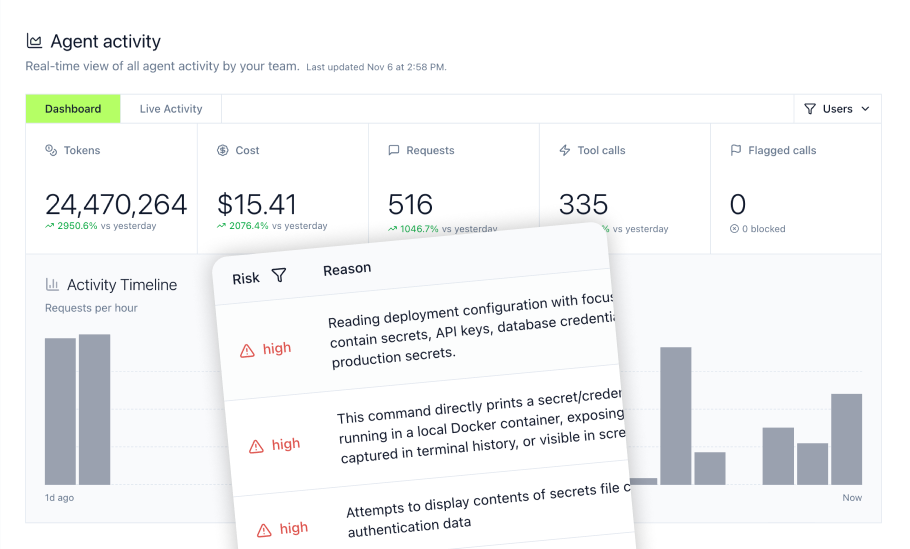
MintMCP solves the coordination problem that multi-agent workflows create by providing two distinct governance layers. The MCP Gateway covers all MCP traffic with centralized authentication and policy enforcement. Agent Monitor extends coverage to local non-MCP agent activity including Bash commands, file operations, and prompt submissions in Claude Code and Cursor.
This two-layer approach addresses shadow AI, the unauthorized agent usage that occurs when developers connect AI tools directly to data sources outside governed infrastructure. Through hooks in Cursor and Claude Code, Agent Monitor detects off-gateway MCP usage and can enforce policies via MDM-pushed configurations.
Core capabilities
- Virtual MCP Bundles create team-specific, per-use-case endpoints that expose only the minimum required tools with SCIM-driven membership, curated tool lists, and fine-grained role-based access
- Agent Bundles give internal agents first-class identities with M2M auth, scoped tools, independent rotation and revocation, and an "act as agent" flow for connectors requiring per-agent OAuth
- Hosted MCP Connectors run by MintMCP with auto-scaling and sandboxed execution per connector, eliminating the infrastructure overhead that typically delays production deployment
- Custom Gateway Middleware runs customer-authored JavaScript in a sandbox with external DLP integrations for masking, blocking, and policy enforcement including AWS Bedrock Guardrails, Google Cloud DLP, Microsoft Purview, Nightfall, and Skyflow
- OAuth brokering for stdio and hosted MCP servers adds enterprise authentication including OAuth 2.x, bearer tokens, headers, and SSO-fronted access without rebuilding each server
- Tool-update policy lets admins auto-enable new upstream tools or require approval, addressing silent capability expansion in MCP
Enterprise integrations
MintMCP provides hosted connectors for Salesforce, GitHub, Slack, HubSpot, Notion, Linear, Gmail, Stripe, Snowflake, Elasticsearch, and 100+ additional services. Custom MCP server deployment supports internal tools and APIs through the Admin MCP interface.
The platform provides governance across Claude, Cursor, ChatGPT, Gemini, and Copilot through the centralized gateway and Agent Monitor coverage.
Compliance and security
MintMCP is SOC 2 Type II audited with continuous compliance monitoring via Drata. The platform is compliant with HIPAA standards, and customers handling protected health information can request documentation. MintMCP signs BAAs.
Security architecture includes penetration-tested infrastructure, data encrypted in transit and at rest, and an uptime SLA. Visit the Trust Center or contact security@mintmcp.com for compliance documentation.
Deployment and pricing
Managed SaaS-first delivery with US and EU availability. VPC and self-hosted deployment available on request. Contact for enterprise demonstration and pricing.
2. TrueFoundry MCP Gateway
TrueFoundry provides a managed AI platform that combines LLM routing with MCP tool management in a unified control plane. The platform targets organizations that want agent orchestration and MCP governance in one product without operating separate infrastructure for each.
Where TrueFoundry fits
TrueFoundry reports that its broader AI Gateway handles 350+ requests per second on a single vCPU with approximately 3-4 ms of gateway latency. These figures should not be interpreted as MCP tool-call latency. The platform supports hub-and-spoke agent routing with a Virtual MCP Server DMZ model that centralizes multi-agent traffic.
Primary capabilities
- Unified LLM routing and MCP tool management in single gateway
- Cross-framework interoperability supporting LangChain and AutoGen agents in the same workflow
- End-to-end trace across multi-agent workflows with single control plane
- Token-level usage attribution by user, team, and geography
- SOC 2 Type 2 and HIPAA compliance options
Deployment options
Cloud, self-hosted, and air-gapped environments. Free trial available with enterprise pricing on request. The platform lists customers including Cargill, Mavenir, Whatfix, and Aviso.
3. Stacklok (ToolHive)
Stacklok provides an open-source MCP runtime platform that emphasizes container isolation and token optimization for Kubernetes-native deployments. The project operates under Apache 2.0 licensing.
Where Stacklok fits
Platform engineering teams running multi-agent workflows on Kubernetes who require runtime-level isolation between MCP servers. Stacklok documents 60-85% per-request token reduction through its embedded MCP Optimizer, which surfaces tools on-demand via semantic search rather than injecting the full catalog into each context window.
Primary capabilities
- Per-MCP-server container isolation with scoped network and filesystem permissions
- vMCP (virtual MCP) scopes tools per agent role with circuit breakers
- Embedded auth server for per-request identity with token exchange including descoped tokens
- OTel MCP semantic conventions with Grafana, Datadog, Splunk, and New Relic support
- Apache 2.0 open-source licensing
Deployment model
Self-hosted on Kubernetes infrastructure. Infrastructure costs vary based on cluster size and usage patterns.
4. Bifrost by Maxim AI
Bifrost provides an open-source AI gateway built in Go that emphasizes performance and vendor neutrality. The project operates under Apache 2.0 licensing with optional enterprise tiers.
Where Bifrost fits
Organizations where gateway latency directly impacts user experience or throughput requirements. Bifrost documents 11 microsecond overhead at 5,000 RPS, positioning it for real-time AI applications where compiled-language performance matters.
Primary capabilities
- Unified interface to 12+ providers including OpenAI, Anthropic, AWS Bedrock, Google Vertex, and Azure
- Semantic caching that reduces cost and latency by reusing responses
- Hierarchical budget management at virtual key, team, project, or customer level
- HashiCorp Vault support for secret management
- Apache 2.0 open-source core with enterprise extensions
Deployment model
Self-hosted via Go binary or Docker. Enterprise tier available for VPC deployment. No managed SaaS option documented.
5. Tetrate Agent Router Enterprise
Tetrate provides an AI gateway built on Envoy AI Gateway, which the company co-created with Bloomberg as a CNCF-backed project. The architecture emphasizes distributed deployment with a single control plane governing data planes across regions and clouds.
Where Tetrate fits
Multi-team, regulated, or globally distributed organizations that need consistent policy enforcement across regions. The Envoy foundation provides battle-tested reliability from internet-scale deployments.
Primary capabilities
- LLM gateway and MCP gateway with pre-built FINOS AI governance controls
- Multi-region deployment with localized model catalogs and region-specific guardrails
- Same-model cross-provider failover (e.g., Anthropic API to Vertex AI)
- Tetrate-managed control plane with data planes in customer VPC or on-premises
- CNCF-backed open-source foundation
Deployment model
Distributed architecture with managed control plane. Agent Router Service has free tier with enterprise pricing on request.
6. Portkey
Portkey provides an LLMOps platform that combines prompt management, guardrails, and evaluation capabilities alongside gateway functionality. Palo Alto Networks announced its intent to acquire Portkey in April 2026 and completed the acquisition on May 29, 2026. Portkey's AI Gateway is being integrated into Prisma AIRS.
Where Portkey fits
Teams that want broader LLMOps capabilities beyond basic routing, including prompt versioning, collaborative templates, and 50+ pre-built guardrails. Portkey publishes SOC 2, ISO 27001, HIPAA, and GDPR security and compliance documentation.
Primary capabilities
- 100+ LLMs through unified API with deterministic and LLM-based guardrails
- Prompt management with collaborative templates and versioning
- MCP Gateway product (separate from main LLMOps offering)
- 99.99% uptime SLA documented
- Multiple deployment options including SaaS, hybrid, and air-gapped
Deployment and pricing
Portkey offers self-service and enterprise plans. Check its current pricing page for request limits and plan pricing. Portkey is now part of Palo Alto Networks, and its AI Gateway is being integrated into Prisma AIRS.
7. Cloudflare AI Gateway
Cloudflare extends its edge infrastructure with AI Gateway capabilities, providing traffic management for AI workloads through its global network. MCP Server Portals entered open beta with centralized server discovery and DLP features.
Where Cloudflare fits
Organizations already standardized on Cloudflare infrastructure who want to add AI gateway capabilities without deploying separate systems. Edge caching eliminates redundant requests and reduces latency for geographically distributed users.
Primary capabilities
- Global edge caching for AI traffic
- MCP Server Portals (open beta) with centralized server discovery
- Zero Data Retention routing for compliance-sensitive workloads
- Unified billing for supported model providers
- Core features free on all Cloudflare plans
Deployment considerations
Cloudflare provides a managed edge deployment rather than a customer-operated VPC or on-premises data plane. Enterprise customers should verify how Cloudflare's Data Localization Suite applies to the specific AI Gateway and MCP Server Portal data they process.
8. Kong AI Gateway
Kong extends its API management platform with AI-specific plugins for rate limiting, PII detection, and prompt validation. MCP Proxy plugin shipped in version 3.12 with A2A support in version 3.14.
Where Kong fits
Organizations with existing Kong deployments seeking unified governance for APIs and AI traffic from a single control plane. The platform applies mature API management patterns to LLM and MCP workloads.
Primary capabilities
- Plugin-based extensibility for rate limiting, PII detection, prompt validation
- MCP Proxy plugin (3.12) and A2A support (3.14)
- Enterprise RBAC, audit logging, policy management
- Multi-cloud and hybrid deployment support
- Konnect cloud or fully self-hosted options
Deployment and pricing
Pricing based on per-request plus per-plugin model. Organizations should evaluate whether AI capabilities as extensions provide the MCP-specific governance primitives they need.
9. Obot by ACORN Labs
Obot provides Kubernetes-native agent orchestration with bundled MCP catalog management. The platform targets teams that want agent orchestration and MCP catalog management through self-hosted Docker or Kubernetes deployments, with a hosted option also available.
Where Obot fits
Platform engineering teams that want agent orchestration and MCP catalog management through self-hosted Docker or Kubernetes deployments, with a hosted option also available. All data stays within customer infrastructure for self-hosted deployments.
Primary capabilities
- Bundled agent orchestration and MCP catalog management
- Enterprise IdP integration and OAuth support
- Built-in chat interface compliant with MCP requirements
- Kubernetes pod isolation for agent security
- Self-hosted and hosted deployment options
Deployment considerations
Obot supports self-hosted Docker and Kubernetes deployments and also offers a hosted MCP platform. Production documentation for regulated environments less extensive than managed alternatives.
10. Lunar.dev MCPX
Lunar.dev provides a unified gateway covering AI model traffic, MCP tools, and enterprise APIs from a single control plane. Lunar.dev states that it was recognized in Gartner research covering the emerging AI Gateway category.
Where Lunar.dev fits
Security, IT, and platform teams that need centralized governance across AI model traffic, MCP tools, and enterprise APIs without deploying separate gateways for each category.
Primary capabilities
- Tool-level ACLs at global, service, and individual tool levels
- Immutable audit trail logging every agent action with full parameters
- Centralized secret management with API keys stored in gateway
- SIEM-ready audit logs with forensic capability per-agent
- SOC 2 compliance in Enterprise offering
Deployment options
Self-hosted via Docker/Kubernetes with optional SaaS dashboards for telemetry and control plane visibility. Free tier available with paid plans on contact.
How MintMCP defines the Agent Gateway category
The distinction between MCP Gateway and Agent Gateway matters because they solve different problems. An MCP Gateway governs how humans and systems access data and tools through the Model Context Protocol. An Agent Gateway extends that foundation to govern how autonomous agents operate, coordinate, and act on behalf of teams.
MintMCP Gateway positions itself at the intersection of both categories. The MCP Gateway layer ensures that every connection to enterprise data and tools flows through centralized authentication, policy enforcement, and audit logging. This prevents the credential sprawl and policy fragmentation that makes multi-agent systems impossible to audit.
The Agent Gateway layer builds on that foundation by giving each agent its own identity through Agent Bundles. When coworker agents work alongside employees in Slack or other collaboration platforms, they need scoped permissions that reflect their role, not their creator's access level. They need independent credential rotation and revocation. They need memory that persists across conversations and carries context forward, but remains scoped to team, organization, or customer boundaries.
MintMCP's approach to agent memory follows Git-like principles: company-owned, versioned, reviewable, auditable, and portable. This contrasts with opaque vendor-controlled memory stores where organizations have limited visibility into what agents remember, how memory evolves, or how to recover when memory drifts. When coworker agents hold context across days and weeks, memory governance becomes as critical as access control.
Agent Monitor extends governance beyond the gateway itself to detect shadow AI at the edge. Through hooks in Cursor and Claude Code, it identifies when developers connect AI tools directly to data sources outside governed infrastructure. This visibility matters because the governance gap in multi-agent workflows often appears not at the gateway, but in local development environments where individual developers test agents against production data.
Organizations deploying Claude, Cursor, ChatGPT, Gemini, and Copilot across teams need infrastructure that answers: which agents accessed which tools, when did they access data, what actions did they take, and under whose authority. Without centralized visibility, audit trails fragment across systems, compliance becomes aspirational, and the question "who authorized this action" becomes genuinely difficult to answer.
MintMCP provides that visibility by treating governance as the foundation, not an afterthought. Start with a free trial to see how MintMCP transforms multi-agent deployment from governance challenge to governed infrastructure.
Frequently asked questions
What is an AI agent gateway and why is it different from an API gateway?
Agent gateways specifically handle the coordination challenges that multi-agent workflows create: tracking actions across agent chains, managing session state, enforcing policies when agents delegate to each other, and maintaining audit trails that span multiple AI systems. Traditional API gateways route HTTP requests between services but lack protocol awareness for MCP, agent identity management, and the observability needed when AI agents access tools and data autonomously.
How does the MintMCP Bundle architecture simplify agent management?
Virtual MCP Bundles package tool access, policy enforcement, and audit logging into single governance units per team or role. Instead of configuring separate plugin, access rule, and credential objects for each agent, administrators create one Bundle with SCIM-driven membership that automatically syncs with Okta or Azure AD group changes. Agent Bundles extend this model to non-human principals, giving each deployed agent its own rotatable credentials and permission scope independent of its creator's access level.
Can agent gateways detect unauthorized AI tool usage within an organization?
MintMCP's Agent Monitor provides shadow AI detection through hooks in Cursor and Claude Code. The system identifies off-gateway MCP usage, detects PII exposure and credential leakage, flags risky bash commands, and spots prompt injection attempts using built-in rules. Organizations can push detect-only or enforce-mode configurations to developer machines via MDM for consistent policy application across the organization.
What compliance programs should enterprises look for in agent gateways?
SOC 2 Type II attestation provides independent verification of security controls over time. HIPAA compliance matters for healthcare data. Organizations should verify whether programs cover the specific gateway components they plan to use, as some vendors separate LLM gateway and MCP gateway compliance. MintMCP is SOC 2 Type II audited with continuous Drata monitoring and is compliant with HIPAA standards with BAA available for healthcare customers.
How do agent gateways integrate with existing enterprise identity systems?
Enterprise agent gateways typically support OAuth 2.x, SAML for SSO, OpenID Connect for modern identity providers, and SCIM for automated user provisioning. MintMCP integrates with Okta and Azure AD for SSO and SCIM-driven RBAC, automatically syncing group membership changes to Virtual MCP Bundle access. Per-agent identity through Agent Bundles enables M2M authentication with rotation and revocation independent of human user credentials.