Platform engineering teams deploying AI agents face a critical infrastructure decision: how do you connect autonomous agents to enterprise systems securely, at scale, without creating integration chaos? According to the HAI Stanford AI Index Report, GenAI usage jumped from 33% to 71% between 2023 and 2024, intensifying the pressure to enable AI tools while maintaining governance.
Model Context Protocol (MCP), introduced by Anthropic in November 2024, has rapidly become a de facto standard for agent-to-tool connectivity, with adoption across major AI and developer platforms. But the protocol alone doesn't solve production challenges. An MCP gateway provides the missing infrastructure layer: centralized authentication, audit logging, rate control, and observability that transforms experimental AI tools into production-ready services.
Key Takeaways
- MCP gateways standardize agent-to-tool access with centralized security and governance
- Open-source options like Docker, Obot, and IBM ContextForge provide vendor independence for self-hosted deployments
- Platform teams should expect MCP features to keep appearing across API gateway, developer-tooling, and AI infrastructure vendors
- AI-native defenses reduce prompt injection, data exfiltration, and unsafe tool execution
- MintMCP reduces procurement and security-review drag by shipping with audited controls and strong governance patterns
1. MintMCP Gateway: Enterprise Compliance Leader
MintMCP Gateway provides a SOC 2 Type II audited platform for enterprise MCP deployment. For platform engineering teams in regulated industries, this can reduce procurement friction by giving security teams audited controls to review.
What Makes MintMCP Different
MintMCP's one-click deployment transforms local STDIO-based MCP servers into production services with OAuth brokering for stdio and hosted MCP servers, reducing infrastructure configuration work. The platform's Virtual MCP Bundles expose curated tool sets per role or use case, enforcing least-privilege access with SCIM-driven membership and tool-level policy.
MintMCP is data-permissions-first: it starts with SSO, SCIM-driven RBAC, IdP groups, Virtual MCP Bundles, tool-level allowlisting, rule-based policy, and audit, then enables agents on top. The official Cursor Hooks partnership also supports MintMCP's governance coverage for coding agents.
Key Capabilities
- SOC 2 Type II audited controls to support enterprise procurement
- Pre-built enterprise connectors for Snowflake, Elasticsearch, and Gmail
- Complete audit trails and centralized observability
- Tool-level allowlisting, rule-based policy, and credential management
- Virtual MCP Bundles with SCIM-driven membership
- Agent Bundles with M2M auth and “act as agent” flow
- Gateway and Agent Monitor coverage for Claude, Cursor, ChatGPT, Gemini, and Copilot governance
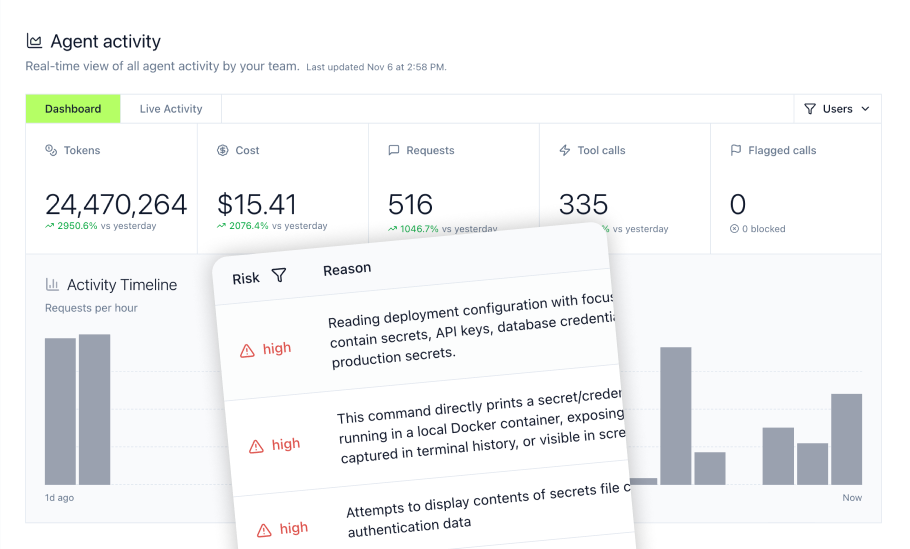
- LLM Proxy for tracking tool calls, bash commands, and file activity
Best For
Regulated industries requiring third-party audited security controls; platform teams where compliance review, tool-level access control, and internal agent governance are procurement requirements.
Deployment
Managed SaaS-first, with US and EU options; VPC/self-hosted on request
Pricing
Contact for demo
2. Bifrost by Maxim AI
Bifrost is designed for low gateway overhead, with public materials commonly describing about 11µs overhead. Built in Go for efficiency, Bifrost is aimed at teams that want a self-hosted, high-performance gateway layer.
Core Features
Bifrost's dual MCP client/server architecture enables advanced routing patterns, letting it act as both consumer and provider simultaneously. The stateless security model keeps control on the client side, preventing unauthorized operations without centralized policy databases.
Key Capabilities
- Optimized for extremely low gateway overhead compared to heavier proxy layers
- Fast local deployment for development and testing
- Apache 2.0 open-source license
- Built-in tool registry for MCP server discovery
- STDIO, HTTP, and SSE transport support
Best For
Latency-sensitive applications where gateway overhead directly impacts user experience; conversational AI requiring real-time responses.
Deployment
Self-hosted or Enterprise edition
Pricing
Free open-source option; Enterprise edition available
3. TrueFoundry MCP Gateway
TrueFoundry builds on a simple but powerful insight: most organizations already have AI infrastructure for managing LLMs. Instead of building parallel systems for MCP tools, TrueFoundry unifies LLM and MCP management into a single control plane, with public materials often citing low-millisecond overhead and 350+ RPS on a single vCPU.
Primary Focus
The platform's in-memory policy enforcement is designed to support governance without database query overhead. MCP Server Groups provide logical isolation so different teams can experiment without creating security conflicts, critical for platform teams supporting multiple product groups.
Key Capabilities
- Unified LLM and MCP management in single dashboard
- OAuth 2.0 Identity Injection for On-Behalf-Of authentication
- Unified billing and observability across AI tool usage
- Policy enforcement for MCP tool access
- Self-hosted and managed deployment options
Best For
Platform teams already managing AI infrastructure who want consolidated management; organizations seeking to reduce architectural fragmentation.
Deployment
Managed or Self-hosted
Pricing
Contact for pricing
4. Docker MCP Gateway
Docker MCP Gateway leverages Docker's core strength, containerization, to provide MCP deployment for container-first platform teams. The approach provides security isolation through familiar Docker patterns.
Container-Native Approach
Container isolation with configurable CPU/memory limits and restricted privileges helps mitigate command injection risks. Cryptographically signed container images address supply chain security, a growing concern for platform teams managing third-party MCP servers. CVE-2025-6514 affected the mcp-remote npm package and was patched in mcp-remote v0.1.16, underscoring the importance of dependency hygiene around MCP tooling.
Key Capabilities
- Docker Compose orchestration for multi-server deployments
- Latency overhead varies by host and container startup/caching behavior
- Docker Desktop integration for local development
- Familiar tooling for existing Docker teams
- Open-source with no licensing costs
Best For
Container-first platform teams; organizations standardized on Docker workflows; teams prioritizing security isolation over raw performance.
Deployment
Self-hosted
Pricing
Free open-source option
5. Lunar.dev MCPX
Lunar.dev MCPX stands out for granular access control capabilities, offering tool-level RBAC at global, service, and individual tool levels. The platform is designed to maintain auditability while adding governance controls to MCP traffic.
Governance Capabilities
The platform's tool customization capabilities let administrators rewrite tool descriptions or lock parameters for safer LLM interactions. This addresses scenarios where default tool configurations pose risks in enterprise contexts.
Key Capabilities
- Enable read operations while blocking write tools at granular level
- Immutable audit logs for compliance
- Prometheus-compatible metrics with labels for tool name, error state, calling agent, and model
- Integration with Lunar AI Gateway for end-to-end coverage
- Enterprise case studies demonstrating scale
Best For
Multi-tenant platform engineering environments requiring strict governance; organizations with complex permission hierarchies.
Deployment
Managed or Self-hosted
Pricing
Free tier available
6. Lasso Security
Lasso Security brings AI threat detection to MCP infrastructure. The platform addresses attack vectors that traditional API gateways may miss.
AI-Native Security
Lasso's real-time prompt injection detection blocks malicious inputs before they reach MCP tools. The MCP server reputation scoring system is designed to reduce supply chain risk from suspicious servers and tool packages.
Key Capabilities
- Real-time prompt injection and jailbreak detection
- PII masking via Presidio integration
- Added latency depends on enabled inspection depth and deployment architecture
- Plugin-based architecture for custom security rules
- Open-source and enterprise options
Best For
High-security environments such as defense, intelligence, and critical infrastructure; platform teams facing sophisticated threat actors.
Deployment
Open-source or Enterprise
Pricing
Free open-source option; enterprise version available
7. IBM ContextForge
IBM ContextForge is known for enabling multi-gateway federation with auto-discovery via mDNS. For large distributed platform teams, this means coordinated gateway instances across regions and business units.
Federation Architecture
Multiple ContextForge instances can discover and share tool registries without manual configuration. The protocol bridging capability wraps existing REST/gRPC APIs as MCP tools without requiring API changes, which can help organizations with significant legacy infrastructure.
Key Capabilities
- Virtual MCP servers combining multiple backends
- 100-300ms latency, configuration dependent
- Protocol bridging for legacy system integration
- Apache 2.0 license
- Multi-gateway federation patterns
Best For
Large distributed organizations needing coordinated gateway instances; legacy integration scenarios.
Deployment
Self-hosted
Pricing
Free open-source option
8. Obot Platform
Obot delivers an open-source MCP platform, including gateway, catalog, chat client, and agent orchestration capabilities. The platform provides a broader agent infrastructure surface for teams that want to run and customize their own environment.
Complete Platform Approach
The hub-and-spoke architecture reduces N-to-N complexity for multi-agent, multi-server environments. The built-in MCP Catalog with searchable directory and trust levels helps platform teams curate approved tools for their organization.
Key Capabilities
- Kubernetes-native deployment with enterprise IdP support such as Okta, Microsoft Entra, GitHub, and Google
- Nanobot framework for advanced agent orchestration
- Complete platform beyond gateway functionality
- Open-source transparency for security audits
- Catalog and trust-level workflows for MCP tool curation
Best For
Platform teams building custom AI agent infrastructure; organizations requiring vendor independence with self-hosted deployment.
Deployment
Self-hosted Kubernetes
Pricing
Free open-source option
9. Composio
Composio takes a different approach: rather than focusing primarily on gateway performance, it prioritizes managed integrations that platform teams would otherwise build themselves. Composio is a fit for teams prioritizing time-to-production for common SaaS and app workflows.
Integration-First Strategy
The unified authentication layer abstracts OAuth and API key complexity across tools. Native support for multiple agent frameworks means platform teams can enable AI tools without framework-specific integration work.
Key Capabilities
- SOC 2 Type II audited controls for enterprise procurement
- Production usage across customer agent workflows
- Performance optimized for production integrations
- Significantly reduces integration setup time for common workflows
- Free tier with 20k calls/month
Best For
Platform teams without dedicated integration engineers; organizations needing broad SaaS tool coverage quickly.
Deployment
Managed SaaS-first; VPC/on-prem on Enterprise tier only
Pricing
Free tier with 20k calls/month
10. Kong AI Gateway
Kong AI Gateway extends Kong's API gateway foundation with MCP capabilities. For organizations already managing APIs through Kong, this can reduce infrastructure sprawl.
API Gateway Extension
Kong's MCP capabilities can expose existing APIs as MCP-compatible tools, helping teams bring existing endpoints into agent workflows. The centralized OAuth plugin secures MCP servers through existing Kong policies.
Key Capabilities
- Mature API gateway foundation with enterprise adoption
- LLM-as-a-Judge policy for output quality validation
- Unified API and MCP management in single platform
- REST-to-MCP conversion without code changes
- Fits teams already standardized on Kong infrastructure
Best For
Platform teams with existing Kong deployments; organizations reducing infrastructure sprawl through consolidation.
Deployment
Enterprise
Pricing
Enterprise licensing
11. Traefik Hub MCP Gateway
Traefik Hub brings its cloud-native approach to MCP with a "Triple Gate Pattern" security architecture protecting AI model, MCP protocol, and underlying API layers simultaneously.
Cloud-Native Security
The On-Behalf-Of Authentication with OAuth 2.0 token exchange enables user-context-aware MCP operations. Task-Based Access Control provides dynamic authorization that adapts to operational context.
Key Capabilities
- MCP capabilities as middleware layers on existing Traefik infrastructure
- OpenTelemetry integration for MCP-specific metrics
- Defense-in-depth across three security layers
- Cloud-native design leveraging familiar tooling
- Commercial licensing tied to Traefik Hub subscription
Best For
Cloud-native platform teams standardized on Traefik; organizations adding MCP without new infrastructure.
Deployment
Commercial
Pricing
Commercial licensing
12. Microsoft Azure MCP Gateway
Microsoft Azure MCP Gateway provides integration with Azure services such as Entra ID, Azure Monitor, App Insights, and Container Apps. For Azure-exclusive platform teams, this can reduce authentication complexity.
Azure Ecosystem Integration
The platform offers two deployment paths: open-source Kubernetes for teams wanting control, or Azure API Management integration for managed deployment. Native Entra ID support means existing Azure AD configurations can work with MCP gateway deployments.
Key Capabilities
- Session-aware routing with Azure native services
- 80-150ms latency for cloud-based deployment, depending on configuration
- Kubernetes-native architecture for multi-tenant routing
- Azure Monitor and App Insights integration built-in
- Open-source implementation with Azure infrastructure costs
Best For
Azure-exclusive platform teams; Microsoft-centric organizations leveraging existing Entra ID investments.
Deployment
Cloud or Self-hosted Kubernetes
Pricing
Free open-source option; Azure infrastructure costs apply
Deploy Enterprise MCP Infrastructure with Confidence
The Model Context Protocol has fundamentally transformed how platform engineering teams connect AI agents to enterprise systems. But as this analysis demonstrates, deploying MCP at scale requires more than protocol support; it demands enterprise-grade security, governance, and monitoring infrastructure.
MintMCP Gateway is a strong choice for organizations prioritizing rapid production deployment with compliance built in. As a SOC 2 Type II audited MCP platform with one-click deployment, MintMCP reduces the infrastructure configuration work that slows many self-hosted approaches. The official Cursor partnership supports MintMCP's position in governance for AI coding agents.
Whether you're securing access to Snowflake data warehouses, Elasticsearch knowledge bases, or custom enterprise tools, MintMCP provides the infrastructure that makes AI deployment practical, compliant, and secure.
For deeper implementation guidance, see this enterprise MCP deployment guide and learn more about AI governance trends shaping enterprise adoption.
Visit mintmcp.com to schedule a demo and see how MintMCP Gateway can accelerate your enterprise AI deployment.
Frequently Asked Questions
What's the difference between an MCP gateway and an API gateway?
An MCP gateway specializes in the Model Context Protocol, the standard for AI agent-to-tool communication. While traditional API gateways handle HTTP request/response patterns, MCP gateways manage tool discovery, authentication delegation, session state, and audit logging specific to AI agent interactions. Many organizations run both, with the MCP gateway handling AI-specific traffic while API gateways manage traditional service-to-service communication.
How quickly can platform teams deploy an MCP gateway?
Deployment timelines vary significantly by approach. Managed platforms like MintMCP offer one-click deployment and can reduce infrastructure setup time. Self-hosted options like Docker or Bifrost require additional work for configuration, security hardening, and observability setup. Enterprise deployments with compliance requirements vary based on security review and internal procurement requirements.
Do MCP gateways work with existing identity providers?
Yes, enterprise-grade gateways support standard identity patterns. MintMCP supports SSO and SCIM-driven RBAC, enabling platform teams to enforce existing access policies without creating parallel identity systems. Other gateways may support OAuth 2.0, SAML, and enterprise SSO providers such as Okta, Microsoft Entra, and Google Workspace, depending on product and deployment model.
Which gateway is best for organizations concerned about vendor lock-in?
Open-source options provide the strongest vendor independence. Bifrost, Docker, IBM ContextForge, Lasso, and Obot all allow self-hosting with code access. Microsoft Azure gateway is also open-source but optimized for Azure infrastructure. For organizations requiring managed services without lock-in, evaluate contract terms, deployment model, and data portability before committing.
How do MCP gateways handle AI-specific security threats?
Traditional API security misses AI-specific attack vectors. Purpose-built gateways like Lasso Security detect prompt injection attempts in real time. MintMCP's LLM Proxy monitors tool calls, bash commands, and file activity from coding agents. Platform teams should prioritize gateways with AI-native security features rather than relying solely on traditional WAF/API gateway protections.