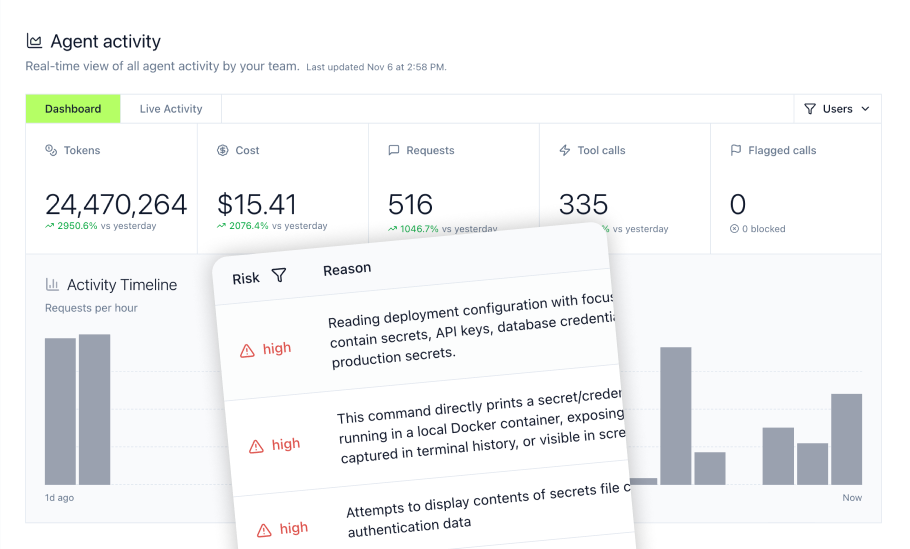
Enterprises deploying AI agents across Claude, Cursor, ChatGPT, Gemini, and Copilot face a critical challenge: governing what those systems access, which credentials they use, and what actions they take. When evaluating alternatives to Prompt Security, now part of SentinelOne, the choice comes down to your governance requirements, deployment model, and whether you need AI runtime protection, shadow AI visibility, or governed MCP gateway access. This guide examines alternatives for securing AI agent infrastructure in 2026, with particular emphasis on MintMCP's approach to governed MCP access, agent identity, and runtime controls.
Key Takeaways
- MintMCP combines Virtual MCP bundles, agent identities, and three-layer guardrails for enterprise teams requiring governed data and tool connections
- Virtual MCPs deliver per-use-case endpoints with SCIM-driven membership, curated tools, and access policies in a unified governance model
- Agent identity models vary significantly: MintMCP's Agent Gateway provides first-class non-human identities with M2M authentication and independently managed credentials, while alternatives differ in how they implement identity, delegation, and policy enforcement
- Deployment flexibility matters: Options range from managed SaaS-first (MintMCP, Composio) to self-hosted and cloud (Obot AI) to full platform solutions (TrueFoundry)
- MintMCP combines MCP-first governance with LLM Gateway for governed model access, usage monitoring, and policy enforcement, while Portkey and TrueFoundry emphasize broad model-routing capabilities
- Guardrails depth varies: MintMCP provides three-layer approach through Mint Guard, Rules, and Gateway Middleware versus single-layer or built-in approaches from competitors
Understanding AI Gateways: Why Prompt Security Is Crucial
The Model Context Protocol has become the connective tissue for enterprise AI, enabling AI clients to access enterprise tools, databases, and services. But this connectivity creates significant security challenges that traditional API security approaches cannot address.
The core problem: AI agents decide which tools to call at runtime. Tools can appear, change, or disappear through the list_tools mechanism. Tool descriptions themselves become an injection surface. Without proper governance, organizations face:
- No visibility into which tools agents are calling or what data they access
- Scattered credentials across developer laptops where a single leak exposes critical systems
- Missing audit trails that make SOC 2, HIPAA, and internal risk reporting impossible
- Config sprawl where every developer configures MCP servers locally across multiple machines
- Prompt injection risks where malicious tool descriptions inject instructions into agent prompts
An AI agent security layer addresses these challenges by centralizing authentication, governing tool access, injecting credentials securely, and logging every interaction.
1. MintMCP: Enterprise MCP and Agent Governance
MintMCP provides an MCP-first governance platform for enterprise teams managing AI clients and autonomous agents. The platform takes a data-permissions-first approach: governance is the foundation, and agents are enabled on top. This architecture makes AI systems deployable, governed, measurable, and swappable without slowing rollout.
Key MintMCP Advantages:
- Virtual MCPs: One endpoint per role, team, use case, or agent with SCIM-driven group membership and curated tool surfaces
- Agent identities: First-class non-human principals with bearer keys, M2M tokens, or workload identity federation
- Three-layer guardrails: Mint Guard for managed detection, Rules for declarative matching, and Gateway Middleware for customer-authored JavaScript logic
- SOC 2 Type II audited infrastructure with HIPAA standards compliance
- Agent Monitor provides visibility beyond gateway traffic into prompts, commands, file access, and tool calls
- Hosted MCP connectors with access to directory of 10,000+ MCP servers
MCP Gateway Capabilities:
- Per-use-case bundled endpoints with Virtual MCPs
- Programmable middleware with DLP integration
- OAuth brokering for STDIO/hosted servers
- Vendor-operated MCP server runtime
Pricing:
Contact MintMCP for customized pricing based on team size and usage. Free 7-day trial advertised for evaluation. The platform is SOC 2 Type II audited, with enterprise SSO/SCIM capabilities, SLAs, and dedicated support options.
2. Composio
Composio positions itself as an integration and MCP governance platform for AI agent builders, offering more than 1,500 prebuilt app integrations. The platform manages OAuth and API key authentication automatically, reducing time-to-integration for development teams.
Key Strengths:
- 1,500+ prebuilt app integrations covering SaaS, databases, and enterprise tools
- Managed authentication handles OAuth flows and API key management automatically
- Framework versatility works with LangChain, CrewAI, AutoGen, and OpenAI Agents
- Quick time to value with integration times measured in minutes
- Enterprise MCP Gateway with centralized policies and team-scoped endpoints
Capabilities:
- Managed OAuth for supported applications, with API key and other authentication methods available
- Execution logs for debugging and audit
- Per-user credential handling
- Action-level access control with SCIM integration
Pricing:
Free tier available. Contact for enterprise pricing with SSO/SCIM support.
Tradeoffs to Consider:
Composio combines developer-oriented agent integrations with an enterprise MCP Gateway offering centralized access policies, team-scoped endpoints, SCIM integration, and audit trails. MintMCP's approach emphasizes internal employee and agent governance through its specific Virtual MCP model, Agent Gateway identities, and broader Agent Monitor visibility.
3. Portkey
Portkey, acquired by Palo Alto Networks in May 2026, provides AI gateway technology now incorporated into Prisma AIRS AI Gateway. Its capabilities include unified access to LLMs, model routing, observability, guardrails, and MCP governance.
Key Strengths:
- 1,600+ AI models accessible through unified OpenAI-compatible API
- 60+ built-in guardrails for safety and policy enforcement
- Comprehensive observability with logging, tracing, and monitoring
- Semantic caching to reduce costs and latency
- Production tier with 100K requests included
Capabilities:
- Fallback and load balancing across model providers
- Virtual keys for credential management
- Real-time guardrails with configurable policies
- OpenTelemetry-compliant observability
- OAuth authentication and agent-scoped governance
Pricing:
- Free Forever: 10K logs/month, 3-day retention
- Production: Starting tier with 100K logs, RBAC support
- Enterprise: Custom pricing for private cloud and BAAs
Tradeoffs to Consider:
Portkey supports centralized MCP governance, OAuth authentication, virtual MCP concepts, and agent-scoped controls. MintMCP differentiates through its Virtual MCP model with SCIM-driven membership and Agent Gateway's independent agent credentials and audit attribution.
4. TrueFoundry
TrueFoundry delivers a complete AI infrastructure platform that includes model serving, deployment, and an MCP gateway as one component of a broader offering. The platform targets ML platform teams building comprehensive AI infrastructure.
Key Strengths:
- Full platform scope including model serving, fine-tuning, and deployment
- Transparent pricing with clear overage rates
- Kubernetes-native architecture for teams with existing K8s infrastructure
- Air-gapped deployment support for regulated environments
- 1,000+ model access with unified management
Capabilities:
- Virtual MCPs similar to MintMCP's approach
- SSO/SCIM integration at enterprise tier
- Agent identity support with RBAC
- Private cloud and on-premise deployment options
Tradeoffs to Consider:
TrueFoundry's breadth means MCP governance is one module among many. Teams focused specifically on MCP governance without needing model serving may find the platform's scope adds complexity.
5. Obot AI
Obot AI takes an OSS-first approach to MCP governance, providing self-hosted and managed options for teams requiring control or preferring cloud deployment.
Key Strengths:
- Open-source core with MIT licensing
- Self-hosted and managed options with free open-source edition and optional hosted cloud offering
- Docker for development, Kubernetes for production
- Virtual MCP endpoints with composite tool surfaces
Capabilities:
- Virtual MCP endpoints and composite servers
- Fine-grained user, group, and tool-level access policies
- Audit logging for tool calls
- OAuth management with identity-provider integration
- Container-based deployment
Tradeoffs to Consider:
Teams choosing Obot's self-hosted edition are responsible for deployment, scaling, monitoring, and infrastructure security. Obot Cloud offers an alternative for organizations preferring managed infrastructure. Obot supports Virtual MCP endpoints, composite tool surfaces, and identity-based access controls. MintMCP differentiates through its specific Virtual MCP model with SCIM-driven membership and Agent Gateway's first-class identities, scoped credentials, and independent rotation and revocation.
6. RunLayer
RunLayer targets IT, Security, and Platform Engineering teams with a hybrid approach that supports both managed SaaS and self-hosted deployment on customer infrastructure.
Key Strengths:
- Hybrid deployment model spanning SaaS and self-hosted
- Internal governance focus for employee and agent control
- Platform engineering orientation with DevEx emphasis
Capabilities:
- MCP gateway functionality
- SSO integration
- Audit logging
- Self-hosted option on customer infrastructure
7. Lasso Security
Lasso Security approaches the space from a security-first perspective, targeting CISOs and security teams concerned with AI risk across the agent lifecycle.
Key Strengths:
- Security-native positioning built for CISO buyers
- AI lifecycle coverage beyond gateway traffic
- Threat detection focus for AI-specific risks
8. Natoma
Natoma targets IT, Security, and AIOps teams with a managed SaaS-first approach to internal employee and agent governance.
Key Strengths:
- Internal governance focus similar to MintMCP
- Managed SaaS deployment reducing operational burden
- IT-Sec-AIOps buyer alignment
Use Case Mapping: Choosing the Right Alternative
Selecting the right prompt security MCP gateway depends on your specific requirements:
MintMCP addresses:
- MCP-first governance with fastest path to production
- Virtual MCP bundles for role-based tool access with SCIM-driven membership
- First-class agent identities with delegated credentials and independent rotation
- Three-layer guardrails including Mint Guard, Rules, and Gateway Middleware
- SOC 2 Type II audited infrastructure supporting organizations working to meet security requirements
- Visibility beyond gateway traffic through Agent Monitor
When evaluating enterprise MCP infrastructure, prioritize identity governance, access policies, runtime security, monitoring coverage, and deployment requirements alongside integration capabilities.
Why MintMCP Addresses Enterprise MCP Governance
MintMCP's approach to MCP governance combines several architectural capabilities designed for enterprise identity, access control, monitoring, and runtime enforcement.
Data-permissions-first architecture means MintMCP starts from governed access to enterprise data and tools through SSO, SCIM, IdP groups, Virtual MCPs, tool-level policy, credential controls, and audit. Agents are then enabled on top of this foundation, not retrofitted with governance afterward.
Virtual MCP bundles are a core MintMCP abstraction, combining governed endpoints, curated tool surfaces, and directory-driven access policies. One endpoint can represent a role, team, use case, or agent with SCIM-driven group membership and a curated tool list. The same primitive applies to human teams and agent identities, creating consistent governance across both.
Agent Gateway builds on the MCP Gateway foundation by extending governed data and tool access to first-class agent identities, scoped permissions, memory, and monitoring. Each autonomous agent can have its own identity with credentials that rotate and revoke independently from human users.
Three-layer guardrails through Mint Guard, Rules, and Gateway Middleware provide defense in depth:
- Mint Guard offers managed prompt injection detection, secrets screening, and PII detection
- Rules enable declarative matching for policy enforcement
- Gateway Middleware supports customer-authored JavaScript for DLP integration and custom policy enforcement
Agent Monitor extends visibility beyond gateway traffic. Coverage includes prompts, commands, file access, MCP tool calls, usage, and cost across supported AI clients. This addresses the shadow AI problem where security teams need visibility into all agent activity, not just what routes through a central gateway.
MintMCP brings together several enterprise MCP governance capabilities, combining Virtual MCP bundles, first-class agent identities, three-layer guardrails, and visibility beyond gateway traffic into a coherent platform. For teams prioritizing MCP-first governance, requiring role-based tool access, or needing independent agent identity and credential management, MintMCP provides an architecture designed around these requirements. The platform's SOC 2 Type II audited infrastructure, audit trails, and security governance capabilities support organizations working to meet security and regulatory requirements.
Frequently Asked Questions
What is the primary difference between a general API gateway and an MCP gateway?
Traditional API gateways handle request routing, authentication, and rate limiting for REST/GraphQL endpoints. MCP gateways specifically govern Model Context Protocol traffic between AI clients and enterprise tools, handling dynamic tool discovery, managing tool descriptions as potential injection surfaces, providing visibility into AI agent decision-making, and supporting agent-specific identity models.
How do prompt injection attacks bypass traditional security measures?
Prompt injection exploits how LLMs process instructions. Malicious content in tool descriptions, API responses, or user inputs can manipulate agent behavior. Traditional security measures like WAFs focus on known attack patterns in HTTP traffic and miss semantic attacks. MintMCP's Mint Guard screens tool call arguments and results for injection patterns.
Can an AI governance framework prevent shadow AI usage?
Agent Monitor can detect MCP tool calls even when the server is not connected through MintMCP's Gateway. Complete shadow AI prevention requires organizational policies, endpoint controls, and network monitoring alongside gateway governance. MintMCP combines gateway controls with broader agent activity visibility.
What role does data loss prevention play in securing autonomous AI agents?
AI agents accessing enterprise systems can inadvertently expose sensitive data through tool calls, prompts, or responses. MintMCP's Gateway Middleware supports integration with AWS Bedrock Guardrails and Google Cloud Model Armor for sensitive-data protection, along with OpenAI moderation for content-safety screening, allowing organizations to enforce custom security policies at the MCP layer.
Are there open-source alternatives for prompt security?
Obot AI provides an MIT-licensed MCP gateway with self-hosted and managed cloud options. Its capabilities include Virtual MCP endpoints, identity-based access policies, OAuth management, and audit logging. Organizations should compare deployment options and governance models with MintMCP's SCIM-driven Virtual MCPs, Agent Gateway identities, managed guardrails, and SOC 2 Type II audited infrastructure.