Enterprise AI agent adoption has reached a critical inflection point. In a Kiteworks survey of 225 security, IT, and risk leaders, 100% said agentic AI is on their roadmap—yet a dangerous gap exists between deployment ambitions and security capabilities. Most organizations can monitor what their AI agents are doing—but the majority cannot stop them when something goes wrong. This governance-containment gap represents the defining security challenge of 2026, as coding agents, customer service bots, and autonomous workflows gain unprecedented access to enterprise systems. Organizations need unified MCP Gateway infrastructure to bridge this gap between AI assistants and internal data while maintaining the authentication, permissions, and audit trails that enterprise deployments demand.
This guide provides a practical framework for securing AI agents across your organization, covering governance structures, essential security tools, compliance requirements, and deployment strategies that transform shadow AI into sanctioned, production-ready infrastructure.
Key takeaways
- The governance-containment gap is the #1 enterprise AI security risk: 58–59% report monitoring / human oversight, but only 37–40% have true containment controls (purpose binding and kill-switch capability)
- Shadow AI proliferation—enterprises cannot secure what they cannot see, making discovery and inventory the critical first step
- Organizations with evidence-quality audit trails are 20-32 points ahead on every AI maturity metric compared to those without
- Board-level engagement on AI governance correlates with 26-28 point advantages in implementation maturity—this is not just a technical decision
- Kill switches matter more than monitoring—prioritize platforms that can terminate agent actions in real-time, not just log them
- Proper governance frameworks significantly reduce policy violations and compliance risks
Understanding the evolving AI agent security landscape in 2026
The enterprise AI security landscape has fundamentally shifted. What began as experimentation with chatbots and coding assistants has evolved into autonomous agents that execute multi-step workflows, access production databases, and make decisions with real business consequences. This shift introduces threat vectors that traditional security tools were never designed to address.
The rise of shadow AI and unsanctioned agent use
Shadow AI has become widespread across enterprise environments—browser extensions, personal ChatGPT accounts, and developer-installed coding agents that bypass IT oversight entirely. This creates blind spots where sensitive data flows through unmonitored channels. The problem intensifies because widespread AI adoption occurs without corresponding controls in many organizations.
Key security challenges posed by enterprise AI agents
Modern AI agents introduce security challenges across multiple dimensions:
- Identity and access proliferation: Agents operate with extensive system access—reading files, executing commands, and accessing production systems through MCP tools. Without proper controls, organizations cannot effectively monitor or restrict agent actions
- Prompt injection attacks: Malicious inputs can manipulate agent behavior, causing them to execute unintended actions or leak sensitive information
- Agent-to-agent attack surfaces: As organizations deploy multiple agents that communicate with each other, new attack vectors emerge at interaction points
- Data exfiltration risks: Employees pasting proprietary code, customer PII, or financial data into public AI tools creates compliance and IP theft exposure
- Tool misuse and privilege escalation: Agents accessing databases, APIs, and internal systems can be manipulated to exceed their intended permissions
Industry trends shaping AI security in 2026
The Model Context Protocol has emerged as the industry standard for connecting AI clients to enterprise systems—supported by Anthropic, OpenAI, Google, and Microsoft. While MCP standardization accelerates integration, it also creates new challenges around deployment, security, and governance that require purpose-built infrastructure.
The regulatory environment continues to intensify. The EU AI Act is now in force, with major requirements and enforcement phases rolling out through 2025–2026 (with broad enforcement starting August 2, 2026), while SOC 2 and GDPR audits increasingly scrutinize AI agent access patterns.
Establishing a robust AI governance framework for agent deployment
Effective AI agent security starts with governance—the policies, roles, and structures that define how agents operate within your organization. Without this foundation, technical controls become ad-hoc reactions rather than systematic protection.
Defining roles and permissions for AI agent access
Role-based access control for AI agents requires thinking beyond traditional user permissions. Agents need purpose-specific access that limits what they can do based on their function.
Key permission considerations:
- Read vs. write access: Many agents need only read access to fulfill their purpose—granting write permissions should require explicit justification
- Scope limitations: Define which databases, repositories, and systems each agent can access, and enforce those boundaries technically
- Time-bound access: Temporary agents should have automatically expiring permissions
- Human-in-the-loop requirements: High-risk actions should require human approval before agent execution
Organizations using centralized governance platforms can configure granular tool access by role—for example, enabling read-only database operations while excluding write tools entirely.
Developing comprehensive AI usage policies
Policy development should involve security, legal, compliance, and business stakeholders. Effective policies address:
- Acceptable use definitions: What AI agents can and cannot do
- Data classification rules: Which data categories can be processed by which agent types
- Incident response procedures: What happens when an agent behaves unexpectedly or maliciously
- Audit requirements: What must be logged, for how long, and who can access audit data
- Exception handling: How to request and approve deviations from standard policies
Integrating AI governance with existing enterprise frameworks
AI governance should align with existing frameworks:
- NIST AI RMF: Provides structured approach to identifying, assessing, and mitigating AI-specific risks
- ISO 27001: Extend information security controls to cover AI agent access and data processing
- SOC 2 Type II: Ensure AI agent audit trails meet evidence requirements auditors expect
Organizations with formal AI strategies demonstrate significantly higher success rates than those without structured approaches—governance is the foundation for operational success.
Implementing essential AI security tools for enterprise agents
With governance frameworks established, technical implementation requires tools that provide real-time visibility, protection, and control. The critical distinction: platforms must not only monitor agent activity but actively prevent harmful actions.
Monitoring AI agent activity and tool invocations
Comprehensive monitoring requires visibility across every AI client in your environment—Claude, ChatGPT, Cursor, Microsoft Copilot, and custom agents. Effective monitoring captures:
- Tool call tracking: Every MCP tool invocation, bash command, and file operation from all coding agents
- MCP inventory: Complete visibility into installed MCPs, their permissions, and usage patterns
- Data access patterns: Which files, databases, and APIs each agent accesses, and when
- Prompt and response logging: What users ask agents to do and how agents respond
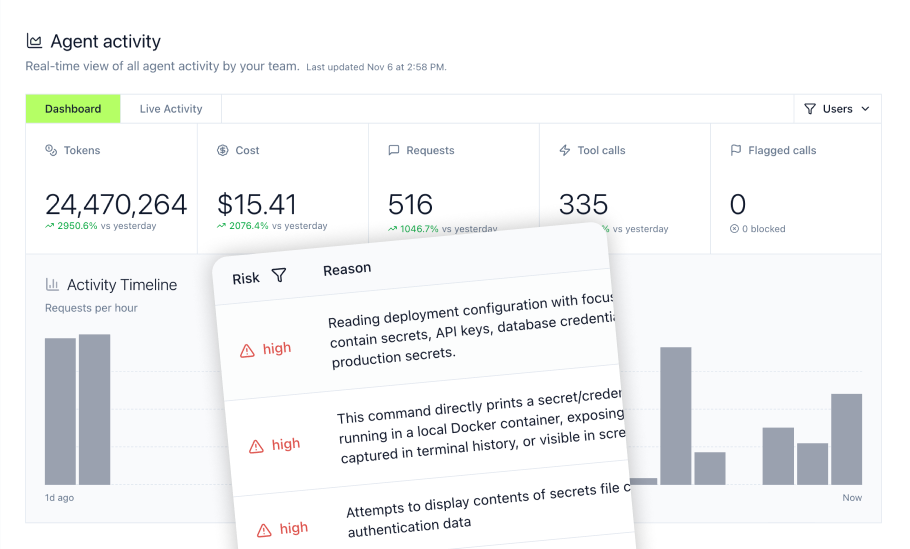
Mintive’s Agent Monitor uses hooks to capture coding-agent file reads, commands and MCP calls before they happen, with rules that block risky behavior. Its LLM gateway records model-call usage, cost and model alongside tool calls, so teams can review model use together with agent activity.
Protecting sensitive data from AI agent access
Data protection for AI agents goes beyond traditional DLP. Agents can access data through indirect paths—querying databases, reading configuration files, or processing documents containing embedded sensitive information.
Protection strategies:
- Sensitive file protection: Prevent access to .env files, SSH keys, credentials, and sensitive configuration
- Prompt inspection: Detect and redact sensitive data before it leaves the network
- Output filtering: Scan agent responses for sensitive data that should not be exposed
- Access controls: Implement strict authentication and authorization for all agent operations
Blocking malicious commands and actions
This addresses the governance-containment gap. 63% of organizations cannot enforce purpose limitations on their AI agents—they know what agents should do, but cannot technically prevent other actions.
Security guardrails should include:
- Command blocklists: Prevent execution of dangerous commands
- File system restrictions: Block access to sensitive directories regardless of permissions
- Network controls: Limit which external endpoints agents can communicate with
- Rate limiting: Prevent rapid-fire operations indicating runaway behavior
- Kill switches: Instant termination capability when agents behave unexpectedly
Security guardrails that block dangerous commands in real-time close the gap between monitoring and control.
Bridging the gap: Integrating AI agents with enterprise data securely
AI agents deliver value when connected to enterprise systems—databases, CRMs, repositories, and business applications. The challenge: enabling these connections without creating uncontrolled data access.
Securely connecting AI agents to internal databases and APIs
Direct database connections for AI agents require careful architecture. Agents should never have production database credentials embedded in their configuration.
Secure integration patterns:
- Gateway-mediated access: Route all agent database queries through a centralized gateway that enforces permissions and logs access
- Read replicas: Direct analytical queries to read replicas rather than production databases
- Service accounts with least privilege: Create purpose-specific database users with minimal required permissions
- Query controls: Limit agents to approved query patterns
The Snowflake MCP Server demonstrates this pattern—enabling AI agents to perform product analytics and executive reporting from governed data warehouses through natural language queries, while maintaining access controls and audit trails.
Enabling AI for data analysis with access controls
Data analysis use cases—querying warehouses, generating reports, answering business questions—represent high-value AI applications requiring careful access management.
Implementation approach:
- Define semantic models: Create business-friendly data abstractions that agents can query
- Apply row-level security: Ensure agents only access data their users are authorized to see
- Log all queries: Maintain complete audit trails
- Set result limits: Prevent bulk data extraction
For search use cases, the Elasticsearch MCP Server enables AI-powered knowledge base search and log analysis while maintaining security boundaries.
Achieving enterprise compliance with AI agent deployments
Compliance requirements for AI agents extend beyond traditional IT controls. Auditors now expect organizations to demonstrate governance over autonomous systems that access and process regulated data.
Ensuring data privacy and protection with AI agents
Privacy regulations impose specific requirements on AI agent deployments:
GDPR requirements:
- Lawful basis: Document legal basis for AI agent data processing
- Data minimization: Agents should process only necessary data
- Right to explanation: Provide meaningful information about automated decision logic
- Data subject access: Ensure you can identify all data an AI agent has processed for specific individuals
Detailed audit trails for regulatory requirements
33% of organizations lack audit trails for their AI agent activity—a critical gap exposing them to compliance failures without forensic evidence.
Audit trails for AI agents must capture:
- Who: Which user initiated the agent action
- What: Specific tool calls, commands, and data accessed
- When: Timestamps with sufficient precision for incident reconstruction
- Where: Which systems and data sources were involved
- Why: Business context justifying the access
Complete audit logs require evidence-quality logging that auditors can verify independently.
Monitoring and observability for AI security operations
Visibility into AI agent behavior enables both security and operational optimization. Without observability, organizations operate blind—unable to detect threats or demonstrate compliance.
Tracking every AI tool interaction across clients
Enterprise AI deployments span multiple clients. Unified tracking requires a platform that aggregates activity across all clients into a single view.
Key metrics to track:
- Usage patterns: Which agents and tools are used most frequently
- Data access frequency: How often agents access specific systems
- Error rates: Which agent operations fail and why
- Security events: Policy violations, blocked actions, and anomalous behavior
Real-time monitoring across all AI clients provides the foundation for both security and operational intelligence.
Detecting anomalies and security alerts in real-time
Anomaly detection transforms passive monitoring into active security. Effective detection identifies:
- Unusual access patterns: Agents accessing systems they have never accessed
- Volume anomalies: Sudden spikes in query frequency or data retrieval
- Off-hours activity: Agent operations outside normal business hours
- Policy boundary testing: Repeated attempts to access restricted resources
Live dashboards for server health and security alerts enable teams to detect and respond to threats before they cause damage.
Protecting enterprise data: From development to production AI agents
The journey from developer laptop to production deployment introduces security risks at every stage. Organizations need consistent controls that protect data regardless of where AI agents operate.
Securing access points: Authentication and identity management
AI agents require the same identity rigor as human users—often more, given their elevated system access.
Authentication requirements:
- OAuth and SAML integration: Agents should authenticate through your existing identity provider
- SSO enforcement: Eliminate credential sprawl by requiring single sign-on
- Service account governance: Agents that operate autonomously need proper lifecycle management
- Token rotation: API keys and tokens should rotate automatically
Platforms that support both shared and per-user authentication—with flexibility to configure service accounts or enable individual OAuth flows—provide the granularity enterprise deployments require.
Transforming local AI servers into production services
Local MCP servers running on developer laptops create security blind spots. Production deployment requires proper infrastructure:
Production requirements:
- Containerized deployment: Move STDIO-based servers from local installations to hosted containers
- Centralized configuration: Manage server settings through a central control plane
- High availability: Implement failover for business-critical operations
- Lifecycle management: Automated deployment, updates, and decommissioning
Hosting STDIO servers on managed infrastructure instead of running locally transforms developer tools into production-grade services. Mintive (formerly MintMCP) supports both STDIO servers deployed on managed infrastructure and other deployable or remote servers you may have.
Managing API keys and credentials for AI agents
Credential management for AI agents requires centralization and automation:
- Centralized credential storage: All agent API keys in one governed location
- Access auditing: Complete logs of credential access and usage
- Automatic rotation: Credentials should rotate without manual intervention
- Revocation capability: Instant credential revocation when needed
- Least privilege assignment: Each agent gets only required credentials
Strategic deployment: Turning shadow AI into sanctioned AI
The goal is not to eliminate AI agents—it is to bring them under governance. Organizations that block AI adoption lose competitive advantage; those that enable it without controls expose themselves to unacceptable risk.
Accelerating secure AI agent deployment
Modern AI security platforms compress implementation timelines through:
- Quick deployment: Deploy STDIO-based MCP servers with built-in hosting
- Pre-configured policies: Start with proven policy templates for common compliance requirements
- Automatic discovery: Scan environments to identify existing AI tools
- Integration templates: Pre-built connectors for common systems
Empowering developers with Self-Service AI tool access
Security that blocks developer productivity will be circumvented. Effective AI security enables rather than restricts:
- Self-service access requests: Developers request and receive AI tool access through automated workflows
- Pre-approved tool catalogs: Curated lists of sanctioned AI tools with security controls pre-configured
- Transparent policies: Developers understand what they can and cannot do
- Fast exception processing: Legitimate edge cases get resolved quickly
This approach transforms the dynamic from "security says no" to "security enables safely."
Managing and scaling AI agent infrastructure
As AI adoption grows, infrastructure must scale without proportional increases in manual oversight:
- Virtual servers: Create and manage virtual MCP servers with role-based access
- Central registry: Maintain available MCP servers with easy installation
- Enterprise SLAs: Guarantee availability and performance for critical operations
Enterprise hardening transforms MCP from developer utility to production-grade infrastructure capable of supporting organization-wide deployment.
Frequently asked questions
What is the governance-containment gap?
The governance-containment gap refers to the disparity between monitoring AI agents and actually stopping them when problems occur. While 58–59% report monitoring / human oversight, only 37–40% report containment controls (purpose binding and kill-switch capability). This gap is dangerous because monitoring provides awareness without protection. Effective AI security requires platforms with both visibility and instant intervention capabilities, including kill switches that can stop agent execution immediately.
How do AI security platforms differ from traditional security tools?
Traditional security tools were designed for human users and predictable applications. AI agents introduce new challenges: prompt injection attacks, tool misuse where agents exceed permissions, agent-to-agent attack vectors, and autonomous decision-making requiring real-time intervention. AI security platforms provide purpose-built capabilities including prompt inspection, tool-level access controls, MCP-native integration, and kill switches for immediate termination.
What implementation timeline should enterprises expect?
Cloud-based platforms with pre-built integrations achieve initial deployment in hours to days, with full rollout in 2-6 weeks. The recommended phased approach: Week 1 for discovery and inventory, Week 1-2 for policy definition, Week 2-3 for SSO and core system integration, Week 3-6 for pilot testing in monitor-only mode, and Week 6-12 for phased full deployment. Skipping the pilot phase leads to overly restrictive policies that block legitimate work.
How should organizations approach AI security tool selection?
Prioritize containment capability over monitoring depth—if a platform cannot stop agents in real-time, it provides awareness without protection. Evaluate deployment speed, integration breadth for your specific AI clients, built-in compliance support for SOC 2 and GDPR, and total cost of ownership. Avoid vendor lock-in from platforms requiring proprietary agents or preventing data export.
What are essential audit trail requirements?
Audit trails must capture who initiated the action, what specific tools and data were accessed, when with precise timestamps, where across which systems, and why based on business context. Evidence-quality logging means auditors can verify independently. Organizations with proper audit trails show significant advantages across all AI maturity metrics compared to those without.