Non-human identities, including AI agents, service accounts, API keys, OAuth tokens, and workload identities, outnumber human identities by more than 90 to 1 in many organizations, yet most lack the governance frameworks to manage them. Unlike traditional IAM built for human users with predictable lifecycles, autonomous agents require purpose-built identity infrastructure that handles ephemeral credentials, machine-speed provisioning, and complex delegation chains across multi-agent systems. The Mintive (formerly MintMCP) Agent Gateway addresses this gap by treating autonomous agents as first-class non-human principals with their own identities, scoped permissions, and attributable audit trails.
This guide provides CISOs with actionable strategies for implementing non-human identity management across AI agent deployments, covering identity taxonomy, authentication methods, access governance, runtime controls, and compliance requirements for 2026 and beyond.
Key Takeaways
- Non-human identities, including AI agents, service accounts, API keys, OAuth tokens, and workload identities, outnumber human identities by more than 90 to 1 in many organizations, creating an identity governance challenge that traditional human-centric IAM was not designed to address
- 91% of organizations have limited or no visibility into their AI agent identity populations
- Five distinct agent identity types (copilot, autonomous, orchestrator, ephemeral sub-agent, and agent-as-a-service) require different governance profiles and credential management approaches
- Data-permissions-first architecture prevents the common mistake of granting broad access and restricting afterward
- Just-in-time access models replace persistent credentials with time-bound grants that automatically revoke after task completion
- Complete lifecycle governance should cover agent discovery, provisioning, ownership, credential management, operation, periodic review, and decommissioning
- Runtime guardrails must screen both agent inputs and tool outputs to prevent credential scrubbing failures and prompt injection attacks
Understanding Non-Human Identity Management for AI Agents
Traditional identity and access management was designed for human users who onboard through HR processes, authenticate interactively with MFA, and offboard when they leave the organization. AI agents break every assumption in this model.
Autonomous agents authenticate programmatically at machine speed. They may spawn sub-agents dynamically during task execution. Their lifecycle has no HR trigger. And when they operate, they make tool calls that security teams cannot see through conventional monitoring.
The governance gap is substantial: 50% of organizations have already experienced a security incident related to non-human identities. Meanwhile, 78% lack formal policies for creating or removing AI identities, and only 28% can trace agent actions back to a human sponsor when incidents occur.
Why traditional IAM falls short
- Human-centric lifecycle management tied to HR events
- Assumes interactive authentication with step-up verification
- Cannot provision credentials at machine speed
- No framework for delegation chains between agents
- Audit trails designed for human session patterns
The paradigm shift requires treating AI agents as first-class principals in the authorization model, with their own identities, credentials, and governance obligations that exist independently from the humans who created them.
Establishing Agent Identities: A Foundation for Secure AI Operations
The Cloud Security Alliance's draft Agent Identity Governance Framework defines five distinct agent identity types, each requiring different governance profiles:
1. Copilot Identities
Interactive assistants under continuous human supervision (GitHub Copilot, Microsoft 365 Copilot). Credentials should be session-bound and expire when the user session ends.
2. Autonomous Agent Identities
Operate independently of active human sessions to run scheduled tasks, respond to events, or manage workflows. Require durable but short-lived credentials with strict tooling perimeters.
3. Orchestrator Identities
Coordinate activities of other agents, decompose goals into sub-tasks, and provision credentials to sub-agents. Require the strongest authentication (mutual TLS or SPIFFE SVIDs) because compromise provides control over all sub-agents.
4. Ephemeral Sub-Agent Identities
Dynamically created to perform single bounded tasks with the shortest lifecycle (seconds to minutes). Must include automatic termination and parentage records linking back to the orchestrator.
5. Agent-as-a-Service (AaaS) Identities
Serve multiple tenants with distinct data access rights. Require strict tenant isolation to prevent data or credential contamination across customers.
Authentication strategies for AI agents
| Method | Use Case | Security Level | Complexity |
|---|---|---|---|
| OAuth 2.0 Client Credentials | SaaS integrations, web-based agents | High | Medium |
| SPIFFE SVIDs | Orchestrators, Kubernetes workloads | Very High | High |
| Mutual TLS | Financial services, healthcare | Very High | Very High |
| Bearer Keys | Internal systems, development | Low | Low |
Mintive's Agent Gateway supports multiple authentication mechanisms from bearer keys for simple deployments to M2M tokens for OAuth client-credentials flows and workload identity federation where the agent's own infrastructure mints short-lived OIDC tokens.
Permissions and Governed Access: The Data-First Approach to AI Security
Mintive's core positioning is that enterprise AI governance should begin with permissions and governed access to company systems, not with an autonomous agent that receives broad access and gets restricted afterward.
This data-permissions-first architecture means defining what an agent can access before deployment, not discovering overreach through incident response.
Implementing least privilege for AI agents
- Unique identity per agent: No shared credentials across agents; compromise of one does not expose all
- Named human owner: Every agent accountable to a specific individual who can attest to continued business justification
- Deny-by-default: Read-only access where possible; write permissions only when explicitly justified
- Task-scoped permissions: Intersection of user permissions, agent permissions, and task requirements
- Tool allowlist: Explicit declaration of permitted APIs and services; unlisted resource access fails and alerts
The key abstraction in Mintive's MCP Gateway is the Virtual MCP (VMCP), which bundles approved connectors and a curated tool surface behind one governed endpoint for a particular team, role, use case, or agent. Directory groups can drive membership through SCIM, applying consistent access policies without requiring individual MCP server configuration.
Virtual MCPs as the unit of governance
- One endpoint, one auth model, one curated tool surface, one audit trail
- Read-only vs read-write is simply two VMCPs over the same connector with different tool curation
- Access granted at the VMCP level, driven by directory groups
- Least privilege emerges from role design rather than post-deployment restriction
Zero Trust for AI: Securing the Autonomous Agent Ecosystem
Zero trust principles translate directly to AI agent governance: never trust, always verify. But agent environments introduce unique challenges because agents make autonomous decisions about which tools to call, and those decisions happen at machine speed.
Applying zero trust to agent interactions
- Verify identity on every call: Agent identity validated for each tool invocation, not just session establishment
- Enforce scope boundaries: Authorization checked against declared task intent, not just static role membership
- Inspect tool outputs: Results returning from connectors screened before entering agent context
- Constrained delegation: Sub-agents receive only a scoped subset of parent privileges; cannot exceed what orchestrator holds
Runtime controls should evaluate policy at governed infrastructure boundaries outside agent code, so enforcement does not depend solely on the agent following its own instructions. Mintive's guardrails architecture applies three complementary layers:
Mint Guard
Managed detection policies for prompt injection, credentials, PII, and harmful content with monitoring and enforcement modes.
Rules
Declarative matching on tool names, argument patterns, or content with actions including flag, block, ask, mask, or notify.
Gateway Middleware
Customer-authored JavaScript running in a sandbox for custom logic, DLP integration, external classifiers, or resource allowlists.
Visibility and Auditability: Tracking AI Agent Actions and Compliance
The most consistent theme across enterprise AI governance is visibility. Security teams cannot protect what they cannot see, and 91% of organizations have limited or no visibility into their AI agent identity populations.
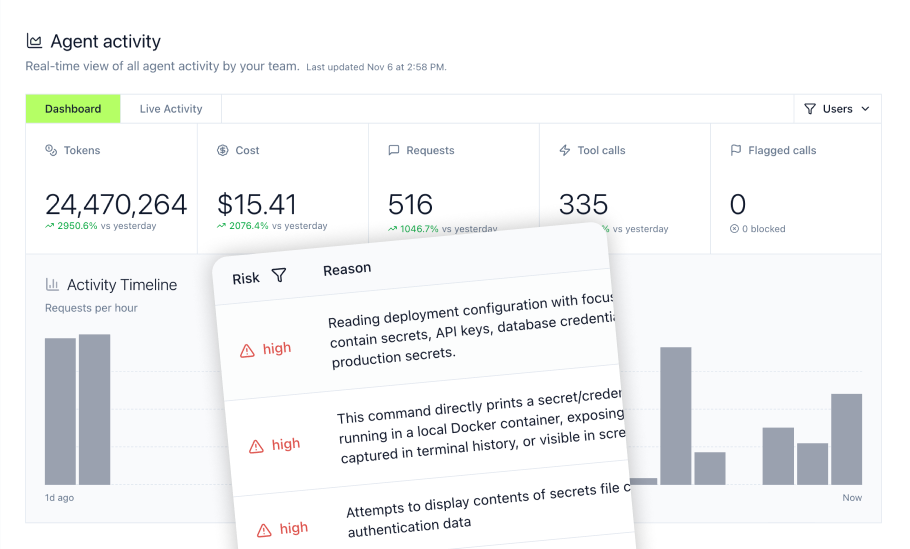
Mintive's Agent Monitor provides organizational visibility into supported activity from AI coding agents and related agent environments, capturing:
- Prompt submissions
- File access (including .env files and SSH keys)
- Commands (bash, installs, git operations)
- MCP tool calls
- Usage and token costs
Achieving centralized agent visibility
- Live activity feed: Real-time view across the organization, filterable by user, agent, tool, or time
- Built-in detection rules: Secrets, prompt injection, and tool permissioning patterns
- Custom rules: Tool-argument and regex matching with configurable actions
- Usage and cost tracking: Token spend by model, user, agent, and session for chargeback-grade visibility
Ensuring regulatory compliance
Auditors ask predictable questions that require documented evidence:
- Who owns this agent?
- What is it allowed to do?
- Who approved it?
- When was it last reviewed?
- When will it be decommissioned?
- What did it actually do?
The EU AI Act requires logging and documentation for high-risk AI systems, with Annex III high-risk requirements applying from December 2, 2027 and requirements for high-risk systems embedded in regulated products applying from August 2, 2028. DORA requires financial entities to maintain a register of contractual arrangements involving ICT services provided by third parties, which can be relevant when agent deployments depend on those providers. The NIST AI Risk Framework calls for documented roles and responsibilities, AI-system inventories, ongoing review, and lifecycle governance.
Mintive supports SIEM export via OTLP or Splunk HEC, providing tool calls, prompt submissions, gateway requests, and access-policy changes in audit-ready formats.
Advanced Controls: Mitigating Risks with Runtime Guardrails for AI Agents
Beyond visibility, enterprises need proactive controls that prevent dangerous actions before they execute. The OWASP Agentic Security Initiative identifies identity and privilege abuse (ASI03) as a critical risk when agents retrieve content containing embedded credentials.
Protecting against prompt injection and data exposure
When agents retrieve documents, web pages, or tool outputs, any credentials embedded in that content become part of the agent's effective identity surface. Without credential scrubbing, agents may inadvertently use discovered secrets to access systems beyond their authorized scope.
Control layers
- Credential scrubbing at tool output boundaries: Processing layer inspects agent-accessible outputs for credential-like patterns before they enter context
- Tooling perimeters: Prevents agents from acting on credentials encountered in retrieved content; using a discovered credential requires re-authorization
- Credential containment: Prevent agents from using credentials encountered in retrieved content without explicit re-authorization
Customizing security with Gateway Middleware
Mintive's middleware runs customer-authored JavaScript on every matching call, enabling:
- Integration with external DLP tools and classifiers
- Custom redaction and transformation rules
- Resource allowlist enforcement
- Fail-closed behavior for policy-critical checks
The platform ships templates for AWS Bedrock Guardrails, Google Cloud Model Armor, OpenAI moderation, and Teleskope, keeping policy in tools security teams already operate.
Credential Management for AI Agents: Beyond Shared Service Accounts
The most common pattern in unmanaged environments is agents running on "whichever human's API key was lying around." This collapses the audit log, over-privileges the agent, and breaks rotation when the human changes roles or leaves the organization.
The dangers of shared credentials
- Cannot attribute actions to specific agents
- Compromise of one credential exposes all agents using it
- No independent rotation or revocation
- Human departure disrupts agent operations
Agent-owned credentials through Mintive
Mintive's Agent Gateway enables agents to have their own credentials, distinguishing them from employee credentials and generic shared service accounts:
- Independent credential expiration: Rotate agent credentials without touching human accounts
- Independent revocation: Disable a specific agent's access without affecting others
- Per-agent audit attribution: Every tool call linked to the agent identity that made it
- Identity forwarding: Pass the agent's identity email to cooperating upstreams for downstream attribution
Automating credential lifecycle
A defensible agent identity lifecycle should cover discovery and inventory, provisioning, documented ownership, credential management, ongoing review, and complete decommissioning. Decommissioning should revoke associated credentials and remove access so retired agents do not leave standing privileges behind.
Just-in-time access models replace persistent credentials with time-bound grants:
- Intent declaration before execution
- Time-limited privilege grants
- Automatic revocation after task completion
- Delegation chain audit linking every action to a human sponsor
Centralized Governance and Operational Control for the AI Workforce
Enterprises will eventually need a system of record for their agent workforce across models, channels, tools, and agent harnesses. That system must answer:
- Which agents exist?
- Who owns or operates them?
- Which systems can they access?
- What credentials and permissions do they use?
- What actions have they taken?
- What memory do they retain?
- Which security policies apply?
- How much usage or cost do they generate?
- How can they be restricted or shut down?
Building the governance foundation
Mintive's security and enterprise capabilities provide the substrate for centralized governance:
- SSO and SCIM integration: Directory groups drive both admin roles and tool access; suspend in the IdP and it propagates
- Role-based access control: Org-level roles for admin reach; VMCP access policies for tool reach as two independent layers
- Tamper-evident audit: Access-grant history signed at write time, verifiable offline via published JWKS
- Operational controls: Org-wide kill switch, per-VMCP disable, connector restart, credential rotation via operational controls
- Configuration as code: Manage gateway config and global rules declaratively
Centralized governance reduces standing access, strengthens attribution, and gives security teams clearer revocation and audit controls when agent activity needs to be investigated or contained.
For organizations evaluating their AI agent governance posture, Mintive's data risk assessment provides a framework for identifying gaps before they become incidents.
Mintive: Production-Ready AI Agent Identity and Access Governance
Mintive provides the identity, access, monitoring, and runtime controls enterprises need to govern autonomous AI agents without relying on shared human credentials.
Its governance stack includes:
- Agent Gateway: Gives agents first-class identities, scoped permissions, dedicated credentials, and per-agent audit trails.
- MCP Gateway: Uses Virtual MCPs to expose curated tool surfaces behind governed endpoints with centralized access policies.
- Agent Monitor: Provides visibility into supported prompts, file access, commands, MCP tool calls, usage, and token costs.
- Runtime guardrails: Combine Mint Guard, declarative Rules, and Gateway Middleware to detect or restrict risky agent and tool activity.
Enterprise controls extend that foundation with SSO, SCIM, scoped access, tamper-evident audit history, and SIEM export.
For agent authentication, Mintive supports:
- Bearer keys
- OAuth client-credentials through M2M tokens
- Workload identity federation with short-lived OIDC tokens
Organizations can also use operational controls to disable governed access, rotate credentials, or shut down affected resources when agent activity needs to be contained.
Frequently Asked Questions
How do I prioritize which AI agents to govern first?
Start with agents that have the highest privilege levels, access to sensitive data, or operate autonomously without human oversight. Orchestrator agents deserve immediate attention because their compromise provides control over all sub-agents. Use a risk-based classification considering data sensitivity, privilege scope, and business criticality. Begin with comprehensive discovery across cloud providers, SaaS platforms, and on-premises environments before attempting governance.
What is the difference between agent observability and agent monitoring?
Observability provides the infrastructure to understand agent behavior through metrics, logs, and traces. Monitoring uses that infrastructure to detect specific conditions and alert on anomalies. Effective agent governance requires both: observability to answer "what happened and why" during incident investigation, and monitoring to detect "something abnormal is happening now" in real time. Mintive's Agent Monitor provides both live activity visibility and rule-based detection.
How should I handle delegation chains when agents spawn sub-agents?
Implement constrained delegation where sub-agents can only receive permissions the parent orchestrator already holds. Include the full delegation chain in every token issued so audit trails link ephemeral sub-agent actions back through the orchestrator to the authorizing human principal. Set maximum delegation depth through policy to prevent unbounded spawning. Sub-agents should have built-in TTLs they cannot extend.
What credentials should orchestrator agents use versus simple autonomous agents?
Simple autonomous agents can use OAuth 2.0 client credentials or bearer keys for straightforward deployments. Orchestrator agents require stronger authentication such as mutual TLS or SPIFFE SVIDs because they coordinate other agents and compromise creates concentrated risk. The authentication method should match the agent's privilege level and the sensitivity of systems it can access.
How do I demonstrate compliance for AI agents during audits?
Maintain provisioning records (creation timestamp, initial owner, business justification, risk classification), access timelines (chronological configuration changes, permission grants and revocations), certification history (periodic attestation records, access reviews), delegation chains (full parentage from agent action to human principal), and decommissioning records (credential revocation proof, retained audit logs). These evidence categories directly answer the questions auditors ask: who owns this agent, what can it do, who approved it, and what did it actually do.