Shadow IT once kept security teams awake at night—employees installing unapproved software, using personal cloud storage, or spinning up rogue SaaS accounts. That threat now looks quaint. Shadow AI has emerged as an exponentially greater risk, with shadow AI now widespread across enterprises, as recent research shows a large majority of employees use unapproved AI tools at work. Unlike traditional shadow IT where unauthorized tools simply stored or processed data, AI agents actively learn from, synthesize, and potentially expose sensitive information in ways that create long-lived security, compliance, and intellectual property risk. Organizations need governance infrastructure that can turn this chaos into controlled, auditable AI deployment, especially when AI assistants and agents access internal tools through MCP.
This article explains why unmanaged AI agents pose fundamentally different risks than traditional shadow IT, what makes detection so difficult, and how enterprises can establish governance frameworks that enable safe AI adoption without killing innovation.
Key Takeaways
- Organizations with high levels of shadow AI saw breach costs average $670,000 higher than organizations with low or no shadow AI, and 20% of breached organizations reported incidents involving shadow AI in IBM's 2025 data
- Traditional security frameworks still need AI-specific extensions to address attack vectors like prompt injection, which OWASP ranks as the top LLM application risk and which security vendors now report seeing frequently in production assessments
- Once sensitive data is submitted to external AI systems, organizations may lose practical control over retention, downstream use, and deletion guarantees—creating long-lived compliance and intellectual property exposure
- 97% of breached organizations that experienced AI-related incidents lacked proper AI access controls, while 63% either had no AI governance program or were still developing one
- Detection requires multi-layer architecture spanning financial, identity, network, endpoint, and browser telemetry—no single tool provides sufficient visibility
- Effective governance provides sanctioned alternatives with built-in controls rather than blanket bans, since employee use of unapproved AI tools often continues even after organizations try to ban them.
The Evolution of Risk: From Shadow IT to Shadow AI
Defining Shadow IT: A Historical Perspective
Shadow IT emerged when employees began adopting consumer technologies faster than IT departments could provision enterprise solutions. Unauthorized Dropbox accounts, personal Gmail for work communications, and unapproved project management tools created governance headaches and data sprawl. The risks were real—data in unknown locations, unpatched software vulnerabilities, compliance gaps—but fundamentally manageable.
Traditional shadow IT tools operated passively. A rogue file-sharing service stored data; it didn't analyze, learn from, or redistribute that information. Security teams could identify unauthorized applications through network monitoring, disable access through endpoint controls, and contain breaches by locating and securing data repositories.
The New Frontier: Understanding Shadow AI
Shadow AI operates on entirely different principles. These tools don't just store information—they actively process, learn from, and potentially incorporate sensitive data into their knowledge bases. Research by LayerX revealed that 6% of workers copied and pasted sensitive information into generative AI tools, with 4% doing so weekly.
The scope extends far beyond ChatGPT conversations. Shadow AI now includes:
- AI coding assistants accessing source code and production systems
- Browser extensions with embedded AI analyzing page content
- SaaS platforms with AI features processing business data
- Locally-run open-source models with zero visibility
- Autonomous agents executing workflows across multiple systems
Analyst forecasts suggest that by 2027, 75% of employees will acquire, modify, or create technology outside IT's visibility—up sharply from 2022 levels. The challenge has fundamentally shifted from finding unauthorized software to governing autonomous systems that operate with unprecedented access.
Unmasking Shadow AI: The Unseen Threat of Unmanaged Agents
What Makes Shadow AI Agents Uniquely Dangerous?
AI systems introduce attack surfaces that conventional security tools cannot address. Prompt injection attacks allow malicious actors to manipulate AI behavior through carefully crafted inputs, potentially overriding instructions, exposing sensitive data, or triggering unintended actions. Model poisoning can corrupt training data during authorized processes, making detection extremely difficult.
According to OWASP's 2025 Top 10 for LLM Applications, prompt injection ranks as the #1 application risk for LLM systems. Traditional security frameworks still need AI-specific controls and operational guardrails for these attack vectors, which means compliant organizations can still carry material AI-agent risk.
The authorization bypass problem compounds these risks. Organizational AI agents operate with permissions far broader than individual users, spanning multiple systems and workflows. When users interact with agents, requests execute under the agent's identity—not the user's. A user with limited access can indirectly trigger actions or retrieve data they wouldn't be authorized to access directly, simply by going through the agent. Because logs attribute activity to the agent rather than the requester, unauthorized activity occurs without clear visibility or accountability.
Real-World Scenarios of Shadow AI Risks
Consider a financial services firm where traders use an unauthorized AI tool to analyze market data and customer trading patterns. The AI system accesses sensitive customer financial information for months, potentially violating GLBA and SEC requirements—yet traditional CASB and DLP tools see only legitimate database queries from authorized accounts.
In healthcare, recent survey data shows both broad use of generic AI tools for work and meaningful levels of unauthorized AI adoption inside hospitals and health systems. Many public AI tools don't sign Business Associate Agreements or meet HIPAA compliance standards, yet staff use them to analyze patient data, generating immediate compliance violations.
Directing Your AI Workforce: Why Governance is Critical
Establishing Clear Boundaries for AI Data Access
While 81.8% of IT leaders have documented policies governing AI tools, effectiveness depends on enforcement, regular updates, and employee awareness—areas where most organizations fail. Many organizations still underinvest in formal training on approved AI usage, creating a gap between written policy and day-to-day practice.
The disconnect is stark: employees often report clear AI guidance while still using unapproved tools, and security research continues to show large volumes of sensitive enterprise data flowing into AI systems.
Effective governance requires:
- Cross-functional AI governance committees with clear ownership across security, legal, and data science
- Risk classification systems recognizing that not all AI usage carries equal risk
- Approved tool catalogs with sanctioned alternatives that match functionality employees need
- Continuous policy review cycles reflecting rapid AI evolution
- Checkpoints embedded across the AI lifecycle from data collection through deployment
The Imperative of Real-Time Monitoring and Control
Static policies fail within months given AI's evolution speed. Organizations need real-time security oversight that monitors AI tool interactions across Claude Code, Cursor, ChatGPT, and other platforms.
Platforms like MCP Gateway provide centralized governance with unified authentication, audit logging, and rate control for all MCP connections. This enables organizations to see which MCP tools teams use, track usage patterns, and understand data access—transforming blind spots into actionable intelligence.
Turning Blind Spots into Insight: Observing AI Agent Activity
Monitoring Every Move: What AI Agents Are Doing
Traditional security tools were designed to detect known applications and user-driven activity. Shadow AI often operates inside approved SaaS platforms, acts through service accounts or tokens, executes automated workflows without user interaction, and blends into normal application traffic.
Survey data from security professionals shows shadow SaaS and AI usage remains common even among security teams, reinforcing how difficult policy-only enforcement can be. Detection requires multi-layer architecture triangulating data from:
- Financial systems: Expense management tracking "AI Credits" or "API Subscription" charges
- Identity providers: OAuth grants to third-party AI applications
- Network traffic: Sustained HTTPS sessions to api.openai.com, huggingface.com, and vector database providers
- Endpoints: Device management scanning browser extensions against allow-lists
- Browser telemetry: Real-time web interactions with AI services
Coding agents present particular challenges. They operate with extensive system access—reading files, executing commands, and accessing production systems through MCP tools. Without monitoring, organizations cannot see what agents access or control their actions.
Detecting and Responding to Anomalous Actions
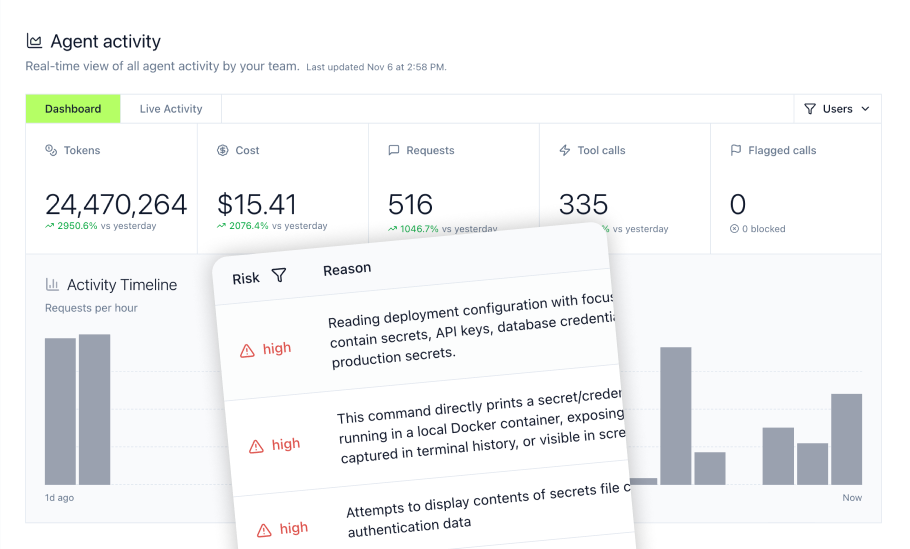
The LLM Proxy provides essential visibility and control over agent behavior by monitoring every MCP tool invocation, bash command, and file operation from all coding agents. This enables organizations to:
- Track which MCPs are installed across development environments
- Monitor what files agents access in real-time
- Block risky tool calls like reading environment secrets or executing dangerous commands
- Maintain complete audit trails of all operations for security review
Protecting Your Data: Security Measures Against Shadow AI Threats
Safeguarding Sensitive Information from AI Agents
Once sensitive data is submitted to external AI systems, organizations may lose practical control over retention, downstream use, and deletion guarantees—creating long-lived compliance and intellectual property exposure. Organizations have seen internal data appear in public large language models long after submission. Unlike traditional data breaches where exposure may be scoped and contained, data submitted to external AI systems can be difficult to trace, delete, or fully remediate once it enters downstream processing and retention pipelines.
IBM's 2025 breach research shows that incidents involving shadow AI take longer to identify and contain than the global average, increasing both remediation difficulty and total cost. Despite being "new," these incidents are harder to remediate because attribution is difficult when activity appears under service account identities.
Implementing Proactive Security Guardrails
Effective protection requires blocking dangerous commands in real-time, restricting file access based on sensitivity classification, and controlling MCP permissions before damage occurs.
The LLM Proxy enforces security guardrails by:
- Preventing access to .env files, SSH keys, credentials, and sensitive configuration
- Blocking dangerous bash commands before execution
- Maintaining complete visibility into installed MCPs and their usage patterns
- Providing complete audit trails for security review and compliance documentation
Building Trust and Compliance: Aligning AI with Enterprise Standards
Meeting Regulatory Demands with Governed AI
Shadow AI creates significant regulatory compliance risks across multiple frameworks. The EU AI Act requires organizations to maintain comprehensive inventories of AI systems and demonstrate compliance with risk management requirements—something impossible with undiscovered shadow AI. The EU AI Act introduces significant penalties for certain categories of non-compliance, including fines that can reach up to €35 million or 7% of global annual turnover for the most serious violations.
GDPR violations occur when shadow AI processes personal data without lawful basis or purpose limitation. In healthcare, many organizations report they are not fully prepared for proposed HIPAA Security Rule updates that would raise cybersecurity expectations around protecting ePHI. State AI rules are also tightening. For example, Texas's Responsible AI Governance Act includes civil penalties that can escalate into the six figures for certain violations, while California has enacted separate healthcare-focused AI restrictions.
The Role of Comprehensive Audit Trails
Organizations face a compliance paradox: they cannot demonstrate regulatory adherence without visibility into AI usage, yet shadow AI proliferation makes complete visibility practically impossible with conventional tools.
MCP Gateway provides complete audit logs and compliance-ready documentation that support internal security reviews, SOC 2 programs, privacy governance, and broader enterprise audit requirements. Every MCP interaction, access request, and configuration change is logged, creating the documentation required for regulatory audits and demonstrating governance over AI deployments.
From Shadow to Sanctioned: Transforming AI Deployment
Empowering Developers with Secure, Accessible AI Tools
Blanket bans don't work. Employees often continue using shadow AI even after organizational prohibitions, making restrictive policies alone counterproductive. The solution is providing sanctioned alternatives with built-in controls—enabling "safe yes" rather than universal "no."
Organizations that turn shadow AI into governed AI see measurable benefits. By understanding use cases driving shadow adoption, they can deploy enterprise AI platforms with proper data classification, provide training on appropriate data sharing, and create safe experimentation environments. Results include increased productivity while eliminating exposure risk.
Streamlining Enterprise AI Onboarding and Management
Enterprise MCP deployment can be dramatically accelerated with managed infrastructure and pre-configured governance controls. Managed deployment for STDIO-based MCP servers, centralized authentication, and production monitoring enable organizations to offer sanctioned AI tooling quickly without leaving teams to manage security and infrastructure on their own.
MintMCP bridges the gap between AI assistants like ChatGPT and Claude with internal data and tools, handling authentication, permissions, audit trails, and the complexity that comes with enterprise deployments. This makes AI tools accessible to everyone in an organization—not just engineers—while maintaining security and governance standards.
Why MintMCP Is the Answer to Shadow AI
Shadow AI proliferation happens when employees choose convenience over compliance because approved alternatives don't exist or are too difficult to access. MintMCP solves this by making governed AI deployment as simple as shadow AI adoption—but with enterprise security, compliance, and visibility built in from day one.
The platform provides two complementary products that transform shadow AI into sanctioned AI infrastructure. MCP Gateway delivers centralized governance with OAuth and SAML authentication, unified audit logging, rate control, and granular tool access permissions configurable by role. LLM Proxy provides real-time monitoring and security guardrails, tracking every MCP invocation, bash command, and file operation while blocking dangerous actions before they execute.
Together, these capabilities enable security teams to provide developers with the AI tools they need while maintaining the visibility and control compliance demands. Organizations can deploy sanctioned AI infrastructure with pre-configured policies that balance security requirements with innovation velocity. Developers get access to powerful AI assistants and MCP tools through familiar interfaces like Claude, ChatGPT, and Cursor—without managing authentication, permissions, or infrastructure complexity. Security teams gain complete visibility into AI agent activity, comprehensive audit trails, and real-time policy enforcement.
The result is faster innovation without increased risk. Teams move from pilot to governed production quickly, shadow AI usage declines as approved alternatives become available, and organizations demonstrate AI governance to auditors and regulators with documented controls and comprehensive logging.
Frequently Asked Questions
How does shadow AI differ from employees simply using ChatGPT for personal tasks?
Shadow AI extends far beyond casual ChatGPT conversations. It encompasses AI coding assistants accessing production systems and source code, browser extensions with embedded AI analyzing sensitive page content, SaaS platforms with AI features processing customer data, locally-run open-source models operating with zero visibility, and autonomous agents executing multi-step workflows across enterprise systems. The risk multiplies when AI agents operate with service account credentials, accessing data across multiple systems under permissions broader than any individual user would possess.
What should organizations prioritize first when addressing shadow AI risks?
Start with visibility before enforcement. You cannot secure what you cannot see. Deploy detection capabilities across financial systems (expense tracking for AI subscriptions), identity providers (monitoring OAuth grants to AI applications), and network traffic (identifying connections to AI service endpoints). Once you understand which AI tools employees actually use and why, you can provide sanctioned alternatives that match needed functionality. Organizations that skip discovery and jump straight to blocking find employees simply circumvent restrictions, creating even less visibility than before.
How do AI agent authorization risks differ from traditional access control challenges?
Traditional access control enforces permissions at the user level—User A can access Dataset X but not Dataset Y. AI agents break this model because they operate with their own identity, often with permissions spanning multiple systems. When User A asks an agent to retrieve information, the action executes under the agent's identity, not User A's. This means users can indirectly access data they shouldn't see simply by routing requests through agents with broader permissions. Logs show the agent accessed the data, not which human requested it, destroying audit trails and creating authorization bypass paths that traditional security tools cannot detect.
Can organizations achieve compliance with regulations like GDPR while allowing AI tool usage?
Yes, but only with proper governance infrastructure. Compliance requires demonstrating lawful basis for data processing, maintaining audit trails showing who accessed what data and when, fulfilling data subject rights like deletion requests, and ensuring data processing occurs within approved jurisdictions. Shadow AI makes all of this impossible—organizations cannot document what they don't know exists. With governed AI platforms that provide comprehensive logging, authentication enforcement, and appropriate controls, organizations can enable AI adoption while maintaining the documentation and controls regulations require. The key is ensuring all AI access flows through centralized governance that captures the audit trail compliance demands.
What role do cyber insurance providers play in shadow AI governance requirements?
Cyber insurance providers are beginning to incorporate AI-specific requirements into policy terms, similar to how MFA requirements became standard coverage prerequisites. Insurers recognize that shadow AI significantly increases breach likelihood and costs—the $670,000 shadow AI premium on breach costs reflects real claims data. Organizations should expect policy renewals to include questions about AI governance programs, approved tool inventories, and monitoring capabilities. Those without demonstrable AI governance may face coverage exclusions or premium increases, making shadow AI detection and governance not just a security issue but a business requirement for maintaining adequate insurance protection.