Enterprises deploying AI agents across Claude, Cursor, ChatGPT, and Copilot need more than basic traffic routing. They need governed tool access, agent identity management, audit trails, and runtime security controls. While Traefik Hub offers MCP gateway capabilities with task-based access control, many organizations require deeper governance features, compliance attestations, or different deployment models. This guide examines Traefik Hub MCP Gateway alternatives for 2026, with particular focus on how MintMCP's MCP Gateway supports governed enterprise tool access and connects with Agent Gateway for autonomous agent identity management.
Key Takeaways
- MintMCP combines enterprise MCP governance with first-class agent identity management through Virtual MCPs, SCIM-driven access policies, curated tools, independently managed agent credentials, and centralized audit trails
- Virtual MCP Bundles are unique to MintMCP, offering pre-configured, role-based endpoints with SCIM-driven membership and curated tool surfaces
- Traefik Hub excels at task-based access control for granular transaction-level restrictions but requires more infrastructure management
- Open-source options like Obot provide MIT-licensed source code and free self-hosted editions with usage limits, while larger deployments may require enterprise licensing
- Integration-focused platforms like Composio provide 1,500+ pre-built SaaS connectors with managed authentication
- Deployment models vary significantly: MintMCP offers managed SaaS with VPC options, while Obot offers both managed cloud hosting and self-hosted deployment options
Understanding MCP Gateway Requirements for Enterprise AI
The Model Context Protocol has become the connective tissue for enterprise AI, enabling agents to interact with business systems through standardized tool interfaces. But connecting AI agents to production systems creates governance challenges that traditional API gateways were never designed to solve.
Why Traditional API Gateways Fall Short
Standard API gateways handle request routing, rate limiting, and basic authentication. MCP traffic introduces fundamentally different requirements:
- Dynamic tool discovery where agents call
list_toolsat runtime and tool sets change without notice - Context window injection where tool descriptions become part of the agent's prompt, creating new attack surfaces
- Non-human principals requiring autonomous agents to have their own identities, not borrowed human credentials
- Unpredictable execution paths where agents decide which tools to call based on prompts, not predetermined API sequences
Organizations evaluating AI gateway alternatives must consider these MCP-specific requirements alongside traditional gateway features.
Core Capabilities for Enterprise MCP Gateways
Based on real enterprise deployments, essential MCP gateway capabilities include:
Access and Identity
- SSO and SCIM integration for directory-driven access
- Role-based tool access tied to organizational structure
- Per-agent identity with independent credentials
- OAuth brokering for hosted connector environments
Governance and Compliance
- Complete audit trails for every tool call
- Tamper-evident logging for compliance reporting
- Third-party security attestations where required
- SIEM export for security operations integration
- Prompt injection detection and blocking
- PII and secret detection in tool arguments
- Middleware for custom policy enforcement
- Kill switch capabilities for incident response
Operational Flexibility
- Hosted connector options to reduce infrastructure burden
- Private network connectivity for on-premises systems
- Tool curation to manage context window bloat
- Configuration as code for GitOps workflows
1. MintMCP: Enterprise Governance with Agent Identity Management
MintMCP provides comprehensive enterprise MCP governance, combining governed data and tool connections through MCP Gateway with first-class agent identity management through Agent Gateway. The platform treats governance as the foundation, enabling AI agents on top rather than retrofitting security controls onto existing infrastructure.
Why MintMCP Leads for Enterprise Governance:
MintMCP's data-permissions-first architecture addresses the core enterprise pain: teams adopting AI clients faster than security can govern what those systems access. The platform answers critical questions about which agents exist, what they can access, what credentials they use, and what actions they've taken.
Unique Capabilities:
- Virtual MCP Bundles: The key differentiator that no competitor offers. Virtual MCPs bundle approved connectors and curated tool surfaces behind one governed endpoint per role, team, or agent. Directory groups drive membership through SCIM, applying consistent access policies without per-machine configuration.
- Agent Identities: Every autonomous agent receives its own non-human identity with independent credentials, scoped MCP access, and attributable audit trails. Credentials can be rotated or revoked independently from human users.
- SOC 2 Type II and HIPAA Compliance: MintMCP is SOC 2 Type II audited and compliant with HIPAA standards. The platform uses continuous compliance monitoring and signs BAAs for customers handling protected health information.
- Guardrails: Three complementary security layers evaluate supported tool activity. Mint Guard provides managed detection for prompt injection, secrets, and PII. Rules offer declarative pattern matching and enforcement. Gateway Middleware runs customer-authored JavaScript in a sandbox for custom policy enforcement and DLP integration.
2. Traefik Hub
Traefik Hub extends the popular Traefik Proxy with MCP gateway capabilities and advanced task-based access control. The platform appeals to infrastructure teams already invested in the Traefik ecosystem who need MCP traffic governance integrated with their existing Kubernetes deployments.
Key Strengths:
- Task-Based Access Control: Granular authorization across tasks, tools, and transaction parameters. TBAC policies can enforce constraints such as maximum dollar amounts on financial transactions.
- Kubernetes-Native Architecture: Built for cloud-native infrastructure teams with GitOps-ready deployment patterns and deep Kubernetes integration.
- OAuth 2.1 Compliance: Modern authentication standards with JWT support and session-aware agent handling.
- OpenTelemetry Integration: Native observability support for metrics and tracing.
Considerations:
- No Virtual MCP Bundles for role-based endpoint configuration
- Requires more infrastructure management than managed SaaS options
- Pricing not publicly disclosed for enterprise features
- MCP governance includes TBAC, audit capabilities, and runtime content guard integrations
3. Composio
Composio positions itself as an integration platform with MCP support, offering a broad library of pre-built SaaS connectors. The platform appeals to development teams prioritizing rapid agent deployment with managed authentication across many services.
Key Strengths:
- 1,500+ Apps and Toolkits: A broad integration catalog with managed OAuth for SaaS tools and support for agent tool execution.
- Usage-Based Pricing: Free access includes 100,000 monthly tool calls for own-app integrations. Pro costs $29/month with usage credits and metered overages, while Enterprise pricing is custom.
- Developer-Focused: Designed for AI engineering teams building agentic applications with rapid integration timelines.
Considerations:
- SOC 2 Type II audited, with SSO, SCIM, role-based access controls, and enterprise audit capabilities
- BAA support available as paid add-on, subject to applicable agreement and service scope
- Primarily developer-focused, with additional enterprise governance features for managing agent tool access
- VPC and self-hosted deployment options available through Enterprise arrangements
Pricing:
- Free: 100,000 tool calls/month for own-app integrations
- Pro: $29/month with usage credits and metered overages
- Enterprise: Custom pricing
- Additional charges may apply for managed apps, premium tools, and compliance add-ons
4. Portkey AI (PRISMA AIRS)
Portkey AI, now part of Palo Alto Networks as PRISMA AIRS AI Gateway, offers a broader AI platform that includes MCP gateway capabilities alongside LLM gateway features. The platform appeals to organizations wanting unified AI infrastructure rather than MCP-specific governance.
Key Strengths:
- 1,600+ LLM Models: Unified API access to all major model providers with routing and fallback capabilities.
- Enterprise Reliability: Production gateway infrastructure with public availability monitoring and enterprise service-level arrangements subject to contract.
- Comprehensive Observability: Built-in monitoring with integrations for Grafana, Datadog, and Prometheus.
- PII Redaction: Guardrail capabilities for sensitive data handling in AI traffic.
Considerations:
- Broader AI platform focus means less specialization in MCP-specific governance
- Portkey's AI Gateway is now part of Palo Alto Networks' Prisma AIRS platform, making the combined AI security offering relevant to enterprise evaluations
- MCP gateway is one feature among many rather than the core focus
- Portkey publicly documents SOC 2 Type II and HIPAA-related compliance capabilities, with enterprise customers responsible for reviewing applicable assurance scope and agreements
5. Obot
Obot provides an open-source MCP control plane with MIT-licensed code, appealing to organizations wanting code transparency and self-hosting flexibility. Free editions have user and device limits, while enterprise licensing supports larger deployments.
Key Strengths:
- MIT-Licensed Code: Complete open-source with code transparency for core functionality.
- Shadow AI Detection: Obot Sentry discovers unmanaged agents operating outside governed infrastructure.
- Full Self-Hosting Control: Deploy on your own Kubernetes infrastructure with complete visibility into the codebase.
- MCP Registry and Hosting: Catalog and host MCP servers within your environment.
Considerations:
- No third-party compliance attestations; compliance responsibility falls on your organization
- Requires Kubernetes expertise for production deployment
- Obot Cloud provides a hosted option, while self-hosted editions remain available for organizations wanting infrastructure control
- Smaller ecosystem and community compared to commercial alternatives
Deployment Options:
- Docker for development environments
- Kubernetes for production required for scale
- Obot Cloud managed instance with enterprise SSO available
6. TrueFoundry
TrueFoundry offers an enterprise AI gateway as part of a broader ML platform, appealing to organizations with existing MLOps investments who want MCP governance integrated with model deployment infrastructure.
Key Strengths:
- SOC 2, HIPAA, and GDPR Compliance: Enterprise-grade compliance posture for regulated industries.
- VPC and On-Premises Deployment: Flexible deployment including air-gapped environments via forward proxy.
- ML Platform Integration: MCP gateway capabilities alongside model serving, experiment tracking, and deployment automation.
Considerations:
- MCP Gateway included within TrueFoundry's AI platform pricing, with MCP tool calls counted toward platform request allowances
- Offers both AI gateway governance and integration with broader ML infrastructure workflows
- Organizations should evaluate gateway requirements, platform usage allowances, and enterprise deployment needs separately
Why MintMCP for Enterprise MCP Governance
Beyond immediate MCP gateway needs, enterprises increasingly require a central governance layer answering fundamental questions about their AI operations: Which agents exist and who owns them? What systems can each agent access? What credentials and permissions apply? What actions have agents taken? How can access be restricted or revoked?
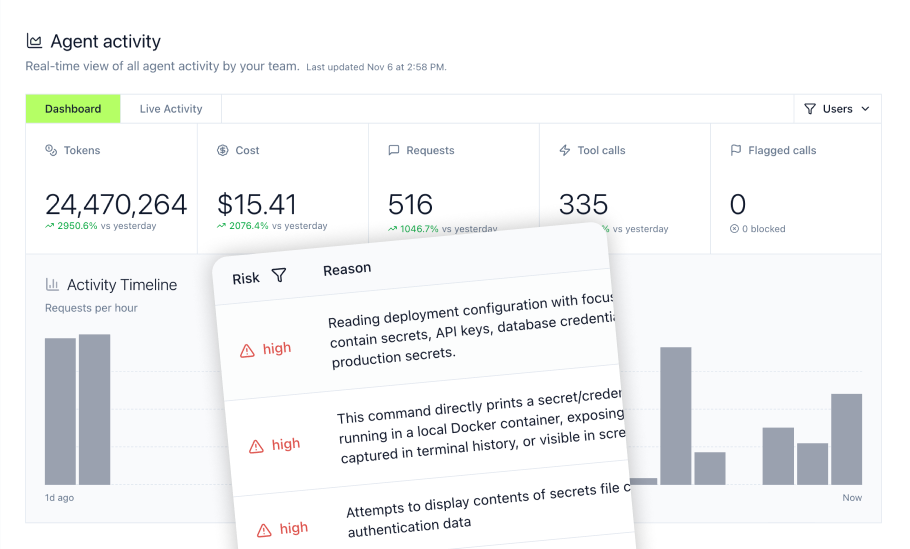
MintMCP's positioning as a system of record for enterprise AI governance addresses these long-term requirements. The platform's Agent Monitor provides visibility into supported agent activity including prompts, commands, file access, and tool calls. Security and enterprise controls including SSO, SCIM, RBAC, and SIEM export create the compliance backbone organizations need.
Virtual MCP Bundles eliminate per-machine configuration by bundling approved connectors behind governed endpoints with SCIM-driven membership. Agent Identities treat autonomous agents as first-class principals with independent credentials that can be rotated or revoked independently from human users. Guardrails provide three coexisting security layers for prompt injection, secrets, PII detection, declarative rules, and custom JavaScript middleware.
For teams deploying Claude Code, Cursor, or custom agents, MintMCP's governance-first approach provides the foundation for scaling AI operations without accumulating security debt.
Choose MintMCP When You Need:
- Compliance-first deployment in regulated industries requiring third-party security attestations
- Virtual MCP Bundles for role-based, pre-configured tool access without per-machine setup
- Per-agent identity with independent credentials and attributable audit trails
- Managed governance that reduces infrastructure burden while maintaining security controls
- Multi-client support across Claude, Cursor, ChatGPT, Gemini, and Copilot
Frequently Asked Questions
What is the main difference between an MCP gateway and a traditional API gateway?
Traditional API gateways handle predetermined request paths with static authentication. MCP gateways must govern dynamic tool discovery where agents call list_tools at runtime and decide which tools to invoke based on prompts. MCP gateways also need to handle non-human agent identities, tool description injection into context windows, and unpredictable execution patterns of autonomous agents.
Can I use multiple MCP gateways together?
Organizations sometimes deploy multiple gateway solutions for different use cases. However, this approach creates governance fragmentation with separate audit logs, access policies, and credential management. A unified gateway like MintMCP with Virtual MCP Bundles allows different configurations for different teams while maintaining centralized visibility and policy enforcement.
How do Virtual MCP Bundles differ from other role-based access approaches?
MintMCP's Virtual MCPs combine approved connectors and curated tools behind governed endpoints with SCIM-driven membership and access policies. The distinction is how MintMCP uses Virtual MCPs as a consistent unit of deployment, access control, tool curation, audit, and administration. Other platforms also support scoped endpoints and role-based permissions, but their configuration and identity models differ.
What compliance certifications should I require from an MCP gateway?
For regulated industries, a SOC 2 Type II report provides independent assurance about controls within the examination's scope. HIPAA requires appropriate safeguards and contractual arrangements when protected health information is involved. MintMCP is SOC 2 Type II audited, compliant with HIPAA standards, and uses continuous compliance monitoring through Drata. Organizations remain responsible for evaluating their own compliance obligations, regardless of infrastructure choice.
What is the typical implementation timeline for an MCP gateway?
Implementation varies by deployment model, connector requirements, identity integration, and security policies. MintMCP supports rapid deployment of governed MCP connections through managed infrastructure. Self-hosted platforms such as Obot require additional infrastructure planning, particularly for production Kubernetes environments. Enterprise deployments involving SSO, SCIM, private networking, and custom middleware should be scoped individually rather than relying on universal timelines.
The MCP gateway market continues evolving as enterprises scale AI agent deployments. While Traefik Hub provides Kubernetes-native MCP governance through task-based access control, MintMCP combines governed MCP connections, Virtual MCPs, first-class agent identities, monitoring, and runtime guardrails in one enterprise control layer. Explore MintMCP's pricing to evaluate whether its governance-first approach fits your AI deployment requirements.