Enterprises are deploying AI agents across Claude, Cursor, ChatGPT, Gemini, and Copilot faster than security and platform teams can govern what those systems access, whose credentials they use, and what actions they take. A 2024 global survey found that 40% of respondents believed their organization's AI governance program was insufficient to ensure the safety and compliance of AI assets and use cases, highlighting a critical gap between AI adoption and operational control. Platforms like MintMCP's MCP Gateway address this by centralizing tool access, credentials, permissions, and audit trails behind governed endpoints, transforming abstract governance principles into enforceable operational requirements.
This article outlines how to select, implement, and operationalize AI governance frameworks, covering four major global models, practical implementation phases, risk management strategies, compliance requirements, and the technical infrastructure needed to govern AI systems at enterprise scale.
Key Takeaways
- 78% of business executives lack strong confidence that their organization could pass an independent AI governance audit within 90 days
- Four major AI governance references: NIST AI RMF (voluntary risk guidance), ISO/IEC 42001 (certifiable management-system standard), EU AI Act (legally binding regulation), and OECD AI Principles (intergovernmental policy principles)
- 46% of leaders cite governance or compliance failures as a leading cause of AI underperformance
- Shadow AI creates financial risk: Organizations using high levels of unapproved AI tools observed $670K higher breach costs than organizations with low or no shadow AI
- Governance investment varies by organization, risk profile, and regulatory scope, with potential financial exposure including regulatory penalties under laws such as the EU AI Act
- Implementation can follow a phased roadmap covering governance foundations, risk classification, technical controls, continuous monitoring, and audit readiness, with timing varying by organization
Understanding AI Governance Frameworks: Core Concepts
AI governance frameworks are structured systems of policies, processes, controls, and accountability mechanisms that ensure AI systems operate safely, ethically, and in compliance with regulations throughout their lifecycle. These frameworks translate abstract principles like fairness and transparency into enforceable operational requirements, defining who approves model changes, what documentation must exist before deployment, and how bias gets measured and remediated.
The Imperative for AI Governance
The governance gap represents a significant unmanaged risk in enterprise AI today. 78% of business executives lack strong confidence that their organization could pass an independent AI governance audit within 90 days.
This creates operational failures at scale:
- Audit readiness gaps: 78% of executives lack audit confidence
- Financial exposure: Organizations using shadow AI observed $670K higher breach costs
- Governance underperformance: 46% of leaders cite governance failures as causing AI underperformance
The challenge intensifies when employees and autonomous agents use multiple AI tools, models, and clients. Security teams cannot see which tools agents use, which files they access, or which actions they take. This visibility gap makes governance frameworks essential operational infrastructure rather than compliance checkboxes.
Key Pillars of Responsible AI
Major AI governance frameworks share overlapping themes around transparency, accountability, fairness, privacy, security, and human oversight, but they differ in their formal principles, obligations, and required controls:
Transparency and Explainability
- Systems must be interpretable and decisions traceable
- Technical implementations include audit trails and decision logging
- Affected individuals should understand how systems reach conclusions
Accountability
- Clear ownership assigned for AI outcomes
- Defined escalation paths for incidents
- Documentation requirements for model changes
Fairness and Non-Discrimination
- Algorithmic bias must be measured and mitigated
- Bias testing and audits where required or appropriate for the system and applicable framework
- Disparate impact tracking
Privacy and Data Protection
- Lawful data usage under GDPR, HIPAA, and regional regulations
- Privacy-preserving techniques where appropriate
- Data minimization principles
Security and Robustness
- Protection against adversarial attacks and prompt injection
- Resilience testing under unexpected conditions
- Runtime controls that screen tool calls
Human Oversight
- Meaningful human control over high-risk decisions
- Human-in-the-loop checkpoints
- Kill switch capabilities
These principles require specific technical infrastructure that operationalizes governance at machine speed, including continuous monitoring, automated policy enforcement, and audit-ready evidence generation.
Establishing AI Risk Management
AI risk management extends beyond traditional IT security to address the unique challenges of autonomous systems making tool calls, accessing enterprise data, and executing multi-step actions.
Common AI Risks
Dangerous or Unpredictable Agent Actions
- Agents can make tool calls that expose data or misuse credentials
- Non-technical users can trigger agents to run commands to random sites
- Malicious tool descriptions can inject instructions into agent prompts
Scattered MCP Configurations
- Developers configure servers independently across devices
- API keys scattered across endpoints
- No centralized credential visibility
Shadow AI Proliferation
- Employees adopt AI tools faster than security teams can evaluate
- Unapproved tools bypass governance controls
- Shadow AI usage correlates with higher breach costs
Missing Agent Identity
- Autonomous agents operate through human credentials
- Attribution of agent actions becomes impossible
- Credential rotation cannot target specific agents
Proactive Risk Identification
The NIST AI RMF provides a structured approach through four core functions:
Map: Understand the AI system context
- Create comprehensive AI system inventory
- Document data flows and integration points
- Identify affected stakeholders
Measure: Assess risks and impacts
- Apply risk taxonomy using likelihood × impact
- Score systems against trustworthiness characteristics
- Evaluate bias and accuracy
Manage: Address identified risks
- Deploy technical controls proportional to risk
- Implement runtime guardrails that screen for injection, secrets, and PII
- Establish human checkpoints
Govern: Establish oversight structure
- Define policies, roles, and accountability
- Create responsible AI culture
- Maintain continuous improvement
MintMCP's Guardrails provide three coexisting layers for runtime risk mitigation:
- Mint Guard: Managed detection policies for prompt injection, credentials, PII, and harmful content
- Rules: Declarative matching on tool names or argument patterns with flag, block, ask, mask, or notify actions
- Gateway Middleware: Customer-authored JavaScript for DLP integrations and custom policy enforcement
Implementing AI Governance Tools
Governance tools must provide operational infrastructure that enforces policies at machine speed, detects shadow AI proliferation, monitors drift continuously, and generates audit-ready evidence automatically.
Key Features of Governance Platforms
Centralized Tool Access
- Single governed entrypoint between AI clients and enterprise tools
- SSO integration through Okta, Entra ID, or Google
- SCIM-driven access that propagates directory changes automatically
- Credential injection per call without long-lived secrets
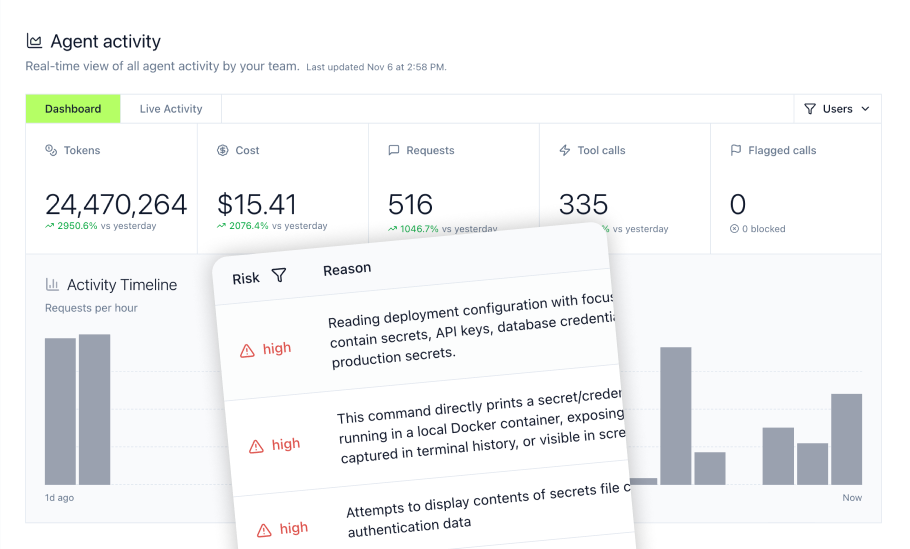
Real-Time Activity Visibility
- Live monitoring of prompts, file access, and tool calls
- Cross-platform capture across Claude Code, Cursor, and other agents
- Usage and cost tracking by model, user, and agent
- SIEM export for compliance reporting
Policy Enforcement at Runtime
- Automated detection and blocking of dangerous patterns
- Tool curation that limits attack surface
- Human-in-the-loop checkpoints
- Kill switch capabilities for incident response
Audit Trail Generation
- Complete logging of tool calls, credential events, and policy changes
- Tamper-evident access history
- Exportable documentation for SOC 2 and HIPAA reviews
Overcoming Scattered Configurations
The traditional model of per-device MCP configuration creates N installs, N auth flows, and N points of failure. Each developer configures each MCP server locally, leading to duplicated setup, inconsistent security, and no centralized visibility.
MintMCP's MCP Gateway solves this through Virtual MCP (VMCP) abstraction. A Virtual MCP bundles approved connectors and a curated tool surface behind one governed endpoint for a particular team, role, use case, or agent. Users connect once instead of configuring each server individually.
Virtual MCP capabilities:
- One endpoint, one auth model, one tool surface, one audit trail
- Read-only vs read-write access as separate VMCPs
- Directory groups driving membership through SCIM
- Credential injection without endpoint secrets
| Challenge | Traditional Approach | VMCP Solution |
|---|---|---|
| Credential management | API keys on laptops | Centralized vault with per-call injection |
| Access control | Per-tool manual config | Role-based policies driven by directory |
| Audit logging | Scattered or nonexistent | Complete logging through gateway |
| Tool curation | Users access all tools | Admin-approved sets per role |
Achieving AI Compliance
AI compliance requires navigating multiple overlapping frameworks with different scopes, enforcement mechanisms, and geographic applicability. Most enterprise programs require alignment with more than one framework simultaneously.
Navigating AI Regulations
Four major frameworks shape global AI governance:
NIST AI RMF 1.0 (Voluntary, US-centric)
- Voluntary framework for managing AI risks and trustworthiness considerations
- Four functions: Govern, Map, Measure, Manage
- Generative AI Profile (AI 600-1) provides supplemental guidance
- Voluntary and designed for organizations across sectors
ISO/IEC 42001:2023 (Voluntary, Global, Certifiable)
- First international standard for AI management systems
- Follows same Annex SL structure as ISO 27001
- Third-party certification available
- Provides common language across jurisdictions
EU AI Act (Mandatory, Legally Binding)
- World's first comprehensive binding AI law (Regulation 2024/1689)
- Prohibited practices banned February 2025
- Following Regulation (EU) 2026/1744, high-risk rules for stand-alone Annex III systems apply from December 2, 2027, while rules for high-risk systems embedded in regulated products apply from August 2, 2028
- Fines up to €35M or 7% of global revenue
- Extraterritorial scope applies to systems used in EU
OECD AI Principles (Voluntary, Intergovernmental)
- Currently has 47 adherents, including the European Union
- Provides an influential policy foundation for international AI governance
- Influences AI policy and governance approaches across jurisdictions
Geographic considerations:
- United States: No comprehensive federal AI law; sector-specific requirements include SR-26-2 for banking organizations and FDA oversight for healthcare
- European Union: Comprehensive binding regulation with extraterritorial scope
- China: Interim Measures for Generative AI services offered to the public, with security-assessment requirements applying to services with public-opinion attributes or social-mobilization capabilities
- Canada: Directive on Automated Decision-Making with four-level impact assessment
Building Auditable AI Ecosystems
Algorithmic Impact Assessments
- EU AI Act Article 27 requires specified deployers of certain high-risk AI systems to conduct a fundamental rights impact assessment before first use
- Canadian Directive requires assessment for automated federal decisions
- Multiple US state laws impose similar requirements
Data Protection Requirements
- GDPR Article 35 requires Data Protection Impact Assessments when AI-related personal-data processing is likely to result in a high risk to individuals' rights and freedoms
- HIPAA Security Rule applies to electronic PHI handled by covered entities and business associates
- State privacy laws add requirements
Documentation and Audit Trails
- SIEM export capabilities through OTLP or Splunk HEC
- Tool calls, prompts, gateway requests, and policy changes logged
- Tamper-evident history verifiable via published JWKS
MintMCP's Security features provide the compliance backbone: penetration tested with data encrypted in transit and at rest, complete audit trails, SOC 2 Type II audited, and compliant with HIPAA standards with BAAs available.
Secure Agent Identity and Access Management
As organizations scale from 10 to 100+ autonomous agents, "who did what" becomes the central governance question. Traditional identity models designed for human users fail to address the unique requirements of agents that operate continuously and make autonomous decisions.
First-Class Agent Identities
Autonomous agents operating through human credentials or generic service accounts create governance failures:
- Attribution collapse: Actions cannot be traced to specific agents
- Over-privileging: Agents inherit all permissions of human accounts
- Rotation failures: Cannot rotate credentials for a specific agent
- Audit gaps: Cannot distinguish human from agent actions
MintMCP's Agent Gateway treats autonomous agents as first-class non-human principals. Each agent receives:
- Its own identity: Named, org-scoped principal
- Its own credentials: Independent rotation and revocation
- Scoped MCP access: Purpose-built toolset
- Attributable audit trail: Governed MCP activity attributed to the specific agent identity
Agent vs Human Credentials
MintMCP supports three approaches from simplest to most secure:
Bearer Keys
- Static key on every request
- Named with expiry and revocability
- Appropriate for development environments
M2M Tokens
- OAuth client-credentials exchange for short-lived tokens
- Secret stays out of request path
- Suitable for production with moderate security
Workload Identity Federation
- Agent's infrastructure (K8s, cloud role, CI job) mints short-lived OIDC tokens
- MintMCP holds no secret
- Highest security for production
| Human Users | Autonomous Agents |
|---|---|
| Interactive authentication | Continuous operation |
| Session-based access | Long-running processes |
| Manual credential management | Automated rotation |
| Individual accountability | Organizational accountability |
Governing AI Clients
Organizations deploying mixed AI environments with Claude, Cursor, ChatGPT, Gemini, and Copilot face a common challenge: each client has separate permission models, logs, and security controls.
Mixed Environment Challenges
- Per-client configuration: Each AI client requires separate setup
- Inconsistent security: Different clients enforce different policies
- Scattered credentials: API keys managed per-client
- No centralized audit: Cannot produce unified reports
Unified Gateway Benefits
MintMCP's MCP Gateway provides consistent governance across AI clients:
Claude Code Integration
- Connect to enterprise tools through one endpoint
- SSO authentication and per-user permissions
- Gateway audit trail for tool calls, with supported file-access visibility through Agent Monitor
Cursor Integration
- Cursor setup with centralized credential management
- Same RBAC policies as other clients
- Consistent monitoring
ChatGPT Integration
- ChatGPT and Custom GPT setup with governed access
- Enterprise authentication through gateway
- Policy enforcement at tool call level
Benefits:
- Single authentication: SSO across all clients
- Consistent policies: RBAC driven by directory groups
- Centralized audit logs: For governed MCP traffic, with Agent Monitor adding supported off-gateway activity where available
- Centralized credentials: Rotate once, not per-client
Building Governance Teams
AI governance requires dedicated organizational capacity, not just technology. Effective programs establish clear accountability across technical, business, and compliance functions.
Key Governance Roles
Governance investment varies by organization, risk profile, and regulatory scope, covering personnel, technology, external audits, and training.
Core roles:
Head of AI / Chief AI Officer
- Overall accountability for AI strategy
- Balances innovation with risk management
- Reports to executive leadership
CISO / Security Leadership
- Owns security policies and controls
- Oversees Agent Monitor and Guardrails
- Manages incident response
Platform Engineering
- Implements governance infrastructure
- Manages MCP Gateway and VMCP configuration
- Integrates with DevOps workflows
Compliance / Legal
- Interprets regulatory requirements
- Coordinates external audits
- Maintains documentation
AI Ethics / Risk Management
- Evaluates bias and fairness
- Conducts algorithmic impact assessments
- Monitors emerging regulations
Implementation Roadmap
A practical implementation can be organized into five phases, with timing determined by the organization's scope, risk profile, and existing controls:
Phase 1: Governance Foundations
- Appoint governance lead and committee
- Create AI system inventory including shadow AI
- Define risk appetite
- Select primary framework
Phase 2: Risk Classification
- Apply risk taxonomy
- Score systems using likelihood × impact
- Prioritize high-risk systems
Phase 3: Technical Controls
- Implement input validation and output filtering
- Configure access control through RBAC
- Establish audit trails
- Deploy Mint Guard for runtime detection
Phase 4: Continuous Monitoring
- Track model drift
- Monitor bias through metrics
- Detect accuracy degradation
- Configure alerts
Phase 5: Audit Readiness
- Quarterly AI inventory updates
- Annual external audits
- Continuous improvement
Managing Agent Memory and Persistence
Autonomous agents that operate continuously require memory systems that persist across sessions. Some agent-memory approaches can make state difficult to inspect, audit, govern, or move between systems.
Challenges of Ephemeral Memory
- Opaque state: Organizations cannot inspect what agents remember
- Vendor lock-in: Memory stored in provider systems
- Audit gaps: No visibility into how memory influences decisions
- Compliance risk: Memory may contain PII without oversight
Enterprise-Grade Memory Design
MintMCP's Coworker Agents implement company-owned memory based on Git-like principles:
Repo-as-Source-of-Truth
CLAUDE.mdcontains agent instructionsprogress.mdpersists memory across sessionsinbound/provides task drop for scheduled work- All state is reviewable and auditable
Memory Scoping
- Private memory for individual context
- Team memory shared across related agents
- Organization memory for company-wide knowledge
- Customer memory for client-specific context
Governance Built In
- Memory changes tracked through version history
- Audit trails show memory evolution
- Sensitive data can be identified and governed
- Memory can be exported or deleted
| Opaque or Provider-Controlled Memory | Company-Owned Memory |
|---|---|
| May be difficult to inspect | Reviewable files |
| May be difficult to move | Git-backed portability |
| Auditability varies by system | Version history |
| Governance depends on provider controls | Governable content |
Coworker Agents extend governance to the complete lifecycle:
- Triggers: Slack mention, cron schedule, or manual run
- Sandbox execution: Restricted egress and secret brokering
- Tool allowlists: Real allowlists, not advisory
- Swappable models: Model and harness choices remain independent across supported environments
Operationalizing AI Governance with MintMCP
Effective AI governance requires more than selecting the right framework. Organizations need operational infrastructure that enforces policies automatically, provides real-time visibility, and generates audit-ready evidence without manual intervention.
MintMCP's governance platform addresses the core operational challenges enterprises face when scaling AI deployments. Rather than requiring each AI client, developer, and agent to manage separate configurations, credentials, and security policies, MintMCP centralizes governance through three integrated layers:
Unified Tool Access: Virtual MCPs eliminate scattered per-device configurations by providing role-specific, pre-approved tool surfaces behind single governed endpoints. Teams connect once through SSO, and directory group membership automatically determines access rights through SCIM integration. Credentials inject per-call from a central vault, removing API keys from endpoints entirely.
Runtime Policy Enforcement: Guardrails provide three coexisting control layers. Mint Guard detects prompt injection, credential leaks, and PII with monitoring and enforcing modes. Declarative Rules match tool names or argument patterns with block, ask, mask, flag, or notify actions. Customer-authored Middleware integrates DLP systems and external classifiers for organization-specific requirements.
Agent Identity and Attribution: Agent Gateway treats autonomous agents as first-class principals with independent credentials, scoped permissions, and attributable audit trails. Whether through bearer keys, M2M tokens, or workload identity federation, each agent receives its own identity that enables precise access control and complete audit attribution.
The result is governance infrastructure that operates at machine speed. Agent Monitor provides cross-platform visibility into prompts, tool calls, file access, and agent behavior. SIEM export sends audit logs to existing compliance systems through OTLP or Splunk HEC. And when incidents occur, operational controls enable immediate response through kill switches and automated alerts.
Organizations can use MintMCP with supported AI clients including Claude Code, Cursor, and ChatGPT while applying centralized governance through MintMCP. This unified approach transforms governance from a compliance burden into operational infrastructure that accelerates secure AI deployment.
Frequently Asked Questions
What is the difference between AI governance and AI ethics?
AI governance is the operational system of policies, processes, and controls that ensure AI systems function safely and comply with regulations. AI ethics provides the underlying principles that governance operationalizes. Ethics asks "should we build this?" while governance asks "given we are building this, how do we ensure it operates responsibly?" Governance translates ethical principles like fairness and transparency into enforceable technical requirements, defined approval processes, and measurable controls. An AI ethics committee might decide that credit scoring models should not discriminate by protected characteristics; the governance framework then specifies how bias gets measured, what thresholds trigger remediation, and who approves deployment.
How do organizations balance innovation speed with governance requirements?
The framing of governance versus innovation creates a false dichotomy. Governance accelerates deployment by establishing a safe, repeatable path from experimentation to production that eliminates ad-hoc approval bottlenecks. Organizations with mature governance programs deploy faster because they have pre-approved compliance pathways, automated policy enforcement, and clear escalation procedures.
What specific technical controls do governance frameworks require?
AI governance frameworks do not prescribe one universal technical-control stack. Depending on the framework, jurisdiction, risk level, and use case, implementation may include documentation and traceability, bias testing, privacy impact assessments, adversarial testing, runtime guardrails, human oversight, and audit controls. Techniques such as SHAP, LIME, or demographic-parity metrics are implementation options rather than universal framework requirements. Platforms like MintMCP operationalize these requirements through centralized tool access, agent identity management, continuous monitoring, and policy enforcement at the gateway level.
How do AI governance requirements differ across regulated industries?
Regulated industries layer AI-specific requirements on top of existing compliance frameworks. Certain federally regulated banking organizations are subject to SR-26-2 model risk management guidance, which superseded SR-11-7 on April 17, 2026 and covers model development, validation, governance, and ongoing risk management. Healthcare organizations navigate FDA SaMD classification for AI as a medical device, HIPAA Security Rule for PHI processing, and ONC HTI-1 transparency requirements. Canadian federal institutions subject to the Directive on Automated Decision-Making use a four-level Algorithmic Impact Assessment framework. The EU AI Act adds cross-industry requirements with risk-tiered obligations. Organizations in regulated industries typically need governance platforms that can generate audit evidence for multiple frameworks simultaneously.
What is the role of shadow AI in enterprise governance risk?
Shadow AI refers to AI tools adopted by employees without IT or security approval. Shadow AI creates governance blind spots because these tools bypass all security controls, audit logging, and access policies. Organizations with high shadow AI usage observed $670K higher breach costs. Effective governance addresses shadow AI through discovery mechanisms that detect unapproved usage, combined with sanctioned alternatives that provide capabilities employees need within governed channels. Agent Monitor can detect MCP usage even when the server is not connected through the governed gateway, providing visibility into shadow AI activity.