Selecting the right AI gateway determines whether organizations deploy AI agents with full governance or expose critical systems to uncontrolled access. As a16z's survey found average annual LLM spend rising from about $4.5M to $7M over two years among large enterprises, the infrastructure supporting enterprise AI increasingly requires centralized authentication, monitoring, and production-grade security controls.
An AI gateway is a broad control layer for AI traffic. LLM-focused AI gateways typically sit between applications and model providers to handle routing, caching, guardrails, and observability, while MCP gateways sit between AI clients or agents and enterprise tools and data. For teams using MCP, the right gateway can replace scattered local configurations with centrally managed authentication, permissions, credentials, policy, and audit. The Model Context Protocol has emerged as the standard for AI-to-tool connectivity, and enterprises now need gateways that understand MCP-specific requirements like authentication, credential handling, tool access, and protocol-aware policy enforcement. This guide evaluates 10 gateway solutions spanning LLM traffic, MCP tool access, and agent governance for enterprise teams in 2026.
Key takeaways
- MintMCP Gateway provides enterprise MCP infrastructure with Virtual MCPs, hosted MCP connectors, SSO and SCIM-driven RBAC, tool-level policy, and audit logs, while Agent Gateway adds per-agent identity, scoped credentials, and attributable audit trails
- Enterprises adopting AI governance frameworks benefit from gateways that centralize identity, credentials, permissions, and monitoring across AI clients and autonomous agents
- MCP gateway selection should evaluate authentication depth, protocol support for both STDIO and Streamable HTTP transports, observability capabilities, and agent identity management
- Organizations face credential sprawl, zero visibility, and audit gaps when AI clients access enterprise systems without proper gateway infrastructure
- Security teams require tool-level authorization, real-time monitoring, guardrails for prompt injection and PII detection, and tamper-evident audit trails
1. MintMCP Gateway: Enterprise MCP infrastructure with governed agent access
MintMCP Gateway provides enterprise infrastructure for governing AI clients and autonomous agents across the Model Context Protocol ecosystem. The platform helps organizations make AI systems deployable, governed, measurable, and swappable by centralizing tool access, agent identity, credentials, permissions, monitoring, guardrails, and auditability.
MintMCP addresses a recurring enterprise problem: teams adopt Claude, Cursor, ChatGPT, Gemini, Copilot, and custom agents faster than security and platform teams can govern what those systems access, whose credentials they use, what actions they take, and how those actions are attributed.
Architecture approach
MintMCP's architecture starts from governed data and tool access, then extends the same identity, permission, audit, and policy foundation to autonomous agents. The key abstraction is the Virtual MCP (VMCP), which bundles approved connectors and a curated tool surface behind one governed endpoint for a particular team, role, use case, or agent.
A Virtual MCP serves as the unit of deployment, access control, tool curation, audit, and administration. Directory groups drive membership through SCIM, helping organizations apply consistent access policies without requiring every employee to configure each MCP server separately.
Core capabilities
MCP Gateway features:
- Virtual MCPs that bundle connectors behind SSO-fronted endpoints with OAuth brokering and SCIM-driven membership
- Hosted MCP connectors running in MintMCP's data plane with auto-scaling and sandboxed execution
- Remote and STDIO connector support for existing MCP servers
- Centralized credential injection with encrypted storage and rotated AES keys
- Tool-level curation that trims context-window bloat while enforcing least privilege
- Private network tunnel for on-prem and VPC connectivity
Agent Gateway features:
MintMCP's Agent Gateway treats autonomous agents as first-class non-human principals. Each agent receives its own identity, scoped MCP access, and credentials that can be rotated or revoked independently.
- Bearer keys for static key authentication with individual expiry and revocation
- M2M tokens for OAuth client-credentials exchange
- Workload identity federation for Kubernetes, cloud roles, and CI job identities
- Per-agent audit trails with full attribution
Agent Monitor features:
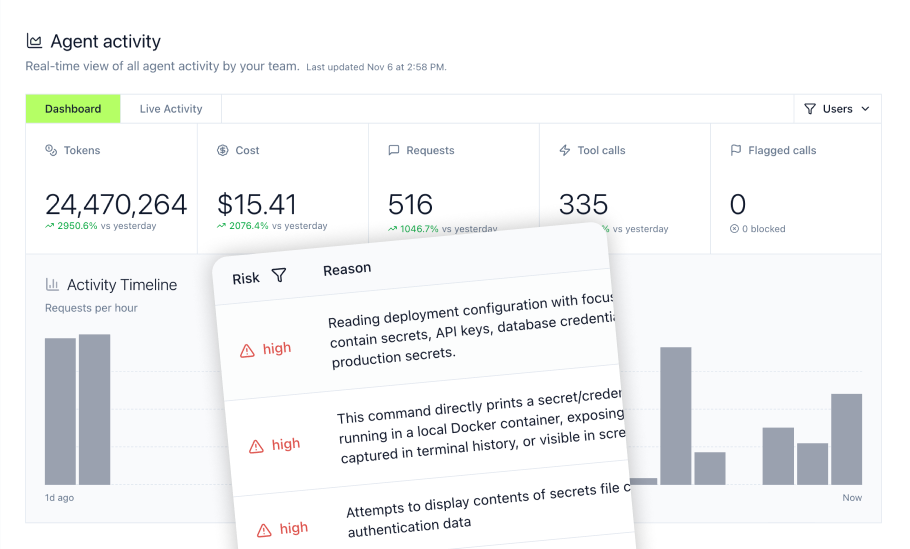
- Live activity feed showing file reads, commands, MCP tool calls, and prompts
- Security rules for built-in detection of secrets, prompt injection, and tool permissioning
- Usage and cost tracking by model, user, agent, and session
- SIEM export via OTLP or Splunk HEC
Guardrails features:
- Mint Guard with managed detection for prompt injection, credentials, PII, and harmful content
- Declarative rules matching tool names, argument patterns, and content
- Gateway middleware running customer JavaScript in a sandbox for DLP integration
Enterprise integrations
MintMCP provides hosted connectors for enterprise systems:
- Snowflake for data warehouse queries
- GitHub for repository access
- Salesforce for CRM integration
- Slack for team collaboration
- Datadog for observability
- Google Workspace for productivity tools
- Microsoft 365 for enterprise collaboration
Compliance and security
- SOC 2 Type II audited
- HIPAA standards compliant (BAA available)
- Penetration tested
- Data encrypted in transit and at rest
- Enterprise SSO with Okta, Entra ID, and Google
- SCIM-driven directory group synchronization
- Tamper-evident audit trails with signed access-grant history
Pricing
Contact MintMCP for enterprise demonstration and pricing.
Getting started
Visit mintmcp.com/mcp-gateway for documentation and deployment guides.
2. Prisma AIRS AI Gateway (formerly Portkey)
Prisma AIRS AI Gateway is Palo Alto Networks' AI gateway, built on Portkey technology after the acquisition closed in May 2026. The product governs AI traffic across LLM, MCP, and A2A interactions.
Primary focus
Prisma AIRS AI Gateway centralizes AI traffic routing, observability, cost controls, and runtime security across models, tools, and agents. It supports SaaS and Hybrid deployment models.
Core features
- Model routing and provider integrations
- Guardrails and runtime security controls
- Logs, observability, quotas, and cost tracking
- MCP and A2A traffic governance
- SaaS and Hybrid deployment options
Fit considerations
Prisma AIRS AI Gateway now overlaps more directly with agent governance than the legacy Portkey positioning suggests. Teams should compare its AI traffic security and observability model with MintMCP's Virtual MCP architecture, hosted connector operations, per-agent identity model, and Agent Monitor coverage.
Pricing
Prisma AIRS AI Gateway uses consumption-based licensing through Palo Alto Networks Flex Credits, with usage metered by token consumption. Contact Palo Alto Networks for an estimate.
3. Kong AI Gateway
Kong AI Gateway extends the established Kong API management platform with AI and MCP protocol support. The solution leverages Kong's infrastructure expertise for organizations already using Kong for API management.
Primary focus
Kong provides universal LLM API routing through its plugin-based architecture. The platform supports MCP and A2A traffic alongside traditional API management.
Core features
- Plugin-based extensibility for custom integrations
- Token-based rate limiting
- Semantic caching
- Integration with existing Kong deployments
- Enterprise-grade scaling
Fit considerations
Kong provides an extension point for organizations already standardized on Kong infrastructure. Teams should evaluate whether the plugin-based approach delivers the MCP-specific governance primitives they need, such as centrally governed tool surfaces, access policies, and credential handling for hosted STDIO servers.
Pricing
30-day free trial, Konnect Plus AI Gateway pricing at $20 per million API calls/events, and custom enterprise pricing.
4. Cequence AI Gateway
Cequence AI Gateway focuses on security for agentic AI workflows, with emphasis on protecting agent-to-tool interactions.
Primary focus
Cequence implements Agentic Zero Trust architecture with Agent Personas that define agent behavior boundaries in plain English.
Core features
- Native MCP support with registry of 140+ applications
- Agent Personas for defining agent behavior boundaries
- Session binding protection
- Prompt injection detection
Fit considerations
Cequence targets organizations prioritizing agentic AI security and governance. Its current product includes Agent Personas, SSO and team controls tied to identity-provider groups, centralized activity visibility, and registries for APIs, LLMs, skills, and agent resources. Teams should compare those controls directly with MintMCP's Virtual MCP architecture, hosted connector operations, Agent Gateway identity model, and Agent Monitor coverage.
Pricing
Enterprise pricing, contact for details.
5. TrueFoundry AI Gateway
TrueFoundry AI Gateway provides a gateway component within a broader GenAI platform, with focus on performance characteristics.
Primary focus
TrueFoundry reports roughly 3-5ms of added gateway overhead in a vendor-run load test using a fake OpenAI endpoint, with the gateway scaling to about 350 RPS on a 1 vCPU, 1 GB instance before CPU saturation. The platform supports third-party, self-hosted, and TrueFoundry-hosted models.
Core features
- Semantic caching with exact match and similarity modes
- Tool calling simulation
- Multimodal support
- YAML-based configuration versioning
- Prometheus and observability integrations
Fit considerations
TrueFoundry serves teams prioritizing low-latency performance. Organizations should compare whether they need MCP-specific features like Virtual MCP Bundles, Agent Bundles with M2M auth, and hosted connector operations alongside performance optimization.
Pricing
Free tier available, paid plans and enterprise pricing.
6. LiteLLM
LiteLLM provides an open-source AI gateway for teams requiring full infrastructure control and self-hosting capabilities.
Primary focus
As of August 2026, LiteLLM lists 140+ providers through an OpenAI-compatible interface. The platform offers both a Python SDK and Proxy Server for deployment flexibility.
Core features
- Virtual keys and budgets
- Team management
- Load balancing across providers
- Self-hosted deployment
Fit considerations
LiteLLM serves teams with DevOps capacity wanting infrastructure control. Organizations should evaluate the operational overhead of self-hosting versus managed alternatives that include governance features out of the box.
Pricing
Free open-source, enterprise custom pricing available.
7. Cloudflare AI Gateway
Cloudflare AI Gateway leverages Cloudflare's global edge network for AI traffic routing with broad free tier availability.
Primary focus
Cloudflare provides edge caching across its global network with support for 20+ AI providers.
Core features
- Global edge distribution for latency optimization
- DLP scanning and guardrails
- Unified billing across providers
- Persistent logs with plan-based storage
Fit considerations
Cloudflare offers a fit for teams already using Cloudflare infrastructure. Organizations should evaluate whether edge-focused features meet their MCP-specific governance requirements.
Pricing
Core features free on all Cloudflare plans.
8. Solo.io Agentgateway
Solo.io Agentgateway provides a Rust-powered gateway with native MCP and A2A protocol support built for Kubernetes environments.
Primary focus
Solo.io emphasizes performance through a Rust implementation and Kubernetes Gateway API integration. Its Virtual MCP feature federates multiple MCP servers behind a single endpoint, while LLM cost controls are handled separately through budgets, rate limits, and cost-management features.
Core features
- Native MCP and A2A support
- Kubernetes Gateway API compatibility
- Progressive disclosure to reduce token usage
- Open-source with enterprise options
Fit considerations
Solo.io serves Kubernetes-native organizations with infrastructure expertise. Teams should evaluate whether self-hosted operation aligns with their operational model.
Pricing
Open-source available, enterprise version with additional features.
9. HAProxy Enterprise AI Gateway
HAProxy Enterprise extends its high-performance proxy foundation with AI-specific capabilities for organizations prioritizing throughput.
Primary focus
HAProxy emphasizes raw performance from its proven proxy core with infrastructure-agnostic deployment options.
Core features
- Token-based rate limiting via Global Profiling Engine
- WAF integration for prompt inspection
- Bare metal, VM, cloud, and Kubernetes deployment
- Advanced ACL expressions
Fit considerations
HAProxy serves organizations prioritizing performance for high-throughput deployments. Teams should evaluate whether traditional proxy architecture delivers the MCP-specific governance features they require.
Pricing
Commercial license with custom pricing.
10. Gravitee Gamma
Gravitee Gamma provides unified management across APIs, events, and agents through a single platform.
Primary focus
Gravitee unifies LLM, MCP, and A2A proxies in one runtime. The platform includes an MCP Tool Server that converts existing APIs to MCP format.
Core features
- Unified API, event, and agent management
- Agent Catalog for discovery and reuse
- Event-native gateway for real-time pipelines
- Policy studio for visual flow building
Fit considerations
Gravitee serves organizations with complex architectures requiring unified management across multiple integration patterns. Teams should evaluate whether the platform approach aligns with their MCP-specific requirements.
Pricing
Enterprise pricing, contact for details.
Making your choice: Selection criteria for enterprise teams
Authentication and identity requirements
Evaluate whether gateways support enterprise SSO, SCIM directory synchronization, per-user OAuth, and per-agent identity. Organizations deploying autonomous agents need gateways that treat agents as first-class principals with independent credentials, not extensions of human accounts. Agent identities become critical as enterprises scale from pilot deployments to production agent fleets.
MCP protocol support depth
Not all gateways provide equivalent MCP support. Consider whether they handle both standard MCP transports: STDIO for client-launched local servers and Streamable HTTP for remote servers. The current MCP specification deprecates the older HTTP+SSE transport, and its authorization framework applies to HTTP-based transports rather than STDIO. Evaluate how each gateway hosts or wraps STDIO servers, handles upstream credentials, operates hosted connectors, and enforces tool-update policy.
Observability and audit requirements
Organizations face visibility challenges when AI clients access enterprise data without centralized logging. Essential capabilities include:
- Tool call tracking across all MCP servers
- Usage and cost attribution by user, agent, and session
- Security event detection for secrets, PII, and prompt injection
- SIEM export for enterprise security operations
- Real-time dashboards versus separate monitoring infrastructure
Security and compliance posture
Evaluate SOC 2 attestation, encryption practices, credential management, and runtime guardrails. For regulated industries, consider whether gateways support:
- PII detection in tool arguments and responses
- Prompt injection prevention
- Tamper-evident audit trails
- Guardrails operating on both request arguments and response content
Operational model alignment
Consider whether managed SaaS deployment, self-hosted operation, or hybrid approaches align with the organization. Managed gateways like MintMCP provide hosted connectors and pre-configured governance, while self-hosted options require infrastructure operation but offer full control.
Agent governance requirements
As organizations deploy autonomous agents for CI jobs, scheduled tasks, and background operations, governance requirements expand beyond simple routing. Evaluate whether gateways provide:
- Agent identity management separate from human accounts
- Scoped MCP access per agent
- Credential rotation independent of human accounts
- Per-agent audit attribution
Why MintMCP fits enterprise AI governance
MintMCP provides the governance foundation that enterprises need as AI adoption accelerates beyond pilot deployments. The platform's data-permissions-first architecture ensures that security, identity, and audit controls are built in from the start, not bolted on after agents already have broad access.
The Virtual MCP abstraction solves the fundamental challenge of deploying governed AI access across diverse teams and use cases. Rather than configuring each MCP server individually across every developer laptop, organizations create Virtual MCPs that bundle connectors, tool curation, and access policies behind single governed endpoints. Directory groups drive membership through SCIM, automatically applying consistent access policies as team composition changes.
Agent Gateway capabilities address the emerging requirement for autonomous agent governance. As enterprises scale from individual AI assistants to fleets of autonomous agents, the question of "who did what" requires agents with their own identities, not agents operating through whatever human credentials happen to be available. MintMCP treats agents as first-class principals with bearer keys, M2M tokens, or workload identity federation, enabling independent credential rotation, scoped MCP access, and attributable audit trails.
Agent Monitor provides a visibility layer for supported agent activity. It can capture supported activity such as file reads, commands, MCP tool calls, prompts, usage, and cost across supported coding-agent environments, including activity outside MintMCP Gateway traffic. Coverage varies by client, agent, and hook phase. Security rules provide built-in detection for secrets, prompt injection, and tool-permission violations, while SIEM export enables integration with enterprise security operations.
For organizations evaluating AI gateway infrastructure, MintMCP offers the combination of MCP-specific governance, agent identity management, runtime guardrails, and enterprise security controls that production deployments demand. Visit mintmcp.com to explore the platform.
Frequently asked questions
What distinguishes an AI gateway from a traditional API gateway?
AI gateways typically govern model-facing AI traffic such as routing, caching, rate limits, guardrails, and observability. MCP gateways govern tool and data access over MCP, while agent gateways add identity, permissions, and governance for autonomous agents. Traditional API gateways do not inherently understand MCP semantics, but some API gateway platforms now add native MCP and A2A capabilities. The current MCP specification is stateless, so multi-step workflow state should not be described as an inherent MCP gateway responsibility.
How do AI gateways support autonomous agent governance?
Gateways that support agent governance treat autonomous agents as first-class principals with their own identities, credentials, and permissions. This means each agent receives scoped MCP access, independent credential rotation, and attributable audit trails separate from human accounts. Without dedicated agent identity, agent actions may be attributed to human or shared credentials, weakening attribution and complicating audit and incident response.
What authentication methods should enterprise AI gateways support?
Enterprise gateways should support OAuth 2.x, SAML for SSO integration, OpenID Connect for modern identity providers, and multiple agent authentication mechanisms. Implementations provide bearer keys for simple agent authentication, M2M tokens for OAuth client-credentials flows, and workload identity federation for Kubernetes and cloud environments. Per-user OAuth ensures data access follows user permissions rather than shared service accounts.
Can AI gateways monitor coding agent activity beyond MCP calls?
Solutions like MintMCP's Agent Monitor capture supported activity beyond MCP traffic, including file reads, bash commands, git operations, and prompt submissions from coding agents like Claude Code and Cursor. This creates two-layer governance: the gateway covers MCP traffic while Agent Monitor covers local agent activity that does not traverse the gateway. Coverage varies by client, agent, and hook phase.
How quickly can organizations deploy enterprise AI gateway infrastructure?
Deployment timelines vary by approach. Managed services with hosted connectors and pre-configured governance can accelerate deployment compared to self-hosted options requiring infrastructure setup, authentication integration, and security configuration. Consider urgency for production deployment against infrastructure control requirements when evaluating deployment models.