Your SOC 2 auditor just asked: "Walk me through a prompt change from request to production deployment." Can you produce the evidence showing how that change was authorized, tested, deployed, and, where applicable, rolled back? If not, you may have difficulty demonstrating that your documented change-management controls operated as designed. AI agents break traditional compliance assumptions because they generate non-deterministic outputs, execute code at runtime, and make decisions without human authorization for each action. Organizations deploying Claude Code, Cursor, ChatGPT, Copilot, and custom agents need governed tool connections that translate traditional IT controls into agent-specific implementations covering model governance, autonomous action controls, and AI-specific audit trails.
This article outlines what SOC 2 auditors will actually ask about your AI agent deployments, the evidence required to answer each question, and how to build the infrastructure that generates that evidence automatically.
Key Takeaways
- SOC 2 Type II evaluates the design and operating effectiveness of controls over a defined reporting period, with evidence retained to demonstrate how those controls operated during that period
- SOC 2 controls also apply to AI systems, but organizations may need AI-specific control implementations for risks such as non-deterministic behavior, model changes, evaluation, and AI data governance
- The user-to-agent-to-tool chain must be auditable end-to-end; using a single "ai-service-account" can weaken attribution and least-privilege enforcement in agentic systems
- Organizations that build evidence pipelines during development spend significantly less time on audit preparation than those attempting post-hoc collection
- Uncontrolled production prompt changes can create CC8 change-management risk when prompts materially affect an in-scope service
- Per-agent identity with scoped credentials, independent rotation, and attributable audit trails addresses the core identity governance gap auditors target
Understanding SOC 2 Compliance for AI Agents
SOC 2 evaluates controls across five Trust Services Criteria: Security (mandatory), Availability, Processing Integrity, Confidentiality, and Privacy. For AI agents, these criteria require translation because autonomous systems generate probabilistic outputs, modify behavior through prompt changes, and drift over time without explicit code deployments.
Type I versus Type II
Type I reports verify control design at a single point in time. Type II reports examine operational effectiveness over an extended observation period, requiring continuous evidence collection.
The AI-specific challenge
SOC 2 controls are technology-neutral, but AI agents introduce risks and operating characteristics that may require different control implementations. AI agents introduce:
- Non-deterministic outputs that cannot be validated through traditional unit tests
- Runtime tool selection where agents decide which tools to call based on context
- Prompt injection surfaces through tool descriptions and user inputs
- Model drift that changes behavior without code changes
- Training data governance requirements absent from traditional software
The Common Criteria controls most critical for AI agents are CC6 (logical access), CC7 (monitoring), and CC8 (change management). These three areas generate the majority of audit findings for organizations deploying autonomous agents.
Establishing AI Agent Governance as a Foundation for SOC 2 Readiness
Before addressing specific auditor questions, organizations need a governance framework that makes AI agents deployable, governed, measurable, and swappable. This foundation determines whether compliance becomes a continuous byproduct of operations or a crisis-driven annual scramble.
The governance stack
- MCP Gateway: Centralized tool connections replacing scattered local configurations
- Agent Gateway: First-class non-human identities with scoped permissions and credentials
- Agent Monitor: Visibility into prompts, commands, file access, and tool calls
- Guardrails: Runtime controls preventing dangerous actions before execution
- Coworker Agents: Persistent agents with company-owned memory and governed execution
Organizations that wire audit logging, model versioning, and evaluation archival into systems from day one spend weeks on audit prep. Those attempting to reconstruct extended periods of evidence spend months in crisis mode.
The quarterly governance cadence
Implement these practices:
- Weekly production health reviews
- Monthly risk committee meetings
- Quarterly framework reviews
This cadence naturally feeds the Type II observation window with pre-assembled evidence, compressing audit prep from months to weeks.
Auditor Questions on AI Agent Identity and Access Control
CC6 logical access controls generate significant findings in AI agent audits. Auditors will probe how agents authenticate, what they can access, and how actions are attributed.
"Show me how you distinguish between human and agent actions in your audit logs"
This question targets the most common failure mode: agents running through shared service accounts or human credentials. When audit logs show "ai-service-account" without distinguishing individual agents, the entire audit trail becomes unreviewable.
Required evidence:
- Per-agent identity records showing unique credentials per autonomous agent
- User-to-agent-to-tool chain capturing delegation at each hop
- Independent credential rotation schedules per agent
- Revocation records demonstrating individual agent access removal
The Mintive (formerly MintMCP) Agent Gateway addresses this by providing each agent with its own identity, scoped MCP access, and independent credentials. Authentication mechanisms range from bearer keys to M2M tokens to workload identity federation where the agent's infrastructure mints short-lived OIDC tokens.
"Walk me through your agent credential rotation and revocation process"
Auditors expect agents to have credentials that can be rotated independently of human accounts and revoked immediately upon compromise detection. If revoking an agent's access requires changing a shared API key used by 50 other services, that's a finding.
"How do you enforce least privilege for agent tool access?"
The answer should demonstrate that agents receive purpose-built toolsets through RBAC policies, not blanket access to every connected system. Virtual MCPs provide this capability by bundling specific connectors behind governed endpoints for particular agents or use cases.
Demonstrating AI Agent Activity Monitoring and Audit Trails for SOC 2
CC7 monitoring controls require organizations to detect anomalies, track activities, and maintain evidence trails that auditors can sample.
"Show me every production model version deployed in the last 12 months"
If model changes are in scope, auditors may test whether the organization's documented change-management controls operated as designed.
Evidence may include:
- Model or deployment version records
- Approval records where required by the control
- Evaluation or test results where applicable
- Rollback procedures or deployment history where relevant
"What activity can you see from your AI agents?"
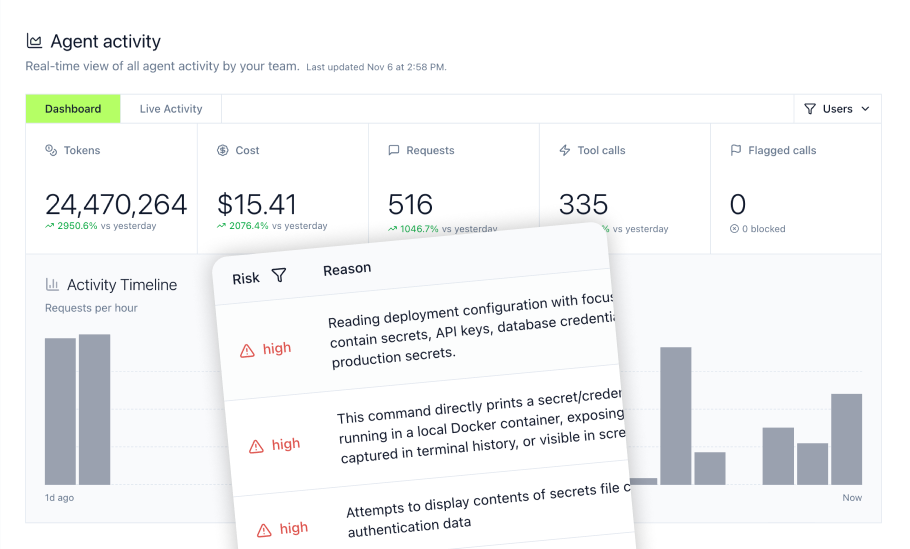
Auditors expect visibility beyond gateway request logging. Agent Monitor provides organizational visibility into:
- Prompt submissions
- File access (including .env files and SSH keys)
- Commands (bash, installations, git operations)
- MCP tool calls
- Usage and token costs per model, user, and session
This two-layer visibility separates gateway governance from broader agent activity monitoring. MCP Gateway governs traffic routed through governed connections while Agent Monitor can capture supported local and off-gateway activity from coding agent environments.
"Show me your SIEM integration for AI agent events"
SIEM export capabilities through OTLP or Splunk HEC demonstrate that agent activities integrate with existing security operations. Exportable events include tool calls, prompt submissions, gateway requests, and access policy changes.
Tamper-evident audit requirements
Audit evidence should be protected against unauthorized alteration in accordance with the organization's control design and risk. Tamper-evident or cryptographically verifiable records can strengthen auditability, but SOC 2 does not prescribe one required logging architecture. Mintive's audit infrastructure provides tamper-evident access-grant history signed at write time, verifiable offline via published JWKS.
Addressing Runtime Security and Guardrails in Your SOC 2 AI Agent Audit
Auditors will probe preventative and detective controls that operate at runtime when agents execute actions.
"How do you prevent prompt injection attacks on your AI agents?"
Prompt injection represents an AI-specific risk where malicious content in tool descriptions or user inputs can manipulate agent behavior. When that risk is relevant to the in-scope service, organizations should document how it is assessed, mitigated, monitored, and handled.
Mintive's Mint Guard provides managed detection policies for prompt injection that block at high confidence, along with credentials/secrets detection, PII detection, and harmful content screening. The three guardrail layers work together:
- Mint Guard: Out-of-the-box detection with monitoring and enforcing modes
- Rules: Declarative pattern matching on tool names, arguments, and content
- Gateway Middleware: Customer-authored JavaScript for DLP integration and custom policies
"Walk me through what happens when an agent attempts a dangerous action"
For policy-critical checks, organizations should document the intended failure behavior and ensure it aligns with their risk assessment and control design. When middleware calls an external DLP classifier and the classifier is unreachable, the configured response should follow that documented policy.
"How do you handle PII in agent tool calls?"
Depending on the service, data involved, and documented controls, relevant evidence can include:
- Controls for detecting or restricting sensitive data where applicable
- Redaction or masking rules with execution logs
- Data retention controls
- Tenant-isolation controls for multi-customer platforms
Gateway middleware templates for AWS Bedrock Guardrails, Google Cloud Model Armor, and OpenAI moderation enable integration with existing DLP infrastructure rather than requiring separate AI-specific tooling.
Centralized AI System Access and Credential Management
CC8 change management controls examine how agent configurations, prompts, and tool access change over time.
"Walk me through a prompt change from request to deployment"
This is the canonical question that exposes whether your organization treats prompts as configuration that can be edited in Slack or as code requiring version control, review, and approval.
The prompts-as-code discipline
Material production prompt changes should go through documented change controls appropriate to their risk and impact. The evidence chain includes:
- Version control history showing prompt modifications
- Code review records with approver signatures
- Test results demonstrating prompt behavior
- Rollback plans and execution capability
- Post-deployment validation windows
Uncontrolled production prompt changes can create significant CC8 change-management risk when those prompts materially affect the in-scope service. Organizations should define how relevant changes are authorized, tested, recorded, and deployed.
Centralized credential management
Scattered credentials across developer laptops represent both security and compliance failures. MCP Gateway centralizes:
- Connector authentication through Virtual MCPs
- Credential injection per call without storing long-lived secrets in connectors
- Per-user OAuth where applicable
- SSO and SCIM integration driving directory-group-based access
When auditors ask "How do you know what each agent can access?", the answer should show that each agent has scoped MCP and tool access, while credential handling is governed centrally and can use agent-specific credentials where appropriate, with activity logged for attribution.
Understanding MCP data risk helps organizations scope their compliance boundaries correctly and identify which systems require the strongest controls.
Company-Owned Memory and Persistent Agents: SOC 2 Implications
Organizations deploying Coworker Agents face additional audit questions about persistent state and memory governance.
"How do you manage agent memory across sessions?"
For agents that continue work across days, auditors will examine:
- Memory storage architecture and encryption
- Access controls on memory by scope (private, team, organization)
- Version history and rollback capability
- Retention policies and purge procedures
Mintive's approach treats memory as governed enterprise infrastructure following Git-like principles: company-owned, scoped, versioned, reviewable, auditable, and portable.
"Can you demonstrate that customer A's agent cannot access customer B's data?"
For multi-tenant platforms, organizations should be able to demonstrate that their documented tenant-isolation controls operate as designed. The appropriate testing method and frequency depend on the organization's risks and control design.
Processing integrity for non-deterministic outputs
SOC 2 Processing Integrity criterion PI1 requires processing to be "complete, valid, accurate, timely, authorized," per AICPA Trust Services. For probabilistic systems, this cannot be proven with deterministic tests.
Depending on the service's processing-integrity commitments, risks, and control design, relevant evidence can include:
- Versioned evaluation suites covering relevant expected and edge-case behavior
- Defined acceptance criteria with documented residual risk
- Re-evaluation after material model or system changes
- Archived evaluation results
- Source-grounding or faithfulness evaluations where relevant
Mintive: Infrastructure Built for AI Agent Compliance
Mintive provides the foundational governance layer that makes SOC 2 compliance achievable for AI agent deployments. Rather than retrofitting controls onto ungoverned systems, Mintive embeds compliance capabilities into the agent execution infrastructure itself.
The platform addresses the three highest-risk control areas:
- Identity and Access (CC6): Agent Gateway delivers per-agent identities with independent credentials, scoped tool access through Virtual MCPs, and attributable audit trails that clearly distinguish human actions from agent actions. This addresses the shared service-account pattern that can weaken attribution and least-privilege enforcement.
- Monitoring and Detection (CC7): Agent Monitor captures comprehensive visibility into prompts, commands, file access, and tool calls, while SIEM integration feeds agent events into existing security operations. Mintive supports audit trails and tamper-evident access-grant history, which organizations can use as evidence within their own audit-control framework.
- Change Management (CC8): Mintive supports centralized governance of tool connections, access policies, and gateway configuration, including configuration-as-code capabilities. Organizations remain responsible for applying their own documented change-management controls to prompts, models, agent instructions, and other in-scope configuration.
Organizations using Mintive build evidence pipelines during development rather than attempting crisis-driven reconstruction at audit time. The quarterly governance cadence naturally generates the continuous documentation required for Type II observation windows. When auditors request evidence related to agent identities, governed tool access, credential activity, supported agent activity, or access-policy changes, Mintive can provide relevant records from its governance and audit infrastructure. Organizations must separately maintain evidence for controls that Mintive does not operate, such as their own model deployment and tenant-isolation testing processes.
Mintive holds SOC 2 Type II attestation, with compliance documentation available at trust.mintmcp.com. Organizations deploying AI agents through Mintive's infrastructure can demonstrate that their systems operate within a governed compliance layer designed specifically for the unique challenges of autonomous, non-deterministic systems, following CISA AI security guidance.
Frequently Asked Questions
What happens if we discover a control gap during the observation window?
Document the gap, assess its impact, implement remediation, and discuss the exception with your auditor. Its effect on the SOC 2 examination depends on the nature and significance of the deviation, how long it existed, any mitigating controls, and evidence that the remediated control subsequently operated as designed.
Do we need separate SOC 2 reports for each AI model we use?
No. Your SOC 2 report covers your organization's controls, not the underlying AI models. However, you must demonstrate vendor due diligence for model providers and document their SOC 2 status in your sub-processor register. Model providers should be handled through the organization's applicable vendor-risk, privacy, contractual, and subservice-organization controls. Verify each provider's current data-retention and model-training policies rather than assuming API inputs and outputs are used for training by default.
How do auditors handle the non-deterministic nature of AI outputs?
For non-deterministic AI systems, organizations should define controls appropriate to their processing-integrity commitments and risks. Relevant evidence may include documented evaluation criteria, monitoring, investigation of material failures, and versioned evaluation results. The auditor evaluates whether those controls are suitably designed and, for Type II, operated effectively during the reporting period.
Can we start with Type I and move to Type II later?
Yes, and this is common for organizations under time pressure. Type I validates control design, allowing you to demonstrate progress to enterprise customers while building toward Type II. However, Type II observation windows must still run for extended periods, so starting Type I does not shorten the total timeline to Type II completion.
What if our AI agents access systems owned by other teams?
SOC 2 scope is based on the in-scope service and the people, processes, technology, data, and relevant dependencies supporting it, not automatically every system an agent can technically access. Document material dependencies and determine with your auditor how connected systems and relevant subservice organizations should be addressed.