When evaluating Workato Enterprise MCP alternatives, organizations must weigh whether they need broad iPaaS automation with MCP capabilities or purpose-built AI agent governance. While Workato offers connectivity across 12,000+ apps and an established workflow automation platform, many enterprises require faster deployment for AI-specific security controls, first-class agent identities, and compliance-ready infrastructure designed around the Model Context Protocol. This guide examines six Workato Enterprise MCP alternatives, with particular focus on how MintMCP differs for organizations prioritizing governed AI agent deployments.
The Model Context Protocol creates new governance challenges as teams adopt Claude, Cursor, ChatGPT, Gemini, and Copilot faster than platform and security teams can control what those systems access. Purpose-built MCP governance platforms address this gap with role-based tool bundling, non-human identity management, and runtime controls that traditional iPaaS platforms retrofit onto existing architectures.
Key takeaways
- MintMCP delivers purpose-built MCP governance with Virtual MCPs that bundle connectors, curated tools, and access policies behind role-based endpoints with SCIM-driven membership
- Agent Gateway provides first-class non-human identities with per-agent credentials, independent rotation, and attributable audit trails
- MintMCP combines Virtual MCPs, first-class agent identities, Agent Monitor visibility, and runtime guardrails in one control layer
- Deployment approaches vary significantly: MintMCP supports one-click workflows, while platforms exposing existing recipe libraries or requiring infrastructure setup follow different timelines
- Workato uses platform edition fees plus credit-based usage, MintMCP uses custom quote-based pricing, and developer-focused alternatives range from free and usage-based plans to custom enterprise pricing
Understanding Workato Enterprise MCP
Workato Enterprise MCP extends the company's established iPaaS platform into Model Context Protocol governance, building on its position as an eight-time Gartner Magic Quadrant Leader. The platform integrates Enterprise MCP into its existing workflow automation, recipe-based orchestration, and cross-departmental integration foundation.
Workato's core strengths
- Broad connectivity across 12,000+ apps, including 1,200+ pre-built connectors
- Recipe-based automation with 900,000+ community recipes
- Multi-regional availability across US, EU, AU, JP, and SG
- Verified User Access (VUA) for enterprise authentication and per-user OAuth downstream authorization
- Established enterprise deployments at Cisco, Nokia, and Monday.com
Implementation considerations
- Recipe-based foundation lets teams expose existing Recipe Functions and Skills through Workato's managed MCP infrastructure, while MintMCP uses Virtual MCPs as its core governed-endpoint abstraction
- Broader orchestration architecture: Workato integrates Enterprise MCP into its existing iPaaS, workflow automation, and agent platform
- Different access-control model: Workato uses server-level end-user groups and tool-level subgroup authorization, while MintMCP uses Virtual MCPs as role-, team-, use-case-, or agent-specific governed endpoints
- Different agent identity model: Workato documents identity-aware execution for authenticated users or agents, while MintMCP explicitly gives autonomous agents first-class non-human identities with independently managed credentials and audit attribution
- Learning investment varies based on whether teams leverage existing Workato recipes or build new MCP governance workflows
Workato uses a usage-based pricing model with platform edition fees plus credits. MCP usage may be measured in MCP calls depending on the customer's plan, while enterprise commercial terms depend on the selected edition, usage, and contract.
1. MintMCP: Purpose-built for governed AI agent deployments
MintMCP provides enterprise infrastructure for governing AI clients and autonomous agents across the Model Context Protocol ecosystem. The platform addresses the recurring problem where teams adopt multiple AI clients faster than security and platform teams can govern what those systems access.
Core capabilities
- Virtual MCPs bundle connectors behind one governed endpoint per role, team, or use case
- One-click deployment for supported configurations gets teams productive quickly
- SOC 2 Type II audited, compliant with HIPAA standards, and penetration tested, with BAAs available for customers handling protected health information
- Agent identities give autonomous agents their own credentials, scoped permissions, and audit trails
- Hosted connectors run by MintMCP for supported integrations, reducing the need for customers to manage connector runtimes themselves
- Mint Guard provides managed detection for prompt injection, secrets, PII, and harmful content
Pricing structure
- Custom quote with per-user licensing based on active AI agent users
- Platform fees scale with usage and team size
- Deployment options include flexible approaches such as self-hosted configurations, with enterprise SLAs and dedicated support available
Agent Gateway architecture
MintMCP's Agent Gateway builds on its MCP Gateway foundation by extending governed data and tool access to first-class agent identities, scoped permissions, memory, and monitoring. Each autonomous agent receives:
- Its own identity separate from human credentials
- Bearer keys, M2M tokens, or workload identity federation authentication
- Independent credential rotation and revocation
- Per-agent audit trail for complete attribution
Runtime controls
MintMCP's guardrails architecture provides three complementary layers:
- Mint Guard: Managed detection policies with off/monitoring/enforcing modes
- Rules: Declarative matching for tool names, arguments, and content
- Gateway Middleware: Customer-authored JavaScript for DLP integrations and custom policy enforcement
Organizations choose MintMCP when they need governed MCP access for employees and internal agents using multiple AI clients. The platform serves teams running multiple AI vendors that need vendor-neutral, cross-platform governance with centralized auditability. Modern Treasury reports saving 30 minutes to 4 hours per case with MintMCP's governed tool access.
2. Composio
Composio positions itself as a developer-friendly entry point to AI agent tooling, offering transparent pricing and SDK integration for teams building agentic applications.
Key strengths
- Public pricing starting at $29/month with free tier available
- 1,000+ managed integrations for AI agents
- Fast SDK and session-based setup for teams building agentic applications
- SOC 2 and ISO 27001 compliance capabilities
- Modern developer experience with GitHub-native workflows
Implementation considerations
- Enterprise controls gated behind higher pricing tiers
- Different governance model than Virtual MCP role-based tool isolation
- Different agent identity model: Composio supports separate unattended agent accounts and scoped API credentials, while MintMCP centers first-class agent identities as an organization-wide governance primitive with scoped MCP access, independent credential rotation and revocation, and audit attribution
- Current pricing combines monthly free allowances with usage-based charges as teams scale
- Governance features differ from purpose-built enterprise platforms
Pricing structure
- Free: $0 with 100,000 tool calls per month
- Pro: $29/month with monthly usage credit and metered overage
- Enterprise: Custom pricing with enterprise security and support features
Composio works for development teams prototyping AI agent applications who need transparent pricing and fast setup. Teams prioritizing governance, compliance, and agent-specific identity controls should evaluate MintMCP's Agent Gateway capabilities.
3. TrueFoundry
TrueFoundry serves platform engineering and ML teams requiring deployment sovereignty, offering VPC, on-prem, and air-gapped options that keep data within customer infrastructure.
Key strengths
- VPC, on-prem, and air-gapped deployment options
- Unified AI platform combining LLM routing, model serving, and MCP
- Low-latency architecture optimized for production AI systems
- Per-server RBAC and JWT-based authentication
- Multi-cloud support across major providers
Implementation considerations
- Platform complexity requires infrastructure or platform engineering expertise
- Public Developer, Pro, and Pro Plus plans are available alongside custom Enterprise pricing
- MCP gateway is part of broader platform rather than dedicated solution
- Different governance focus than purpose-built MCP gateway platforms
- Deployment effort varies by architecture, with managed SaaS as well as VPC, on-prem, and air-gapped Enterprise options
TrueFoundry suits organizations with strict data sovereignty requirements and existing platform engineering capacity. Teams seeking faster deployment with comparable security governance should evaluate MintMCP's managed SaaS option with VPC or self-hosted alternatives available.
4. Portkey, now PRISMA AIRS AI Gateway
Portkey AI approaches MCP governance from an LLM gateway perspective, offering unified observability across both model calls and tool use in a single dashboard.
Key strengths
- Unified dashboard for LLM and MCP tracing
- Support for 1,600+ models across providers
- 60+ AI guardrails for policy and safety enforcement
- Full context logging for complete observability
- Open-source AI Gateway option available
Implementation considerations
- Prisma AIRS AI Gateway now spans LLM, MCP, and A2A traffic, with governance, identity, observability, and runtime security controls
- MCP server and tool provisioning are available through a centralized registry
- Access controls can scope MCP servers and tools to organizations, workspaces, teams, individual users, or agents
- Its identity and credential model differs from MintMCP's first-class Agent Gateway identity model
- Prisma AIRS AI Gateway supports SaaS deployment and a Hybrid mode that runs the gateway data plane in the customer's Kubernetes environment
Prisma AIRS AI Gateway serves teams seeking unified governance and security across LLM, MCP, and agentic traffic. Organizations comparing it with MintMCP should evaluate differences in agent identity architecture, governed tool access, deployment model, monitoring, and runtime policy controls.
5. Sealgate
Sealgate focuses on AI data leak prevention and runtime agent security, combining identity-aware enforcement with MCP access controls, policy enforcement, Shadow MCP discovery, and organizational monitoring.
Key strengths
- AI data leak prevention and runtime agent security focus
- Fine-grained permission controls for tool access
- Integration with existing identity infrastructure
- Enterprise SIEM integration and organization-wide audit and security monitoring
- Focused solution for runtime security use cases
Implementation considerations
- Primary focus is runtime agent data security rather than broad integration and workflow orchestration
- Current public documentation states that computer-use agents such as browser-automation tools are not yet secured
- Organizations should verify deployment, compliance, and connector requirements against their specific environment
Sealgate serves organizations with specific runtime security and data leak prevention requirements for MCP environments. Teams needing comprehensive MCP gateway capabilities combined with agent identity should evaluate MintMCP's integrated approach.
6. Lunar.dev MCPX
Lunar.dev MCPX provides governance-focused MCP proxy capabilities with emphasis on fine-grained capability control at the tool and argument level.
Key strengths
- Fine-grained capability control for MCP tool calls
- Governance-focused proxy architecture
- Policy enforcement at the tool level
- Integration with existing security infrastructure
- Developer-friendly configuration approach
Implementation considerations
- Enterprise deployment is fully self-hosted and licensed per seat
- Public pricing identifies Free, Pro, and custom Enterprise plans but does not publish dollar amounts for paid tiers
- Several centralized governance capabilities, including hosted MCP, SSO/RBAC, agent inventory, and risk scoring, are Enterprise features
- Organizations should verify framework-specific certification requirements directly
Lunar.dev MCPX works for teams seeking specific capability control features in MCP environments. Organizations requiring complete enterprise AI governance with agent identity, monitoring, and guardrails should consider MintMCP's comprehensive platform.
Pricing model comparison
Pricing should be evaluated using each vendor's current commercial model rather than estimated implementation or training costs.
- MintMCP: Custom quote with per-user licensing and platform fees that scale with usage and team size
- Workato Enterprise MCP: Platform edition fee plus usage measured in credits; MCP usage depends on the applicable plan and contract
- Composio: Free plan, $29/month Pro plan with usage-based charges, and custom Enterprise pricing
- TrueFoundry: Published Developer, Pro, and Pro Plus plans with custom Enterprise pricing
- Prisma AIRS AI Gateway: SaaS and Hybrid deployment modes; access requires a Prisma AIRS license with flex credits
- Sealgate: Contact for pricing based on deployment and security requirements
- Lunar.dev MCPX: Free, Pro, and custom Enterprise plans with per-seat self-hosted licensing
Deployment time varies based on connector scope, identity configuration, security review, deployment architecture, and customer requirements.
Governance capabilities
MCP governance platforms differ in how they implement tool-level policy, credential management, and audit logging. Key differentiators include:
- Governed endpoint design: MintMCP's Virtual MCPs bundle approved connectors and curated tools behind one governed endpoint per role, team, or use case. Directory groups drive membership through SCIM, so access policies apply automatically without per-user configuration. Workato uses server-level end-user groups and tool-level subgroup authorization within its broader recipe-based orchestration architecture.
- Agent identity models: MintMCP provides first-class non-human identities where each autonomous agent receives its own credentials (bearer keys, M2M tokens, or workload identity federation), independent rotation, and per-agent audit attribution. Workato documents identity-aware execution for authenticated users or agents within its existing authentication framework.
- Credential handling: MintMCP uses credential injection where connectors never hold long-lived secrets and credentials are injected per call. Workato's Verified User Access handles per-user OAuth-based downstream authorization for supported OAuth 2.0 connections.
- Audit and observability: Every tool call, credential lifecycle event, and access-policy change should generate audit records. MintMCP provides audit logging with SIEM export through OTLP or Splunk HEC integration for security operations.
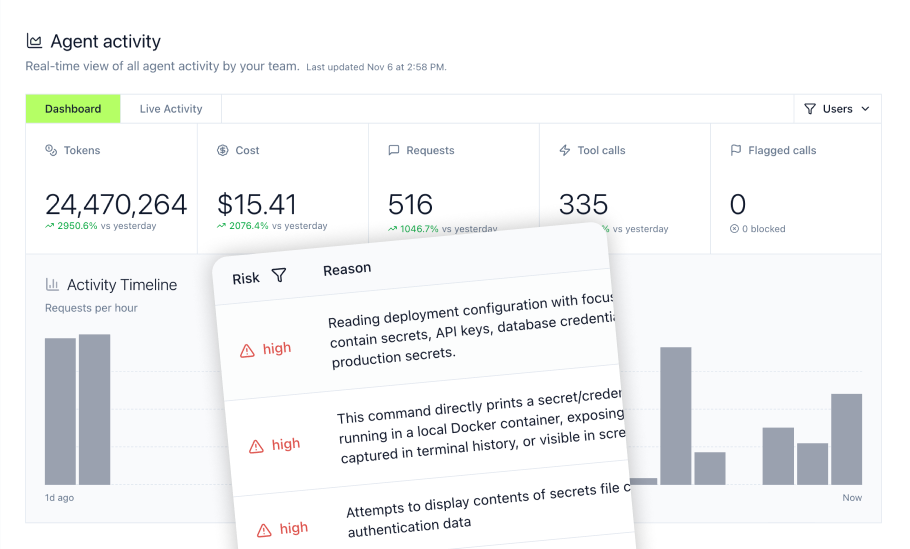
Agent Monitor provides visibility beyond gateway traffic, including live activity feeds across supported agents, file read detection, command capture for bash and git operations, MCP tool call logging with full context, and token spend tracking by model, user, and session.
Why teams evaluate MintMCP for enterprise AI governance
Selecting a Workato Enterprise MCP alternative depends on specific requirements, technical expertise, deployment model, and primary governance focus. MintMCP is designed for organizations prioritizing governed AI agent deployments, combining managed MCP access with first-class agent identities, monitoring, and runtime controls.
Organizations evaluate MintMCP when they need:
- Governed MCP access for employees and internal agents across Claude, Cursor, ChatGPT, Gemini, and Copilot
- Virtual MCPs that bundle approved connectors behind role-, team-, or use-case-specific endpoints with SCIM-driven membership
- First-class agent identities with independently managed credentials, rotation, and per-agent audit attribution separate from human users
- SOC 2 Type II audited, compliant with HIPAA standards, and penetration tested, with BAAs available for customers handling protected health information
- Runtime guardrails combining Mint Guard managed detection, declarative Rules, and customer-authored Gateway Middleware
- Agent Monitor visibility for file reads, command execution, and token spend tracking beyond gateway traffic
- Deployment in regulated industries like healthcare or financial services with compliance-ready infrastructure
For teams prioritizing AI agent governance across multiple clients, requiring compliance-ready infrastructure, or needing per-agent identity management, MintMCP combines governed tool access with agent identity, monitoring, and runtime controls. The platform's Virtual MCP abstraction and one-click deployment for supported configurations create a foundation for scaling AI agent deployments with centralized governance.
Start building governed AI agent infrastructure with MintMCP and join organizations like Stability AI, Modern Treasury, and Deerfield Group who have chosen the platform for enterprise MCP governance.
Frequently asked questions
Can migration from Workato Enterprise MCP to MintMCP be accomplished?
Migration scope depends on which Workato recipes, MCP servers, credentials, access policies, and downstream systems must be recreated or reconnected. MintMCP's Virtual MCPs provide centrally governed endpoints for connectors and curated tools, but migration timing varies by environment and security requirements.
How do pricing and governance approaches differ?
MintMCP uses custom quote-based pricing and focuses on centrally governed MCP access, first-class agent identities, Agent Monitor visibility, and runtime guardrails. Workato combines Enterprise MCP with its broader integration and workflow automation platform and uses platform editions plus usage-based pricing. Teams should compare current quotes alongside the specific identity, monitoring, deployment, and policy capabilities they require.
How do Virtual MCPs differ from Workato's approach?
Virtual MCPs bundle approved connectors and curated tools behind one governed endpoint per role, team, or use case. Directory groups drive membership through SCIM, so access policies apply automatically without per-user configuration. Workato uses server-level end-user groups and tool-level subgroup authorization within its recipe-based orchestration architecture. Virtual MCPs provide consistent governance at the infrastructure level, while Workato integrates MCP into its existing workflow automation foundation.
What security certifications do MCP governance platforms offer?
MintMCP is SOC 2 Type II audited, compliant with HIPAA standards, and penetration tested. Customers handling protected health information can request HIPAA documentation, and MintMCP signs BAAs. Workato offers SOC 1, 2, 3 and ISO 27001 certifications with HIPAA capabilities requiring Business Associate Agreements. Developer-focused platforms vary significantly in compliance offerings, with many gating enterprise security features behind higher pricing tiers.
Can MintMCP handle autonomous agents differently from human users?
Yes, this is MintMCP's core differentiation. Agent Gateway treats autonomous agents as first-class non-human principals. Each agent receives its own identity, credentials (bearer keys, M2M tokens, or workload identity federation), scoped MCP access, and independent audit trail. Credentials can be rotated or revoked without affecting human users or other agents. Workato documents identity-aware execution for authenticated users or agents within its existing framework, while MintMCP provides purpose-built agent identity infrastructure.