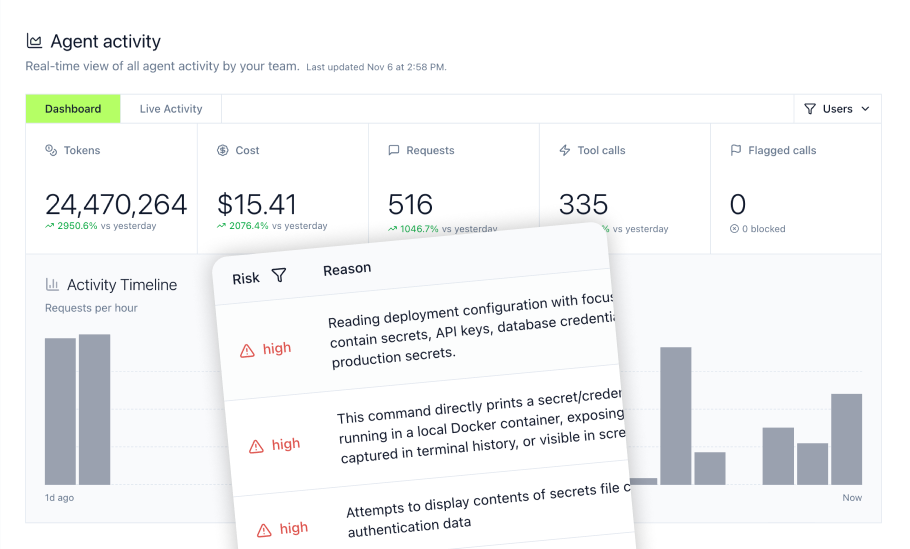
Your AI agents just called multiple APIs, generated unexpected LLM costs, and you have no clear audit trail of what they did. Sound familiar? As enterprises scale from simple chatbots to autonomous multi-agent systems, the infrastructure question shifts from "how do I call an LLM?" to "how do I govern what my agents access?" The answer depends on understanding three distinct gateway categories: AI gateways for LLM traffic, MCP gateways for tool access, and agent gateways for agent identity, permissions, memory, monitoring, and multi-agent coordination. Each solves a specific architectural problem, and choosing the wrong one creates either capability gaps or unnecessary complexity. Platforms like MintMCP Gateway address these challenges by providing centralized governance for Model Context Protocol traffic while extending into agent identity and policy management.
This article breaks down when you need each gateway type, what capabilities matter at each stage, and how to build an infrastructure stack that scales with your AI maturity.
Key Takeaways
- AI Gateway handles LLM traffic only: routing, rate limiting, cost tracking, and failover between model providers. It does not govern what tools agents access or how they interact with internal systems.
- MCP Gateway governs tool access: when agents need to query databases, call APIs, or read files via Model Context Protocol, the MCP gateway centralizes authentication, filters tool permissions, and logs every invocation for audit review.
- Agent Gateway governs autonomous agents: persistent agent identities, scoped permissions, memory, monitoring, workflow state, and policies for agent-to-agent communication.
- Most teams start with AI Gateway needs first. Add MCP Gateway when agents begin accessing internal tools, data sources, or role-scoped systems. Add Agent Gateway when autonomous agents need persistent identities, permissions, memory, and monitoring.
- Shadow AI detection requires coverage beyond the gateway: agents using tools outside governed channels create compliance blind spots that gateway-only solutions cannot address.
- Per-agent credential management prevents the shared service-account problem where one compromised key exposes every system the agent touches.
- Unified platforms reduce gateway sprawl: managing three separate systems creates operational overhead that consolidated infrastructure avoids.
Understanding the AI Gateway Concept for LLM Deployments
An AI gateway sits between your applications and AI model providers like OpenAI, Anthropic, and AWS Bedrock. It handles authentication, routing, rate limiting, cost tracking, and caching. Think of it as an API gateway specialized for AI model calls: you send prompts in, get completions back, with governance controls applied throughout.
What an AI Gateway Does Well
AI gateways excel at multi-model routing, directing traffic to the most cost-effective or performant model based on query type. They provide semantic caching, where similar prompts can return cached responses, helping reduce repeated model calls when workloads contain reusable queries. Failover capabilities ensure that when one provider experiences downtime, traffic automatically shifts to alternatives.
Cost control represents the primary enterprise value. Without a gateway, LLM costs can spiral quickly. An AI gateway enforces budget caps per department, tracks token usage by team, and routes non-critical queries to cheaper models. Organizations can reduce avoidable LLM spend through caching, budget controls, usage attribution, and routing non-critical workloads to lower-cost models.
When a Simple LLM Gateway Suffices
If you are building a chatbot or copilot that calls one or two LLMs, need cost control and failover, but do not have complex multi-step agent workflows, an AI gateway covers your requirements. This applies to many early enterprise AI deployments.
The limitation appears when agents need to interact with systems beyond LLM providers. The moment your AI needs to query a database, read Salesforce records, or create tickets in Jira, an AI gateway cannot help. It only sees LLM traffic, leaving tool access ungoverned.
What is an MCP Gateway, and Why is it Critical for AI Agent Governance?
When AI agents need to access external tools, they use Model Context Protocol to discover and invoke capabilities. An MCP gateway centralizes authentication for these tools, filters which agents can access which tools, and logs every tool invocation for compliance. It prevents "shadow MCP servers" from spreading across your organization.
Demystifying the Model Context Protocol
MCP standardizes how AI agents interact with external systems. Instead of building custom integrations for each tool, agents use MCP to discover available tools, understand their schemas, and invoke them through a consistent interface. The protocol supports a growing ecosystem of MCP servers for common platforms including Google Drive, Slack, PostgreSQL, and Salesforce.
The protocol has gained broad ecosystem support as major AI platforms and developer tools adopt standardized ways for agents to connect with external systems. This standardization creates both opportunity and risk: agents can now access more systems more easily, but without governance, that access happens outside security team visibility.
Solving Enterprise AI's Last Mile Problem
The "last mile problem" in enterprise AI refers to the gap between what LLMs can do and what they can safely access. An agent might have the capability to analyze customer data, but connecting it to your CRM without exposing credentials, logging access, and enforcing least privilege requires infrastructure beyond the AI gateway.
MCP gateways address this by:
- Centralizing tool authentication: OAuth brokering handles credentials so agents never see database passwords or API keys
- Filtering tool availability: Teams see only the tools appropriate for their role
- Logging every invocation: Immutable audit trails capture which agent accessed which tool with what parameters
- Enforcing rate limits: Prevent runaway agents from overwhelming downstream systems
MintMCP's architecture applies these controls through Virtual MCP Bundles, which package tool access, policy enforcement, and audit logging into single governance units per team or role. This approach simplifies administration compared to managing separate plugin, access rule, and credential objects for each tool.
Agent Gateway: Secure and Governed Access for Autonomous AI Agents
When you have multiple AI agents collaborating on complex tasks (one researching, one writing, one reviewing), the infrastructure requirements shift again. An agent gateway routes messages between them, maintains workflow state, and enforces policies on agent-to-agent communication. It understands protocols like Agent-to-Agent (A2A) that traditional gateways do not.
Beyond API Proxies: The Agent-Centric Approach
Traditional gateways treat every request independently. Agent gateways understand that a multi-step research workflow involves state that persists across calls. When the Reviewer agent rejects a draft, the gateway routes feedback back to the Drafter agent with context about why the rejection happened.
This stateful orchestration enables:
- Retry logic: Automatic re-routing when one agent fails
- Human-in-the-loop checkpoints: Pausing workflows for approval before high-stakes actions
- Provenance tracking: Understanding which agent contributed what to a final output
- Inter-agent rate limiting: Preventing one agent from monopolizing shared resources
Why Agents Need Their Own Gateway
Each deployed agent requires its own persistent identity with scoped credentials that can be rotated independently. This matters for audit attribution (knowing which agent took which action) and credential hygiene (revoking one agent's access without affecting others).
MintMCP's Agent Bundles extend the Virtual MCP Bundle model to non-human principals. Each agent receives bearer API keys plus OAuth 2.0 client-credentials, with rotation and revocation independent of human users. An "act as agent" admin flow handles connectors that require per-agent OAuth authorization.
Credential Management and Security: A Core Distinction for AI Agent Infrastructure
The most critical difference between gateway architectures appears in how they handle credentials. Shared service accounts, where multiple agents use the same API key, create audit gaps and blast radius problems. If one agent's credentials leak, every system that agent could access becomes compromised.
How Per-Agent Credentials Enhance Security
Per-agent credential management means each deployed agent has its own:
- Rotatable credentials: Rotate one agent's keys without affecting others
- Scoped permissions: Agent A can read from the database; Agent B can write
- Isolated audit trails: Know exactly which agent performed each action
- Independent revocation: Disable a misbehaving agent instantly
MintMCP implements this through Agent Bundles, which combine M2M (machine-to-machine) authentication with the Virtual MCP Bundle permission model. This reduces the operational risk of shared credentials by making each agent independently attributable, scoped, rotatable, and revocable.
OAuth Brokering for Complex Authentication
Many enterprise tools require OAuth flows that assume a browser and a human. When an agent running in a container needs to authenticate against Salesforce, the standard OAuth redirect breaks. MCP gateways that support OAuth brokering handle this by brokering connector authentication and passing the required token through headers or environment variables at request time.
Policy Enforcement and Governance: Why AI Agents Need More Than API Security
Traditional API security focuses on authentication and authorization at the request level, while AI risk guidance like the NIST AI RMF emphasizes governance, measurement, and risk management across the AI lifecycle. Agent governance requires policy enforcement at the tool-call level, with the ability to inspect, transform, or block based on content.
From Declarative Rules to Dynamic Policy Enforcement
Declarative policy languages work well for simple rules: "Team A cannot access Tool B." But enterprise requirements often need dynamic evaluation: "Block any database query that would return more than 10,000 customer records" or "Mask PII in responses before returning to the agent."
MintMCP provides custom policy code execution through a JS sandbox middleware layer with allowed-domains fetch, secret injection, and built-in templates for OpenAI moderation, jailbreak detection, and AWS Bedrock Guardrails. This enables inline DLP integration with providers like Nightfall, Skyflow, and Microsoft Purview.
Audit Logging and Compliance Reporting
Regulated industries require audit trails that capture who accessed which tools, what actions were taken, and which data paths were involved, with attribution that security and compliance teams can review. MintMCP's conversation-level logging supports configurable retention and export to SIEM platforms including Splunk and Microsoft Sentinel.
MintMCP is SOC 2 Type II audited, with continuous compliance monitoring via Drata. Customers handling protected health information can request HIPAA documentation, and MintMCP signs BAAs. Organizations handling sensitive data can review the full security posture in the MintMCP Trust Center.
Detecting Shadow AI: Coverage Beyond the Gateway
Gateway-only visibility misses a critical risk: agents using tools outside governed channels. When developers configure Claude Code to access local file systems or run bash commands, that activity bypasses the MCP gateway entirely.
The Hidden Risks of Off-Gateway AI Usage
Shadow AI describes AI agent activity that occurs outside enterprise governance infrastructure. This includes:
- Developers installing MCP servers on their machines without IT approval
- Agents executing bash commands that modify production systems
- File reads and writes that bypass document management policies
- Prompt submissions containing sensitive data that never touch the gateway
Security teams should assume some agent activity will happen outside governed pathways unless they monitor local development environments, MCP server usage, and direct tool access. Without detection capabilities, security teams cannot enforce policies they do not know are being violated.
Real-Time Visibility into Agent Actions Across the Organization
MintMCP Agent Monitor extends visibility beyond MCP traffic, including local agent activity in developer tools like Claude Code and Cursor, while MintMCP’s broader governance layer supports Claude, Cursor, ChatGPT, Gemini, and Copilot workflows. It detects PII exposure, credential leakage, risky bash commands, and prompt injection attempts using built-in rules, with support for custom guardrail policies that can block, flag, or alert.
MDM integration enables push of detect-only or enforce-mode configurations to developer machines for consistent policy application. Org-level analytics show MCP adoption, usage patterns by team and tool, latency monitoring, and error tracking.
Choosing the Right Gateway: Use Cases for AI, MCP, and Agent Gateways
The decision framework maps to your AI maturity stage:
Choose AI Gateway when:
- Building a chatbot or copilot calling one or two LLMs
- Primary concern is cost control and failover
- No agent-to-tool interactions beyond the LLM itself
- Testing AI capabilities before broader rollout
Choose MCP Gateway when:
- Agents need access to multiple external tools (databases, APIs, file systems)
- Operating in regulated industries requiring audit trails of every tool call
- Teams deploying shadow MCP servers that need centralization
- Compliance requirements mandate knowing exactly what data agents accessed
Choose Agent Gateway when:
- Deploying multi-agent systems where multiple agents collaborate
- Workflows require stateful orchestration across multi-step tasks
- Need to route messages between agents with retry logic and human checkpoints
- Requiring full trace logs for debugging agent-to-agent interactions
Practical Reality: Many enterprises eventually need all three capabilities. Starting with AI Gateway, adding MCP Gateway as tool complexity grows, and incorporating Agent Gateway when multi-agent workflows emerge follows natural adoption patterns. Unified platforms that provide all three in one deployment avoid the operational overhead of managing separate systems.
Why MintMCP Delivers Unified MCP Gateway and Agent Gateway Infrastructure
Rather than treating MCP Gateway and Agent Gateway as separate governance layers, MintMCP connects governed tool access with agent identities, permissions, memory, and monitoring in one platform. This unified approach reduces the operational complexity of managing separate authentication systems, policy frameworks, and audit streams for agent-to-tool activity.
Data-Permissions-First Architecture
MintMCP starts from data permissions (SSO, SCIM, IdP groups, Virtual MCP Bundles, tool-level policy, audit) and enables agents on top. An agent's access is always a subset of an already-governed permission model. SCIM-driven membership means Bundle access syncs automatically with Okta or Azure AD group changes. Tool-update policy controls whether new upstream tools auto-enable or require admin approval, addressing silent capability expansion.
Complete Coverage from LLM Calls to Agent Collaboration
The MCP Gateway provides governed data and tool connections for Claude, Cursor, ChatGPT, Gemini, and Copilot. The Agent Gateway layer adds identities, permissions, memory, and monitoring for agents that work alongside users. For teams building coworker agents, long-running agents that live in Slack, hold memory, continue work across days, and operate alongside employees, MintMCP's managed agents platform provides turnkey hosting with sandboxed runtime and scoped tool access via Virtual MCP Bundles.
Each agent maintains independent identity rather than shared service-account keys, providing the credential isolation and audit attribution that enterprise security teams require. Admin MCP capabilities enable platform operation from any MCP client, managing rules and pulling logs conversationally.
Understanding the MCP data risk framework helps teams assess which gateway capabilities their deployments require and where gaps in current infrastructure create compliance exposure. MintMCP's Bundle architecture packages tool access, policy enforcement, and audit logging into single governance units, simplifying administration compared to approaches requiring separate configuration of plugins, access rules, and agent accounts.
Frequently Asked Questions
What latency does adding a gateway introduce to AI agent workflows?
Gateway overhead depends on deployment architecture, policy evaluation complexity, connector latency, and geographic proximity. This overhead is usually smaller than model response time, but it can still matter in high-frequency workflows or tool-heavy agent loops. Deploy gateways in the same cloud region as your workloads to minimize latency. Enable metadata caching for tool discovery calls to reduce repeated lookup work where your gateway and client architecture support it.
How do I migrate existing direct-API agent integrations to a gateway architecture?
Migration follows a phased approach: inventory existing LLM calls and tool integrations, deploy the gateway in staging, route a controlled subset of traffic through it, gradually expand coverage, then decommission direct API calls once rollback paths and monitoring are in place. Most organizations maintain rollback capability throughout, reverting to direct calls if issues arise.
Can I use open-source gateways instead of managed platforms?
Open-source options exist for AI gateways and, increasingly, MCP gateways. They work well for proof-of-concept deployments and teams with Kubernetes expertise. The tradeoffs include managing infrastructure yourself, handling upgrades and security patches, and building compliance features (audit logging, SIEM integration) that managed platforms include. Organizations typically use open-source for initial testing and move to managed platforms when they need SLAs, support, and compliance attestations.
How does gateway pricing scale with agent usage?
Gateway pricing varies by vendor and can depend on users, request volume, deployment model, support requirements, compliance needs, and enterprise features. Evaluate whether pricing is tied to requests, seats, agents, connectors, or usage tiers, and confirm overage terms before production rollout.
What happens when a gateway goes down? Do my agents stop working?
Resilient gateway architectures use multiple availability zones and automatic failover. Enterprise gateway deployments should be evaluated for uptime commitments, failover design, and operational support. When outages occur, behavior depends on configuration: agents can fail closed (stop working to prevent ungoverned access), fail open (bypass the gateway temporarily), or queue requests for retry. Security-conscious deployments typically fail closed, accepting temporary downtime over ungoverned agent activity. Evaluate vendor SLAs and architecture documentation before committing to production deployments.