Enterprises are rolling out AI agents faster than they can govern them. Claude Code, Cursor, ChatGPT, Gemini, and Copilot are now embedded across engineering teams, while autonomous agents handle everything from CI jobs to Slack-based customer support. The challenge is no longer adoption. It is governance: knowing which tools agents call, securing credentials, enforcing access policies, and producing audit trails that satisfy SOC 2 and HIPAA requirements.
Solo.io's agentgateway emerged as an open-source, Rust-based gateway for MCP, A2A, LLM, HTTP, and gRPC traffic. It supports both standalone deployment and Kubernetes integration through the Gateway API. For organizations seeking a managed governance layer rather than operating gateway infrastructure themselves, alternatives like MintMCP's agent gateway offer a different operational model. This guide compares 7 agentgateway alternatives for 2026, with a focus on managed MCP gateways and agent gateways designed for enterprise AI governance.
Key takeaways
- MintMCP is SOC 2 Type II audited, compliant with HIPAA standards, and signs BAAs with customers handling protected health information
- Managed STDIO hosting lets organizations centrally host local MCP servers with SSO/OAuth, governed access, and audit logging instead of requiring users to run them locally
- Virtual MCPs bundle connectors, curated tools, and access policies behind one governed endpoint per role, team, or agent
- Agent identity as a first-class concept enables per-agent credentials, scoped permissions, and independent rotation without relying on human accounts
- Enterprise features vary by vendor: some gate SSO, SCIM, and RBAC behind enterprise tiers, while others include them across plans
- Total cost of ownership extends beyond licensing to infrastructure, compliance documentation, and ongoing operations
- Deployment models range from managed SaaS to self-hosted, VPC, Kubernetes, and air-gapped options
Understanding agentgateway: a Kubernetes-native approach
Solo.io's agentgateway is a purpose-built Rust data plane that supports MCP, Agent-to-Agent (A2A), LLM, HTTP, and gRPC traffic. It can run as a standalone gateway or integrate with the Kubernetes Gateway API, with authentication, authorization, rate limiting, observability, and traffic-management capabilities.
Key agentgateway strengths:
- Rust-based architecture with low latency overhead
- Supports MCP, A2A, and LLM protocols in one gateway
- Kubernetes Gateway API integration for platform teams
- Open-source Apache 2.0 license for the core
- Can expose REST APIs as MCP servers via OpenAPI integration
Operational considerations:
- Teams are responsible for operating the gateway infrastructure in standalone or Kubernetes deployments
- Solo Enterprise capabilities require a commercial license
- The operating burden is higher than with a fully managed gateway service
- Customers remain responsible for how their deployment satisfies their own regulatory and compliance obligations
For organizations seeking alternatives that reduce operational complexity or provide built-in compliance documentation, the managed MCP and agent gateways below offer different operational models.
1. MintMCP: Managed enterprise AI governance
MintMCP provides enterprise infrastructure for governing AI clients and autonomous agents across the Model Context Protocol ecosystem. The platform helps organizations make AI systems deployable, governed, measurable, and swappable by centralizing tool access, agent identity, credentials, permissions, monitoring, guardrails, and auditability.
MintMCP's data-permissions-first architecture starts from governed access to enterprise data and tools, then extends that foundation to autonomous agents. This approach contrasts with solutions that grant agents broad access and attempt to restrict them afterward.
Core capabilities
- SOC 2 Type II audited and compliant with HIPAA standards with continuous compliance monitoring via Drata. MintMCP signs BAAs with customers handling protected health information.
- Managed STDIO hosting lets MintMCP host local MCP servers centrally and wrap them with SSO/OAuth, governed access, and audit logging instead of requiring users to run them locally.
- Virtual MCPs bundle connectors and curated tools behind one governed endpoint per role or agent. Instead of each developer configuring every MCP server locally, users connect once to a VMCP and receive only the tools their role permits.
- Hosted MCP connectors run by MintMCP, reducing the need for customers to operate supported connector runtimes themselves.
- Enterprise SSO, SCIM, and RBAC for centralized identity, provisioning, and access control.
- Self-serve MCP Store where employees browse and activate tools after SSO authentication.
MCP gateway capabilities
The MCP Gateway serves as the governed entrypoint between AI clients and enterprise tools:
- Credential injection where connectors never hold long-lived secrets; MintMCP injects credentials per call
- SCIM-driven access policies where directory groups drive tool access automatically
- Private network tunnel for reaching on-prem connectors without public exposure
- Tool curation to trim context-window bloat and enforce least privilege
- Audit logging for every tool call, credential lifecycle event, and access-policy change
Agent gateway capabilities
MintMCP's Agent Gateway builds on the MCP Gateway foundation by extending governed data and tool access to first-class agent identities:
- Non-human identities in the same authorization model as humans
- Per-agent credentials that can be rotated or revoked independently
- Bearer keys, M2M tokens, and workload identity for authentication
- Scoped VMCPs with purpose-built toolsets per agent
- Independent audit trails attributing every action to the specific agent
Agent monitor and guardrails
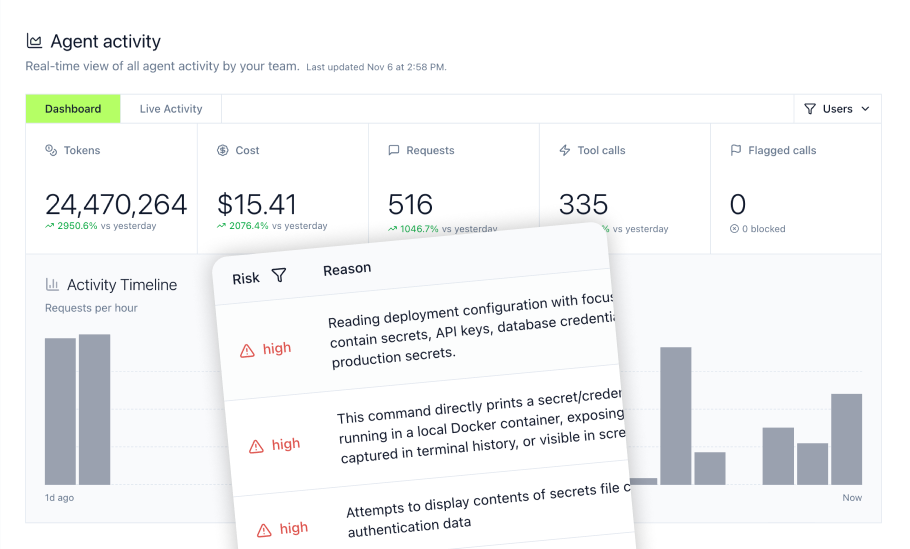
Agent Monitor provides visibility into supported AI-agent activity beyond gateway traffic, including prompts, commands, file access, MCP tool calls, usage, and token costs:
- Mint Guard for managed detection policies covering prompt injection, secrets, PII, and harmful content
- Declarative Rules for tool-name conditions, argument matching, and regex-based enforcement
- Gateway Middleware for customer-authored JavaScript logic, DLP integrations, and external classifiers
Coworker agents
Coworker Agents are hosted, long-running autonomous agents that operate alongside employees:
- Work through Slack, scheduled triggers, or manual runs
- Maintain company-owned memory that is scoped, versioned, and auditable
- Continue work across days with governed tools and sandboxed execution
- Support swappable model and harness choices so governance is not tied to a single provider
Pricing and deployment
MintMCP offers custom pricing tailored to team size and requirements, with per-user licensing for active AI-agent users and platform fees that scale with usage and team size. Flexible deployment options include self-hosted deployments.
2. Composio
Composio positions itself as an integration platform for AI agents with a focus on breadth of connectivity. The platform currently lists 1,500+ toolkits and also advertises 500+ managed MCP servers. Its primary orientation is developer-facing agent integration infrastructure, with policy, authentication, and audit capabilities built into the platform.
Key Composio features:
- 1,500+ pre-built toolkits spanning common SaaS applications
- 500+ managed MCP servers in the Universal MCP Gateway
- OAuth management handles for simplified authentication
- Developer-first experience with Python SDKs
- Generous free tier with 100,000 tool calls per month
Pricing structure:
- Free: 100,000 tool calls/month
- Pro: $29/month with $29 in monthly usage credit and usage-based overages
- Enterprise: Custom pricing with SSO, SCIM, and KMS
Deployment considerations:
Composio is SaaS-first, with private VPC and fully self-hosted deployment available through Enterprise arrangements. SSO and SCIM are also Enterprise features.
3. TrueFoundry
TrueFoundry provides a full AI platform that includes MCP gateway capabilities alongside model serving, training, and LLMOps. Recognized by Gartner, the platform appeals to organizations wanting a unified ML lifecycle platform rather than a standalone gateway.
Key TrueFoundry features:
- VPC, on-premises, and air-gap deployment options
- Unified LLM gateway and MCP gateway in one platform
- A2A protocol support for agent-to-agent communication
- Full ML platform with model serving and training
- SOC 2 and HIPAA compliance available
Pricing structure:
- Developer: $0/month with 50,000 requests/month and 3 users
- Pro: $499/month with 1 million requests/month and 10 users
- Pro Plus: $2,999/month with additional data controls, account management, and priority SLAs
- Enterprise: Custom pricing with VPC, on-premises, and air-gapped deployment options
Platform scope:
TrueFoundry's MCP gateway is one component of a larger platform, which adds operational complexity compared to focused gateway solutions. Organizations seeking only MCP governance may find the broader platform scope unnecessary.
4. Runlayer
Runlayer emphasizes security-first design with shadow AI discovery capabilities that identify unapproved agent and MCP usage across the organization. The platform operates on a hybrid model with managed SaaS and self-hosted deployment on customer infrastructure.
Key Runlayer features:
- Shadow AI discovery across the organization
- ToolGuard scanning for security analysis
- Advertises 18,000+ MCPs in its catalog
- Single-tenant AWS deployment option
- SSO and SCIM for enterprise identity
Pricing structure:
Runlayer pricing is available through enterprise sales. No public self-serve pricing tiers are published.
Evaluation considerations:
Limited public documentation and independent reviews make capability verification more difficult. The enterprise sales model may slow evaluation for teams preferring self-serve trials.
5. Portkey
Portkey provides an LLM gateway with MCP support, focusing on observability, caching, and cost optimization for LLM traffic. Palo Alto Networks completed its acquisition of Portkey on May 29, 2026. Portkey is now being integrated and marketed as Prisma AIRS AI Gateway, so evaluations should use the current Prisma AIRS product direction and packaging rather than treating Portkey as a fully independent platform.
Key Portkey features:
- LLM observability and tracing
- Semantic caching for cost reduction
- Load balancing across multiple LLM providers
- Open-source AI Gateway option
- MCP support within the gateway
Pricing structure:
- Developer: Free for 10,000 logs with 3-day retention
- Production: $49/month for 100,000 logs with 30-day retention
- Enterprise: Custom pricing with advanced governance and VPC
Acquisition context:
Evaluations should use the current Prisma AIRS product direction and packaging rather than treating Portkey as a fully independent platform.
6. Bifrost
Bifrost from Maxim AI is an open-source gateway written in Go. In Maxim AI's published t3.xlarge benchmark, Bifrost added 11 microseconds of gateway overhead per request at a sustained 5,000 RPS. This measures gateway overhead, not end-to-end model or tool-call latency.
Key Bifrost features:
- Low gateway overhead in published benchmarks
- Apache 2.0 open-source license
- Go binary or Docker deployment
- Enterprise tier available as in-VPC deployment
- Focus on raw performance over managed features
Pricing structure:
The open-source core is free. Enterprise features and in-VPC deployment require a paid tier.
Operational requirements:
Bifrost requires self-hosted deployment and infrastructure management. Compliance certifications and enterprise governance features are customer responsibilities on the open-source tier.
7. Obot
Obot provides an open-source AI control plane and MCP gateway with both self-hosted and managed deployment options. Docker is supported for development and small-scale deployments, Kubernetes is recommended for production self-hosting, and Obot Cloud provides a fully hosted option.
Key Obot features:
- Open-source agent platform
- Docker deployment for development environments
- Kubernetes deployment for production
- MCP gateway functionality included
- Community-driven development
Pricing structure:
Obot Community is free and open source for self-hosting. Obot Cloud provides a hosted edition, while Obot Enterprise provides self-hosted software with enterprise support.
Infrastructure requirements:
Self-hosted production deployments require customers to operate the supporting infrastructure, while Obot Cloud provides a fully managed alternative.
Managed governance and compliance posture
MintMCP is SOC 2 Type II audited and compliant with HIPAA standards, uses continuous compliance monitoring through Drata, and signs BAAs with customers handling protected health information. Its managed gateway and hosted connector options can reduce the infrastructure customers need to operate themselves.
Compliance responsibility still depends on each organization's configuration, policies, controls, and regulatory obligations. Other vendors provide different compliance and deployment models that should be evaluated against those requirements.
Pre-built integration breadth
Composio currently lists 1,500+ toolkits and also advertises 500+ managed MCP servers. Runlayer advertises 18,000+ MCPs in its catalog. These figures measure different catalog units and should not be treated as directly comparable.
MintMCP operates supported hosted connectors so customers can centrally deploy and govern connector access without operating the supported connector runtime themselves.
Self-hosted and air-gap deployment
TrueFoundry Enterprise supports VPC, on-premises, and air-gapped deployments. MintMCP offers self-hosted deployment options. Solo.io's agentgateway can be self-operated as a standalone gateway or through Kubernetes.
Composio is SaaS-first, with VPC and fully self-hosted deployment available on the Enterprise tier.
Agent identity and governance
MintMCP's Agent Gateway treats autonomous agents as first-class non-human principals with their own identities, credentials, scoped permissions, and audit trails. Authentication options include bearer keys, M2M tokens, and workload identity federation.
Solo.io's agentgateway supports OAuth 2.1 and integrates with Kubernetes service accounts. TrueFoundry includes agent identity capabilities within its broader platform.
Runtime guardrails and policy enforcement
MintMCP's three-layer guardrail architecture includes Mint Guard for managed detection policies, declarative Rules for pattern matching, and Gateway Middleware for customer-authored JavaScript logic and DLP integrations.
Other platforms offer policy capabilities: Runlayer emphasizes ToolGuard scanning, while Solo.io's agentgateway provides rate limiting and traffic management.
Cost and usage tracking
Agent Monitor provides token spend tracking by model, user, agent, and session with SIEM export via OTLP or Splunk HEC. This enables chargeback-grade visibility and cost attribution across teams.
Portkey focuses on LLM-level observability and cost optimization. TrueFoundry includes usage tracking within its broader platform.
Total cost of ownership considerations
Pricing comparisons should account for more than monthly licensing:
Infrastructure and operations:
- Managed services reduce the gateway and connector infrastructure customers operate directly
- Self-hosted, VPC, Kubernetes, and air-gapped deployments add infrastructure, monitoring, patching, scaling, and incident-response responsibilities
Security and compliance:
- Vendor audit reports, BAAs, identity controls, logging, and data-residency options can support customer compliance programs
- Customers remain responsible for their own configurations, policies, controls, assessments, and regulatory obligations
Usage and growth:
- Compare included usage, overage pricing, infrastructure costs, and support requirements as deployment volume grows
Migration and portability:
- Evaluate how credentials, policies, connectors, identities, logs, and agent configurations can be moved if requirements or vendors change
MintMCP for enterprise AI governance
MintMCP combines managed MCP governance with first-class agent identities, Virtual MCPs, Agent Monitor visibility, and runtime guardrails. Its data-permissions-first approach starts with governed access to enterprise tools and extends the same identity, permission, credential, and audit model to autonomous agents.
Key differentiators:
- Virtual MCPs bundle approved connectors and curated tools behind one governed endpoint per role, team, or agent, with SCIM-driven membership and consistent access policies
- First-class agent identities give each autonomous agent its own credentials, scoped permissions, and independent audit trail with bearer keys, M2M tokens, and workload identity federation
- Managed STDIO hosting centrally hosts local MCP servers with SSO/OAuth, governed access, and audit logging
- Three-layer guardrails combine Mint Guard managed detection, declarative Rules, and programmable Gateway Middleware for runtime policy enforcement
- Agent Monitor tracks prompts, commands, file access, MCP tool calls, usage, and token costs with SIEM export
- Coworker Agents operate through Slack, scheduled triggers, or manual runs with company-owned memory that is scoped, versioned, and auditable
Compliance and security:
MintMCP is SOC 2 Type II audited and compliant with HIPAA standards, uses continuous compliance monitoring through Drata, and signs BAAs with customers handling protected health information. MintMCP logs tool calls, credential lifecycle events, and access-policy changes, while its tamper-evident access-grant history is signed at write time and verifiable offline via published JWKS.
Deployment flexibility:
MintMCP offers custom pricing tailored to team size and requirements, with per-user licensing for active AI-agent users and platform fees that scale with usage and team size. Flexible deployment options include self-hosted deployments.
The alternatives in this guide use different operating models, including developer-focused integration infrastructure, broader AI platforms, self-hosted open-source gateways, and security-focused control planes. Compare those architectures against requirements for deployment, identity, runtime policy, observability, compliance documentation, and operational ownership.
Frequently asked questions
What is the difference between an API gateway and an agent gateway for AI?
Traditional API gateways handle request routing, rate limiting, and authentication for application-to-application traffic. Agent gateways address the unique requirements of AI agents: runtime tool selection, non-deterministic behavior, identity for autonomous agents, and governance over what tools agents can access and what data flows through. An agent gateway must handle questions like "which agent is acting?" and "what tools can it access?" that traditional API gateways were not designed to answer.
How does a Virtual MCP improve AI client governance?
A Virtual MCP (VMCP) bundles approved connectors and a curated tool surface behind one governed endpoint for a particular team, role, use case, or agent. Instead of each developer configuring every MCP server locally, users connect once to a VMCP and receive only the tools their role permits. Directory groups via SCIM can drive membership, applying consistent access policies without per-employee configuration.
Why is it critical for autonomous agents to have their own identities?
When autonomous agents operate through human credentials or shared API keys, the audit log collapses. You cannot distinguish agent actions from human actions, cannot rotate or revoke agent credentials independently, and cannot attribute problems to specific agents. First-class agent identities solve this by giving each agent its own credentials, scoped permissions, and audit trail. This enables independent rotation, revocation, and attribution.
How does MintMCP ensure compliance for AI agent activities?
MintMCP is SOC 2 Type II audited and compliant with HIPAA standards, with continuous compliance monitoring through Drata. Every tool call, credential lifecycle event, and access-policy change is logged. MintMCP logs tool calls, credential lifecycle events, and access-policy changes, while its tamper-evident access-grant history is signed at write time and verifiable offline via published JWKS. Customers handling protected health information can request HIPAA documentation, and MintMCP signs BAAs.
Can MintMCP's Coworker Agents integrate with existing enterprise tools?
Coworker Agents access enterprise tools through VMCP-scoped allowlists, receiving only the tools explicitly permitted for that agent. They can operate through Slack, scheduled triggers, or manual runs while using governed credentials and sandboxed execution. The agents maintain company-owned memory that is scoped, versioned, reviewable, and auditable.