AWS Bedrock provides enterprises with a fully managed API layer for accessing 100+ foundation models from providers including Anthropic, OpenAI, Amazon, Meta, and Mistral through a single unified interface. While per-token pricing appears straightforward, organizations consistently face unexpected costs from Knowledge Bases, agent workflows, and operational services. Understanding the complete cost structure before production deployment can prevent significant gaps between per-request estimates and actual monthly spend. For enterprises running AI workloads across multiple platforms, tools like Agent Monitor provide visibility into token costs and usage patterns that help validate estimates against actual consumption.
This article breaks down AWS Bedrock's pricing models, identifies the hidden cost layers that cause unexpected bills, and provides actionable strategies for optimizing generative AI expenditures while maintaining governance across your AI infrastructure.
Key takeaways
- AWS Bedrock model pricing varies significantly by model, Region, context length, and inference profile, making model-routing decisions a major cost variable
- Knowledge Base vector-store costs depend on the backend and workload. OpenSearch Serverless now supports scale-to-zero with no idle OCU charges, while S3 Vectors is usage-based and can reduce vector upload, storage, and query costs by up to 90%
- Agent workflows can increase token consumption because one user interaction may trigger multiple model invocations for planning, tool use, execution, and summarization, so costs should be measured across the full agent trajectory
- Batch inference is priced 50% below on-demand inference for select supported foundation models and is intended for non-time-sensitive workloads with a 24-hour processing window
- Output-token pricing is often higher than input-token pricing, but the ratio varies by model and some Bedrock models price input and output tokens equally
- Legacy Claude 3.5 Sonnet moved to Public Extended Access pricing, making migration to newer supported Claude models worth evaluating
Understanding AWS Bedrock pricing models
AWS Bedrock operates on a consumption-based pricing structure with multiple tiers designed for different workload patterns. The fundamental unit of measurement is the token, where 1,000 tokens approximate 750 words of text. Unlike traditional cloud services with predictable per-hour or per-instance rates, generative AI costs scale with both request volume and the computational complexity of each model.
On-demand inference costs
On-demand inference represents the default pricing model where you pay only for what you use with no upfront commitment. Input and output tokens are billed separately, with the price relationship varying by model and provider.
Amazon Bedrock offers Standard, Priority, and Flex service tiers, but availability varies by model:
- Standard: The default on-demand tier
- Priority: A premium tier available for supported models that prioritizes faster response times
- Flex: A discounted tier available for supported models that can tolerate more variable latency
Check the selected model's current service-tier support before applying Priority or Flex pricing assumptions.
For a customer support chatbot processing 10,000 conversations daily with 2,000 input tokens and 500 output tokens per conversation, monthly costs using Claude Haiku 4.5 at standard rates would require calculating total token volume multiplied by the model's current regional pricing.
Provisioned throughput explained
Provisioned Throughput provides dedicated model capacity measured in Model Units. Depending on the model, AWS supports no-commitment Provisioned Throughput as well as 1-month and 6-month commitments. This is separate from Bedrock's Reserved service tier, which reserves input and output tokens per minute for 1- or 3-month terms.
This model makes sense when:
- Monthly on-demand spend justifies commitment pricing
- Applications require guaranteed latency SLAs
- Applications require dedicated Provisioned Throughput, or use a custom model that does not support on-demand deployment
The tradeoff is paying for reserved capacity whether utilized or not. Teams should thoroughly optimize on-demand costs through batch inference and caching before evaluating reserved commitments.
Fine-tuning and custom model pricing
Custom model training introduces additional cost dimensions beyond inference. Fine-tuning charges vary by model and customization method:
- Training may be priced by tokens processed or by training hours, depending on the model and customization method
- Custom model storage is charged according to the model-specific monthly storage rate
- Inference may use Provisioned Throughput or, for supported custom models and customization methods, on-demand deployment
For custom model imports using your own weights, CMU pricing varies by model family, CMU version, and Region. For example, v1 Custom Model Units in US East and US West are priced at $0.05718 per CMU-minute with $1.95 per CMU per month for storage, while OpenAI imports use a differently priced v2 CMU. Five-minute billing windows apply.
Organizations tracking AI costs across multiple platforms benefit from usage analytics tools that attribute spend by model, user, and session rather than relying solely on cloud provider billing reports.
Key factors influencing AWS Bedrock costs
Understanding cost drivers prevents budget overruns and enables accurate forecasting. Three primary factors determine monthly Bedrock expenses: model selection, token volume patterns, and supporting service consumption.
The impact of model selection
Model choice represents the single largest cost variable. Current pricing varies substantially across providers and models:
- Amazon Nova Micro: $0.035 input / $0.14 output per million tokens
- Amazon Nova Pro: $0.80 input / $3.20 output per million tokens
- Anthropic Claude Haiku 4.5: $1.00 input / $5.00 output per million tokens
- Anthropic Claude Sonnet 5: $3.00 input / $15.00 output per million tokens
- Anthropic Claude Opus: Pricing varies by generation and profile
- OpenAI GPT models: Pricing varies by context tier and inference profile
- Meta Llama 3.3 70B: $1.00 input / $1.00 output per million tokens
Pricing varies substantially across models, but direct comparisons should use the same Region, inference profile, context tier, and token type. Routing simpler workloads to lower-cost models can materially reduce inference spend.
Legacy Claude 3.5 Sonnet moved to Public Extended Access pricing at $6/$30 per million tokens, making migration to newer supported Claude models worth evaluating. Teams with pinned Claude 3.5 Sonnet model IDs should review the higher Extended Access pricing and evaluate migration to a current supported model and inference profile.
Volume and token usage
Token consumption follows non-obvious patterns that complicate forecasting:
- Context window expansion: Large documents or conversation history inflate input tokens per request
- Response verbosity: Model temperature and prompt design influence output length
- Agent amplification: Single user queries can trigger multiple internal model calls for planning, tool selection, execution, and summarization
A user query to an agent-based system requesting database analysis might generate:
- Planning call with 500 input and 200 output tokens
- Tool selection call with 800 input and 100 output tokens
- SQL generation call with 1,000 input and 300 output tokens
- Results interpretation call with 2,000 input and 500 output tokens
- Summary call with 1,500 input and 400 output tokens
Total tokens consumed: 5,800 input and 1,500 output for what appeared to be a single interaction. Budget for trajectories, not individual calls.
Regional cost variations
For supported models, Global cross-Region inference can cost approximately 10% less than Geographic cross-Region inference. Organizations without geographic data residency requirements should compare available inference profiles and current model pricing before selecting a profile.
Estimating your AWS Bedrock spend with the pricing calculator
Accurate cost estimation requires modeling all three cost layers: model inference, supporting services, and operational overhead. Standard pricing calculators provide baseline estimates, but real-world deployments require adjustments for factors the calculators do not surface.
How pricing calculators work
Basic pricing calculators accept inputs for:
- Model selection and region
- Monthly request volume estimates
- Average input and output tokens per request
- Optional Knowledge Base and Agent configurations
For basic inference workloads, calculator estimates align reasonably with actual costs. However, standard tools do not model:
- Agent token amplification across multiple invocations
- Knowledge Base vector storage and retrieval patterns
- CloudWatch logging volume
- Guardrails per-text-unit charges
Teams should validate calculator outputs against measured staging traffic and explicitly model agent invocations, vector storage and retrieval, Guardrails, logging, and data transfer.
Best practices for cost estimation
Before production deployment, instrument your development environment with token tracking to measure actual consumption patterns:
- Capture baseline metrics: Input tokens, output tokens, and cache hits per request type
- Measure agent trajectories: Total tokens consumed across all internal calls for representative user queries
- Profile Knowledge Base queries: Retrieval API calls and vector storage requirements
- Log Guardrails evaluations: Text units processed even when guardrails block requests
Deploy CloudWatch metrics from day one, specifically InputTokenCount, OutputTokenCount, CacheReadInputTokenCount, and CacheWriteInputTokenCount. You cannot optimize what you do not measure.
Scenario-based planning
Model multiple scenarios reflecting business growth:
- Conservative scenario: Current usage patterns, no growth
- Base scenario: 20% monthly growth with current architecture
- Aggressive scenario: 50% growth plus new agent capabilities
For each scenario, calculate:
- Model inference costs based on measured token volumes and current regional pricing
- Knowledge Base costs for selected storage and retrieval option
- Agent runtime costs for AgentCore components in use
- Guardrails costs based on enabled safeguards and text unit volume
- Monitoring costs for CloudWatch ingestion
Validating estimates against production reality requires cost attribution tools that track supported token spend by model, user, agent, and session rather than relying only on aggregated cloud provider billing categories.
Optimizing AWS Bedrock costs: Strategies and best practices
Cost optimization follows a specific sequence: measure current consumption, apply architectural improvements, route to appropriate models, implement caching, and only then evaluate committed capacity. Teams should measure and optimize their actual workload before committing to reserved capacity so they do not pay for capacity they do not consistently use.
Choosing the right model for your workload
Implement model routing based on task complexity rather than defaulting to the most capable option:
- Classification, routing, extraction: Amazon Nova Micro ($0.035/$0.14)
- Document analysis, simple Q&A: Amazon Nova Lite ($0.06/$0.24)
- Standard production workloads: Claude Haiku 4.5 ($1.00/$5.00)
- Complex reasoning: Claude Sonnet 5 ($3.00/$15.00)
- Highest intelligence requirements: Evaluate the current Claude Opus generation and its profile-specific Bedrock pricing
A simple classifier routing 40% of traffic to Haiku instead of Sonnet can reduce those requests' costs while maintaining quality for genuinely complex queries.
Leveraging batch inference
Batch inference is priced 50% below on-demand inference for select supported foundation models and is intended for non-time-sensitive workloads with a 24-hour processing window:
- Overnight document processing
- Bulk content generation
- Data enrichment pipelines
- Compliance analysis
Batch record limits vary by model, with many current models supporting up to 100,000 records per job. Check the applicable Bedrock Service Quota before submission. Configure S3 buckets for input and output, trigger via EventBridge automation, and schedule during off-peak hours.
Batch inference does not support tool calling, streaming responses, or real-time interaction. Evaluate workload requirements before assuming batch applicability.
Implementing prompt caching
Bedrock prompt caching can reduce repeated-context input costs, but cache-read discounts and implementation behavior vary by model. Bedrock supports both implicit and explicit prompt caching:
- Stable prefix requirement: System instructions, few-shot examples, and static context must remain identical across requests
- Cache breakpoints: For explicit caching, insert markers separating cacheable prefix from variable content
- Verification: Monitor CacheReadInputTokenCount and CacheWriteInputTokenCount in CloudWatch to evaluate cache usage
Common caching failures:
- Timestamps, session IDs, or UUIDs interpolated into stable prefixes
- Assuming one caching behavior applies to every model, since Bedrock supports implicit caching, explicit caching, or both depending on the model and API
- Prefix changes from prompt engineering iterations invalidating cache
For a 2,000-token system prompt repeated across 100,000 daily requests, caching can materially reduce input costs on cached tokens, potentially saving thousands monthly.
Usage monitoring and alerts
Establish proactive cost controls rather than reactive bill review:
- CloudWatch alarms: Trigger at 50%, 80%, and 100% of monthly budget threshold
- Daily cost reports: Automated summaries highlighting anomalies
- Per-team attribution: Break down consumption by business unit for chargeback
- Weekly architecture review: First 3 months require active optimization, not set and forget
Organizations managing AI usage across multiple agent environments benefit from centralized monitoring solutions that provide a common view of supported usage and token costs by model, user, agent, and session.
Generative AI services: Comparing AWS Bedrock to other platforms
Bedrock competes within a broader generative AI infrastructure landscape. Understanding alternatives helps organizations make informed platform decisions based on specific requirements rather than defaulting to existing cloud relationships.
AWS Bedrock vs. Azure OpenAI Service
Azure OpenAI Service provides exclusive access to OpenAI models with Azure's enterprise compliance posture. Key differences:
- Model availability: Azure offers models unavailable on Bedrock; Bedrock provides broader multi-vendor access
- Enterprise integration: Azure integrates deeply with Microsoft 365 and Dynamics ecosystems
- Pricing structure: Both use token-based billing with comparable rates for overlapping models
- Compliance: Amazon Bedrock is HIPAA eligible and is in scope for specified SOC and ISO programs. Azure OpenAI Service publishes its own enterprise compliance documentation
Azure OpenAI Service emphasizes OpenAI model access and integration with the broader Microsoft ecosystem.
Bedrock vs. Google Cloud Vertex AI
Vertex AI emphasizes MLOps tooling alongside model access:
- Model access: Gemini models, plus third-party providers through Model Garden
- Strengths: Stronger notebook-based experimentation, integrated feature store, AutoML capabilities
- Pricing: Token-based pricing with different supporting service structures
Vertex AI combines managed model access with broader ML engineering and MLOps capabilities.
Open-source vs. managed services
Self-hosted deployment using models like Llama on GPU infrastructure trades managed simplicity for cost control:
Self-hosted advantages:
- Predictable costs at scale with no per-token charges
- Complete data residency control
- Customization flexibility
Self-hosted challenges:
- GPU procurement and management
- Model optimization expertise required
- Operational overhead for scaling, failover, and updates
Break-even between managed inference and self-hosting depends on model size, GPU utilization, serving efficiency, availability requirements, traffic patterns, and infrastructure pricing, so there is no universal monthly token threshold.
For enterprises operating across mixed AI environments, MCP Gateway centralizes governed access to enterprise tools through Virtual MCPs, authentication, credential handling, RBAC, tool curation, and audit.
Governing generative AI costs across your organization
Enterprise AI deployments require governance structures that extend beyond individual team cost tracking. Without organizational controls, departments optimize locally while aggregate spend spirals.
Implementing cost allocation and chargeback
Effective chargeback requires granular attribution:
- By team: Development, marketing, customer support, operations
- By use case: Chatbot, document processing, code generation, analytics
- By user: Individual developer consumption for capacity planning
- By agent: Autonomous systems tracked separately from human-initiated requests
Cloud provider resource tagging enables basic attribution, but agent-level tracking provides finer granularity by capturing which specific agents consume resources rather than aggregating all agent traffic.
Enforcing budgetary controls
Implement multi-layer controls:
- Soft limits: Alerts at threshold percentages prompting review
- Hard limits: Automatic request rejection when budget exhausted
- Approval workflows: Large or unusual requests require authorization
- Rate limiting: Maximum requests per user or agent per time period
Cloud provider service quotas provide basic throttling, but enterprise governance typically requires additional policy enforcement at the gateway layer rather than relying solely on cloud provider controls.
Centralized governance for AI spend
Single-platform deployments can rely on cloud-native tools. Multi-platform environments where teams use different providers and open-source models require centralized governance that:
- Aggregates usage across implementations
- Enforces consistent policies regardless of underlying platform
- Attributes usage to organizational entities rather than cloud accounts
- Provides audit trails for compliance reporting
Platforms providing enterprise controls including SSO, RBAC, and audit trails across heterogeneous AI infrastructure reduce the governance burden compared to implementing separate controls per provider.
The role of machine learning platforms in Bedrock cost management
Bedrock exists within broader MLOps ecosystems. Understanding integration patterns helps organizations maximize existing infrastructure investments.
Integrating Bedrock with MLOps tools
Bedrock complements rather than replaces ML platforms:
- Experiment tracking: Tools like MLflow or Weights & Biases track prompt iterations and model comparisons
- Pipeline orchestration: Airflow, Step Functions, or Kubeflow manage complex workflows combining Bedrock inference with custom processing
- Feature stores: SageMaker Feature Store or Feast provide consistent data inputs for RAG architectures
- Model monitoring: Bedrock generates CloudWatch metrics that integrate with existing observability stacks
Streamlining model deployment and iteration
Production deployment patterns that control costs:
- Shadow deployment: Run new models alongside production, comparing outputs without customer impact
- Gradual rollout: Shift traffic percentages to new models, monitoring cost and quality metrics
- A/B testing: Compare model variants with explicit cost tracking per variant
- Rollback automation: Revert to previous models if cost or quality thresholds breach
Automating resource scaling
For workloads with predictable patterns:
- Time-based optimization: Shift eligible workloads among Standard, Flex, and batch processing based on latency requirements; committed Reserved or Provisioned capacity is not designed to be scaled down nightly
- Event-driven scaling: Trigger additional capacity for product launches or marketing campaigns
- Cost-aware routing: Shift to batch processing when real-time response not required
Automation reduces manual intervention while maintaining cost discipline.
Hidden costs: Vector storage, AgentCore, and operational overhead
Bedrock's three-layer cost structure catches most teams during first production deployments. Model inference represents only the visible layer; supporting services and operational overhead often exceed inference costs.
Layer 1: Model inference (what everyone plans for)
Token-based billing is transparent and well-documented. Organizations budget for this layer effectively.
Layer 2: Supporting services (the surprise)
Knowledge Bases:
- Amazon Bedrock Managed Knowledge Bases charges $5 per GB of raw indexed data per month and $1 per 1,000 standard retrieval API calls
- OpenSearch Serverless now supports scale-to-zero, so there is no universal 2-OCU monthly compute floor
- S3 Vectors uses separate usage-based storage, upload, and query pricing and can reduce vector costs by up to 90% compared with specialized vector databases
AgentCore components:
- Runtime: Usage-based CPU and memory pricing that depends on Runtime version and actual execution time
- Gateway InvokeTool API: $5 per million calls
- Gateway Search API: $25 per million calls
- Web Search: $7 per 1,000 queries, or $70 for 10,000 queries
- Short-term Memory: $0.25 per 1,000 new events
Guardrails:
- Content filters and denied topics: $0.15 per 1,000 text units
- Sensitive information and contextual grounding checks: $0.10 per 1,000 text units
- Automated Reasoning: $0.17 per 1,000 text units per policy
- Regex and word filters: free
- Actual monthly cost depends on which safeguards are enabled and how many text units each processes
Layer 3: Operational tail
CloudWatch:
- Log ingestion at $0.50 per GB
- Verbose prompt and response logging generates substantial volume at scale
- Production recommendation: Enable sampling rather than full logging
Data transfer:
- $0.09 per GB egress
- Negligible for text, significant for image generation
Cross-region overhead:
- For supported models, Global cross-Region inference can cost approximately 10% less than Geographic cross-Region inference
- Profile selection should account for model support, pricing, and data residency requirements
Production cost example
Production Bedrock costs depend on the exact model and inference profile, actual input and output token volume, agent invocation count, Knowledge Base storage and retrieval volume, enabled Guardrails safeguards, AgentCore usage, and CloudWatch ingestion.
Build workload-specific estimates from measured token and service usage rather than applying a fixed agent multiplier or fixed monthly infrastructure cost. Agent systems should be modeled across the complete trajectory of model invocations and tool calls triggered by each user interaction.
Future trends in AWS Bedrock pricing and generative AI
Several trends will shape Bedrock pricing evolution through 2026 and beyond.
Predicting pricing model adjustments
Historical patterns suggest:
- Continued price compression: Token rates have decreased annually as model efficiency improves
- New model tiers: Additional capability levels between current options
- Specialized pricing: Task-specific models with optimized price and performance ratios
- Commitment incentives: Longer-term reserved capacity with steeper discounts
The impact of new AI capabilities
Emerging capabilities introduce new cost dimensions:
- Multi-modal processing: Image, video, and audio tokens priced differently than text
- Longer context windows: Million-token contexts enable new use cases but amplify input costs
- Agent orchestration: AWS investments in AgentCore suggest expanded agent pricing models
- Real-time applications: Streaming and voice interfaces require different optimization strategies
Long-term cost projections for enterprise AI
Enterprise AI spend trajectories depend on:
- Adoption curves: Broader organizational deployment multiplies consumption
- Capability expansion: New use cases unlock previously untapped demand
- Efficiency improvements: Better prompting, caching, and routing offset volume growth
- Platform maturation: Cost optimization tooling improves governance capabilities
Organizations should plan for growing AI infrastructure spend while implementing governance that ensures costs scale proportionally with business value rather than unconstrained consumption.
MintMCP: Enterprise governance and cost visibility for multi-platform AI deployments
As organizations scale AI deployments across AWS Bedrock and other platforms, fragmented cost tracking and governance become critical bottlenecks. MintMCP provides enterprise-grade AI infrastructure that unifies visibility, control, and security across heterogeneous environments.
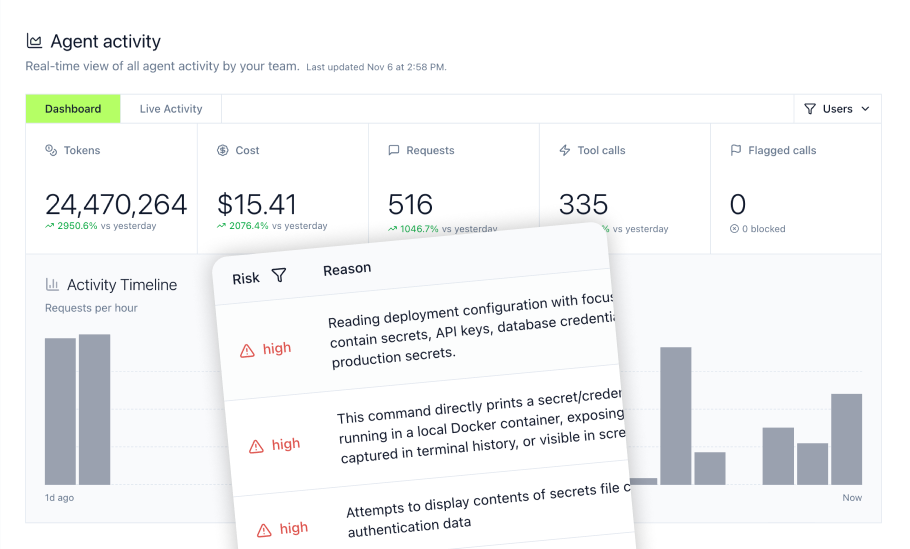
MintMCP's Agent Monitor delivers granular cost attribution by model, user, agent, and session, enabling teams to understand actual consumption patterns that standard cloud billing cannot surface. Rather than waiting for monthly invoices to reveal budget overruns, organizations gain real-time visibility into token usage, cache efficiency, and agent trajectory costs. This proactive monitoring supports the scenario-based planning and optimization strategies outlined throughout this article, transforming cost management from reactive damage control to strategic resource allocation.
Beyond monitoring, MintMCP's governance infrastructure addresses the multi-platform coordination challenges that emerge as teams adopt different AI providers for different use cases. MintMCP centralizes governed tool access, authentication, role-based access control, audit trails, and policy enforcement across supported AI clients and agent environments. This governance layer helps reduce credential sprawl and inconsistent access policies as organizations adopt different AI models, clients, and agent harnesses.
Frequently asked questions
How do Reserved Capacity commitments work, and when should I consider them?
Bedrock's Reserved tier reserves input and output tokens per minute for 1-month or 3-month terms and is billed monthly. This is separate from Provisioned Throughput, which uses Model Units and supports no-commitment, 1-month, and 6-month options depending on the model. Consider reserved capacity only after optimizing current spend through batch inference, prompt caching, and model routing. Teams should optimize and measure workload utilization before committing to reserved capacity. The decision point is when monthly on-demand costs justify commitment pricing AND usage patterns are predictable enough that reserved capacity will be consistently utilized.
What happens to my costs if a model I'm using is deprecated?
Legacy models moved to Extended Access tiers can see dramatic price increases. To protect against this, avoid hardcoding specific model version identifiers in production code, use inference profiles that can be updated centrally, monitor provider announcements for model lifecycle changes, and test new model versions in staging before deprecation deadlines. Budget models should assume a percentage of spend requires annual migration to newer model versions.
How do Guardrails pricing and model inference pricing interact?
Guardrails pricing depends on the safeguard enabled, and a text unit contains up to 1,000 characters. For contextual grounding, cloud providers calculate text units from the combined source, query, and model response. Guardrails pricing is separate from and additive to model inference costs. You pay for guardrails evaluation when a guardrail intervenes. If the input prompt is blocked before model invocation, there is no foundation-model inference charge. If the guardrail blocks the model response, both guardrail evaluation and model inference charges apply.
Can I use different models for different parts of a single request to optimize costs?
Yes, this is a recommended optimization strategy called model routing or model chaining. A common pattern uses an inexpensive model for initial classification or intent detection, then routes to more capable models only when complexity warrants. For example, route simple FAQ lookups to Haiku while sending complex reasoning tasks to Sonnet. Implementation requires application-level logic to classify requests and route accordingly. The tradeoff is increased latency from the routing call and engineering complexity in maintaining multiple model integrations.
What is the minimum viable Bedrock deployment cost for testing?
On-demand inference with low-cost models has no minimum commitment. A minimal testing deployment might cost $10 to $50 per month for light experimentation. However, Knowledge Base costs depend on the storage and retrieval option you select. OpenSearch Serverless can now scale compute to zero when idle, while S3 Vectors uses usage-based storage, upload, and query pricing rather than a fixed monthly minimum. To minimize testing costs, use on-demand inference, select the cheapest applicable model, limit test volume, and delete unused resources promptly.