Your AI bill tripled last quarter. When the CFO asks which team, feature, or customer drove the spike, most organizations cannot answer. This gap between AI spending and AI accountability represents one of the largest operational blind spots in enterprise technology today. Proper cost attribution gives teams the visibility to identify waste, enforce accountability, and optimize AI spend without guessing which workloads drive the bill.
Key Takeaways
- Cost attribution creates the visibility needed to optimize AI spend by team, feature, customer, and workflow
- Effective cost allocation maps AI spend to accountable owners such as teams, products, projects, and customers
- Unattributed spend should be tracked as a quality metric and reduced as tagging and metadata coverage matures
- Automated allocation reduces the manual reconciliation work required to prepare showback and chargeback reports
- Basic cost visibility can be implemented before more complex showback and chargeback workflows, which require mature tagging, reporting, and finance integration
- Shared GPU infrastructure should use usage-based or utilization-weighted allocation methods
Understanding AI Cost Allocation: Why Traditional Methods Fall Short
AI cost allocation differs fundamentally from traditional IT cost management. Where server costs scale predictably with capacity, AI costs scale with usage patterns that vary wildly by user behavior, prompt complexity, and agent autonomy. A single engineer running GPT-4o for code review might consume more tokens in one afternoon than an entire marketing team uses in a month.
Traditional cloud billing tells you how much you spent on compute, storage, and network. It does not tell you which business outcomes that spending produced. When finance asks about ROI on your AI investments, traditional allocation methods leave you guessing.
The Challenge of Shared LLM and GPU Infrastructure
Most enterprises run AI workloads on shared infrastructure. Multiple teams call the same OpenAI endpoint. Multiple agents share the same vector database. Multiple projects draw from the same GPU cluster. This creates allocation challenges that traditional cost center models were never designed to handle:
- Token-based billing varies by model, prompt length, and response complexity
- GPU inference clusters process requests from dozens of applications simultaneously
- Vector databases store embeddings for multiple use cases without clear boundaries
- Agent retry loops can consume thousands of tokens on a single failed task
- Batch jobs spike costs unpredictably based on data volume
The FinOps Foundation identifies attribution, usage visibility, and optimization as important FinOps considerations for AI workloads.
Limitations of Basic Cloud Billing Tags
Cloud provider tagging works well for infrastructure costs but breaks down for AI workloads. Here's why:
- API calls lack native tagging: When your application calls OpenAI or Anthropic, those API requests don't inherit your cloud tags
- Managed AI services require explicit attribution configuration: Amazon Bedrock supports cost attribution by application, team, or workload through Application Inference Profiles, while finer per-request analysis requires additional invocation metadata
- Cross-cloud complexity multiplies: Teams using OpenAI, Anthropic, AND Bedrock need unified attribution across three billing systems
- Agent autonomy creates unpredictability: An agent making tool calls generates costs that no human explicitly authorized
Organizations serious about AI governance need attribution built into their agent infrastructure from day one, not retrofitted after costs spiral.
Developing a Robust AI Cost Allocation Plan
A cost allocation plan connects every dollar of AI spend back to the team, feature, product, or customer that generated it. Without this connection, optimization becomes guesswork, forecasting becomes fiction, and accountability becomes impossible.
Defining Clear Allocation Drivers for AI Workloads
Allocation drivers are the metrics you use to distribute costs. For AI workloads, the most common drivers include:
Direct drivers (preferred when available):
- Token consumption per request (input tokens + output tokens)
- API call count per endpoint
- Compute time per inference job
- Data transfer volume per workflow
Proportional drivers (used for shared resources):
- Percentage of total requests by team
- Weighted usage by model tier
- Time-weighted utilization for batch processing
- Storage consumption for vector embeddings
Activity-based drivers (used for complex workflows):
- Cost per agent execution
- Cost per workflow completion
- Cost per customer interaction
- Cost per feature invocation
Start with direct drivers wherever possible, using proportional splits only for resources that genuinely cannot be tagged at the request level.
Establishing a Framework for Team-Level Cost Reporting
Team-level reporting requires consistent taxonomy across all AI touchpoints. Before deploying your first AI feature, define standard metadata tags:
| Tag | Purpose | Example Values |
|---|---|---|
team_id | Business unit attribution | engineering, marketing, support, data-science |
feature | Product capability | ai-search, doc-summarization, chatbot, code-gen |
environment | Lifecycle stage | production, staging, development |
customer_id | Per-customer attribution (SaaS) | cust_12345, enterprise_acme |
project | Initiative tracking | q1-pilot, poc-rag, agent-v2 |
agent_id | Per-agent attribution | expense-agent, support-bot, code-reviewer |
Document this taxonomy and share it with engineering teams before deployment. The FinOps Foundation notes that provider tags generally cannot be applied retroactively, making early metadata design important. Teams using role-based access control can tie these tags directly to identity groups, ensuring attribution happens automatically.
Leveraging Usage-Based Billing Models for AI Agent Consumption
Agents present unique attribution challenges. Unlike human users who make discrete, intentional requests, agents operate autonomously, making tool calls, retrying failed operations, and spawning sub-tasks without explicit human approval for each action.
Mapping Agent Actions to Billable Units
Every agent action should map to a billable unit. This requires instrumentation at multiple levels:
LLM calls: Token consumption (input + output) with model identifier and pricing tier
Tool invocations: Each MCP tool call logged with tool name, execution time, and associated data transfer
Memory operations: Vector store queries, embedding generation, context retrieval
External API calls: Third-party services invoked by the agent
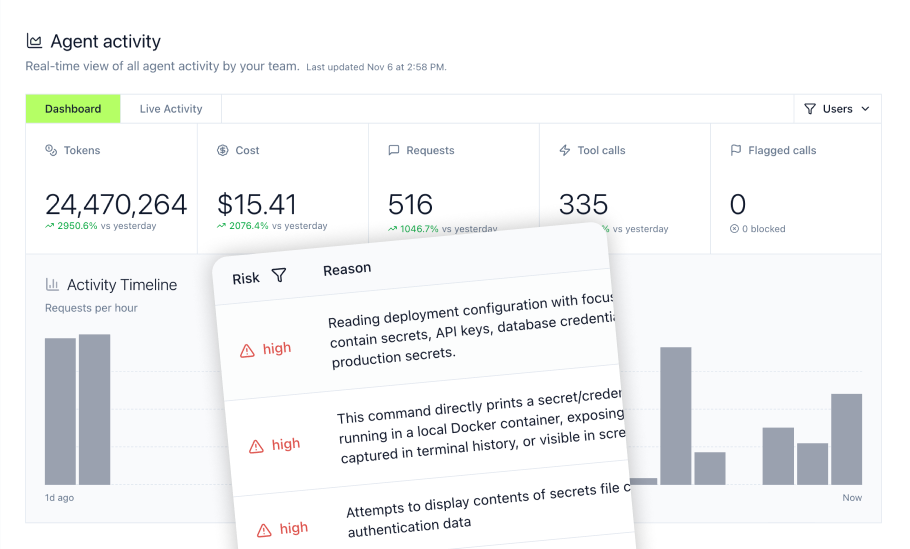
Platforms like MintMCP's Agent Monitor track agent activity in real-time, including MCP calls made outside the gateway through hooks in Cursor and Claude Code. This visibility is essential for accurate cost attribution because shadow AI activity that bypasses your gateway also bypasses your attribution.
Implementing Real-Time Usage Tracking
Real-time tracking enables proactive cost management rather than reactive surprise. Key capabilities include:
- Per-agent token visibility: Track token consumption and estimated costs for monitored agents that report usage telemetry
- Anomaly detection: Flag agents exceeding 2x normal token usage
- Workflow-level attribution: Track costs across multi-step agent tasks
- Retry cost isolation: Distinguish legitimate retries from infinite loops
Organizations using agent identities with scoped credentials can attribute gateway activity to individual agents and independently control their tool access.
Essential Cloud Cost Management Tools for AI Infrastructure
The AI cost management tooling landscape has evolved rapidly. Native cloud tools provide basic visibility, while specialized platforms add business-dimension attribution, chargeback automation, and unit economics calculation.
Integrating Cloud Provider Billing with AI-Specific Metrics
Each major cloud provider offers native cost visibility, but with significant limitations:
AWS: Cost Explorer provides service-level breakdown. Bedrock Inference Profiles enable per-profile cost tracking. However, OpenAI and Anthropic direct API calls require separate integration.
Azure: Cost Management offers tag inheritance from subscriptions. Azure OpenAI Service logs can feed into custom analytics, but cross-provider attribution requires additional tooling.
GCP: BigQuery billing exports enable SQL-based custom analytics. Vertex AI costs appear in standard billing but lack feature-level granularity.
For organizations running multi-cloud AI infrastructure, native tools require manual consolidation.
Automating Cost Reporting Workflows
Manual cost reconciliation consumes significant time for finance teams without automation. Key automation capabilities include:
- Scheduled report generation: Daily, weekly, or monthly cost summaries by team, project, and feature
- Budget threshold alerts: Automated notifications when spending exceeds targets
- SIEM integration: Cost data flowing into existing security and observability platforms
- GL/ERP synchronization: Chargeback amounts automatically posted to financial systems
Organizations using MintMCP can export logs to SIEM platforms, enabling finance teams to build cost dashboards within existing analytics infrastructure.
Allocating Costs to AI-Driven Teams
Team-level allocation transforms AI from a shared cost center into an accountable business capability. When teams see the cost impact of their AI usage, behavior changes. Engineers optimize prompts. Data scientists evaluate model tradeoffs. Product managers question whether every feature needs GPT-4o.
Best Practices for Multi-Team AI Resource Sharing
Shared resources require explicit sharing agreements. Document these before contention arises:
Dedicated resources: Tag and attribute directly to owning team.
Shared endpoints: Allocate by request volume or token consumption. Requires per-request tagging.
Common infrastructure: Allocate by utilization percentage, reviewed monthly.
Development environments: Either exclude from team chargebacks or allocate by headcount.
The showback versus chargeback decision matters here. Showback (visibility without billing) builds awareness and lets teams understand drivers before money changes hands. Chargeback (actual internal invoicing) drives behavior change but requires stable instrumentation and finance integration.
Recommendation: Run showback before transitioning to chargeback. Move to chargeback once teams understand their usage, attribution is reliable, and teams have enough control to change their spending behavior.
Reporting AI Costs to Team Leads and Stakeholders
Effective cost reporting answers four questions:
- What did we spend? Total cost by team, trend over time
- Why did we spend it? Breakdown by feature, model, environment
- Is this expected? Comparison to budget, previous period, peer teams
- What should we do? Optimization recommendations, anomaly flags
Reports should include context, not just numbers. A 50% cost spike looks alarming until annotated with "new feature launch" or "batch job for quarter-end reporting."
MintMCP's Agent Monitor provides org-level analytics on MCP adoption and usage patterns by team and tool, including latency monitoring and error tracking. This observability layer enables both engineering optimization and finance reporting from a single data source.
Pinpointing User-Level AI Costs
User-level attribution answers the question: "Which individuals are driving AI costs?" This granularity matters for understanding adoption patterns, identifying power users, and detecting potential misuse.
Tracking Individual AI Tool Consumption
Per-user tracking requires identity propagation through every AI touchpoint:
- SSO integration: Every request authenticated against corporate identity
- Session tracking: User sessions linked across multiple AI interactions
- Tool-level logging: Which specific tools each user invokes
- Time-based analysis: Usage patterns by hour, day, week
MintMCP's MCP Gateway logs MCP tool calls routed through the gateway with identity and request context. Agent Monitor adds prompt and local-agent activity monitoring, while its Usage view estimates token spend from telemetry reported by supported monitored agents. These estimates support visibility and chargeback analysis but are not a model-provider billing statement.
Attributing Costs for Shared AI Assistants
Shared assistants require careful attribution design:
Option 1: Attribute to the invoking user. Simple but may discourage legitimate use.
Option 2: Attribute to the owning team. Encourages responsible deployment but hides individual usage.
Option 3: Hybrid attribution. Base cost to owning a team, incremental usage to individual users.
For organizations with strict compliance requirements, security governance and audit trails become inseparable from cost attribution.
The Future of FinOps Tools for AI
FinOps (financial operations for cloud) is evolving to address AI-specific challenges. The FinOps Foundation has launched dedicated working groups for AI cost management.
The Role of AI in Optimizing AI Spend
Emerging capabilities include:
- Intelligent routing: Automatically select the cheapest model capable of handling each request
- Semantic caching: Reuse responses to similar prompts rather than recomputing
- Prompt optimization: Automatically compress prompts to reduce token consumption
- Predictive budgeting: Forecast costs based on planned feature launches and growth
These techniques can materially reduce inference spend. The FinOps Foundation notes that lightweight-model routing can reduce average inference cost by 60-80% for workloads that mix simple and complex queries, although results depend on workload and quality requirements.
Building a Comprehensive FinOps Strategy for Agentic AI
Agentic AI introduces new FinOps challenges:
Agent proliferation: Each new agent adds cost surface. Without governance, agent sprawl becomes cost sprawl.
Autonomous spending: Agents make decisions that incur costs without human approval for each transaction.
Multi-step workflows: A single user request might trigger dozens of agent actions across multiple systems.
Memory and context: Agents with persistent memory accumulate context that increases token consumption over time.
Organizations need agent governance frameworks that address both security and cost. The same infrastructure that enforces access controls can enforce budget limits. The same audit trails that satisfy compliance can feed cost analytics.
How MintMCP Enables AI Cost Attribution and Governance
MintMCP combines its MCP Gateway for governed data and tool connections with Agent Gateway for agent identities, permissions, memory, and monitoring. Together, these layers provide the governance and attribution foundation for tracking AI activity across users, teams, and agents.
Centralizing Observability for Cost Control
MintMCP combines MCP Gateway and Agent Monitor for centralized observability. MCP Gateway covers MCP traffic routed through governed endpoints, while Agent Monitor captures supported local agent actions and usage telemetry. Together, they provide:
- MCP calls through the gateway: Full visibility into governed traffic
- Off-gateway activity detection: With Agent Monitor hooks deployed in supported developer tools, MintMCP can capture off-gateway MCP and local agent activity that the gateway itself cannot see
- Team and tool analytics: Usage patterns broken down by organizational unit
- Latency and error tracking: Operational metrics that explain cost anomalies
This observability serves both engineering and finance. Engineers use it to optimize performance. Finance uses it to allocate costs. Security uses it to detect anomalies.
Securing and Metering AI Agent Access
MintMCP's Bundle model ties SCIM group membership to curated MCP server lists, custom policy rules, and isolated audit trails. This architecture enables cost allocation per team or role by design:
- Virtual Bundles: Each Bundle becomes a cost allocation unit with its own audit trail
- SCIM-driven membership: Team membership automatically determines cost attribution
- Tool-level policy: Control which tools are available and which consume premium resources
- Isolated audit trails: Per-Bundle logging simplifies cost reconciliation
For agent workloads, Agent Bundles extend this model to non-human principals. Each deployed agent gets its own rotatable credentials and permission scope independent of creator's access level. This enables:
- Per-agent attribution: Agent Bundles give each deployed agent its own identity and token for audit attribution, while token and estimated-cost views depend on usage telemetry from monitored agents
- Credential isolation: Clear separation between agent costs and human costs
- Operational controls: Use per-user and per-team rate limits, managed-agent runtime limits, tool controls, or the gateway kill switch to constrain runaway activity
MintMCP exports tool-call, prompt-submission, gateway-request, and access-policy logs to OTLP-compatible endpoints or Splunk HEC, enabling integration with existing observability and security pipelines.
Frequently Asked Questions
Why is attributing AI costs more complex than traditional IT costs?
Traditional IT costs scale with provisioned capacity: servers, storage, network bandwidth. AI costs scale with actual usage: tokens consumed, API calls made, inference time used. This usage varies unpredictably by user behavior, prompt complexity, model selection, and agent autonomy. Additionally, AI workloads often span multiple providers with different billing structures, making consolidation challenging.
What is the difference between showback and chargeback in AI cost management?
Showback provides visibility into costs without transferring budget responsibility. Teams see reports showing their AI consumption but aren't billed internally. Chargeback actually transfers costs to consuming business units through internal invoicing, impacting their P&L or budget. Best practice is to implement showback before transitioning to chargeback. Move to chargeback once teams understand their usage, attribution is reliable, and teams have enough control to change their spending behavior.
How can shadow AI impact cost attribution and what tools can help?
Shadow AI refers to AI usage that bypasses governed channels, such as developers using personal API keys or teams deploying unauthorized agents. This usage creates blind spots in cost attribution because ungoverned traffic doesn't appear in your attribution reports. With Agent Monitor hooks deployed in supported developer tools, MintMCP can capture off-gateway activity, ensuring comprehensive visibility even when users attempt to bypass central governance.
What role does per-agent credential scoping play in cost allocation?
When agents share credentials, all agent activity attributes to a single identity. This makes it impossible to determine which agent drove costs, which agent failed, or which agent needs optimization. Per-agent credential scoping gives each agent its own identity, enabling granular attribution. MintMCP's Agent Bundles provide rotatable credentials per agent with permission scopes independent of the creator's access level.
Can usage-based billing apply to internal AI deployments?
Yes. Internal chargebacks can follow the same usage-based model as external billing. Track token consumption, API calls, and compute time per agent, then allocate those costs to the owning team or project. The key requirements are consistent instrumentation (every request tagged with attribution metadata), reliable logging (all activity captured in auditable records), and finance integration (cost data flowing into internal accounting systems). Robust attribution reduces ambiguity in cost allocation by giving every team the same allocation rules and reporting logic.