AI agents are proliferating across enterprises faster than governance frameworks can keep pace. While 88% of organizations now use AI in at least one business function, two-thirds have not scaled beyond pilots, often because memory systems remain ungoverned, opaque, and impossible to audit. As enterprises deploy Claude, Cursor, ChatGPT, Copilot, and custom agents across teams, the question of who owns agent memory, who can access it, and how it persists becomes central to both security and operational success. The Mintive (formerly MintMCP) Coworker Agents address this challenge through company-owned memory that follows Git-like principles: scoped, versioned, reviewable, and auditable.
This article defines the four critical scopes of agent memory, explains why scoping matters for compliance and security, and outlines how enterprises can implement governed memory across private, team, organizational, and customer contexts.
Key Takeaways
- Agent memory requires explicit scoping to prevent data leakage, compliance violations, and security incidents across private, team, organizational, and customer contexts
- 40% of enterprises will demote or decommission agents by 2027 due to governance gaps, making memory governance a survival requirement
- The EU AI Act became generally applicable on August 2, 2026, while some provisions follow different application timelines; Articles 12-14 establish record-keeping, transparency, and human-oversight requirements for high-risk AI systems within scope
- Database-layer enforcement such as row-level security is a strong production pattern for multi-tenant memory, but it is not universally mandatory; production systems need reliable tenant and scope isolation at the appropriate enforcement layer
- Company-owned memory following Git-like principles (versioned, reviewable, auditable, portable) enables enterprises to inspect, govern, and migrate agent memory rather than leaving it trapped in opaque vendor systems
- Memory poisoning attacks represent a distinct threat category (OWASP ASI06), requiring scope isolation to contain blast radius
Understanding Agent Memory: More Than Just Recall
Agent memory encompasses far more than simple data persistence:
- Working memory: the agent's current context window
- Semantic memory: learned facts and relationships
- Episodic memory: interaction history
- Procedural memory: learned workflows and preferences
Each type serves distinct purposes and carries different governance requirements.
The challenge for enterprises is that multi-agent system inquiries surged 1,445% from early 2024 to mid-2025, yet most organizations lack frameworks to govern what these agents remember, who can access those memories, and how long they persist. Only 14.4% of organizations reported full IT and security approval for their entire agent fleet, highlighting a substantial gap between agent deployment and centralized oversight.
Why memory scoping matters
- Security: Prevents cross-user data leakage in shared deployments
- Compliance: Enables GDPR erasure, HIPAA audit trails, and EU AI Act traceability
- Performance: Reduces token costs by retrieving only relevant context
- Governance: Creates clear ownership and accountability for agent actions
Modern memory architectures like CrewAI's hierarchical scope trees and Mem0's multi-identifier model demonstrate industry movement toward explicit scoping. However, enterprises need more than technical isolation; they need governance frameworks that map to organizational reality.
Private Agent Memory: The Individual Workspace
Private memory belongs exclusively to a single agent or user-agent pairing. It functions as a personal scratchpad for preferences, drafts, sensitive history, and individual workflow state that should never leak to other users or agents.
Key characteristics of private memory
- Owner-only access: Isolated by namespace, row-level security (RLS), or dedicated storage
- GDPR Article 17 erasure: Where private memory contains personal data subject to GDPR, organizations need processes to honor applicable erasure requests, subject to Article 17's exceptions
- Minimal retention: Store only what the agent needs for immediate tasks
- Session vs. persistent: Distinguish ephemeral working memory from durable preferences
Implementation patterns
Private memory typically uses user_id or owner_id scoping at the database layer. Frameworks like CrewAI implement this through /agent/ scope paths, while Mem0 uses user_id identifiers that filter all memory retrieval operations.
Mintive's Agent Gateway supports private memory by providing each agent with its own identity, scoped permissions, and independent credential lifecycle. When an agent operates with a distinct non-human identity rather than inheriting a human's credentials, private memory attribution becomes unambiguous.
When to use private memory
- Personal assistant preferences and interaction history
- Draft documents or work-in-progress analysis
- Individual agent learning and calibration data
- Sensitive information the user shares with their personal agent
Team-Level Agent Memory: Shared Knowledge Bases
Team memory enables collaboration across agents and users within defined group boundaries. It encompasses shared knowledge bases, resolved issues, standard operating procedures, and project-specific context that multiple team members need but should remain invisible to other teams.
Key characteristics of team memory
- Group-scoped access: Controlled by team membership, typically synced from directory groups
- RBAC enforcement: Different team members may have read-only vs. read-write access
- Version control: Changes to shared memory should be tracked and reversible
- Access logging: Audit trails showing who accessed and modified team memory
Implementation considerations
The critical mistake many organizations make is implementing team sharing through application-layer filters rather than database-layer enforcement. Row-level security (RLS) at the PostgreSQL or vector database level prevents memory leakage even when application code contains bugs or misconfigurations.
Mintive's Virtual MCPs can govern the tools and data sources agents use to reach shared team systems. A Virtual MCP bundles approved connectors and curated tools behind one governed endpoint for a particular team, role, use case, or agent, with access policies that can be driven by SCIM-synced directory groups. The underlying memory system still needs to enforce its own team-level memory boundaries.
Common team memory use cases
- Shared customer context across sales pod members
- Engineering team knowledge bases and resolved incidents
- Marketing campaign assets and messaging guidelines
- Department-specific compliance procedures
Organizational Agent Memory: Enterprise-Wide Knowledge
Organization memory represents the canonical source of truth for enterprise-wide knowledge that all authenticated users and agents should access consistently. This includes brand guidelines, compliance rules, approved messaging, company policies, and definitions that must remain consistent across the organization.
Key characteristics of organizational memory
- Admin-controlled writes: Only authorized administrators can modify organizational memory
- Universal read access: All authenticated agents and users can retrieve organizational knowledge
- Version history: Full audit trail of changes with rollback capability
- Tamper evidence: Signatures or integrity checks to detect unauthorized modifications
Governance requirements intensify at org scope
The EU AI Act imposes record-keeping, transparency, and human-oversight obligations for high-risk AI systems under Articles 12-14, subject to the Act's scope and application schedule. Versioned and auditable memory can support these governance goals, but the Act does not specifically require organizations to preserve a complete snapshot of everything an agent knew for every decision.
Mintive's Security & Enterprise controls provide SSO, SCIM-driven RBAC, audit trails, and SIEM export around governed access and supported activity. For Coworker Agents, company-owned memory and operating state are designed to remain reviewable and controlled by the organization, while platform audit trails cover supported tool calls, credential lifecycle events, and access-policy changes.
Organizational memory patterns
- Company-wide compliance policies and prohibited actions
- Brand voice guidelines and approved terminology
- Product definitions and canonical documentation
- Cross-functional process documentation
Customer-Centric Agent Memory: Multi-Tenant Isolation
Customer memory represents the most sensitive scope: context specific to external customers or clients that must remain strictly isolated between tenants. This scope matters for any organization deploying AI agents in customer-facing applications or SaaS products.
Key characteristics of customer memory
- Tenant isolation: Absolute separation between customers' data
- Data residency: Memory may need to reside in specific geographic regions
- BAA requirements: A business associate agreement is required when a covered entity or business associate uses another business associate to create, receive, maintain, or transmit PHI on its behalf
- Privacy controls: Applicable laws and policies may require controls over the collection, use, retention, access, and deletion of personal data
- Deletion requests: GDPR Article 17 and the CCPA provide deletion rights in defined circumstances, subject to applicable exceptions
Implementation complexity
Customer memory requires the most rigorous isolation because failures expose the organization to both regulatory penalties and customer trust violations. CockroachDB's REGIONAL BY ROW pattern demonstrates how to maintain data residency while supporting global multi-tenant architectures.
Mintive's MCP Gateway governs data and tool connections for agents interacting with customer memory systems. When agents access CRM data, support tickets, or customer-specific knowledge bases through governed MCP connections, the gateway can enforce credential injection, access policies, and audit logging around those tool calls. This creates attributable records of supported access and activity, while tenant isolation and customer-memory controls remain the responsibility of the underlying systems and policies.
Customer memory security controls
- Tenant ID scoping on every database query
- Row-level security policies preventing cross-tenant reads
- Encryption with tenant-specific keys where required
- Complete audit trails of customer data access
Challenges in Managing Multi-Scope Agent Memory
Even organizations that understand the four scopes face substantial implementation challenges. The MAST taxonomy, built from more than 1,600 annotated traces across seven multi-agent frameworks, groups observed failures into system-design issues (44.2%), inter-agent misalignment (32.3%), and task verification (23.5%).
Challenge 1: Memory poisoning and stale context
OWASP identifies Memory and Context Poisoning (ASI06) as a distinct AI agent threat category. Attackers can inject malicious content into agent memory through manipulated documents, poisoned training data, or tool description injection. Once poisoned, agents can propagate errors across interactions until the contaminated memory is identified and purged.
Mintive's Guardrails provide runtime protection through Mint Guard (managed detection for prompt injection, secrets, and PII), Rules (declarative pattern matching), and Gateway Middleware (custom logic for DLP integration). These controls can inspect supported gateway inputs and outputs and block or flag risky content at those enforcement points, reducing poisoning risk when memory-related operations pass through governed tool paths.
Challenge 2: Scope migration and evolution
Memory often needs to migrate between scopes as work progresses. A draft analysis starts as private memory, becomes team memory during collaboration, and may eventually become organizational memory as an approved reference. Few frameworks handle these transitions gracefully, leading to manual copy-paste operations that break audit trails.
Challenge 3: Stale permission synchronization
When someone leaves a team or organization, their access to team and organizational memory should revoke immediately. Yet many implementations cache permissions, creating windows where former employees or agents can access memory they should no longer see.
Mintive addresses the access-control side through SCIM integration that propagates directory changes into Mintive access policies. Suspending a user in the identity provider can revoke their access to governed Virtual MCPs and tools, while downstream memory systems still need to honor the same updated permissions.
Challenge 4: Vector embeddings and erasure rights
GDPR's right to erasure becomes technically complex when memory exists as vector embeddings. Deleting the source document does not automatically remove derived embeddings, and re-embedding the corpus after every deletion creates performance problems. Organizations need architectures that maintain clear linkage between source data and derived memory representations.
Mintive's Approach to Governed Agent Memory
Mintive treats memory as governed enterprise infrastructure, not as a feature bolted onto agent capabilities. This data-permissions-first architecture creates a foundation for both human-operated AI clients and autonomous agents.
Git-like memory principles
Mintive's Coworker Agents demonstrate these principles in practice. The agent's repository contains instructions (CLAUDE.md), memory (progress.md), and task queues (inbound/) as reviewable files. This approach means:
- Company-owned: The enterprise owns and controls agent memory, not a vendor
- Scoped: Memory can be organized around private, team, organization, or customer contexts with access boundaries defined by the organization's memory architecture
- Versioned: Full history of memory changes with rollback capability
- Reviewable: Administrators can inspect what agents remember
- Auditable: Memory state and version history remain reviewable alongside supported agent activity and platform audit records
- Portable: Memory can migrate between platforms without vendor lock-in
The Bundle architecture
Mintive's Agent Gateway builds on its MCP Gateway foundation by extending governed data and tool access to first-class agent identities, scoped permissions, memory, and monitoring. Each agent receives:
- Its own non-human identity
- Scoped MCP access through Virtual MCPs
- Independent credential lifecycle
- Attributable audit trail
- Defined memory scope
This architecture enables organizations to answer governance questions that become critical at scale: Which agents exist? What memory do they retain? Which scopes can they access? How is their activity attributed?
Implementing Memory Governance with Mintive
Practical implementation requires mapping memory scopes to Mintive's product capabilities.
Step 1: Define scope boundaries
Identify which memory belongs to individuals (private), determine team boundaries and shared knowledge needs, establish organizational knowledge that requires universal consistency, and map customer data flows and isolation requirements.
Step 2: Govern the systems each scope can access
Virtual MCPs bundle connectors and tools behind governed endpoints. Use VMCPs to control which memory or knowledge systems a user or agent can reach, while the underlying memory backend enforces the actual scope boundaries:
- Private scope with user-specific or agent-specific access
- Team scope with directory-group-driven access to shared systems
- Organizational scope with controlled access to canonical company knowledge
- Customer scope with tenant-aware isolation enforced by the underlying customer data system
Step 3: Establish agent identities
Use Agent Gateway to give each autonomous agent its own identity, enabling:
- Clear attribution of governed agent and tool activity used to access memory systems
- Independent credential rotation
- Scope-appropriate permissions
- Per-agent audit trails
Step 4: Enable monitoring and guardrails
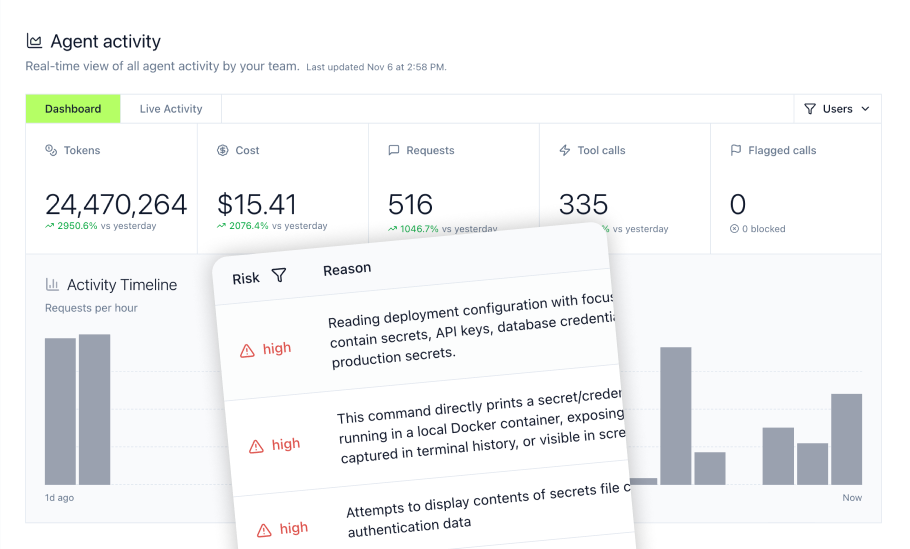
Configure Agent Monitor to capture supported agent activity relevant to memory workflows, including file access, prompts, MCP tool calls, and usage and token costs by user, agent, model, and session.
Apply runtime guardrails to detect, block, or flag risky content and tool activity at supported enforcement points, reducing memory-poisoning risk when memory-related operations pass through governed tool paths.
Step 5: Connect audit to compliance
Export supported activity through SIEM integration to centralize security and audit records:
- Supported prompt and agent activity
- Gateway requests and tool calls
- Access-policy changes and other supported security events
Why Mintive for Multi-Scope Memory Governance
Multi-scope memory governance requires more than a vector database or retrieval layer. Organizations need control over who or what can access memory-backed systems, how agent activity is attributed, and whether memory remains inspectable and portable.
Mintive connects those requirements across its governance stack:
- Coworker Agents use company-owned, Git-like memory that remains reviewable, versioned, and portable.
- Agent Gateway gives autonomous agents distinct non-human identities, scoped permissions, and independent credentials instead of relying on inherited human credentials or shared service accounts.
- Virtual MCPs let access to memory-backed tools and knowledge systems follow the same directory-driven controls as other governed tools.
- SCIM integration helps propagate directory changes into Mintive access policies as users and teams change.
- Agent Monitor provides visibility into supported agent activity, while Guardrails add runtime enforcement at supported interaction points.
Per-agent identity improves attribution because governed tool calls can be associated with the agent's own identity and scoped permissions. The underlying memory system still needs to record the actual memory change and any task-specific context required for audit.
For Coworker Agents, memory exists as reviewable files such as progress.md and CLAUDE.md within company-controlled repositories. This gives organizations a familiar Git-like model for inspecting memory state, reviewing changes, and moving agent configurations between environments.
The result is a governance foundation that can support private, team, organizational, and customer memory while keeping the underlying isolation mechanisms explicit. As AI governance requirements mature, company-owned, scoped, versioned, and reviewable memory gives enterprises greater control over the persistent context their agents rely on.
Frequently Asked Questions
How does agent memory differ from traditional database storage?
Agent memory combines multiple storage paradigms: vector embeddings for semantic similarity search, graph structures for entity relationships, and traditional databases for structured attributes. Unlike conventional data storage, agent memory must support retrieval operations optimized for LLM context windows, typically returning the most relevant fragments from potentially millions of stored facts. Additionally, retrieved memory can increase input-token usage when the retrieved content is added to an LLM's context, making efficient scoping a performance concern as well as a governance requirement.
Can memory scopes change dynamically during agent execution?
Yes, but transitions require careful governance. An agent might start processing in private scope, escalate to team scope when collaboration is needed, and eventually publish results to organizational scope. Mintive can govern the tools and data systems available at each stage through Virtual MCP access policies and per-agent permissions, while the underlying memory system must implement and audit the actual movement or promotion of memory between private, team, and organizational scopes.
What happens to agent memory when an employee leaves the organization?
Private memory tied to the departing employee should be deleted or transferred based on organizational policy. Team memory can remain with the team while preserving historical attribution of the individual's contributions. Organizational memory persists unchanged. The key challenge is ensuring prompt access revocation: SCIM integration propagates directory changes to Mintive access policies, but organizations should verify that downstream memory systems also honor these revocations rather than caching stale permissions.
How do memory governance requirements differ for regulated industries?
Healthcare organizations subject to HIPAA may need business associate agreements when a service provider acts as a business associate handling PHI, along with minimum-necessary access where applicable; HIPAA itself does not set a general retention period for patient medical records. Broker-dealers and other covered firms subject to SEC Rule 17a-4 must satisfy applicable recordkeeping requirements, which can use either WORM storage or the rule's audit-trail alternative for electronic records. The EU AI Act adds record-keeping, transparency, and human-oversight obligations for high-risk AI systems within scope. Mintive is SOC 2 Type II audited and compliant with HIPAA standards, and customers handling PHI can request HIPAA documentation and BAAs, but organizations should validate their own regulatory obligations with qualified counsel.
What role does memory scope play in preventing prompt injection attacks?
Memory scope isolation limits the blast radius of successful injection attacks. If an attacker poisons an agent's private memory, the poisoned memory is confined to that scope, reducing direct exposure to other agents; the compromised agent may still affect shared systems through actions it is authorized to take. Without scope isolation, poisoned content can propagate to team, organizational, or customer memory, affecting far more users and requiring extensive remediation.
Mintive's Mint Guard can detect prompt-injection patterns on supported gateway inputs and outputs, while scope boundaries can limit the impact of poisoned context. Content written directly to memory outside governed tool paths requires separate memory-specific controls.