When evaluating MCPJungle alternatives, the choice depends on governance requirements, deployment preferences, and compliance needs. MCPJungle offers a self-hosted MCP gateway with tool groups and per-client allowlisting, but enterprise teams may need broader capabilities such as directory-driven SSO and SCIM, compliance-oriented audit trails, and first-class agent identity management beyond MCPJungle's current access-control model.
This guide examines MCPJungle alternatives for 2026, with particular emphasis on how MintMCP approaches enterprise AI governance. Enterprise MCP governance can support the broader risk-management goals described in the NIST AI Risk Management Framework by strengthening control and visibility around AI systems connecting to enterprise data.
Key takeaways
- MintMCP provides managed enterprise MCP deployment with one-click setup, Virtual MCPs for role- and use-case-specific tool access, first-class agent identities, monitoring, and runtime guardrails
- Virtual MCPs enable per-use-case endpoints with SCIM-driven membership and curated tool sets, supporting centralized access governance as AI system use scales
- Agent identity models vary by platform; MintMCP differentiates through first-class agent identities with scoped MCP access, independent credentials, M2M authentication, and attributable audit trails
- Deployment models range from managed SaaS to self-hosted options, with varying responsibility for infrastructure operations, security controls, and compliance documentation
- Compliance responsibilities vary by deployment model; managed platforms can provide vendor audit and compliance documentation, while self-hosted deployments place more responsibility for infrastructure controls on the customer
Understanding MCPJungle: a self-hosted MCP gateway
MCPJungle positions itself as an open-source, self-hosted MCP gateway that centralizes management of multiple MCP servers. The platform enables teams to organize tools into groups with per-client allowlisting, providing access control for AI agents connecting to enterprise systems.
MCPJungle strengths:
- Free and open-source with no licensing costs
- Self-hosted deployment for data sovereignty
- Tool groups with per-client allowlisting
- Centralized gateway for MCP server management
Enterprise considerations:
- No documented SSO or SCIM integration comparable to enterprise IdP integrations offered by several managed platforms
- Basic access-control model with authentication, admin/user roles, and per-client allowlists rather than a broader directory-driven policy model
- Observability support is available, but MCPJungle does not document the same compliance-oriented audit model as enterprise governance platforms compared here
- Self-hosted deployment with no managed service currently documented
- No documented first-class agent identity model with independent agent credentials and lifecycle controls
For teams with MCP aggregation needs and Kubernetes expertise, MCPJungle provides a starting point. However, enterprises requiring governed data and tool connections with directory-driven SSO, per-agent identity, compliance-oriented audit trails, and runtime guardrails will find MCPJungle's current capabilities limited.
1. MintMCP: enterprise AI governance across MCP clients and agents
MintMCP provides enterprise infrastructure for governing AI clients and autonomous agents across the Model Context Protocol ecosystem. The platform makes AI systems deployable, governed, measurable, and swappable by centralizing tool access, agent identity, credentials, permissions, monitoring, guardrails, and auditability.
How MintMCP approaches enterprise governance
MintMCP's MCP Gateway serves as a single governed entrypoint between AI clients (Claude, Cursor, ChatGPT, Gemini, Copilot) and MCP servers. The key abstraction is the Virtual MCP (VMCP), which bundles approved connectors and a curated tool surface behind one governed endpoint for a particular team, role, use case, or agent.
Core capabilities
- Virtual MCP Bundles: Per-use-case endpoints with SCIM-driven group membership, curated tools, and access policy
- Agent Gateway: First-class non-human identities with independent credentials, scoped permissions, and attributable audit trails
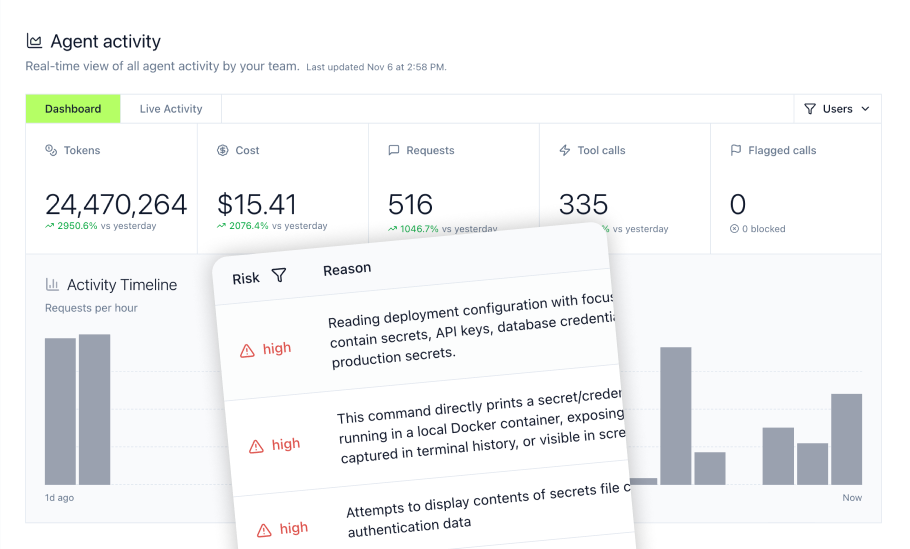
- Agent Monitor: Real-time visibility into supported agent activity including prompts, commands, file access, MCP tool calls, usage, and token costs
- Guardrails: Mint Guard managed detection, declarative Rules, and customer-authored Gateway Middleware for security controls like prompt injection detection and PII screening
- One-click MCP deployment: Deploy in minutes rather than weeks
- Compliance-ready infrastructure: SOC 2 Type II audited, compliant with HIPAA standards with BAA availability
Product solutions by area
- MCP Gateway: Centralized tool access, credential injection, RBAC, audit logging
- Agent Gateway: Per-agent identity, M2M auth, workload identity federation
- Agent Monitor: Live activity visibility, usage tracking, SIEM export
- Coworker Agents: Long-running agents with company-owned memory
- Guardrails: Prompt injection detection, PII/secrets screening, DLP integration
Customer perspective
Juan Vasquez, CTO at Deerfield Group, notes: "It's as simple as adding the bundle to your Claude or Codex, and it has all the tools our IT team has already vetted. The virtual bundles are our number one feature."
Christian Burrows, Head of Security at Stability AI, confirms: "I'm very happy that we found MintMCP. It solved our most immediate MCP problems."
Pricing and deployment
MintMCP uses customized pricing based on team size and organizational requirements, with per-user licensing and platform fees that scale with usage and team size.
2. Composio: integration library with MCP governance
Composio targets developer and AI engineering teams with 1,500+ managed toolkits, managed authentication, and an MCP gateway that adds centralized access policies, identity integration, and auditability.
Key capabilities
- 1,500+ managed toolkits across SaaS tools
- Managed authentication and OAuth across supported integrations
- SDK embedding for building integrations into custom applications
- Developer-oriented tooling with agent-optimized interfaces
Deployment options
- Composio Cloud
- Customer VPC deployment
- Fully self-hosted deployment for Enterprise customers
Platform positioning
Composio combines developer-facing integration infrastructure with enterprise MCP governance capabilities including SSO, SCIM, action-level access control, audit trails, and multiple deployment options.
- No MintMCP-style Virtual MCP model with per-use-case endpoints and SCIM-driven membership
- Governance is centered on Composio's gateway, teams, policies, and managed integration model
- Public pricing includes a Free tier with 100,000 monthly tool calls, Pro at $29/month plus usage, and custom Enterprise pricing
3. TrueFoundry: unified AI platform with MCP and LLMOps
TrueFoundry operates as a unified AI platform combining LLM routing, MCP gateway capabilities, and MLOps infrastructure in one control plane. The platform targets platform engineering and ML teams who want consolidated AI infrastructure.
Key capabilities
- Unified LLM, MCP, and MLOps control plane
- Published performance benchmarks; teams should validate current benchmark methodology against their own workloads
- Deployment flexibility across SaaS, VPC, on-prem, hybrid, and air-gapped options
- SOC 2 Type II audited with HIPAA compliance
- 99.9% monthly uptime SLA for Enterprise SaaS and on-premises deployments
Deployment options
- Managed SaaS
- Self-hosted control plane in customer Kubernetes
- VPC deployment
- On-premises installation
- Air-gapped via forward proxy
- Multi-cloud support
Platform considerations
- Deploy-your-own connector model rather than fully managed connectors
- No Virtual MCP Bundles for per-use-case access control
- Platform depth may exceed requirements for MCP-only use cases
4. Obot: open-source MCP governance for self-hosted teams
Obot provides a 100% open-source MCP control plane for teams requiring complete infrastructure control and code transparency. The platform targets Kubernetes-fluent infrastructure teams who can self-manage deployment and operations.
Key capabilities
- 100% open-source with complete code transparency
- Free open-source edition with up to 100 users and 100 devices
- Self-hosted deployment via Docker or Kubernetes
- Managed Obot Cloud option for hosted deployments
- Full data sovereignty with infrastructure control
- Enterprise authentication support including GitHub, Google, Okta, Microsoft Entra, and other supported IdPs
Deployment and editions
- Obot Community: Free, open-source, and self-hosted with up to 100 users and 100 devices
- Obot Cloud: Hosted deployment with enterprise authentication and no stated user limit
- Obot Enterprise: Self-hosted with unlimited users and devices plus enterprise support
Platform considerations
- Not currently stated to hold SOC 2 Type II attestation in reviewed materials
- Self-hosted deployments require infrastructure operations and maintenance
- Managed Obot Cloud is available for teams that do not want to operate the platform themselves
- Enterprise support is available through the Enterprise edition
5. Portkey (PRISMA AIRS AI Gateway): full-stack GenAI platform
Portkey, now part of Palo Alto Networks as PRISMA AIRS AI Gateway, provides a comprehensive GenAI platform with AI Gateway, observability, guardrails, and prompt management. The platform supports 1,600+ LLMs via unified API access.
Key capabilities
- Enterprise security backing from Palo Alto Networks
- Broad AI platform covering AI Gateway, observability, guardrails, and prompt management
- 1,600+ LLMs supported via unified API
- Enterprise SLAs available on enterprise plans
- Free tier includes 10,000 recorded logs per month; $49/month Production tier includes 100,000 recorded logs per month
- Enterprise HIPAA/BAA support
Platform considerations
- MCP Gateway is one component of a broader platform
- Enterprise engagement now requires Palo Alto Networks involvement
- No Virtual MCP Bundles for per-use-case endpoints
- Primary focus on LLM Gateway rather than MCP-specific governance
6. Runlayer: security-first governance gateway
Runlayer positions as a security-first MCP and agent governance gateway targeting IT, Security, and AIOps teams. The platform emphasizes ML threat detection and approved-access workflows for enterprise environments.
Key capabilities
- Security-first architecture with ML threat detection
- Approved-access workflows for tool governance
- Hybrid deployment with managed SaaS plus self-hosted options
- Internal employee and agent governance focus
Platform considerations
- Comparing MintMCP vs Runlayer reveals differences in Virtual Bundle implementation
- Deployment model combines managed and self-hosted options
7. Natoma: enterprise MCP governance
Natoma provides an enterprise MCP governance platform for AI clients and agents, with centralized tool access, identity-aware authorization, policy enforcement, Shadow AI discovery, and auditability.
Key capabilities
- Role- and intent-based Profiles for governed toolkits
- Identity-aware and attribute-based authorization across tools and AI clients
- Shadow AI and MCP discovery with audit and security integrations
- Flexible deployment across cloud, VPC, on-premises, proxy, and desktop environments
Platform considerations
- Natoma's Profiles and authorization model differ from MintMCP's Virtual MCP and Agent Bundle architecture
- Deployment and pricing requirements should be evaluated against each organization's infrastructure and governance model
- Positioning overlaps directly with MintMCP's internal employee and agent governance focus
Total cost of ownership considerations
Enterprise MCP governance involves more than software licensing. Consider these factors:
Time to value and operational readiness:
- Managed platforms can reduce infrastructure setup by providing hosted control-plane and connector operations
- Self-hosted options place more responsibility for deployment, upgrades, scaling, connector operations, and identity integration on the customer
- Hosted MCP connectors eliminate connector runtime management overhead
Compliance operations and evidence:
- MintMCP is SOC 2 Type II audited and compliant with HIPAA standards, and signs BAAs with customers handling protected health information
- Self-hosted deployments place more responsibility for infrastructure controls, logging, evidence collection, and operational security on the customer
- Compliance obligations remain the customer's responsibility regardless of deployment model
Why MintMCP for enterprise MCP governance
Enterprise teams evaluating MCPJungle alternatives need to consider how MCP governance scales across multiple AI clients, autonomous agents, diverse tool surfaces, and evolving compliance requirements. MintMCP's approach centers on three differentiating capabilities:
- Virtual MCPs provide per-use-case governed endpoints rather than one-size-fits-all aggregation. Different teams, roles, and agents can access different curated tool surfaces over the same underlying connectors, with SCIM-driven membership and access policy. This solves the governance challenge of maintaining least-privilege access as MCP deployments grow.
- First-class agent identities separate autonomous workloads from human credentials. Agent Gateway provides independent M2M credentials, scoped permissions, and attributable audit trails for each agent, eliminating the security and audit risks of shared service accounts or human credential reuse.
- Runtime guardrails protect against AI-specific risks before tool execution. MintMCP's three-layer model includes Mint Guard for managed detection, declarative Rules for pattern matching, and Gateway Middleware for custom logic integrating external DLP systems.
- Compliance-ready infrastructure supports compliance operations. SOC 2 Type II audit, HIPAA standards compliance, BAA availability, tamper-evident audit history, and SIEM export support internal risk reporting and compliance workflows, while customers remain responsible for their own compliance scope and controls.
- One-click deployment accelerates production readiness. Teams can deploy governed MCP access in minutes rather than weeks, with centralized SSO, RBAC, and monitoring capabilities rather than building those controls from scratch.
Frequently asked questions
What are the main considerations when evaluating MCPJungle for enterprise teams?
MCPJungle provides MCP gateway functionality with tool groups and per-client allowlisting but does not currently document enterprise IdP integration comparable to SSO/SCIM capabilities offered by managed governance platforms. Enterprise teams should evaluate whether MCPJungle's basic access-control model meets requirements for directory-driven policy, compliance-oriented audit trails, and first-class agent identity beyond per-client allowlists.
How do Virtual MCP Bundles differ from basic MCP aggregation?
Virtual MCP Bundles are MintMCP's abstraction for per-use-case MCP endpoints. Each Virtual MCP bundles approved connectors and a curated tool surface behind one governed endpoint with SCIM-driven group membership and access policy. This enables different tool surfaces for different teams, roles, or agents over the same underlying connectors. Basic aggregation combines MCP servers without role-based curation or policy enforcement.
Can teams migrate from MCPJungle to an enterprise MCP gateway?
Yes, migration involves reconfiguring MCP server connections through the new gateway and establishing identity provider integration. MintMCP's one-click deployment and pre-configured connectors accelerate migration. The primary benefit is centralized identity, access control, and auditability through capabilities such as SSO, RBAC, and audit trails, while the organization remains responsible for its own compliance requirements.
What defines a first-class agent identity and why does it matter?
A first-class agent identity treats autonomous agents as independent principals with their own credentials, scoped permissions, MCP access, and audit trails separate from human users. This matters because agents operating through human credentials or shared service accounts collapse audit trails, over-privilege agent access, and break credential rotation. MintMCP's Agent Gateway provides bearer credentials, M2M tokens, and workload identity federation for agent authentication.
How do runtime guardrails protect against AI agent risks?
Runtime guardrails screen and control tool calls before execution. MintMCP's three-layer approach includes Mint Guard for managed detection of prompt injection, secrets, and PII; Rules for declarative pattern matching with block/flag/mask actions; and Gateway Middleware for customer-authored JavaScript logic integrating external DLP systems. This prevents dangerous agent actions rather than just logging them after the fact.