Enterprise MCP deployment requires evaluating compliance frameworks, deployment speed, security architecture, and ecosystem access. Both MintMCP and RunLayer have positioned themselves as MCP gateway solutions for enterprise AI infrastructure, serving different organizational priorities through distinct approaches. MintMCP Gateway delivers a managed SaaS-first MCP gateway with authentication, tool-level access control, credential management, logging, and rule-based policy, while RunLayer operates as a security-focused platform for MCP access, governance, and threat detection. This comparison examines both solutions to help engineering leaders determine which platform aligns with infrastructure requirements and compliance timelines.
Key Takeaways
- MintMCP supports hosted MCP connectors, OAuth brokering for stdio and hosted MCP servers, and managed SaaS-first deployment, accelerating production rollout
- MintMCP supports hundreds of prebuilt connectors and hosted MCP connectors run by MintMCP, with examples such as Elasticsearch, Snowflake, and Gmail, while RunLayer emphasizes broad MCP server access
- MintMCP's Virtual MCP Bundles create per-use-case endpoints with SCIM-driven membership, curated tool lists, and tool-level policy, while RunLayer emphasizes secure identity management and fine-grained permissions
- MintMCP includes Agent Monitor for coding agent monitoring with real-time security guardrails, complementing Gateway controls for MCP traffic
- MintMCP supports Agent Bundles with M2M auth and an “act as agent” flow for per-agent identity governance
Understanding MCP Gateways for Enterprise AI Infrastructure
The Model Context Protocol has created standardized communication between AI assistants and enterprise data sources. However, deploying MCPs at enterprise scale introduces challenges: authentication across multiple identity providers, compliance audit trails, security guardrails, and operational monitoring.
MCP gateways address these challenges by providing centralized infrastructure that transforms individual MCP servers into governed, observable, production-ready services. Without gateway infrastructure, organizations face scattered credentials, limited visibility into AI agent actions, and governance gaps that enterprises need to close.
Why Gateway Infrastructure Matters
Organizations implementing AI agents without gateway infrastructure encounter three critical problems:
- Zero Telemetry: Individual MCP servers provide minimal logging, making it difficult to track what data AI agents access or which tools they invoke
- Authentication Complexity: Each MCP server requires separate authentication configuration, creating credential sprawl and management overhead
- Compliance Gaps: Regulatory frameworks like SOC 2, NIST AI RMF, and GDPR can require governance records and auditability that scattered MCP deployments struggle to provide
MCP gateway infrastructure solves these problems by creating a centralized control plane that enforces authentication, captures audit trails, and provides monitoring across MCP interactions. For regulated industries operating under strict compliance requirements, gateway infrastructure transforms from optional to essential.
MintMCP's Enterprise AI Gateway
MintMCP provides production-grade infrastructure for MCP deployment with emphasis on data-permissions-first governance, deployment speed, and operational simplicity. The platform serves organizations that need AI agents accessing internal data while maintaining audit trails, authentication controls, and security oversight.
Deployment and Governance Capabilities
MintMCP Gateway handles the complete lifecycle of MCP server deployment:
- Managed SaaS-First Deployment: Deploy MCP gateway infrastructure through MintMCP's managed SaaS, with US and EU deployment options and VPC/self-hosted deployment available on request
- OAuth Brokering for Stdio and Hosted Servers: Add enterprise authentication and OAuth brokering to MCP servers, with support for enterprise SSO and identity providers
- SSO and SCIM-Driven RBAC: Use SSO, SCIM, and IdP groups to govern access for internal employees and internal agents
- Virtual MCP Bundles: Create per-use-case endpoints with SCIM-driven membership, curated tool lists, and access policy, exposing only the minimum required tools per role or workflow
- Tool-Level Allowlisting and Rule-Based Policy: Configure which tools are available, apply access rules, and require approval for upstream tool updates where needed
- Agent Bundles: Govern agents with per-agent identity, M2M auth, scoped tools, token rotation, and an “act as agent” flow for connectors that require per-agent OAuth
- Complete Audit Trails: Track tool invocations with timestamp, user or agent identity, parameters, and data access patterns across integrated systems
- Hosted MCP Connectors: Use connectors operated by MintMCP with isolated execution, centralized observability, and reduced runtime overhead for customer teams
This infrastructure approach addresses a fundamental challenge: many MCP servers use STDIO transport, making them difficult to deploy without hosting, authentication, and governance infrastructure.
Security and Compliance Framework
MintMCP provides compliance and security materials that simplify enterprise procurement:
- SOC 2 Type II audited: Third-party validation of security controls demonstrating operational effectiveness over time
- CASA Tier 2: Listed in MintMCP's Trust Center
- Compliant with HIPAA standards, with BAA availability: Listed in MintMCP's Trust Center for organizations that require a BAA
- Audit Logging for Compliance Workflows: Audit logs can support governance reviews and downstream compliance processes, including data subject access requests
These compliance materials align with enterprise security requirements outlined in CISA secure software development practices and support procurement teams evaluating vendor security posture.
Technical Architecture
MintMCP operates on enterprise-grade infrastructure with attention to operational requirements:
- Cloud Deployment: Managed SaaS-first service for organizations that want hosted MCP infrastructure
- VPC/Self-Hosted Options: VPC and self-hosted deployment options are available on request for organizations requiring more infrastructure control
- Enterprise Availability: Built for production MCP management with enterprise security and governance controls
- Identity and Access: Supports SSO, SCIM-driven RBAC, IdP groups, and access management for MCP deployments
- JavaScript Gateway Middleware: Supports customer-authored Gateway Middleware in a JS sandbox for inline policy, transformations, and external DLP or guardrails integrations
- Admin MCP: Enables platform administration from MCP clients, including rules, connector deployment, logs, and connector operations with auditability
The platform supports common AI clients and agents, including ChatGPT, Claude, Gemini, Copilot, Cursor, and custom agents. As an official Cursor Hooks partner, MintMCP uses beforeMCPExecution and afterMCPExecution hooks for coding agent monitoring.
Securing Coding Agents with Agent Monitor
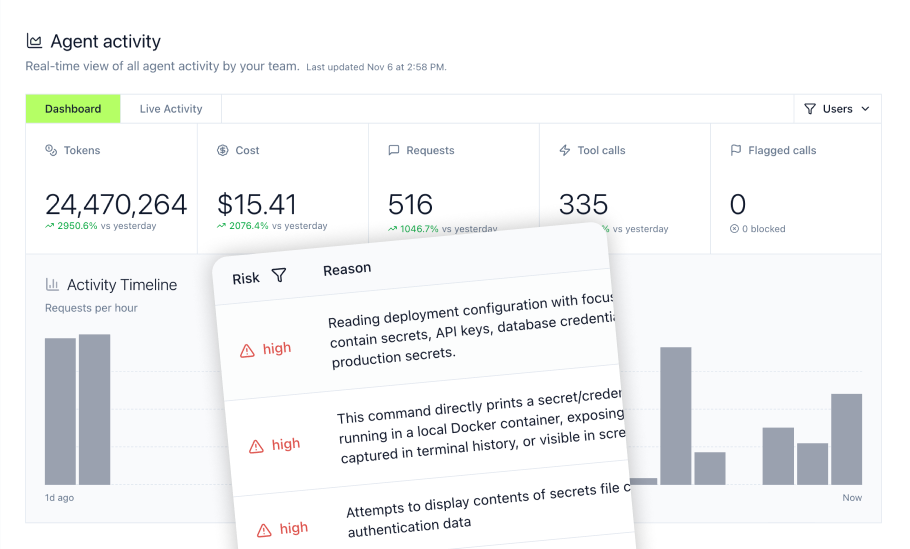
Coding agents operate with extensive system access, reading files, executing bash commands, and accessing production systems through MCP tools. Without monitoring, organizations cannot see what agents access or control their actions. Agent Monitor provides visibility and control over agent behavior.
Real-Time Tool Call Tracking
Agent Monitor monitors interactions between coding agents and the systems they access:
- Tool Call Monitoring: Track MCP tool invocations with context such as user, tool, parameters, and timestamp
- Bash Command History: Record shell commands coding agents execute, identifying potentially dangerous operations before they run
- File Access Logging: Monitor which files agents read or modify, protecting sensitive configuration files and credentials
Security Guardrails
Beyond monitoring, Agent Monitor enables proactive security controls:
- Command Blocking: Define policies that block dangerous commands like reading .env secrets, accessing SSH keys, or executing system-level operations
- Sensitive File Protection: Prevent agent access to credential files, database configuration, and other sensitive paths
- MCP Inventory Visibility: See which MCPs are installed across coding agents, track usage patterns, and identify unauthorized server installations
For organizations concerned about coding agent security risks, Agent Monitor transforms invisible agent activity into observable, controllable operations with policy enforcement aligned with internal AI governance requirements.
Enterprise Data Integration: Pre-Built Connectors
MintMCP includes production-ready connectors that eliminate custom development for common enterprise integrations. These connectors come with built-in authentication, monitoring, and governance controls, ready for deployment.
Elasticsearch Integration
The Elasticsearch MCP Server enables AI agents to query enterprise search infrastructure.
Enterprise Use Cases:
- HR Teams: Build AI-accessible knowledge bases from company documentation, policies, and training materials
- Support Teams: Enable AI agents to search historical support tickets and resolution patterns
- Product Teams: Power AI-driven documentation search using product knowledge bases
Snowflake Integration
The Snowflake MCP Server provides AI agents with governed access to data warehouse infrastructure.
Enterprise Use Cases:
- Finance Teams: Automate financial reporting and variance analysis with AI agents accessing Snowflake financial data models
- Executive Teams: Generate real-time business intelligence dashboards from governed data without SQL expertise
- Product Management: Enable AI-driven product analytics directly from data warehouses
Gmail Integration
The Gmail MCP Server facilitates AI-powered email workflows, including governed search, retrieval, drafting, and controlled send flows.
These pre-built connectors represent significant value: each reduces custom development while providing authentication, monitoring, and governance controls that custom integrations often lack.
Unified AI Client Management
MintMCP provides centralized management capabilities that address operational requirements beyond individual MCP server deployment:
Enterprise Authentication
- OAuth 2.0 and SSO Support: Integrate with enterprise identity providers and support OAuth brokering for stdio and hosted MCP servers
- Single Sign-On (SSO): Enable users to access MCP tools using existing corporate credentials
- SCIM-Driven Role-Based Access Control: Define which users, teams, and agents can access specific MCP servers, bundles, and tools using SCIM and IdP group membership
Operational Visibility
- Real-Time Usage Tracking: Monitor AI tool interactions across Claude, Cursor, ChatGPT, Gemini, Copilot, and other supported clients
- Centralized Observability: Track usage across users, agents, bundles, connectors, and tools with one governance layer
- Performance Metrics: Measure response times, error rates, and usage patterns
- Data Access Logs: See what data each AI tool accesses, which is critical for security audits
Policy Enforcement
- Automated Policy Enforcement: Configure and enforce data access policies automatically across MCP interactions
- Tool-Update Policy: Auto-enable new upstream tools or require admin approval to prevent silent capability expansion
- Compliance Audit Trails: Generate logs supporting security and compliance reporting
- Centralized Credentials: Manage AI tool API keys and tokens in one secure location
RunLayer Platform Overview
RunLayer operates as an MCP security and orchestration platform emphasizing threat detection and ecosystem access.
Core Value Proposition
RunLayer focuses on three primary capabilities:
- Large MCP Server Catalog: Access to a broad set of MCP servers organized in a private registry for team sharing
- MCP-Specific Threat Detection: Security models for risks such as tool poisoning, tool shadowing, command injections, and fake MCPs
- No-Code MCP Building: Remix existing tools into custom MCPs without coding, enabling faster deployments
Technical Approach
The platform provides MCP gateway capabilities including enterprise SSO, audit trails, identity provider integration, and real-time security scanning.
RunLayer positions itself as addressing MCP sprawl challenges for organizations experiencing rapid AI agent adoption. The platform offers hybrid deployment with managed SaaS plus self-hosted options for enterprises requiring more infrastructure control.
Key Architectural Differences
MintMCP and RunLayer approach enterprise MCP infrastructure through different philosophical lenses. Understanding these differences helps identify the right solution for organizational priorities.
Deployment Philosophy
MintMCP prioritizes managed SaaS-first deployment, hosted MCP connectors, OAuth brokering for stdio and hosted servers, and VPC/self-hosted deployment on request. This approach serves organizations that want governed MCP access without operating connector runtimes, scaling, and infrastructure by default.
RunLayer focuses on hybrid deployment, combining managed SaaS with self-hosted options for customer infrastructure. This approach can fit organizations that prioritize security customization and infrastructure control.
Compliance Positioning
MintMCP lists SOC 2 Type II audited security controls, CASA Tier 2, and compliance with HIPAA standards, with BAA availability, in its Trust Center, with public verification available. This documentation can simplify procurement for regulated industries by giving teams security materials to review.
RunLayer also positions security and compliance as core parts of its platform. For organizations where procurement depends on documentation and control mapping, teams should compare each vendor's current trust materials directly during evaluation.
Architecture Approach
MintMCP's Virtual MCP Bundles create per-use-case endpoints with SCIM-driven membership, curated tool lists, and per-bundle access policy. This approach enables tool-level access control, configuring read-only operations and excluding write tools based on organizational policies.
RunLayer implements fine-grained permissions and group-based access controls through its platform. This approach works well for organizations comfortable with identity-driven access models.
Ecosystem Access
MintMCP includes pre-built enterprise connectors for Elasticsearch, Snowflake, Gmail, Outlook, Linear, and Notion, each with built-in authentication, monitoring, and governance controls ready for deployment. MintMCP also runs hosted MCP connectors for customers, reducing connector runtime and scaling work.
RunLayer provides broad MCP server access, though community servers may require additional configuration and security validation before production deployment.
Security Approach
MintMCP addresses security through SSO and SCIM-driven RBAC, tool-level allowlisting, rule-based policy, credential management, audit logs, OAuth brokering, Virtual MCP Bundles, Agent Bundles, and Agent Monitor for coding agents. This approach provides two-layer governance across MCP traffic and local non-MCP coding agent activity.
RunLayer emphasizes MCP-specific threat detection with security models for tool poisoning, command injection, and fake MCP identification. This specialized security focus serves organizations where advanced threat detection aligns with security requirements.
Tradeoffs to consider
RunLayer's security-focused approach can be a strong fit for teams prioritizing MCP-specific threat detection and hybrid deployment. Teams should also evaluate whether they need MintMCP-specific governance primitives such as Virtual MCP Bundles with SCIM-driven membership, Agent Bundles with M2M auth and “act as agent” flow, OAuth brokering for stdio and hosted MCP servers, hosted MCP connectors run by MintMCP, tool-update policy, and Gateway + Agent Monitor two-layer governance.
Achieving Production Readiness with MintMCP
For organizations deploying AI agents at scale, MintMCP delivers enterprise-grade infrastructure that transforms MCP access into governed, observable services. The platform supports procurement through public trust materials, accelerates deployment through managed SaaS-first gateway infrastructure and hosted MCP connectors, and provides pre-built enterprise connectors that reduce custom development.
Organizations choosing MintMCP benefit from Virtual MCP Bundles providing tool-level access control, Agent Bundles for per-agent identity governance, Agent Monitor for coding agent visibility, and compliance materials supporting SOC 2 Type II audited security controls, CASA Tier 2, compliance with HIPAA standards, BAA availability, and audit logging for governance workflows. The platform's infrastructure handles enterprise authentication, VPC/self-hosted deployment on request, and production MCP management, transforming scattered MCP deployments into governed infrastructure with centralized visibility and control.
MintMCP addresses the urgency problem organizations face: teams are already using AI tools like Claude Code, Cursor, ChatGPT, Gemini, Copilot, and custom agents. Without governance infrastructure, this creates "shadow AI," meaning unmonitored agent activity accessing internal systems with limited visibility. MintMCP transforms shadow AI into sanctioned AI through deployment that matches the speed at which teams adopt AI tools, centralized visibility tracking tool calls and data queries, and policy enforcement that works without slowing developer workflows.
For regulated industries operating under strict compliance requirements, the platform's trust materials and audit trails provide a foundation for AI governance that supports enterprise security reviews. Engineering teams can deploy governed MCP access, provide developers with self-service access to AI tools through existing corporate credentials, and maintain visibility into which data AI agents access across integrated systems.
Schedule a demo to see how MintMCP's deployment capabilities and compliance framework can accelerate AI agent infrastructure.
Frequently Asked Questions
What makes MintMCP's deployment faster?
MintMCP supports rapid deployment through managed SaaS-first gateway infrastructure, hosted MCP connectors, OAuth brokering for stdio and hosted MCP servers, and prebuilt connectors. The platform reduces manual infrastructure configuration, authentication setup, and governance integration work that teams may otherwise need to build or operate themselves. For organizations facing regulatory deadlines or rapid AI deployment requirements, this approach directly impacts time-to-value.
Does MintMCP provide verified compliance attestations?
Yes. MintMCP lists SOC 2 Type II audited security controls for MCP gateway infrastructure, with verification available at trust.mintmcp.com. The platform also lists CASA Tier 2, compliance with HIPAA standards, and BAA availability. These materials can simplify procurement cycle time for organizations evaluating vendor security posture.
How does Virtual MCP architecture provide access control?
Virtual MCP Bundles create per-use-case endpoints with SCIM-driven membership, curated tool lists, and per-bundle access policy, enabling tool-level access control rather than only server-level permissions. This architecture allows organizations to configure read-only operations, exclude write tools, and provide different capabilities based on user roles. Support teams might receive search and read capabilities while engineering teams get broader access including approved write operations.
Can MintMCP monitor coding agent activity?
Yes. Agent Monitor monitors tool calls, bash commands, file access, and other coding agent activity from tools like Cursor and Claude Code. The platform tracks which users invoke which tools with parameter visibility, enabling security policies that block dangerous commands, protect sensitive files, and generate audit trails for incident investigation.
What pre-built enterprise connectors are included?
MintMCP provides production-ready connectors for Elasticsearch, Snowflake, Gmail, Outlook, Linear, and Notion, each with built-in authentication, monitoring, and governance controls. MintMCP also runs hosted MCP connectors, reducing the runtime and scaling work customers need to operate.
How does MintMCP handle regulated environments?
MintMCP Gateway provides enterprise security, governance, and VPC/self-hosted deployment options on request for organizations that need more control over how MCP infrastructure is deployed. Teams with strict regulatory requirements should confirm current deployment constraints and controls directly with MintMCP during evaluation.