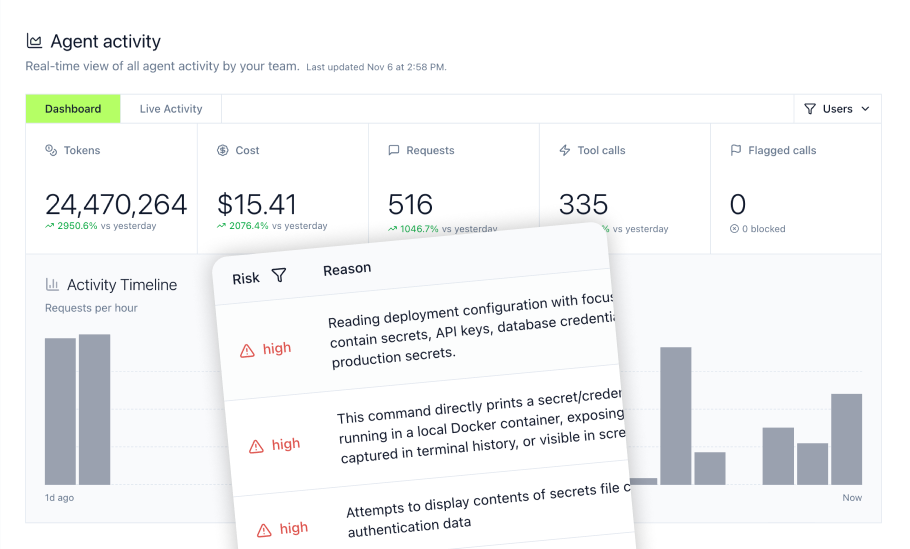
Enterprises deploying AI agents across Claude, Cursor, ChatGPT, Gemini, and Copilot face a common challenge: governing what those systems access, which credentials they use, what actions they take, and how those actions are attributed. Bifrost is an open-source AI gateway with native MCP support and self-hosted, private, and managed deployment options. Organizations evaluating alternatives should compare its AI gateway orientation with platforms focused more specifically on internal MCP and agent governance.
This guide compares leading enterprise LLM and MCP gateways for 2026, helping IT, security, and platform teams identify the right fit for their internal AI governance requirements. The comparison covers managed and self-hosted architectures, compliance posture, MCP-specific capabilities, agent identity management, and operational models to support informed evaluation.
Key takeaways
- MintMCP combines managed MCP and agent governance with Virtual MCPs, hosted connectors, first-class agent identities, Agent Monitor visibility, and runtime guardrails
- Bifrost publishes low gateway-overhead results including 11µs internal overhead at 5,000 RPS on an AWS t3.xlarge in its own benchmark
- Operations burden varies by deployment model: managed services reduce customer-managed gateway infrastructure, while self-hosted options place more infrastructure and operational responsibility on the customer
- Agent identity management is a critical differentiator in enterprise AI deployments, requiring scoped permissions and independent credential rotation
- Organizations should evaluate MCP governance depth, deployment model, compliance requirements, and total operational overhead when comparing platforms
Understanding Bifrost's position in the LLM gateway market
Bifrost, developed by Maxim AI, launched in mid-2025 as a high-performance Go-based gateway combining LLM routing with native MCP support. The platform has gained traction among engineering teams prioritizing throughput and infrastructure control.
Bifrost strengths
- Published benchmark reports 11µs internal gateway overhead at 5,000 RPS on an AWS t3.xlarge, with 59µs on t3.medium
- Combined multi-provider LLM routing and native MCP gateway in one platform
- Code Mode is reported by Bifrost to reduce token usage by 50% and execution time by 40% in its MCP benchmark
- Apache 2.0 open-source core
- Native CLI agent support for Claude Code, Cursor, Codex CLI, and Gemini CLI
Bifrost limitations
- OSS-first and self-hosted-first architecture, although current Bifrost materials also advertise a fully managed option
- Provider coverage remains narrower than platforms advertising 100+ providers
- Open-source and enterprise capabilities differ by deployment and edition, so teams should verify which governance and operational features are included in their target configuration
For teams needing gateway performance with infrastructure control, Bifrost delivers. For organizations prioritizing operational simplicity, compliance readiness, or specialized MCP governance, alternatives offer different approaches.
1. MintMCP: Managed MCP and agent governance
MintMCP provides enterprise infrastructure for governing AI clients and autonomous agents across the Model Context Protocol ecosystem. The platform addresses a recurring enterprise problem: teams adopt AI systems faster than security teams can govern what those systems access.
MCP-focused governance architecture
MintMCP's data-permissions-first architecture starts from governed access to enterprise data and tools, then extends that foundation to autonomous agents. This contrasts with approaches that grant agents broad access and restrict afterward.
Key capabilities include:
- Managed MCP gateway with MintMCP operating the infrastructure
- SOC 2 Type II audited, compliant with HIPAA standards, and CASA Tier 2 listed in MintMCP's Trust Center, with compliance documentation available to customers
- Agent Monitor for laptop-level governance that hooks coding agents on developer machines, providing visibility into GitHub Copilot CLI and similar tools
- Self-serve MCP Store where employees discover and access approved tools after SSO authentication
- Virtual MCPs bundle connectors and curated tool surfaces behind one governed endpoint per team, role, or agent
- Agent Gateway provides first-class non-human identities with scoped permissions, M2M authentication per OAuth 2.0, and independent credential rotation
MCP gateway capabilities
- Hosted, remote, custom, and STDIO connector support
- Centralized authentication and credential injection
- SCIM-driven access policies with directory group membership
- Tool-level curation trimming context-window bloat
- Private network tunnel for on-prem connectors
- OAuth brokering for STDIO/hosted server environments
Guardrails architecture
MintMCP implements runtime security controls through three layers:
- Mint Guard: Managed detection policies for prompt injection, secrets, PII, and harmful content
- Rules: Declarative matching and enforcement on tools, arguments, or content
- Gateway Middleware: Customer-authored JavaScript in a sandbox for DLP integrations and custom policy
MintMCP offers enterprise pricing with managed operations included. Contact for demo and pricing details. MintMCP operates supported hosted connector infrastructure, reducing the connector-runtime infrastructure and operations customers need to manage directly.
2. LiteLLM
LiteLLM is a widely adopted open-source AI gateway with a Rust core and Python SDK. The platform supports 100+ LLM providers alongside MCP gateway functionality.
Key capabilities
- 100+ LLM provider integrations, representing wide coverage
- MIT license with core features fully open source
- Large community and ecosystem maturity
- Native MCP gateway support
- Python SDK for extension
Technical specifications
- LiteLLM's published benchmark reports approximately 8ms P95 gateway overhead in its tested four-instance configuration at roughly 1,000 RPS
- Current deployment guidance covers 2-5K RPS and 5K+ RPS workloads through appropriate infrastructure sizing and horizontal scaling
- SSO, SCIM, and audit logs are available in the Enterprise tier
Operational considerations
- March 2026 supply chain security incident affected PyPI package, requiring careful dependency management
- Enterprise features require paid license
- Self-hosted deployment requires dedicated infrastructure and DevOps resources
Pricing includes free OSS for core functionality, with Enterprise tier offering custom pricing for SSO, SCIM, and air-gap deployment.
3. Portkey
Portkey positions itself as a comprehensive LLMOps platform extending beyond basic gateway routing to include observability, prompt management, and guardrails. The platform was acquired by Palo Alto Networks in May 2026, adding enterprise security backing.
Key capabilities
- Broad multi-provider model coverage
- Full observability platform with native dashboards
- Built-in guardrails and prompt management
- Native MCP Gateway with authentication, access control, registry, and policy enforcement
- Managed and self-hosted deployment options
- MIT-licensed open-source AI gateway
Operational considerations
- Broader AI gateway and LLMOps scope may add capabilities beyond what teams need for MCP-only governance
- Enterprise security, deployment, and governance capabilities vary by plan
Pricing tiers include Developer (free with 10K logs), Production ($49/month with 100K requests and 30-day logs), and Enterprise (custom pricing with SSO and custom SLAs).
4. Kong AI gateway
Kong AI Gateway extends the established Kong API platform with AI-specific capabilities. For organizations already running Kong for API management, adding AI gateway features creates unified governance.
Key capabilities
- Extends existing API infrastructure investments
- Mature RBAC and audit logging from enterprise API gateway heritage
- Extensive plugin ecosystem
- Unified governance for API and AI traffic
- Konnect SaaS control plane with self-hosted data plane option
Technical specifications
- Kong AI Gateway 2.0 is generally available and production-supported
- Current Kong sizing guidance describes gateway overhead as typically under 10ms relative to model latency
- Some MCP components, including the MCP Registry and AI MCP OAuth2 plugin, remain in Tech Preview
Operational considerations
- Operational fit differs for organizations not already using Kong's API and platform infrastructure
- Some MCP capabilities remain in Tech Preview even though AI Gateway 2.0 itself is generally available
Pricing includes a 30-day trial, Plus pricing with AI Gateway model-proxy charges of $100/month per model subject to current plan limits, and custom Enterprise pricing.
5. Cloudflare AI gateway
Cloudflare AI Gateway delivers managed AI gateway functionality at the edge across its global network. The platform prioritizes operational simplicity over customization depth.
Key capabilities
- Zero-ops deployment with no infrastructure to manage
- Free core features including analytics, caching, and rate limiting
- Managed deployment on Cloudflare's global network
- Unified billing for supported LLM providers
Technical specifications
- 24 native provider integrations in the current AI Gateway provider list
- Exact-match caching by default, with customizable cache keys
- Unified Billing applies a 5% fee to purchased credits
Operational considerations
- Managed only with no self-hosted option for regulated/air-gapped deployments
- MCP offering became GA on September 24, 2026 as MCP server portals, which remains a separate Cloudflare One/Access capability rather than part of AI Gateway itself
- Limited governance controls for multi-team enterprise deployments
Pricing includes free core features, 5% surcharge on unified provider billing, and Enterprise tier with custom pricing.
6. TrueFoundry
TrueFoundry provides a broader AI infrastructure platform spanning AI Gateway, MCP Gateway, Agent Gateway, and ML platform capabilities. It targets platform engineering and ML teams with managed SaaS, VPC, on-premises, and air-gapped deployment options.
Key capabilities
- Dedicated AI Gateway, MCP Gateway, and Agent Gateway capabilities
- MCP authentication, RBAC, and audit logging
- Agent governance features
- Hybrid deployment with multiple hosting models
- Air-gapped deployment via forward proxy
- Enterprise governance features
Operational considerations
- Broader platform scope may introduce capabilities beyond what teams need for MCP-only deployments
- Platform engineering buyer may not align with IT/Security governance needs
Platform deployment and compliance considerations
Enterprise AI gateway selection depends on deployment model, traffic volume, security controls, staffing, and licensing requirements.
TCO considerations
Total cost depends on deployment model, traffic volume, redundancy requirements, security controls, staffing, and enterprise licensing:
- Managed services shift more gateway and connector-runtime operations to the vendor but still require customer configuration, identity integration, and policy administration
- Self-hosted platforms add infrastructure and operational responsibilities whose cost varies substantially by workload and organization
- Compliance program costs and timelines depend on organizational scope and should not be assigned to a gateway product using generic estimates
- MintMCP operates supported hosted connectors and provides configuration as code for centrally managing supported gateway configuration and policies
Migration considerations
Migration scope depends on the connector mix, authentication model, access policies, deployment architecture, and client configuration. MCP standardization can simplify protocol interoperability, but credentials, policies, connector configuration, monitoring, and security controls still require migration planning.
MintMCP can reduce customer-operated connector infrastructure by operating supported hosted connectors. Its SOC 2 Type II attestation and HIPAA-related controls support customer security and compliance programs, but they do not automatically transfer compliance status to a customer deployment.
MintMCP can also operate alongside an LLM gateway when an organization wants separate layers for governed MCP tool access and model routing.
Why enterprises choose MintMCP for MCP governance
Organizations evaluating MCP gateways increasingly prioritize governance depth over generic AI routing. MintMCP delivers enterprise-grade MCP and agent infrastructure through several differentiating capabilities:
- Managed operations eliminate infrastructure overhead: MintMCP operates the gateway and supported hosted connectors, removing the burden of maintaining runtime infrastructure, handling updates, and managing reliability across connector fleets
- Compliance documentation supports security reviews: MintMCP is SOC 2 Type II audited, compliant with HIPAA standards, and provides compliance documentation through its Trust Center; these controls support customer security and compliance programs without automatically making customer deployments compliant
- Agent Monitor extends governance to developer laptops: Unlike gateway-only approaches, Agent Monitor provides visibility and control over coding agents running directly on employee machines, including GitHub Copilot CLI
- First-class agent identities replace credential sprawl: The Agent Gateway issues independent identities to each agent with scoped permissions and separate credential lifecycle management, eliminating shared API keys and inherited human credentials
- Virtual MCPs simplify multi-team access control: Virtual MCPs bundle approved connectors behind governed endpoints, with SCIM-driven membership ensuring access policies automatically reflect role changes
- Runtime guardrails prevent dangerous actions before execution: Mint Guard, Rules, and Gateway Middleware screen tool calls for prompt injection, secrets, PII, and policy violations before agents take action
These capabilities support organizations deploying AI coworker agents with company-owned memory and sandboxed execution, where traditional API gateways lack the governance depth MCP environments require.
Frequently asked questions
What is the primary difference between an LLM gateway and an MCP gateway?
An LLM gateway routes requests between applications and language model providers, handling tasks like load balancing, caching, and provider failover. An MCP gateway governs how AI agents connect to enterprise tools and data sources through the Model Context Protocol, managing authentication, access control, credential injection, and audit trails for tool calls.
How does a data-permissions-first architecture benefit enterprise AI governance?
Starting from governed access to enterprise data and tools means security teams control what agents can reach before those agents operate independently. MintMCP's approach uses Virtual MCPs to bundle connectors and curated tool surfaces behind one governed endpoint per role or agent, with SCIM-driven access policies determining membership.
What security considerations are paramount when deploying autonomous agents?
Critical considerations include agent identity management, credential scoping, and action attribution per NIST AI risk frameworks. Autonomous agents should receive their own non-human identities rather than inheriting human credentials or shared API keys. MintMCP's Agent Gateway provides independent credential rotation, revocation, and per-agent audit trails.
How do Virtual MCPs simplify access control for different teams?
A Virtual MCP bundles approved connectors and a curated tool surface behind one governed endpoint. Directory groups via SCIM drive membership, so access policies update automatically when employees change roles. Different VMCPs can expose read-only and read-write tool sets over the same underlying connector.
What role do runtime guardrails play in preventing dangerous agent actions?
Runtime guardrails screen tool calls before they execute. MintMCP's Mint Guard provides managed detection for prompt injection, secrets, PII, and harmful content. Rules enable declarative pattern matching, and Gateway Middleware supports customer-authored JavaScript for DLP integrations and custom policy enforcement.