As of August 2026, the EU AI Act continues to take effect in phases: high-risk AI system rules for Annex III systems apply from December 2, 2027, while rules for high-risk AI embedded in Annex I products apply from August 2, 2028. Penalties vary by violation; the maximum EUR 35 million or 7% of worldwide annual turnover applies to prohibited AI practices under Article 5.
The IAPP's 2025 AI Governance Profession Report found that 77% of surveyed organizations were working on AI governance, underscoring how broadly governance programs were already being built. The challenge extends beyond regulatory compliance. Shadow AI creates governance blind spots when employees or agents use AI systems outside approved controls. As 40% of enterprise applications are expected to include task-specific AI agents by the end of 2026, organizations increasingly need governance platforms that address identity, permissions, monitoring, and compliance.
MintMCP addresses these challenges through a data-permissions-first architecture that starts with governed data and tool connections through MCP Gateway, then extends to first-class agent identities through Agent Gateway, organizational visibility through Agent Monitor, and runtime guardrails. This approach makes AI systems deployable, governed, measurable, and swappable without slowing down innovation.
Key takeaways
- MCP Gateway provides Virtual MCPs that bundle approved connectors behind governed endpoints with SCIM-driven access control
- Agent Gateway treats autonomous agents as first-class non-human principals with independent credentials and scoped MCP access
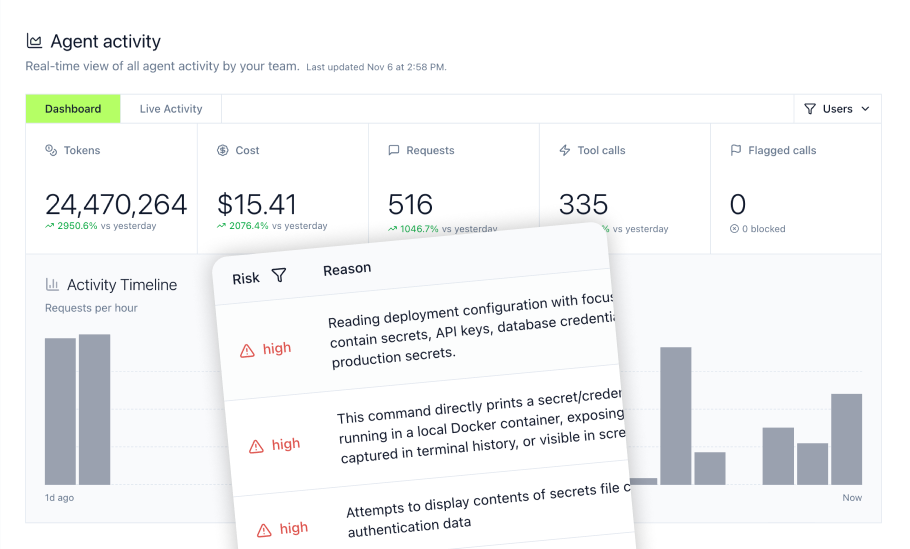
- Agent Monitor delivers organizational visibility into AI agent activity with live feeds, usage tracking, and SIEM export
- Mint Guard, Rules, and Gateway Middleware provide three layers of runtime guardrails for gateway tool calls
- MintMCP is SOC 2 Type II audited and compliant with HIPAA standards with BAA available
- OAuth brokering adds enterprise authentication to MCP servers without rebuilding each server
- Attributable audit trails track each agent's governed MCP activity with tamper-evident access-grant history
- Enterprise integrations include Snowflake, GitHub, Salesforce, and Slack with support for Claude, Cursor, ChatGPT, Gemini, and Copilot
1. MintMCP: Enterprise AI governance with data-permissions-first architecture
MintMCP provides enterprise infrastructure for governing AI clients and autonomous agents across the Model Context Protocol ecosystem. The platform helps organizations make AI systems deployable, governed, measurable, and swappable by centralizing tool access, agent identity, credentials, permissions, monitoring, guardrails, and auditability.
What makes MintMCP different
MintMCP's primary value proposition is that enterprise AI governance should begin with permissions and governed access to company systems, not with an autonomous agent that is granted broad access and restricted afterward. This data-permissions-first architecture creates a foundation for both human-operated AI clients and autonomous agents.
Core capabilities
MCP Gateway provides a single governed entrypoint between AI clients and enterprise tools:
- Virtual MCPs bundle approved connectors and curated tool surfaces behind one governed endpoint for specific teams, roles, use cases, or agents
- Hosted connectors run in MintMCP's data plane with auto-scaling and sandboxed execution
- OAuth brokering adds enterprise authentication to local and hosted MCP servers without rebuilding each server
- SCIM-driven RBAC enables directory groups to drive tool access with consistent policies
Agent Gateway treats autonomous agents as first-class non-human principals:
- Each agent receives its own identity, credentials, and scoped MCP access
- Authentication mechanisms include bearer keys, M2M tokens, and workload identity federation
- Independent credential rotation and revocation without affecting other agents or users
- Attributable audit trails for each agent's governed MCP activity
Agent Monitor provides organizational visibility into AI agent activity:
- Live activity feeds showing prompts, file access, commands, and MCP tool calls
- Usage and cost tracking by model, user, agent, and session
- SIEM export via OTLP or Splunk HEC for security integration
- Rules for detecting and blocking risky behavior in real time
Guardrails screen and control gateway tool calls through three layers:
- Mint Guard offers managed detection for prompt injection, secrets, PII, and harmful content
- Rules enable declarative matching on tool names, arguments, or content patterns
- Gateway Middleware runs customer-authored JavaScript for DLP integrations and custom policy enforcement
Security and compliance
- SOC 2 Type II audited
- Compliant with HIPAA standards (BAA available)
- Penetration tested
- Data encrypted in transit and at rest
- SSO and SCIM integration with Okta, Entra ID, and Google
- Tamper-evident access-grant history signed at write time
Enterprise integrations
MintMCP provides governed connectivity to enterprise systems:
- Snowflake data warehouse access with natural language queries
- GitHub for code repository integration
- Salesforce for CRM connectivity
- Slack for collaboration and Coworker Agent deployment
- Support for Claude, Cursor, ChatGPT, Gemini, and Copilot through centralized governance
Getting started
Visit mintmcp.com for enterprise demonstration and pricing.
2. OneTrust AI Governance
OneTrust AI Governance provides a platform for AI inventory management, risk assessment, and compliance automation. The platform was named Visionary in the 2026 Gartner Magic Quadrant for AI Governance Platforms with a 4.0/5 rating from 11 verified reviews.
Core capabilities
OneTrust focuses on centralized AI inventory with model, dataset, agent, and vendor tracking:
- Centralized AI inventory tracking across models, datasets, agents, and vendors
- Runtime guardrails for policy enforcement during AI execution
- Automated compliance workflows aligned with major regulatory frameworks
- Integration with Vertex, Databricks, and Amazon SageMaker for native policy enforcement
"With OneTrust, our AI governance council has a technology-driven process to review projects, assess data needs, and uphold compliance." - Ren Nunes, Senior Manager, Data & AI Governance, Blackbaud
3. IBM watsonx.governance
IBM watsonx.governance appears in the Gartner Magic Quadrant for AI Governance Platforms with positioning for Ability to Execute and Completeness of Vision. The platform currently has a 4.3/5 Gartner Peer Insights rating from 8 ratings.
Core capabilities
IBM watsonx.governance offers proactive risk detection and mitigation across the AI lifecycle:
- AI lifecycle management with proactive risk detection
- Works with IBM technologies and third-party platforms including OpenAI, AWS, and Meta
- Agent inventory management and behavior monitoring capabilities
- Guardium AI security integration for securing AI deployments
Version 2.3.x, released December 2025, introduced agent inventory management and behavior monitoring capabilities for agentic AI governance.
4. Holistic AI
Holistic AI provides AI governance with a focus on risk assessment and compliance. The platform ranked first for AI Risk and Compliance Use Case in the Gartner Critical Capabilities evaluation with a 4.1/5 rating from 7 reviews.
Core capabilities
Holistic AI emphasizes automatic AI discovery across cloud platforms:
- Automatic AI discovery across cloud platforms and code repositories with 20+ integrations
- 40+ specialized tests covering bias, robustness, transparency, and efficacy
- Guardian Agents (Sentinel and Operative) for real-time oversight of agentic AI
- Shadow AI detection and continuous automated discovery
"Holistic AI's Governance Platform enabled us to systematically govern AI use cases across Unilever's value chain." - Sam Dover, Global AI Strategy Lead, Unilever
5. Microsoft Purview
Microsoft Purview extends data governance capabilities into AI management with the highest review volume among AI governance platforms. The platform received a 4.3/5 rating from 61 verified customer reviews on Gartner.
Core capabilities
Microsoft Purview provides data discovery, classification, and management:
- Automated data discovery and mapping for sensitive information
- Native integration with Microsoft 365, Azure, and Azure OpenAI
- Unified data and AI governance within a single platform
- Purview Suite capabilities are included with Microsoft 365 E5, while broader data governance capabilities are available through pay-as-you-go licensing
The platform integrates with Microsoft ecosystem tools for organizations standardized on Microsoft infrastructure.
6. Credo AI
Credo AI specializes in regulatory compliance and vendor risk management with a 5.0/5 Gartner rating from 2 verified reviews. The platform emphasizes standardized workflows for AI governance.
Core capabilities
Credo AI provides an AI registry and risk management center:
- AI registry with comprehensive model metadata management
- Risk center providing compliance insights and vulnerability analysis
- Regulatory automation for policy management
- Integrations with AWS, Azure, Google Cloud, Jira, Salesforce, Databricks, and ServiceNow
The platform focuses on regulatory automation that simplifies policy management across multiple frameworks.
7. Dataiku
Dataiku provides an AI platform with embedded governance capabilities for organizations seeking to democratize AI across user skill levels. The platform received a 4.2/5 rating from 5 Gartner reviews.
Core capabilities
Dataiku offers accessibility across different user skill levels:
- No-code, low-code, and full-code interfaces for all user types
- Infrastructure-agnostic deployment avoiding vendor lock-in
- Built-in governance and monitoring for AI deployment at scale
- Single platform for building and managing analytics, models, and agents
The platform works with any cloud provider, data platform, or GenAI service while maintaining governance controls.
8. Collibra Platform
Collibra extends its data governance capabilities into AI management with unified governance across data ecosystems. The platform received a 4.3/5 rating from 4 Gartner reviews.
Core capabilities
Collibra emphasizes automated visibility and control:
- Unified data and AI governance across all data sources
- Enterprise metadata graph for deep data context and lineage
- Automated documentation and data traceability for AI use cases
- Integrations with AWS, Microsoft, Google Cloud, Snowflake, Tableau, and SAP
The enterprise metadata graph enriches data context with every use for comprehensive lineage tracking.
9. Fiddler AI
Fiddler AI provides AI observability and model monitoring with emphasis on explainability. The platform focuses on real-time monitoring and bias detection.
Core capabilities
Fiddler AI emphasizes explainability features:
- Explainability features for understanding AI decision-making
- Bias detection tools for catching potential issues early
- Real-time anomaly detection and alerting
- Integrations with Amazon SageMaker, Datadog, Domino, Google Cloud, and Snowflake
The platform provides tools for breaking down AI decision-making processes with real-time monitoring tracking model performance continuously.
10. Airia
Airia provides enterprise AI security and orchestration with a focus on agentic AI environments. Named Visionary in the 2026 Gartner Magic Quadrant, the platform received a 4.3/5 rating from 7 reviews.
Core capabilities
Airia offers centralized controls for managing AI systems:
- Centralized controls for AI agents, models, and applications
- Policy enforcement and access management
- Monitoring and risk reduction for agentic AI environments
- Oversight and auditability required in regulated environments
The platform provides controls designed for regulated and complex enterprise settings.
Choosing the right AI governance platform for your enterprise
AI governance has become a strategic priority as organizations scale AI systems and regulatory requirements continue to evolve. The right platform depends on what needs to be governed, which controls must be enforced, and how AI systems access enterprise data and tools.
MintMCP takes a data-permissions-first approach: govern access to enterprise systems first, then extend those controls to autonomous agents.
Key capabilities include:
- Virtual MCPs: Bundle approved connectors and curated tools behind governed endpoints, with access policies that can be driven by directory groups through SCIM.
- Agent Gateway: Gives autonomous agents their own identities, credentials, scoped MCP access, and attributable audit trails.
- Agent Monitor: Provides visibility into supported agent activity, including prompts, commands, file access, MCP tool calls, usage, and token costs.
- Mint Guard: Adds managed detection for prompt injection, secrets, PII, and harmful content.
- Runtime guardrails: Rules and Gateway Middleware provide additional declarative and customer-authored policy enforcement.
For organizations using Claude, Cursor, ChatGPT, Gemini, and Copilot, MintMCP helps keep identity, permissions, monitoring, and tool governance consistent across changing AI environments.
Enterprise controls also include SSO, SCIM, RBAC, audit trails, SIEM export, and credential lifecycle controls. MintMCP is SOC 2 Type II audited and compliant with HIPAA standards.
By centralizing governed tool access first and extending the same controls to autonomous agents, MintMCP gives enterprises a foundation for AI deployments that remain measurable, auditable, and easier to govern across models and clients.
Visit MintMCP to see how MintMCP helps govern AI agents in production.
Frequently asked questions
What is AI governance and why is it important for enterprises?
AI governance is the framework of policies, processes, and controls used to help AI systems operate safely, ethically, and in line with applicable requirements. For enterprises, AI governance addresses challenges including shadow AI detection, regulatory compliance, access control, and auditability. Under the EU AI Act, penalty ceilings depend on the violation; the EUR 35 million or 7% maximum applies to prohibited AI practices under Article 5. Effective governance helps organizations make AI systems more controlled, reviewable, and production-ready.
How do AI governance platforms help manage AI-related risks?
AI governance platforms provide centralized visibility into AI model inventories, automated risk assessments, runtime guardrails for detecting prompt injection and PII exposure, and audit trails for compliance reporting. Platforms like MintMCP add agent-specific governance through Agent Monitor for visibility and Mint Guard for runtime protection, addressing the unique risks of autonomous AI agents that make their own tool-calling decisions.
What are the key differences between governing human-operated AI clients and autonomous agents?
Human-operated AI clients use existing employee identities and follow interactive workflows where humans approve actions. Autonomous agents require first-class non-human identities with their own credentials, scoped permissions, independent rotation and revocation, and attributable audit trails. MintMCP's Agent Gateway addresses this distinction by treating autonomous agents as first-class principals separate from the humans who created them.
Can AI governance tools ensure compliance with regulations like HIPAA or the EU AI Act?
AI governance tools support compliance through features like audit trails, access controls, PII detection, and risk assessments, but they do not automatically make organizations compliant. Compliance requires implementing appropriate policies, training, and procedures alongside technical controls. MintMCP is SOC 2 Type II audited and compliant with HIPAA standards, providing the technical foundation for compliance programs while organizations maintain responsibility for overall compliance posture.
What is a Virtual MCP and how does it contribute to AI governance?
A Virtual MCP bundles approved connectors and a curated tool surface behind one governed endpoint for a particular team, role, use case, or agent. Virtual MCPs serve as the unit of deployment, access control, tool curation, and audit. Directory groups can drive membership through SCIM, helping organizations apply consistent access policies without requiring every employee to configure each MCP server separately.