Deploying AI agents at enterprise scale without proper compliance infrastructure creates significant risk exposure. Gartner predicts that 50% of AI agent deployment failures will stem from insufficient governance by 2030, while 97% of organizations reporting breaches of AI models or applications lacked AI access controls. As EU AI Act enforcement began in August 2026, with major high-risk system requirements now scheduled for 2027 and 2028, enterprises scaling from dozens to thousands of autonomous agents face growing pressure to select the right compliance software.
The right AI compliance platform should address the full lifecycle: discovering shadow agents across environments, enforcing policies at runtime, generating audit-ready evidence for standards and frameworks like ISO 42001 and NIST AI RMF, and providing the agent identities that make attribution and accountability possible. This guide evaluates 10 platforms that help organizations govern AI agent deployments while maintaining the speed that engineering teams demand.
Key takeaways
- Enterprise MCP and Agent Gateway with data-permissions-first architecture for governed AI client and autonomous agent deployments
- Virtual MCPs bundle approved connectors behind governed endpoints with SSO and SCIM-driven RBAC
- Agent Bundles provide per-agent identity with independent credentials, scoped access, and attributable audit trails
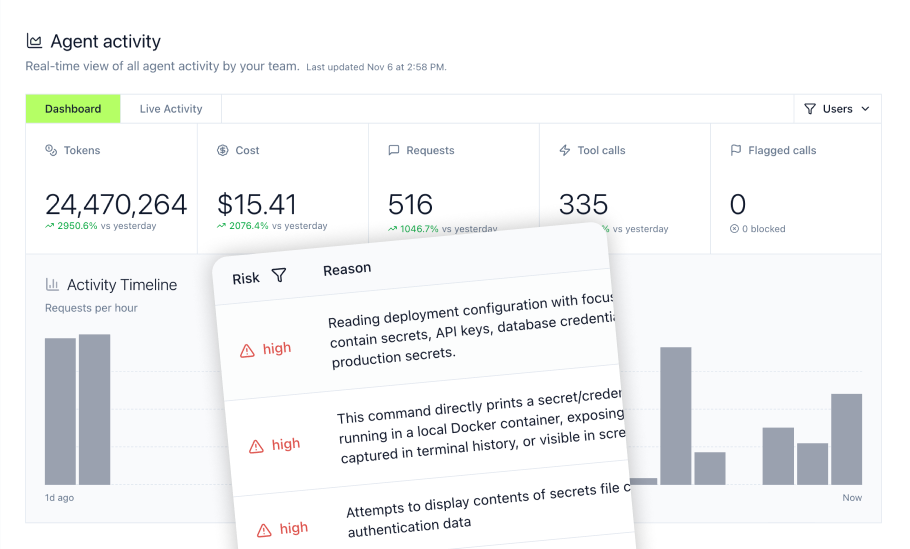
- Agent Monitor delivers real-time visibility into prompts, tool calls, and file access across supported AI agents
- Mint Guard offers managed detection policies for prompt injection, secrets, PII, and harmful content
- Declarative Rules enable tool-name conditions and regex-based enforcement with flag, block, ask, mask, or notify actions
- Gateway Middleware runs customer-authored JavaScript for DLP integration and custom policy logic
- SOC 2 Type II attestation with HIPAA compliance and continuous monitoring through Drata
- Centralized credential management with encrypted secrets, rotating AES keys, and complete audit logging
- Managed SaaS deployment with US and EU availability, plus VPC and self-hosted options
1. MintMCP - Enterprise AI governance with data-permissions-first architecture
MintMCP provides enterprise infrastructure for governing AI clients and autonomous agents across the Model Context Protocol ecosystem. The platform addresses a governance gap highlighted by IBM's 2025 breach research, which found that 63% of breached organizations either had no AI governance policy or were still developing one.
MintMCP's architecture starts with permissions and governed access to company systems, then extends identity, audit, and policy enforcement to autonomous agents. This data-permissions-first approach creates a foundation for both human-operated AI clients like Claude, Cursor, and ChatGPT, as well as autonomous agents that operate independently.
Core compliance capabilities
MCP Gateway
The MCP Gateway provides a governed entrypoint between AI clients and enterprise tools through:
- Virtual MCPs that bundle approved connectors and curated tool surfaces behind governed endpoints for specific teams, roles, or agents
- Centralized authentication through SSO with SCIM-driven membership
- Credential brokering and injection with encrypted secrets and rotating AES keys
- Tool-level curation that trims context-window bloat while enforcing least privilege
- Complete audit logging of every tool call, credential lifecycle event, and access policy change
Agent Gateway
The Agent Gateway treats autonomous agents as first-class non-human principals, addressing the 80% of organizations that reported risky agent behavior in production:
- Agent identities with their own credentials, scoped MCP access, and independent audit trails
- Bearer keys, M2M tokens, and workload identity federation for authentication
- Independent credential rotation and revocation without touching human accounts
- Identity forwarding that passes agent identity to cooperating upstreams
Agent Monitor
Agent Monitor provides visibility into supported AI-agent activity including:
- Live activity feeds showing prompts, commands, file access, and MCP tool calls
- Security rules with built-in detection for secrets, prompt injection, and tool permissioning
- Usage and cost tracking by model, user, agent, and session
- SIEM export via OTLP or Splunk HEC
Guardrails
Mint Guard provides managed detection policies for:
- Prompt injection detection and blocking
- Credentials and secrets detection
- PII detection
- Harmful content filtering
Declarative Rules enable tool-name conditions, argument matching, and regex-based enforcement with flag, block, ask, mask, or notify actions. Gateway Middleware runs customer-authored JavaScript in a sandbox for DLP integrations and custom policy logic.
Security and compliance posture
- SOC 2 Type II attestation
- HIPAA compliance standards
- Tamper-evident access-grant history signed at write time
- Continuous compliance monitoring through Drata
- Trust Center available at trust.mintmcp.com
Deployment options
- Managed SaaS with US and EU availability
- VPC and self-hosted deployment available on request
Pricing
Contact for enterprise demonstration and pricing
Getting started
Visit mintmcp.com for documentation and deployment guides
2. Fiddler AI
Fiddler AI provides an AI observability and control plane for regulated industries requiring audit-grade evidence generation. The platform focuses on runtime enforcement with documented latency under 80 milliseconds for inline guardrails.
Primary focus areas
- Centor Models that run evaluations and guardrails in-environment without external LLM API calls
- Runtime guardrails at the agent request and response path
- Audit-grade evidence trails aligned with GDPR, HIPAA, NAIC, and SR 11-7
- Deployment options including SaaS, VPC, AWS GovCloud, and on-premises
The platform serves organizations in financial services, healthcare, and other regulated industries. Fiddler AI received a $30 million Series C in January 2026 and counts Nielsen and the US Navy among customers.
Analyst recognition
Named in Forrester Agentic Control Plane Solutions Landscape Q2 2026, Forrester Responsible AI Solutions Landscape Q2 2026, Gartner Market Guide for AI Evaluation and Observability Platforms February 2026, and IDC ProductScape for Worldwide Generative AI Governance Platforms 2025.
Pricing
Free plan available with Developer tier at $0.002 per trace and Enterprise custom pricing
3. Arthur AI
Arthur AI positions itself as an agent discovery and governance platform with automated detection capabilities across multiple vectors. The platform addresses the challenge of finding shadow agents across multi-cloud and multi-framework environments.
Primary focus areas
- Automated agent discovery via OpenTelemetry streams, MCP server monitoring, network-layer analysis, and platform APIs for Vertex AI, AWS Bedrock, and Azure AI Foundry
- Continuous evaluations on every production interaction
- Self-correction loops that feed bad outputs back to agents before users see them
- Framework-agnostic governance across LangChain, LangGraph, CrewAI, Mastra, and Google ADK
The platform uses a federated architecture where sensitive inference data stays inside the customer VPC.
Pricing
Free tier at $0 per month, Premium at $60 per month, and Enterprise custom pricing
4. Credo AI
Credo AI focuses on policy-driven compliance program management with pre-built policy packs that translate major regulations into concrete control sets.
Primary focus areas
- Policy Packs for EU AI Act, NIST AI RMF, ISO 42001, SOC 2, and NYC Local Law 144
- Agent Registry in public preview with agent cards covering purpose, tools, data sources, and guardrails
- GAIA governance assistant agent that reached general availability in May 2026
- Governance Knowledge Graph connecting regulations, business context, and AI configurations
IBM resells Credo AI Policy Packs as a compliance accelerator add-on to watsonx.governance.
Analyst recognition
Leader in Forrester Wave for AI Governance Solutions Q3 2025 and Visionary in Gartner Magic Quadrant June 2026. Fast Company named Credo AI number 6 in Applied AI on the 2026 Most Innovative Companies list.
Pricing
Enterprise quote only with no free tier or self-serve option
5. IBM watsonx.governance
IBM watsonx.governance brings model-risk management heritage to AI governance, with particular strength in deployment sovereignty and integration with existing IBM ecosystems.
Primary focus areas
- Governance Graph mapping AI assets, policies, risks, and regulatory requirements
- Cross-vendor governance for AI systems from IBM, OpenAI, AWS, Meta, and other vendors
- Integration with Guardium AI security for runtime threat detection
- OpenPages model-risk workflows extended to generative AI and agents
The platform serves large regulated enterprises with existing IBM relationships or heavy regulatory reporting requirements, particularly in banking where SR 11-7 model risk management is established practice. The platform offers FedRAMP Moderate GovCloud deployment since April 2026 and self-managed on-premises installs via Cloud Pak for Data.
Analyst recognition
Leader in Gartner Magic Quadrant for AI Governance Platforms June 2026.
Pricing
Free trial available with Model Management starting at $0.64 per Resource Unit, Risk & Compliance plans starting at $3,500 per month, and software pricing based on virtual processor cores
6. Holistic AI
Holistic AI combines governance program workflows with runtime enforcement capabilities through Guardian Agents.
Primary focus areas
- Guardian Agents with Sentinel agents for observation and Operative agents for blocking, quarantine, revocation, and kill-switch actions
- AI Safeguard for runtime input and output filtering
- Published jailbreak audits of frontier models including Claude 3.7 Sonnet and Grok-3
- Bias audits recognized in UK government's AI assurance portfolio
The platform has particular strength in the UK and European regulatory environment.
Analyst recognition
Challenger in Gartner Magic Quadrant for AI Governance Platforms June 2026 and Representative Vendor in Gartner Market Guide for Guardian Agents February 2026.
Pricing
Enterprise sales only with no public pricing
7. Zenity
Zenity focuses on AI agent security with depth in Microsoft Copilot and Salesforce Agentforce environments, offering inline prevention capabilities for tool invocations.
Primary focus areas
- Native Copilot Studio integration with documented prevention and automated response
- Agent runtime security for Microsoft Foundry with inline prevention since March 2026
- Correlation Agent for interpreting agent behavior and surfacing intent-driven risk
- Shadow agent discovery across low-code Copilot builders and SaaS agent platforms
The platform received $125 million Series C funding led by Norwest in August 2026.
Analyst recognition
Gartner Cool Vendor in Agentic AI Trust, Risk and Security Management 2025 and Fortune Cyber 60 2026.
Pricing
Enterprise quote with no public pricing
8. OneTrust AI Governance
OneTrust AI Governance extends the OneTrust privacy and GRC platform with AI-specific capabilities, leveraging existing workflows and regulatory intelligence.
Primary focus areas
- Agent Detection and Inventory with automated discovery connectors for AWS Bedrock, Azure AI Foundry, and Google Vertex AI
- AI Guard SDK released under Apache-2.0 with 300+ classifiers for prompt and response classification
- Inherited DPIA and PIA workflows from the OneTrust privacy platform
- Regulatory intelligence spanning 300+ jurisdictions
The platform serves 14,000+ customers with existing OneTrust privacy or GRC investments.
Analyst recognition
Visionary in Gartner Magic Quadrant for AI Governance Platforms June 2026.
Pricing
Enterprise AI module pricing available by quote
9. Microsoft Purview
Microsoft Purview provides unified data and AI governance for organizations standardized on Microsoft 365 and Azure, offering native integration with Microsoft's AI ecosystem.
Primary focus areas
- Native governance for Copilot for Microsoft 365, Copilot Studio agents, and Azure OpenAI deployments
- Unified platform for data classification, DLP, and AI agent governance
- Pre-built compliance mappings for GDPR, HIPAA, and other frameworks
- Integration with Microsoft 365 audit logs and compliance center
Pricing
Starting at $12 per user per month paid yearly with additional pay-as-you-go for data governance and security modules
10. Apono Agent Privilege Guard
Apono Agent Privilege Guard addresses AI agent security through privileged access management principles, focusing on what agents can access rather than what they say.
Primary focus areas
- Zero Standing Privilege for AI agents with just-in-time, task-scoped, ephemeral credentials
- Intent-Based Access Control for real-time privilege decisions validating agent intent against actions
- Human-in-the-loop approvals for sensitive actions with complete audit trails
- Prevention of non-human identity sprawl through task-scoped access
The company was acquired by 1Password in June 2026.
Pricing
Available by inquiry
Selecting the right AI compliance platform for your agent deployment
As enterprises move AI agents from pilots into production, compliance depends on more than monitoring. Organizations need clear identities, least-privilege access, runtime controls, and audit trails that show who or what accessed enterprise systems.
MintMCP takes a data-permissions-first approach: govern access to company tools and data first, then extend those controls to autonomous agents.
Key capabilities include:
- MCP Gateway: Centralizes authentication, credentials, tool access, and audit logging. Virtual MCPs bundle approved connectors and curated tools behind governed endpoints, with access policies that can be driven by SSO, SCIM, and directory groups.
- Agent Gateway: Gives autonomous agents their own identities, scoped MCP access, credentials, and attributable audit trails. Bearer credentials, M2M authentication, and workload identity federation support independent rotation and revocation.
- Agent Monitor: Provides visibility into supported agent activity, including prompts, commands, file access, MCP tool calls, usage, and token costs. SIEM export supports centralized security workflows.
- Mint Guard: Adds managed detection for prompt injection, credentials and secrets, PII, and harmful content.
- Rules and Gateway Middleware: Extend runtime enforcement with declarative conditions, blocking or masking actions, DLP integrations, and customer-authored policy logic running in a JS sandbox.
For organizations using Claude, Cursor, ChatGPT, Gemini, and Copilot, MintMCP keeps identity, permissions, credentials, monitoring, and tool governance consistent across AI environments.
Enterprise controls include SSO, SCIM, RBAC, audit trails, SIEM export, credential lifecycle controls, and operational shutdown controls. MintMCP is SOC 2 Type II audited, compliant with HIPAA standards, penetration tested, and supports encryption in transit and at rest.
Visit MintMCP to explore the platform and its enterprise AI governance capabilities.
Frequently asked questions
What are the primary challenges in ensuring AI compliance for autonomous agents?
The primary challenges include limited visibility into agent activity, scattered credentials across developer laptops, no unified access control, missing audit trails for SOC 2 or HIPAA reporting, and configuration sprawl where every developer configures servers independently. Additionally, agents decide which tools to call at runtime, creating unpredictability that traditional governance tools struggle to address.
How does a data-permissions-first approach benefit AI compliance?
A data-permissions-first approach ensures that governance begins with controlled access to enterprise systems rather than granting agents broad access and restricting afterward. This architecture treats permissions, credentials, and audit as foundational infrastructure that both human-operated AI clients and autonomous agents inherit. The result is consistent policy enforcement regardless of which AI system or agent framework organizations deploy.
What role do agent identities play in AI governance and auditability?
Agent identities enable treating autonomous agents as first-class non-human principals with their own credentials, scoped tool access, and independent audit trails. Without dedicated agent identities, agents operate through whichever human credential or shared API key is available, collapsing the audit log, over-privileging the agent, and making credential rotation difficult. Per-agent identity supports independent rotation, revocation, and clear attribution of every action.
What are runtime guardrails and how do they contribute to AI security?
Runtime guardrails evaluate and enforce policies during agent execution rather than only monitoring after the fact. They can screen tool call arguments and results for prompt injection, detect credentials and PII, block dangerous patterns, and integrate with external DLP systems. The key distinction is between explaining what happened after an incident versus determining what can happen before it occurs.
Is MintMCP SOC 2 Type II attested and compliant with HIPAA standards?
MintMCP maintains SOC 2 Type II attestation and HIPAA compliance. The platform uses continuous compliance monitoring through Drata, and customers handling protected health information can request HIPAA documentation. MintMCP signs Business Associate Agreements for customers requiring them. The Trust Center is available at trust.mintmcp.com.