When evaluating Waxell alternatives for Model Context Protocol (MCP) governance, the choice depends on your deployment model, governance depth, and whether you prioritize managed hosting over infrastructure control. Waxell combines centrally managed policies, MCP Gateway controls, managed agent execution, and endpoint governance. Organizations comparing alternatives should evaluate connector hosting, agent identity, deployment requirements, and operational control. This guide examines the top Waxell alternatives, with particular emphasis on how MintMCP approaches enterprise MCP governance through managed hosting, Virtual MCPs, first-class agent identities, and runtime controls.
Key Takeaways
- MintMCP combines managed MCP hosting with enterprise governance through 50+ managed connectors, Virtual MCPs for team-scoped access, first-class agent identities, and runtime guardrails
- Organizations deploying governance infrastructure can centralize access policies, audit trails, and security controls to support more consistent AI agent deployment
- Enterprise MCP governance spans multiple AI clients, including Claude, Cursor, ChatGPT, Gemini, and Copilot, driving demand for centralized access control across platforms
- AI agents introduce risks involving unauthorized tool access, credential exposure, and sensitive data. The NIST AI RMF provides guidance for managing AI-related risks
- Deployment models vary significantly: MintMCP offers managed SaaS, Bifrost and Stacklok provide open-source self-hosted options, while TrueFoundry combines both approaches
- Consider your primary use case: Compare managed hosting, MCP governance, agent identity, deployment requirements, runtime security, and infrastructure ownership
Understanding Waxell: A Governance-First MCP Platform
Waxell positions itself as an AI governance plane for agentic systems in production. The platform combines MCP-native observability with centrally managed runtime policies that evaluate governance conditions before agent execution and supported workflow steps.
Key Waxell Strengths
- In-process enforcement with 50+ policy categories mapped to OWASP LLM Top 10, NIST AI RMF, ISO 42001, EU AI Act, GDPR, and HIPAA
- Cross-framework governance working identically across LangChain, CrewAI, Autogen, and custom agents
- MCP tool drift detection with 5-state trust tracking on server definition changes
- Device-level governance via Endpoints product for shadow AI discovery
- OpenTelemetry-native observability with two-line SDK integration
- Claims 0.045ms p95 latency across 1,000+ policies
Considerations to Evaluate
- Connector hosting model: Waxell provides an MCP Gateway with 160+ cataloged upstreams, including remotely hosted connectors, alongside managed agent Runtime. Teams should verify hosting requirements for individual upstream services
- Multiple integration paths: Waxell supports SDK instrumentation, MCP Gateway governance, and endpoint controls, with implementation requirements varying by deployment
- Catalog scope: Does not compete on catalog depth against platforms offering 18,000+ MCP servers
- No ML infrastructure: Not designed for GPU orchestration, model serving, or fine-tuning workflows
Waxell publishes Free, Team ($49/month), Business ($499/month), and custom Enterprise plans, with usage limits and optional add-ons. Its platform combines runtime policy enforcement, MCP Gateway controls, and managed agent execution.
1. MintMCP: The Best Overall Alternative for Enterprise MCP Governance
MintMCP provides enterprise infrastructure for governing AI clients and autonomous agents across the Model Context Protocol ecosystem. The platform addresses a recurring enterprise problem: teams adopt Claude, Cursor, ChatGPT, Gemini, Copilot, and custom agents faster than security and platform teams can govern what those systems access, whose credentials they use, and how actions are attributed.
Key MintMCP Advantages
- Managed MCP hosting with 50+ ready-to-deploy connectors removes operational burden
- Virtual MCPs (VMCPs) bundle approved connectors behind governed endpoints per team, role, or agent
- SCIM-driven membership automatically syncs directory groups to tool access policies
- Agent Gateway provides first-class non-human identities with scoped permissions
- One-click employee access via MCP Store after SSO authentication
- Coding agent monitoring captures file reads, commands, and tool calls in Claude Code and Cursor
Core Product Areas
MintMCP's platform spans four integrated products:
- MCP Gateway: Governed data and tool connections for AI clients (Primary buyer: Head of AI, CTO)
- Agent Gateway: Identity, permissions, and credentials for autonomous agents (Primary buyer: CISO, Platform Engineering)
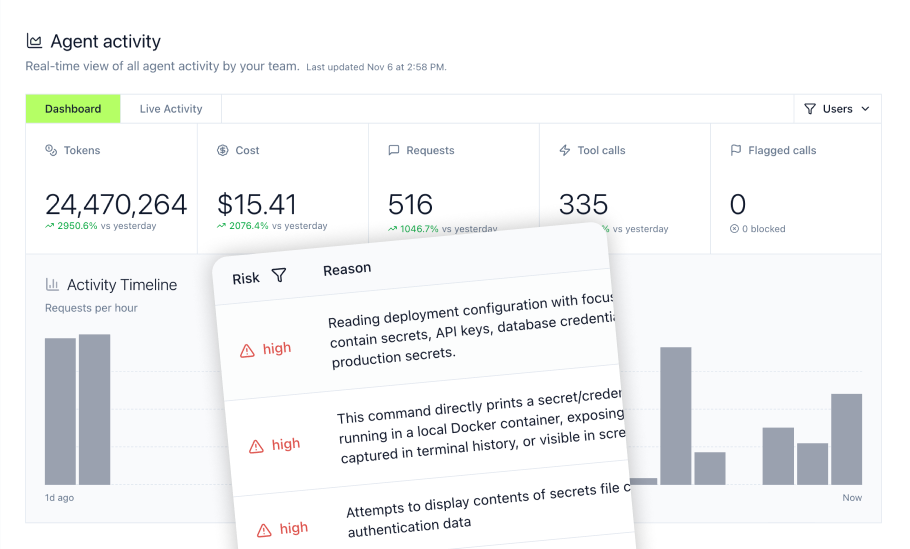
- Agent Monitor: Visibility into agent activity, usage, and costs (Primary buyer: CISO, IT)
- Guardrails: Runtime controls through Mint Guard, Rules, and Middleware (Primary buyer: CISO, Security)
Virtual MCP Architecture
Unlike platforms that require per-connector configuration across every developer workstation, MintMCP's Virtual MCPs serve as the unit of deployment, access control, tool curation, audit, and administration. A single VMCP can expose read-only tools to one team while a parallel VMCP exposes read-write tools to another, all over the same underlying connectors.
Agent Identity Capabilities
MintMCP's Agent Gateway treats autonomous agents as first-class non-human principals. Each agent can have:
- Its own identity separate from human credentials
- Scoped MCP access through dedicated VMCPs
- Independent credential rotation and revocation
- Bearer keys, M2M tokens, or workload identity federation
- Attributable audit trails for compliance reporting
Guardrails Architecture
MintMCP provides three-layer runtime controls:
- Mint Guard: Managed detection for prompt injection, secrets, PII, and harmful content
- Rules: Declarative matching on tool names, arguments, and content with flag, block, ask, mask, or notify actions
- Gateway Middleware: Customer-authored JavaScript in a sandbox for DLP integrations, external classifiers, and custom policy enforcement
Pricing Structure
- Free 7-day trial available for evaluation
- Contact-based pricing for enterprise deployments
- Self-serve onboarding without requiring sales calls
Best Fit Use Cases
- IT, Security, and AIOps owners needing governed MCP access across Claude, Cursor, ChatGPT, Gemini, and Copilot
- Organizations running multiple AI vendors requiring cross-platform governance
- Teams wanting MintMCP to host and operate connector infrastructure
- Buyers requiring per-agent identity as a first-class governance primitive
- Organizations with existing DLP investments wanting middleware integrations
2. Runlayer
Runlayer positions itself as an enterprise AI control plane for the tool layer, combining the deepest MCP server catalog with governance controls. The platform targets IT-Sec-AIOps and Platform Engineering teams with AI/DevEx as the initial wedge.
Key Runlayer Strengths
- 18,000+ MCP server catalog across 300+ AI clients for discovery and enablement
- Agent builder and skills marketplace bundled with governance
- MCP-specific threat detection with purpose-built ML classifiers
- MDM-based shadow MCP discovery reaching employee laptops for unmanaged agent detection
- Identity-scoped access with tool-use permissioning controls
- Hybrid deployment: Managed SaaS plus self-hosted on customer infrastructure
Considerations to Evaluate
- MCP-centered visibility and enforcement, including endpoint-level shadow MCP discovery, rather than universal monitoring of all model calls and workflow execution
- Production suitability should be evaluated against deployment requirements, operational controls, and the specific capabilities your organization needs
- Custom pricing through demo-led sales cycle
3. Bifrost (Maxim AI)
Bifrost provides an open-source AI gateway under Apache 2.0 licensing, combining LLM and MCP routing in a single Go binary. The platform targets developers, platform engineering, and AI-ML teams prioritizing performance and infrastructure control.
Key Bifrost Strengths
- Open source with permissive licensing (Apache 2.0), allowing organizations to inspect, deploy, and modify the gateway
- Low gateway overhead: Bifrost reports 11 microseconds of gateway overhead at 5,000 requests per second in its own benchmark, not independently verified end-to-end latency
- Token cost optimization: Code Mode achieved up to 92.8% input token reduction in a vendor-run benchmark involving 508 tools across 16 MCP servers
- Unified LLM + MCP gateway routing 25+ providers with automatic failover
- Virtual keys for governing tool access
- OAuth 2.1 upstream authentication
Considerations to Evaluate
- Self-hosted deployment requires infrastructure expertise
- No managed hosting option available
- Performance benchmarks are vendor-run, not independently verified
- Organizations wanting turnkey solutions need different platforms
Pricing Model
- Open source (Apache 2.0) with no license cost
- Infrastructure and operational costs apply
- Enterprise tier available for INVPC deployments
4. TrueFoundry
TrueFoundry combines MCP Gateway with broader AI infrastructure including GPU orchestration, model serving, and fine-tuning. The platform targets Platform Engineering and ML Platform teams with secondary IT-Sec governance needs.
Key TrueFoundry Strengths
- Unified AI infrastructure: Combines MCP governance with GPU orchestration, model serving, and fine-tuning capabilities
- Published pricing: Developer ($0), Pro ($25/user/month), and custom Enterprise pricing
- Detailed guardrail engine with documented validate/mutate modes, enforce/audit strategies, and hooks
- Flexible deployment: SaaS, VPC, on-prem, and air-gapped options
- 1,600+ model support across Azure and AWS
Pricing Tiers
- Developer ($0): Entry-level access for experimentation and prototyping
- Pro ($25/user/month): 20,000 included requests per user monthly, with additional usage charges
- Enterprise (Custom): Advanced security, custom deployments, and enterprise governance
Considerations to Evaluate
- Governance features gated at higher tiers
- Runtime policies, approval mechanisms, and tool-call enforcement should be evaluated separately against the organization's requirements
- Broader platform scope extends beyond MCP-only governance needs
- Small set of managed MCP connectors compared to dedicated platforms
5. Stacklok (ToolHive)
Stacklok provides MCP server management and governance through ToolHive, supporting local development environments and Kubernetes deployments. Its enterprise offering is designed for organizations that need to operate governed MCP infrastructure within their own environments.
Key Stacklok Strengths
- Open-source architecture: Apache 2.0-licensed MCP management supporting local deployments and Kubernetes-based infrastructure
- Full supply-chain security beyond gateway governance
- Customer-controlled deployment: Self-hosted infrastructure gives organizations control over data flows, network access, and external integrations
- Curated MCP registry with security vetting
- Policy enforcement through K8s-native controls
- Open source PoC path before enterprise commitment
Considerations to Evaluate
- Kubernetes expertise required for production deployments that use the Kubernetes operator
- Enterprise-scale Kubernetes deployments require operational expertise, while local ToolHive workflows offer a simpler evaluation path
- Smaller enterprise footprint with fewer documented production deployments
- No SaaS option for organizations wanting managed services
Pricing Model
- Open source (Apache 2.0) for PoC capabilities
- Step-up to Enterprise tier for additional features and support
6. IBM ContextForge
IBM ContextForge is an open-source MCP and agent gateway project combining protocol bridging, federation, centralized governance, authentication, and observability. It supports heterogeneous MCP, REST, gRPC, and agent environments.
Key ContextForge Strengths
- REST/gRPC-to-MCP conversion for legacy API integration
- Multi-gateway federation across distributed infrastructure
- Enterprise IBM ecosystem integration
- Protocol bridging for heterogeneous environments
Considerations to Evaluate
- Self-hosted deployment requires customers to manage infrastructure, configuration, and upgrades
- Authentication, authorization, and policy features should be evaluated against enterprise requirements
- Open-source deployment provides flexibility but places operational responsibility on the implementing team
7. Kong AI Gateway
Kong AI Gateway extends established API management capabilities into AI and MCP traffic, including MCP proxying, API-to-MCP exposure, tool aggregation, authentication, and observability.
Key Kong AI Gateway Strengths
- MCP integration capabilities for proxying existing servers, exposing APIs as MCP tools, and aggregating MCP tool surfaces
- OAuth/JWT authentication through established patterns
- Native Azure Entra ID integration
- Hybrid deployment: Konnect SaaS control plane with self-hosted data plane
- Existing API management investment leverage
Considerations to Evaluate
- Primarily extends API management rather than purpose-built MCP governance
- Best suited for organizations with existing Kong deployments
- Governance capabilities require layering on top of API management features
Use Case Decision Framework
Choose MintMCP when you need:
- Managed MCP hosting that eliminates connector operational complexity
- One-click employee access via MCP Store with SSO after role-based approval
- Coding agent visibility into Claude Code and Cursor file access, commands, and tool calls
- Team-scoped Virtual MCPs with SCIM-driven membership
- Per-agent identity with independent credential rotation
Why MintMCP for Enterprise MCP Governance
MintMCP offers a managed approach to enterprise MCP and agent governance, combining hosted connectors, Virtual MCPs, first-class agent identities, and runtime security controls.
For teams prioritizing managed infrastructure, requiring SSO-driven employee access, or needing per-agent identity governance, MintMCP combines centralized administration with scoped access controls. The platform supports enterprise MCP security through identity management, runtime guardrails, audit trails, and monitoring capabilities. MintMCP is SOC 2 Type II audited and compliant with HIPAA standards, supporting enterprise security and governance requirements.
MintMCP's key differentiators include:
- Managed MCP hosting: 50+ connectors hosted and operated by MintMCP eliminate the burden of running connector runtime infrastructure
- Virtual MCP architecture: Team-scoped bundles of approved connectors simplify deployment and access control
- Agent-first identity: First-class non-human principals with independent credentials, scoped access, and attributable audit trails
- Three-layer guardrails: Mint Guard for managed detection, Rules for declarative policies, and Gateway Middleware for custom integrations
- Cross-platform governance: Unified controls across Claude, Cursor, ChatGPT, Gemini, and Copilot
Organizations seeking governed MCP infrastructure can explore MintMCP's pricing or start a free trial to evaluate governed MCP access and enterprise AI agent governance.
Frequently Asked Questions
What makes MintMCP different from Waxell for MCP governance?
MintMCP focuses on managed MCP hosting with 50+ ready-to-deploy connectors, eliminating operational burden. While Waxell provides SDK-based policy enforcement alongside MCP Gateway controls, MintMCP's MCP Gateway uses Virtual MCPs to centralize tool access without requiring changes to agent code for supported integrations. MintMCP also provides Agent Gateway for first-class agent identities.
Can I migrate from Waxell to MintMCP?
Yes, organizations can migrate supported MCP connections, though effort depends on current implementation. Teams can redirect supported MCP client configurations to MintMCP endpoints, while existing Waxell policies, SDK instrumentation, and runtime controls may require separate migration or replacement. The Virtual MCP architecture allows replicating existing access patterns with enterprise controls.
Which platform offers the best value for enterprise MCP governance?
MintMCP offers quote-based pricing for enterprises prioritizing managed hosting, centralized access control, and reduced connector maintenance. The free 7-day trial enables evaluation, while managed connectors reduce the need to operate connector runtime infrastructure directly. Enterprise value should be assessed against total operating costs, required governance capabilities, deployment requirements, and ongoing effort.
How do these platforms handle agent identity and non-human principals?
MintMCP's Agent Gateway treats autonomous agents as first-class non-human principals with dedicated identities, scoped VMCPs, and independent credential rotation. Authentication supports bearer keys, M2M tokens, and workload identity federation. The key MintMCP differentiator is the act-as-agent flow where administrators complete OAuth for connectors requiring per-agent authentication.
What compliance certifications do these MCP governance platforms have?
MintMCP is SOC 2 Type II audited and compliant with HIPAA standards, with continuous compliance monitoring through Drata. TrueFoundry offers SOC 2 and HIPAA-ready capabilities at the Pro Plus tier and above. Waxell advertises SOC 2 Type II and enterprise HIPAA BAA options, with compliance-related features subject to applicable plan terms. The MintMCP Trust Center provides detailed compliance documentation.