Enterprise security teams are facing a fundamental challenge: the digital entities requiring authentication have evolved beyond simple machine credentials into autonomous agents that reason, adapt, and make independent decisions. With machine identities now outnumbering humans at an overwhelming margin and AI agents introducing non-deterministic behavior that traditional IAM systems cannot handle, organizations need clarity on how these identity types differ and why securing them requires distinct approaches. Platforms like MintMCP's MCP Gateway are addressing this challenge by providing centralized governance that covers both machine credentials and AI agent access patterns.
This article clarifies the fundamental differences between machine identity and AI agent identity, exploring their unique management challenges, security implications, and the specialized solutions required for each in an enterprise context.
Key Takeaways
- Machine identities are deterministic; AI agents are not. Machines usually follow predictable workflows where the same inputs and code produce the same outputs, while AI agents interpret intent, reason independently, and adapt decisions in real-time.
- Scale is overwhelming. Machine identities outnumber humans at ratios by an overwhelming margin with 79% of organizations expecting further growth up to 150% in the next year.
- Traditional IAM breaks for AI agents. OAuth and SAML fall short in dynamic AI environments because they provide coarse-grained access control that cannot adapt to ephemeral, evolving AI-driven automation.
- Governance gaps create breaches. 50% of organizations experienced security breaches linked to compromised machine identities in the past year, while 42% lack cohesive strategies.
- AI agents require delegation chains. Unlike static machine credentials, AI agents need delegated authority defining what they can do and on whose behalf—a concept absent from traditional machine identity management.
- Emerging protocols are essential. Model Context Protocol (MCP), Agent-to-Agent Protocol (A2A), and OAuth On-Behalf-Of (OBO) enable secure, auditable autonomous operations that static identity models cannot support.
Understanding Machine Identity: The Foundation of Digital Security
Machine identities are digital credentials—X.509 certificates, SSH keys, API tokens, and service accounts—used to authenticate non-human entities like servers, applications, containers, and IoT devices. These credentials enable secure machine-to-machine communication through cryptographic verification, operating on predictable, deterministic workflows.
What Constitutes a Machine Identity?
The core components of machine identity include:
- Certificates and keys: X.509 certificates, SSH keys, and TLS certificates that establish encrypted communication channels
- API credentials: API keys and tokens that authenticate applications accessing services
- Service accounts: System accounts enabling automated processes to access resources without human intervention
- Workload identities: Dynamic credentials for containerized applications and cloud-native workloads
Machine identities are created dynamically—adding a cloud service can generate hundreds of machine accounts instantly. This exponential growth drives the staggering ratios organizations now face.
Traditional Machine Identity Management Challenges
Organizations struggle with several persistent challenges:
- Certificate lifecycle management: 72% experienced outages, with 45% having weekly disruptions
- Manual processes at scale: 34% use manual management despite the impossibility of managing millions of credentials by hand
- Visibility gaps: 42% lack cohesive strategy across hybrid and multi-cloud environments
- Credential sprawl: API keys (34%) and SSL/TLS certificates (34%) are top attack vectors for compromised machine identities
Defining AI Agent Identity: A New Frontier in Digital Trust
AI agent identities represent autonomous software entities that plan, reason, and execute multi-step tasks independently, operating with delegated authority on behalf of users or systems. Unlike static machine identities, AI agents are non-deterministic—they interpret instructions, adapt to context, and make decisions that were not explicitly programmed.
How AI Agents Establish and Use Their Identity
AI agent identity consists of three core elements:
- Unique persistent identifiers: A stable reference that distinguishes one agent from another across systems
- Cryptographic proof of legitimacy: Verifiable credentials that prove an agent's authenticity
- Explicitly delegated authority: Clear definitions of what the agent can do and on whose behalf
AI agent identity management requires Just-in-Time (JIT) identity provisioning, delegated authority through OAuth On-Behalf-Of (OBO), task- and context-aware authorization, runtime authentication using PKCE/SPIFFE/DPoP, and comprehensive auditing.
The Unique Complexities of AI Agent Identities
AI agents introduce complexities absent from traditional machine identity:
- Autonomous decision-making: Agents interpret natural language and improvise solutions rather than following scripted commands
- Delegation chains: Actions must be traceable back through multiple authorization levels to the original human authorizer
- Context-aware access: The same agent may need different permissions based on current task, data sensitivity, and risk context
- Ephemeral credentials: Short-lived, task-specific identities that expire after completion rather than persistent long-term credentials
Key Distinctions: Scope, Behavior, and Enterprise Impact
The fundamental difference between machine and AI agent identities is determinism versus autonomy. This behavioral distinction drives all other differences in authentication, authorization, and governance requirements.
How Operational Scope Differentiates Identities
Machine identities:
- Perform repetitive, predictable tasks (database syncs, image processing, log aggregation)
- Operate within tightly defined parameters
- Execute the same output given the same inputs and code
- Require static, predefined policies
AI agent identities:
- Perform multi-step, adaptive tasks (research, analysis, autonomous decision-making)
- Interpret user intent and adjust approach based on context
- Produce varying outputs based on reasoning, even with identical inputs
- Require policies that adapt to context and delegation paths
Behavioral Characteristics and Security Implications
AI agents are autonomous—they interpret intent, reason independently, and make decisions that evolve in real-time. Their actions are not scripted; they are autonomous. This non-deterministic behavior means AI agents can "surprise you, and that's not a side-effect—it's a feature."
For enterprises deploying MCP-based systems, this distinction matters enormously. Understanding how MCP gateways bridge AI infrastructure helps security teams design appropriate controls for both identity types.
Security Challenges: Protecting Different Types of Digital Entities
Organizations face a dangerous disconnect between identity scale and governance maturity. While 92% claim to have a machine identity security program, the actual security posture tells a different story.
Machine Identity Vulnerabilities and Mitigation
Primary attack vectors for machine identities include:
- Compromised API keys: Leading attack vector at 34% of machine identity breaches
- Certificate mismanagement: 72% of organizations experience certificate-related outages
- Service account abuse: Over-privileged service accounts enable lateral movement
- Secrets sprawl: Hardcoded credentials in repositories and configuration files
AI Agent-Specific Security Threats
AI agents introduce novel attack vectors that traditional controls cannot address:
- Prompt injection: Malicious inputs manipulating agent behavior
- Tool poisoning: Compromised tools in the agent's execution chain
- Agent hijacking: Unauthorized control of autonomous agent actions
- Cascading failures: Security breaches propagating across chained agent systems
Traditional security controls like firewalls and authentication tokens are insufficient when LLMs act as intermediaries between user intent and system actions.
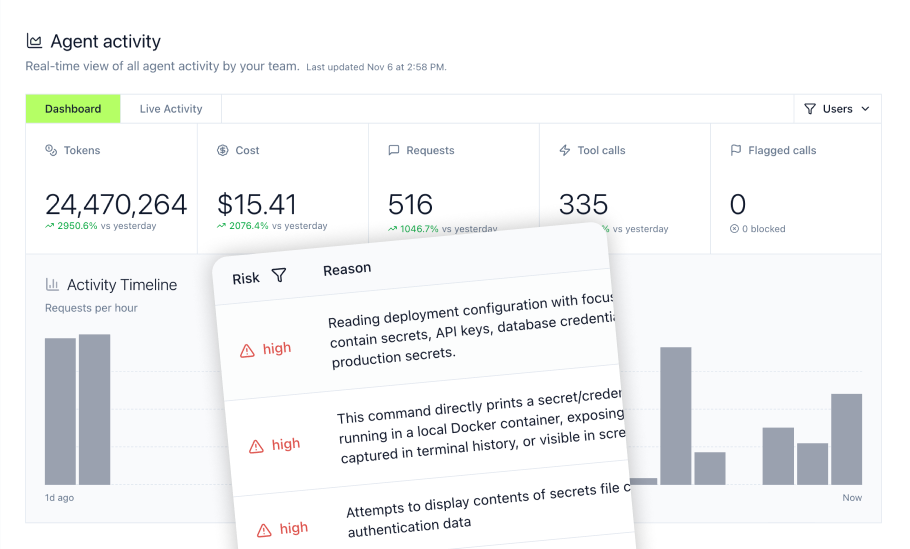
MintMCP's LLM Proxy addresses these agent-specific threats by monitoring every MCP tool invocation, tracking bash commands, and blocking dangerous operations in real-time—providing the behavioral monitoring that static machine identity controls cannot deliver.
Governance and Compliance for AI Agents
The governance gap creates immediate vulnerability in MCP ecosystems. Organizations face a dangerous disconnect: while most believe their efforts are keeping pace with threats, shadow AI incidents reveal systemic vulnerabilities.
The Imperative for AI Agent Governance
Data privacy remains the top obstacle to AI agent adoption, with over-permissioned agents accessing unauthorized systems or revealing credentials. Traditional security models break down because AI agents execute non-deterministic actions, making them prime targets for exploitation when governance is absent.
Key governance requirements include:
- Delegation documentation: Proving which human authorized which agent to perform which actions
- Audit trail requirements: Logging every autonomous action with agent identity, delegation chain, and business context
- Algorithmic accountability: Explainability requirements for automated decisions affecting individuals
Compliance Standards and AI Agent Interactions
Regulatory frameworks are evolving to address AI agent governance:
- EU AI Act: Requires human oversight, transparency, and auditability for high-risk AI systems
- GDPR/CCPA: Data minimization and purpose limitation principles apply to AI agent data access
- SOX/PCI-DSS: Financial systems using AI agents demand full audit trails with 6-7 year record retention
MintMCP's MCP Gateway provides complete audit trails for every MCP interaction, access request, and configuration change. With SOC2 Type II compliance and support for enterprise compliance frameworks, it enables audit and observability that meets regulatory requirements for both machine and AI agent identities.
Identity Management Solutions for AI Agents
Traditional OAuth and SAML fall short in the dynamic world of AI agents because they provide coarse-grained access control that cannot adapt to ephemeral, evolving AI-driven automation.
Adapting Traditional Identity Tools for AI
Organizations are extending traditional identity platforms to cover AI agent requirements through:
- Centralized authentication: OAuth 2.0, SAML, and SSO integration across all agent endpoints
- Just-in-Time provisioning: Creating agent identities only when needed, revoking after task completion
- Behavioral analytics: Monitoring agent actions for anomalies that deviate from expected patterns
- Secrets management: Eliminating hardcoded credentials through identity-based, ephemeral access
Specialized Solutions for AI Agent Identities
Emerging protocols specifically designed for AI agent environments include:
- Model Context Protocol (MCP): Structured AI agent access to tools and data
- Agent-to-Agent Protocol (A2A): Inter-agent communication and trust delegation
- SPIFFE/SVID: Workload identity attestation for containerized agents
- OAuth On-Behalf-Of (OBO): Delegation chains tracing agent authority to human authorizers
- PKCE/DPoP: Proof-of-possession preventing token replay attacks
MintMCP's platform supports these protocols through enterprise-grade tool governance, enabling granular control over which agents can access which tools with what permissions.
Bridging Shadow AI to Sanctioned AI
Shadow AI represents unmanaged AI agents deployed outside governance frameworks. Security leaders must tackle a new, exploding attack surface—machine identities and AI agents—while breaking silos and doing more with less.
The Dangers of Unmanaged AI Agents
Unmanaged AI agents create several risks:
- Accountability gaps: No traceability from autonomous actions to authorizing humans
- Over-permissioning: Agents granted excessive access without proper review
- Compliance violations: Agents accessing regulated data without required controls
- Security blind spots: No visibility into what agents access or execute
With 81% of security leaders saying machine identity is vital for AI security, organizations recognize the urgency but struggle with implementation.
Strategies for Formalizing AI Agent Use
Converting shadow AI to sanctioned AI requires:
- Agent discovery: Identifying all AI agents operating across the enterprise
- Policy enforcement: Implementing consistent access controls across all agent types
- Continuous monitoring: Real-time visibility into agent actions and data access
- Rapid deployment: Enabling legitimate agent use without slowing development teams
MintMCP's mission addresses this directly: turning shadow AI into sanctioned AI by providing the security, governance, and ease-of-use that enterprises need to deploy MCP at scale.
Future Outlook: The Evolving Landscape of Digital Identities
The convergence of machine identity management and AI agent governance could consolidate into unified "non-human identity platforms" that manage the full spectrum from static credentials to autonomous agents.
Emerging Trends
- Secretless architectures: Eliminating static credentials entirely through identity-based authentication
- AI-driven policy generation: Using AI to create and adapt authorization policies dynamically
- Behavioral trust scoring: Dynamic trust scores based on agent behavior patterns
- Ephemeral authentication: Short-lived, context-aware identities tailored to current tasks
Organizations that establish agent governance frameworks now—combining identity-first architecture, zero-trust for agents, behavioral monitoring, and MCP security controls—will gain competitive advantage in safely deploying autonomous systems while competitors struggle with ungoverned shadow AI and compliance violations.
MintMCP: Enterprise-Grade Governance for Machine and AI Agent Identities
MintMCP provides the centralized governance platform enterprises need to manage both traditional machine identities and emerging AI agent identities within a unified security framework. As organizations navigate the transition from shadow AI to sanctioned AI deployments, MintMCP addresses the core challenges that prevent secure, scalable AI adoption.
The MCP Gateway delivers comprehensive identity and access management across your entire AI infrastructure. With SOC2 Type II certification and support for enterprise compliance frameworks, it provides the audit trails, policy enforcement, and real-time monitoring required for both deterministic machine credentials and non-deterministic AI agent behaviors. Every MCP interaction, tool invocation, and access request is logged with user identity and agent identifiers, enabling organizations to attribute actions and support compliance evidence.
MintMCP supports flexible deployment models—whether you're running STDIO servers on the managed service or integrating with your own deployable or remote servers. This flexibility ensures organizations can adopt MCP at their own pace while maintaining consistent governance across all deployment patterns.
The LLM Proxy adds behavioral security controls specifically designed for AI agents, monitoring tool invocations, tracking bash commands, and blocking dangerous operations before they execute. Combined with enterprise tool governance, organizations gain granular control over which agents access which tools with what permissions—transforming ungoverned shadow AI into sanctioned, auditable AI infrastructure.
By unifying machine identity management with AI agent governance, MintMCP enables security teams to protect the expanding attack surface while empowering development teams to safely deploy autonomous AI capabilities at enterprise scale.
Frequently Asked Questions
Can AI agents have multiple identities, and how are these managed?
Yes, AI agents may require multiple identity contexts depending on task requirements. An agent might use delegated human authority when accessing patient records but switch to autonomous machine credentials for scheduling tasks. These are hybrid "agentic identities" combining both human-delegated and machine-autonomous identity models. Management requires platforms capable of context-aware identity switching with full audit trails documenting which identity type was active for each action.
What authentication protocols should organizations prioritize for AI agent deployments?
Organizations should implement a layered protocol stack: PKCE and DPoP for proof-of-possession preventing token replay, OAuth On-Behalf-Of (OBO) for delegation chains, SPIFFE/SVID for workload attestation, and MCP for structured tool access. Industry best practices recommend ephemeral authentication generating short-lived, context-aware identities tailored to each agent's current task rather than long-lived static credentials.
How do certificate lifecycle changes impact machine identity security?
Certificate lifespans are shortening significantly, moving toward 47-day validity by 2029 according to industry projections. With 72% of organizations already experiencing certificate-related outages and 45% having weekly disruptions, automation becomes mandatory. Organizations need centralized certificate management platforms with predictive renewal, automated rotation, and integration across hybrid cloud environments—capabilities that manual processes cannot provide at enterprise scale.
What is the difference between non-human identity (NHI) and AI agent identity?
Non-human identity (NHI) is a broader category encompassing all digital identities that are not human users, including machine identities, service accounts, and AI agents. AI agents represent a distinct subcategory because of their non-deterministic behavior, delegation requirements, and ability to make independent decisions. Machine identities are persistent credentials requiring governance; AI agents require both persistent identity governance and real-time behavioral controls.
How should organizations handle AI agent identity during incident response?
AI agent incident response differs from machine identity incidents. When a machine identity is compromised, organizations rotate credentials and audit access logs. When an AI agent is compromised or exhibits anomalous behavior, organizations must immediately suspend the agent's authority, trace all actions through delegation chains to identify scope of impact, analyze decision patterns to understand what the agent accessed, and implement containment before resuming operations. This requires real-time monitoring and the ability to instantly revoke agent permissions—capabilities that static credential management systems lack.