Business intelligence teams face an infrastructure paradox: AI agents promise new analytics capabilities, but connecting them to data warehouses creates significant security and governance challenges. MCP gateways govern connections to data and tools, AI gateways govern model traffic, and agent gateways build on those layers with agent identities, permissions, memory, and monitoring. MintMCP's MCP Gateway provides the governed data and tool foundation, while its Agent Gateway extends that foundation to agents that operate alongside users.
The stakes are high. 86% of enterprises require tech stack upgrades to properly deploy AI agents, while 62% of practitioners cite security concerns as their top challenge. For BI teams querying Snowflake, BigQuery, and Elasticsearch through AI agents, the right gateway transforms a security risk into governed, production-ready infrastructure.
This guide evaluates 10 AI, MCP, and agent gateways for BI team requirements: security and compliance posture, native data warehouse connectors, performance benchmarks, governance features, and deployment flexibility.
Key takeaways
- MintMCP Agent Gateway: Built on MintMCP's data-permissions-first MCP Gateway foundation, it provides agent identities with M2M auth, scoped tool access, independent rotation and revocation, SCIM-driven RBAC, and Git-like memory for coworker agents that operate alongside employees in Slack
- 42% of enterprises require AI agents to access eight or more data sources, creating credential sprawl and governance challenges
- Published gateway overhead ranges from approximately 11 microseconds for Bifrost to approximately 4ms p99 for Lunar MCPX, though these are vendor-reported benchmarks with different hardware, traffic, and measurement methods
- Open-source options include Apache 2.0-licensed agentgateway and Bifrost, alongside enterprise offerings with hosted deployment
- Multi-region distributed architectures address data residency requirements for global BI teams
1. MintMCP Agent Gateway: agent identities and permissions for BI teams
MintMCP Agent Gateway provides first-class agent identities, permissions, memory, and monitoring for agents that work alongside BI teams. Built on MintMCP's MCP Gateway foundation, which governs data and tool connections through SSO, SCIM-driven RBAC, Virtual MCP Bundles, and audit logs, the Agent Gateway layer extends those capabilities to long-running agents with independent identities.
For BI teams, this dual-layer approach means coworker agents can query Snowflake, search Elasticsearch, and generate reports with their own credentials, scoped permissions, and persistent memory, while every action flows through governed MCP connections.
What makes MintMCP Agent Gateway different
MintMCP addresses the integration and governance challenge highlighted by a survey in which 42% of enterprises said AI agents require access to eight or more data sources. The platform wraps stdio, hosted, HTTP-streamable, and SSE MCP servers behind SSO-fronted remote MCP endpoints with OAuth brokering, SCIM-driven membership, and rule-based policy, then enables Agent Gateway capabilities on top.
Core Agent Gateway capabilities
- Agent Bundles: Give internal agents first-class identities with M2M auth, scoped tools, independent rotation and revocation, and an "act as agent" flow for connectors requiring per-agent OAuth
- Git-Like Memory for Coworker Agents: Company-owned, versioned, reviewable, auditable, and portable memory that follows Git-like principles, supporting private, team, org, and customer memory scopes for agents that live in Slack and continue work across days
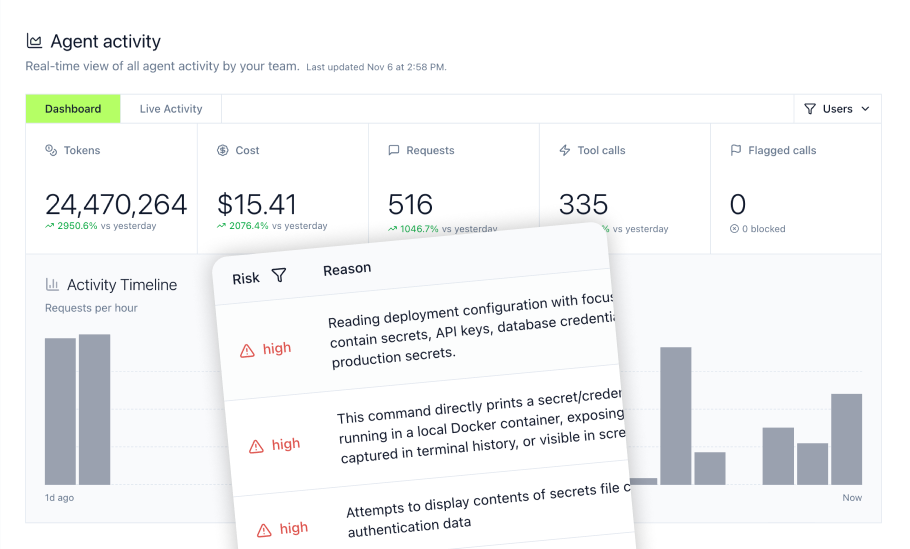
- Two-Layer Monitoring: MintMCP Gateway provides logs and visibility for MCP traffic, while Agent Monitor covers local non-MCP agent activity such as shell commands, file access, and prompt submissions through supported hooks
- Virtual MCP Bundles: Create team-specific, per-use-case endpoints that expose only the minimum required tools with SCIM-driven membership and fine-grained role-based access
MCP Gateway foundation
- Native Data Warehouse Connectors: Pre-configured Snowflake integration with natural language queries and Cortex Analyst support, Elasticsearch knowledge base search for log analysis and documentation, BigQuery connectivity for Google Cloud environments
- Hosted MCP Connectors: MintMCP runs connector instances with auto-scaling and sandboxed execution per connector, reducing infrastructure teams must operate for connector deployment
- Custom Gateway Middleware: Customer-authored JavaScript middleware in a sandbox with external DLP and guardrails integrations including AWS Bedrock Guardrails, Google Cloud DLP, Microsoft Purview, Nightfall, and Skyflow
BI-specific use cases
- Financial analysts querying Snowflake through coworker agents with persistent memory of report templates and calculation methods
- Data teams running Elasticsearch searches through agents with their own identities and audit trails
- Executive reporting agents with read-only access to aggregated metrics while blocking access to underlying PII
- Gmail integration for AI-driven customer response automation linked to BI workflows
Security and compliance
MintMCP is SOC 2 Type II audited with continuous compliance monitoring via Drata. Enterprise SSO, complete audit trails, PII detection, and role-based access control are built into every layer. Customers handling protected health information can request HIPAA documentation. MintMCP signs BAAs.
Deployment
Managed SaaS-first delivery with US and EU availability, hosted MCP connectors, and self-service access for developers. VPC and self-hosted deployment available on request.
Pricing
Contact for enterprise demonstration and pricing.
2. TrueFoundry MCP Gateway
TrueFoundry provides a unified AI infrastructure platform that includes MCP gateway capabilities alongside LLM deployment and model serving. The platform emphasizes performance benchmarks for latency-sensitive BI workloads.
Primary focus
TrueFoundry targets platform engineering and ML teams who need to manage both LLM traffic and MCP connections through a single control plane. The platform recently acquired Seldon AI to accelerate agentic AI capabilities.
Core capabilities
- Published MCP benchmark reports approximately 7-8ms of overhead at 200-220 RPS and 7-12ms at 350-370 RPS on a 1 vCPU, 1 GB pod, depending on tracing
- Kubernetes-native deployment with hybrid GPU/MCP server support
- SOC 2 Type II audited and compliant with HIPAA standards
- Unified control plane for both LLM and MCP traffic
Where TrueFoundry fits
Organizations prioritizing performance for interactive BI queries and teams already invested in Kubernetes infrastructure who want unified AI infrastructure management.
Deployment
Hybrid model with managed SaaS plus self-hosted control plane options. Air-gapped deployment available via forward proxy.
3. Portkey MCP Gateway
Portkey offers a production stack for generative AI with broad model access and enterprise security features. The platform was acquired by Palo Alto Networks in May 2026, integrating with the Prisma AIRS security platform.
Primary focus
Portkey emphasizes breadth of model access, with its current model directory listing 2,000+ AI models. It also provides an MIT-licensed open-source gateway.
Core capabilities
- Access to 2,000+ AI models through a unified API
- SOC 2 Type II audited, ISO 27001 certified, compliant with HIPAA standards, and GDPR compliant
- 50+ LLM guardrails for production deployments
- MIT-licensed open-source gateway option
Where Portkey fits
BI teams requiring access to multiple model providers through a single interface, and organizations that prioritize model flexibility alongside security controls.
Deployment
A free managed tier and an MIT-licensed self-hosted gateway are available, alongside enterprise deployment options.
4. Bifrost by Maxim AI
Bifrost is an open-source AI gateway that prioritizes performance and cost optimization through semantic caching. The project is Apache 2.0 licensed.
Primary focus
Bifrost targets teams where query response time and throughput directly impact BI workflow efficiency. The gateway reports approximately 11 microseconds of internal overhead at 5,000 RPS on AWS t3.xlarge instances.
Core capabilities
- Approximately 11 microseconds internal gateway overhead
- 5,000 RPS benchmark on standard cloud instances
- Semantic caching for reducing redundant queries and costs
- Single Go binary deployment for operational simplicity
- Hierarchical budget management for cost allocation
Where Bifrost fits
BI teams running high-volume analytical queries who need minimal latency overhead, and organizations with existing infrastructure teams who prefer self-hosted open-source solutions.
Deployment
Self-hosted via Go binary or Docker. Enterprise tier available for VPC installations.
5. Lunar.dev MCPX
Lunar.dev MCPX provides a governance-focused MCP gateway with emphasis on testing and policy enforcement before production deployment.
Primary focus
MCPX targets platform and infrastructure teams who need to validate MCP server behavior before exposing them to production BI workflows. The Enterprise offering includes an MCP evaluation sandbox for pre-production testing.
Core capabilities
- Enterprise MCP evaluation sandbox for testing server behavior before deployment
- Granular RBAC at global, service, and tool levels
- Tool customization with parameter locking
- Administrative approval workflow for new MCP servers
- Approximately 4ms p99 gateway overhead in Lunar's published benchmark
Where Lunar.dev fits
BI teams in regulated industries requiring extensive pre-production validation, and organizations that need multi-level approval workflows before granting data warehouse access.
Deployment
Hybrid model with Docker/Kubernetes self-hosted options and optional SaaS dashboards for telemetry.
6. Kong AI Gateway
Kong extends its established API management platform with MCP-specific capabilities, allowing organizations to generate MCP servers from existing REST APIs.
Primary focus
Kong targets organizations already standardized on Kong for API gateway functionality who want to add MCP support without deploying separate infrastructure. The platform can transform existing REST APIs into AI-accessible MCP tools.
Core capabilities
- Generate MCP servers from existing REST APIs without rebuilding
- AI MCP OAuth2 plugin for MCP traffic, currently in tech preview
- LLM-as-a-Judge prompt-response evaluation through an AI-license-required plugin
- Integration with Kong Developer Portal
- Leverage existing API gateway authentication and rate limiting
Where Kong fits
BI teams with existing Kong infrastructure who want to expose internal data APIs as MCP servers, and organizations preferring to extend current tooling rather than deploy purpose-built solutions.
Deployment
Hybrid model with Konnect SaaS control plane plus self-hosted data plane, or fully self-hosted.
7. agentgateway
Agentgateway is an open-source gateway originally created by Solo.io. After its initial donation to the Linux Foundation in August 2025, it joined the Agentic AI Foundation as a hosted project in June 2026.
Primary focus
The project targets organizations seeking vendor-neutral MCP gateway infrastructure with community governance. Contributing organizations include CoreWeave, Red Hat, Adobe, and Salesforce.
Core capabilities
- Rust-based data plane for performance
- CEL-based policy engine with JWT claims support
- Multi-protocol support for LLM, MCP, and A2A from single data plane
- Linux Foundation governance ensures vendor neutrality
- Apache 2.0 licensing
Where agentgateway fits
BI teams in organizations that prioritize open-source and vendor-neutral infrastructure, and Kubernetes-native environments seeking community-driven MCP gateway options.
Deployment
Self-hosted as a standalone deployment or on Kubernetes.
8. Cloudflare AI Gateway and MCP Server Portals
Cloudflare AI Gateway provides caching, analytics, rate limiting, guardrails, and model fallback for model API traffic. MCP Server Portals are a separate Cloudflare One capability for governing access to remote MCP servers.
Primary focus
The platform targets organizations seeking to reduce latency through edge caching and those already using Cloudflare's network infrastructure. Cloudflare claims up to 90% latency reduction for identical repeated requests through edge caching.
Core capabilities
- AI Gateway caching with up to 90% latency reduction for identical repeated requests
- AI Gateway analytics, rate limiting, guardrails, and model fallback
- MCP Server Portals protected through Cloudflare Access policies
- Optional routing of MCP portal traffic through Cloudflare Gateway for HTTP logging and DLP inspection
- Shadow-MCP detection through Gateway logs, GraphQL analytics, and DLP patterns
- AI Gateway free plan with 100,000 logs included
Where Cloudflare fits
BI teams sending identical repeated model requests that can benefit from exact-request caching, and organizations already on Cloudflare seeking to add AI gateway capabilities with minimal setup.
Deployment
Fully managed on Cloudflare's infrastructure. Usage-based scaling beyond free tier.
9. Obot Platform
Obot provides an all-in-one agent orchestration platform that includes MCP gateway capabilities alongside agent framework tooling. The project offers an open-source core with enterprise options.
Primary focus
Obot targets platform engineering teams who want a complete stack for both MCP routing and agent orchestration in a single deployment. The platform includes a Nanobot framework for converting MCP servers into autonomous agents.
Core capabilities
- Built-in MCP Catalog with discovery
- Nanobot framework for MCP-to-agent conversion
- Kubernetes-native with GitOps-ready configuration
- Combined gateway, catalog, admin console, and chat client
- White-label ready for custom branding
Where Obot fits
BI teams that want to build custom analytical agents on top of their MCP infrastructure, and organizations seeking all-in-one platforms rather than point solutions.
Deployment
Available as a self-hosted deployment using Docker or Kubernetes, and as a hosted MCP platform.
10. Tetrate Agent Router
Tetrate Agent Router provides multi-region distributed gateway capabilities built on Envoy, targeting global organizations with data residency requirements.
Primary focus
The platform targets multinational BI teams that need to meet data residency requirements across regions while providing unified governance. The architecture supports distributed data planes with a single control plane.
Core capabilities
- Distributed data planes with single control plane
- Distributed data planes deployable per region to keep traffic where organizational requirements demand
- Built on Envoy (CNCF-backed)
- FINOS AI governance controls with pre-built guardrails
- Automatic failover and configurable routing across models and providers
- Data planes deployable in AWS, Azure, GCP VPCs, or on-premises
Where Tetrate fits
Global BI teams with data residency requirements across multiple regions, and organizations in financial services where FINOS governance controls align with regulatory needs.
Deployment
Pay-as-you-go with introductory free credit. Enterprise tier available for dedicated support.
Selecting an agent gateway for your BI team
Choosing the right gateway depends on your team's specific requirements around compliance, performance, and existing infrastructure investments.
Compliance-first selection
Organizations in regulated industries handling sensitive financial or healthcare data should prioritize gateways that are SOC 2 Type II audited with comprehensive audit logging. MintMCP's security governance features ensure every agent action is logged with full context: who initiated it, which tools were called, what data flowed through, and when.
Native BI integration requirements
BI teams querying Snowflake, BigQuery, and Elasticsearch need gateways with pre-configured connectors rather than custom integration work. MintMCP's hosted MCP connectors reduce the infrastructure teams must operate for connector deployment, isolation, and scaling.
Performance considerations
Published figures range from approximately 11 microseconds of internal gateway overhead for Bifrost to approximately 4ms p99 gateway overhead for Lunar MCPX. These are vendor-reported benchmarks with different hardware, traffic, and measurement methods, so they should not be treated as directly comparable.
Governance architecture
The Virtual MCP Bundles model provides per-use-case endpoints with SCIM-driven membership, allowing BI teams to create analyst-specific bundles with read-only access while maintaining separate admin bundles with full capabilities. This addresses the common challenge of granting appropriate access without over-privileging users.
Why MintMCP Agent Gateway is built for BI teams running coworker agents
For BI teams ready to deploy agents that work alongside analysts, not just answer questions, MintMCP Agent Gateway provides the full stack: agent identities with M2M auth, scoped tool permissions, Git-like memory, and continuous monitoring. Built on MintMCP's data-permissions-first MCP Gateway foundation, which governs connections to Snowflake, BigQuery, and Elasticsearch with SSO, SCIM-driven RBAC, and audit logs, the Agent Gateway layer extends those capabilities to long-running coworker agents.
Unlike gateways that focus only on model traffic or MCP connections, MintMCP provides both layers: the MCP Gateway secures data and tool access for the AI systems users already run, including Claude, Cursor, ChatGPT, Gemini, and Copilot, while the Agent Gateway gives agents their own identities, memory, and permissions. Coworker agents live in Slack, hold memory across days, continue work when employees are offline, and operate with the same governed access as human team members.
MintMCP's approach to enterprise agent memory follows Git-like principles: company-owned, versioned, reviewable, auditable, and portable. Memory is scoped at private, team, org, and customer levels, ensuring agents remember context without creating opaque, hard-to-audit vendor-controlled memory stores. For BI teams managing financial data, healthcare records, or customer analytics, this means every agent action, every memory update, and every tool call flows through auditable infrastructure that meets SOC 2 Type II and HIPAA requirements.
Start your MintMCP Gateway trial to see how governed MCP connections and Agent Gateway capabilities can transform your BI workflows.
Frequently asked questions
How can AI agent gateways improve efficiency for BI teams?
Agent gateways provide centralized authentication and access control that eliminate the need to configure credentials for each individual MCP server. BI teams can deploy AI agents that query Snowflake, BigQuery, or Elasticsearch through a single governed endpoint. This centralization can reduce repeated credential and policy configuration while maintaining a unified audit trail. It can also streamline routine report generation and data exploration when agents have governed access to approved data sources.
What are the primary security concerns for AI agents accessing BI data, and how do gateways address them?
The primary concerns include credential sprawl, unauthorized data access, and lack of visibility into agent behavior. The OWASP MCP guide also identifies risks such as tool poisoning, prompt injection, memory poisoning, and tool interference. Agent gateways address these through centralized credential management where secrets are stored once rather than scattered across configurations, role-based access controls that limit which tools each user or agent can invoke, comprehensive audit logging that tracks every tool call with full context, and policy enforcement that can block or mask sensitive data before it reaches the AI model. Without a gateway, organizations face fragmented security policies across dozens of MCP servers with no unified visibility.
Can AI agent gateways integrate with my existing business intelligence tools and data warehouses?
Yes, but integration depth varies by gateway. Some gateways offer native connectors for specific platforms like Snowflake, BigQuery, and Elasticsearch with pre-configured authentication and natural language query support. Others require custom MCP server development to connect to your data sources. When evaluating gateways, check whether they support the specific data platforms your BI team uses and whether connectors are pre-built or require development work.
What is shadow AI in the context of business intelligence, and how can agent gateways prevent it?
Shadow AI occurs when employees use AI tools to access business data outside of approved channels, creating security blind spots and compliance risks. In BI contexts, this might mean analysts using personal AI assistants to query production databases or running MCP servers locally without IT oversight. Agent gateways prevent shadow AI by requiring all agent-to-data connections to route through centralized infrastructure with SSO enforcement. Some gateways also include detection capabilities that identify off-gateway MCP usage in tools like Cursor and Claude Code.
How do agent gateways ensure compliance with data governance standards?
The NIST AI RMF provides a vendor-neutral foundation for managing AI risks. Agent gateways support compliance through several mechanisms: being SOC 2 Type II audited, comprehensive audit logs that capture every tool invocation for investigation and reporting, role-based access controls that enforce least-privilege access to data, and integration with external DLP tools that can mask or block sensitive data. For healthcare organizations, gateways that sign Business Associate Agreements and support HIPAA documentation enable compliant AI deployments. The key is that governance is centralized rather than scattered across individual server configurations.