As AI agents move into production, persistent memory creates governance obligations around access, retention, provenance, and auditability. Most provisions of the EU AI Act have applied since August 2, 2026, with some obligations following different phased dates. Companies face regulatory exposure when they lack infrastructure to control what agents store, who can access it, and how long it persists. MintMCP's agent gateway provides the foundation for governing AI knowledge through first-class agent identities, scoped permissions, and attributable audit trails that make memory governance enforceable rather than advisory.
This article outlines the frameworks, controls, and implementation strategies required to govern AI agent memory effectively, covering access control architecture, retention policies, compliance requirements, and runtime enforcement mechanisms that protect enterprise data while enabling AI productivity.
Key Takeaways
- Ungoverned agent memory creates regulatory and operational risk when organizations cannot control provenance, access, retention, auditability, and data freshness
- EU AI Act Articles 12-13 impose record-keeping and transparency requirements on high-risk AI systems: Article 12 requires automatic event logging, while Article 13 requires sufficient transparency for deployers to interpret outputs and use them appropriately
- Agent deployment continues to outpace governance, making pre-deployment security review, identity, access control, and monitoring core operational requirements
- Memory governance frameworks must address six failure modes: poisoning, staleness, access violations, compliance failures, audit gaps, and multi-agent conflicts
- Enterprise agent memory should be company-owned, scoped, versioned, reviewable, and auditable rather than hidden inside opaque vendor systems
- Runtime enforcement at the memory layer provides structural guarantees that post-hoc output filtering cannot match
Establishing Foundation: Why AI Knowledge Governance Matters for Enterprises
The Challenge of Ungoverned AI Expansion
Organizations are deploying AI agents across Claude, Cursor, ChatGPT, Gemini, and Copilot faster than security teams can govern what those systems access, store, and remember. The problem compounds because agents with persistent memory retain information across sessions, creating knowledge repositories that sit outside traditional data governance programs.
Six distinct failure modes emerge from ungoverned agent memory:
- Memory poisoning - Agents store incorrect or malicious data that persists and influences future decisions
- Stale context - Outdated information lacks freshness signals, leading to decisions based on obsolete data
- Access control violations - One user's data surfaces to unauthorized users through shared memory scopes
- Compliance failures - GDPR Article 17 deletion requests, HIPAA retention requirements, and EU AI Act transparency mandates go unmet
- Audit trail absence - No record exists of what the agent knew when it made a specific decision
- Multi-agent conflicts - Different agents store contradictory facts about the same entities
The governance gap carries measurable consequences. Gartner predicts over 40% of agentic AI projects will be canceled by the end of 2027 due to escalating costs, unclear business value, or inadequate risk controls, and certain EU AI Act operator and transparency violations can carry penalties of up to €15 million or 3% of worldwide annual turnover, subject to Article 99.
Building a Data-Permissions-First Architecture
Effective memory governance starts from permissions and governed access to company systems, not from an autonomous agent that receives broad access and faces restrictions afterward. This data-permissions-first architecture creates a foundation for both human-operated AI clients and autonomous agents.
MintMCP's approach centralizes tool access, agent identity, credentials, permissions, monitoring, guardrails, and auditability through a connected platform. The MCP Gateway governs data and tool connections, while the Agent Gateway extends that foundation to first-class non-human identities with their own scoped permissions and audit trails.
Granular Access Control for AI Agents and Knowledge Systems
Agent Identities as First-Class Principals
The most common access control failure in agent deployments involves shared credentials. Shared API keys weaken agent accountability by collapsing attribution and making least-privilege access, independent credential rotation, and per-agent revocation harder to enforce.
Agent identity governance treats autonomous agents as first-class non-human principals. Each agent receives:
- Its own named identity within the organization's authorization model
- Independent credentials with configurable expiration
- Scoped permissions determining which tools and data it can access
- An attributable audit trail recording every action
Authentication mechanisms range from bearer keys for simple deployments to OAuth client-credentials for short-lived tokens to workload identity federation where the agent's infrastructure mints tokens directly.
Virtual MCPs: Unit of Access and Curation
The Virtual MCP (VMCP) abstraction bundles approved connectors and a curated tool surface behind one governed endpoint. A VMCP can serve as the unit of deployment, access control, tool curation, audit, and administration.
Directory groups drive membership through SCIM integration, allowing organizations to apply consistent access policies without requiring every employee to configure each MCP server separately. Different VMCPs can expose read-only versus read-write tool sets over the same underlying connector, implementing least-privilege access through architecture rather than advisory policies.
Ensuring Data Retention and Company-Owned Memory for AI Agents
The Imperative for Persistent and Reviewable AI Memory
Memory persistence creates value when agents continue work across days, retain context about projects, and build knowledge about organizational processes. But that same persistence creates governance obligations.
Five pillars for governed agent memory include:
- Provenance tracking - Every memory entry links to its source data with metadata capturing timestamp, authoring identity, and authority signals
- Access scoping - Memory partitions by identity scope (user-level, team-level, org-level) with verified isolation
- Retention policies - TTL values align with regulatory requirements, with automated expiration and manual erasure capabilities
- Auditability - Every read and write logs with timestamps, identity context, and active policies
- Quality signals - Staleness detection triggers when source data changes
Structuring Memory for Compliance and Collaboration
Enterprise agent memory should follow Git-like principles: company-owned, scoped, versioned, reviewable, auditable, and portable. MintMCP's Coworker Agents implement this through repo-as-memory architecture where instructions, memory, and audit logs are all reviewable files.
Memory scopes include:
- Private memory - Individual workspace tied to a single user or agent
- Team memory - Shared context accessible to team members with appropriate permissions
- Organization memory - Canonical facts and definitions available enterprise-wide
- Customer memory - Isolated data for customer-facing agent interactions
This structure enables retention policy automation where different data types follow different lifecycle rules. Financial records might require 7-year retention while conversation context expires after 90 days.
Compliance and Auditability for AI Knowledge Interactions
Comprehensive Audit Trails for AI Activity
EU AI Act Articles 12-13 impose record-keeping and transparency requirements on high-risk AI systems. Article 12 requires technical capability for automatic event logging, while Article 13 requires sufficient transparency for deployers to interpret outputs and use the system appropriately. These requirements apply under the Act's phased implementation schedule, making audit trail implementation a compliance priority.
Effective audit trail implementation captures:
- Every tool call with arguments and results
- Credential lifecycle events (creation, rotation, revocation)
- Access policy changes with attribution
- Memory reads and writes with identity context
- Decision rationale linking outputs to source data
MintMCP provides tamper-evident access-grant history signed at write time, verifiable offline via published JWKS. SIEM export through OTLP or Splunk HEC integrates agent activity into existing security infrastructure.
Meeting Regulatory Standards with AI Governance
Different regulatory frameworks impose distinct requirements on agent memory:
- GDPR Article 17 - Right to erasure requires deletion capabilities for personal data in memory. Erasure requests must account for personal data that may persist beyond the source record in embeddings, indexes, caches, logs, or backups; deleting the source alone may not remove every derived copy.
- HIPAA - Covered entities and business associates must implement appropriate safeguards and audit controls for ePHI, including minimum-necessary access where applicable. The Security Rule requires certain compliance documentation to be retained for six years, but HIPAA itself does not impose a blanket retention period for ePHI or medical records.
- SOX - Governed data access for financial reporting systems with complete audit trails.
- EU AI Act - For high-risk AI systems, Article 12 requires technical capability for automatic event logging, while Article 13 requires sufficient transparency and information so deployers can interpret outputs and use the system appropriately.
Organizations handling protected health information should review SOC 2 compliance for AI agents. MintMCP signs Business Associate Agreements and maintains SOC 2 Type II audited status.
Real-time Guardrails for Safe AI Knowledge Operations
Preventing Risky AI Knowledge Access and Actions
Visibility alone does not prevent harmful agent actions. Runtime controls determine whether an action should be allowed before it executes, providing structural guarantees that post-hoc filtering cannot match.
MintMCP's guardrail architecture operates through three complementary layers:
Mint Guard provides managed detection policies for:
- Prompt injection detection (blocks at high confidence)
- Secret and credential detection
- PII detection
- Harmful content detection
Rules provide declarative matching and enforcement:
- Tool-name conditions
- Argument or content matching
- Regex-based pattern detection
- Actions including flag, block, ask, mask, or notify
Gateway Middleware enables customer-authored logic:
- JavaScript running in a sandboxed environment
- Integration with external DLP tools and classifiers
- Content transformation and redaction
- Custom resource allowlists
Customizing Runtime Policies with Gateway Middleware
Organizations with existing DLP investments can integrate those systems inline at the MCP gateway. Policy-as-code approaches enable declarative security configurations that version alongside application code.
Middleware templates ship for AWS Bedrock Guardrails, Google Cloud Model Armor, and OpenAI moderation, keeping policy enforcement within tools security teams already operate.
Addressing Shadow AI: Visibility into Knowledge Use Across Your Organization
Uncovering Unsanctioned AI Knowledge Access
Shadow AI represents a significant governance challenge. Organizations continue to deploy AI agents faster than governance controls are being applied consistently, creating visibility and security gaps around agents operating without complete monitoring, approval, or access controls.
Two-Layer Visibility for Comprehensive Oversight
MintMCP separates gateway governance from broader agent activity visibility:
MCP Gateway governs traffic routed through governed MCP connections, providing centralized logging for:
- Tool calls with arguments and results
- Credential usage
- Access policy enforcement
Agent Monitor provides visibility into supported local and agent activity beyond gateway traffic:
- Prompt submissions
- File access (including .env files and SSH keys)
- Commands (bash, installs, git operations)
- MCP tool calls
- Usage and token costs
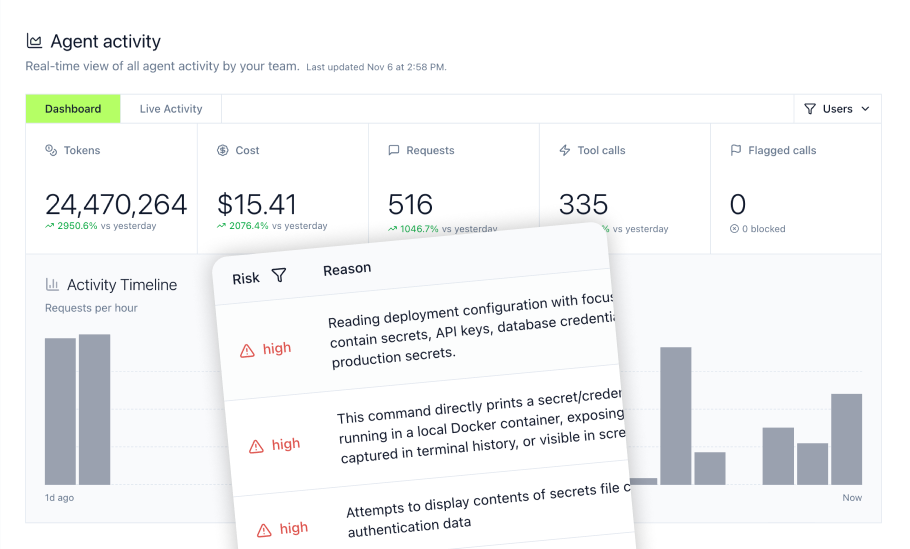
This distinction matters because shadow AI visibility requires seeing agent activity that never touches the governed gateway path. Agent Monitor captures activity from Claude Code, Cursor, Codex, and GitHub Copilot through lightweight local hooks.
Centralized Governance for Diverse AI Clients and Knowledge Sources
Unifying Access Across a Mixed AI Ecosystem
Enterprises rarely standardize on a single AI platform. Teams use Claude for analysis, Cursor for coding, ChatGPT for customer interactions, and custom agents for specialized workflows. Each platform creates its own access patterns, credential requirements, and audit formats.
Centralized governance through MCP Gateway provides a single entrypoint that:
- Authenticates users through existing identity providers
- Curates which tools each role can see
- Injects centrally managed credentials per call so connectors do not hold long-lived secrets
- Routes to hosted, remote, custom, or STDIO connectors
- Logs every interaction for audit
The Role of Virtual MCPs in Harmonizing Knowledge Access
Virtual MCPs create per-use-case endpoints that abstract the complexity of underlying connector configurations. A data analyst connects to one endpoint that provides governed access to Snowflake, BigQuery, and Databricks. A developer connects to a different endpoint with GitHub, Jira, and Datadog access.
Review the MCP data risk guide for detailed assessment frameworks covering connector security, credential handling, and access control implementation.
Building a System of Record for the Enterprise Agent Workforce's Knowledge
From Individual Agents to a Governed Workforce
As organizations scale from 10 to 100+ agents, the central governance question becomes "who did what." A system of record for the enterprise agent workforce must answer:
- Which agents exist across the organization?
- Who owns or operates each agent?
- Which systems can each agent access?
- What credentials and permissions does each agent use?
- What actions has each agent taken?
- What memory does each agent retain?
- Which security policies apply to each agent?
- How much usage or cost does each agent generate?
- How can any agent be restricted or shut down?
Key Questions for Agent Knowledge System of Record
Organizations implementing agent memory governance should evaluate their readiness across several dimensions:
- Inventory completeness - Can you enumerate every agent deployed in your organization, including those built outside official platforms?
- Provenance tracking - Can you trace every fact in agent memory back to its authoritative source?
- Access isolation - Have you verified that no cross-user memory leakage exists in your agent deployments?
- Retention automation - Do your retention policies execute automatically, or do they depend on manual review cycles?
- Audit completeness - Could you produce a complete record of what any agent knew at any point in time?
MintMCP: Complete Memory Governance for Enterprise AI Agents
MintMCP delivers end-to-end agent memory governance through an integrated platform that addresses every dimension of the framework outlined in this article. The MCP Gateway provides the data-permissions-first foundation for governed tool and data access, while Agent Gateway gives autonomous agents first-class identities with independent credentials, scoped permissions, and attributable audit trails. Virtual MCPs bundle curated tool access behind governed endpoints, letting organizations apply consistent policies across heterogeneous AI clients without requiring manual configuration per employee.
The Agent Gateway extends this foundation to non-human identities, giving autonomous agents their own named principals within your authorization model. Combined with Agent Monitor, MintMCP provides visibility into both governed gateway traffic and shadow AI activity that bypasses official channels, capturing prompts, file access, commands, and tool calls from Claude Code, Cursor, Codex, and GitHub Copilot.
Runtime guardrails operate inline through Mint Guard's managed detection policies, declarative rules, and extensible middleware that integrates with existing DLP and classification systems. MintMCP provides audit logging and SIEM export, with tamper-evident access-grant history available for supported access records. These controls can support organizations addressing audit, access-control, and regulatory requirements. MintMCP's repo-as-memory architecture for Coworker Agents makes instructions, memory, and audit logs reviewable files under version control, ensuring memory remains company-owned, scoped, and portable rather than locked inside vendor systems. Organizations gain a complete system of record answering which agents exist, what they access, what they remember, and what they've done.
Frequently Asked Questions
How does agent memory governance differ from traditional data governance?
Traditional data governance focuses on data at rest in databases, warehouses, and file systems. Agent memory governance addresses the dynamic layer where AI systems synthesize, store, and retrieve information across sessions. The key differences include provenance tracking that must handle LLM-synthesized facts combining multiple sources, access control partitioned by both human and agent identity, retention policies accounting for personal data that may persist across embeddings, indexes, caches, logs, or other derived storage, and audit trails capturing the context an agent operated with when making decisions. Organizations with mature data governance programs can extend existing catalog, glossary, and lineage infrastructure to cover agent memory, but the memory layer requires additional governance controls that traditional programs do not address.
What happens to agent memory when an employee leaves the organization?
Employee departure triggers several memory governance considerations. Memory scoped to the individual user should follow the same offboarding process as other enterprise data, typically transferring ownership or archiving based on retention policies. Agent identities created by the employee should be reassigned or disabled through the identity management system. More complex scenarios arise when the departing employee's interactions contributed to team or organization-level memory, where content may need to persist while removing personal attribution. MintMCP's directory-group-driven access policies can propagate user suspension from the identity provider. Separately, autonomous agent identities can be independently rotated or revoked as part of the organization's offboarding and ownership-transfer process.
Can agent memory governance support multi-tenant environments?
Multi-tenant agent deployments require strict memory isolation between customers or business units. The governance framework must enforce tenant boundaries at the memory layer, not just the application layer. This means separate memory scopes per tenant, tenant-aware provenance tracking that prevents cross-tenant data leakage, independent retention policies per tenant, and tenant-isolated audit trails. Customer-facing agents present the highest risk because a governance failure exposes one customer's data to another. Memory-layer enforcement through identity-bound access controls provides stronger guarantees than application-level tenant filtering.
How do you handle memory governance for agents that access real-time data sources?
Real-time data sources create staleness detection challenges because authoritative data changes continuously. Governance frameworks should implement active metadata monitoring that tracks source system changes and triggers memory expiration when underlying data is modified. For financial data, this might mean invalidating cached market information after minutes. For customer records, staleness windows might extend to hours or days depending on update frequency. The key is connecting memory governance to source system change streams rather than relying on fixed TTL values that cannot account for actual data freshness.
What are the cost implications of comprehensive agent memory governance?
Memory governance adds infrastructure and operational costs for audit logging, provenance metadata, retention enforcement, access controls, integrations, and ongoing review. The actual cost varies significantly with data volume, retention periods, architecture, regulatory scope, and the organization's existing governance infrastructure, so organizations should model these requirements against their own environment rather than relying on generic cost or break-even benchmarks. However, these costs should be weighed against regulatory penalty exposure, incident response efficiency improvements from complete audit trails, and reduced manual security review time for agent approvals.