Cursor's rapid adoption as an AI-powered code editor has seen rapid enterprise adoption, including tens of thousands of enterprises and more than half of the Fortune 500—but recent critical vulnerabilities demonstrate that enterprise deployment requires robust security controls beyond default settings. With coding agents gaining extensive system access to read files, execute commands, and connect to production systems through MCP tools, organizations need centralized governance to maintain visibility and control over agent behavior. This guide provides actionable strategies for securing Cursor deployments, from immediate configuration hardening to enterprise-grade compliance frameworks.
Key takeaways
- Privacy Mode is essential for proprietary code protection, with over 50% of users already enabling zero data retention guarantees
- Common security risks for AI coding agents include prompt injection, context poisoning, hidden payloads in rules files, and agent auto-runs without oversight
- Auto-Run Mode represents the single biggest security risk—disabling it materially reduces risk by forcing human review before commands run
- SOC 2 Type II certification confirms Cursor's security architecture, with full reports available at trust.cursor.com
- Layered security approach combining Cursor settings, rules files, external tooling, and team governance provides comprehensive protection
Understanding Cursor security risks and vulnerabilities
Cursor transforms code editing by embedding AI directly into the IDE, allowing developers to write code through conversation, automatically refactor multi-file projects, and execute terminal commands via natural language. Unlike traditional code editors with AI plugins, Cursor's AI can autonomously run commands, install dependencies, and modify files based on project context—creating both productivity gains and substantial attack surfaces.
Common attack vectors targeting Cursor environments
Security researchers have identified seven core vulnerability categories affecting Cursor deployments:
- Prompt injection and command execution: Malicious prompts trick AI into running destructive commands or data exfiltration scripts
- Context poisoning: Contaminated context from one project infects unrelated work, causing logic corruption and credential leaks across projects
- Hidden payloads in rules files: Compromised
.cursorrulesfiles contain backdoors enabling persistent access and widespread team compromise - Agent auto-runs without oversight: Commands execute without human review in auto-run mode, enabling unsafe code execution and malware installation
- Token and credential leaks: AI outputs expose API keys and passwords in logs or commits
- Malicious NPM package execution: AI suggests typo-squatted packages containing malware
- Namespace collisions and agent spoofing: Fake agents impersonate trusted ones for data exfiltration
The impact of unsecured AI tool access
The CurXecute vulnerability (CVE-2025-54135) demonstrated real-world exploitation potential: attackers could craft malicious Slack messages that, when summarized by Cursor's AI, would rewrite MCP configuration files and execute arbitrary commands with developer privileges. This attack chain—from social media posts to remote code execution—completed within minutes.
Similarly, MCPoison (CVE-2025-54136) enabled persistent team-wide compromise through shared repository configurations. An attacker commits a benign MCP config; team members approve it once; the attacker then silently modifies it to execute backdoor commands every time any team member opens the project.
Establishing cyber security best practices for Cursor deployment
Effective Cursor security requires immediate configuration changes, project-level controls, and ongoing governance processes.
Securing the development environment
Immediate actions (15-30 minutes):
- Update to version 1.3.9+: Critical for patching CVE-2025-54135 and CVE-2025-54136
- Enable Privacy Mode: Settings → General → Enable "Privacy Mode" for zero data retention
- Disable Auto-Run Mode in Cursor settings: (or enforce it via org policy) so shell commands require explicit user approval
- Enable Dotfile Protection: Prevents AI from modifying
.env,.ssh/config, or credential files - Enable MCP Tool Protection: Blocks Model Context Protocol tools from running without explicit approval
Security research shows that disabling auto-run mode alone prevents the majority of documented attack scenarios by ensuring AI-generated commands require human verification.
Data protection strategies for AI workflows
Create a .cursorignore file in your project root to exclude sensitive content from AI processing:
.env
.env.*
**/.env
**/secrets/
**/.ssh/
**/node_modules/
*.key
*.pem
Leveraging application security tools for Cursor environments
Organizations require specialized tooling to monitor and control AI agent behavior at scale.
Real-time threat detection in Cursor workflows
Standard application security tools—SAST, DAST, and dependency scanners—remain valuable for analyzing AI-generated code, but they cannot observe AI agent behavior in real time.
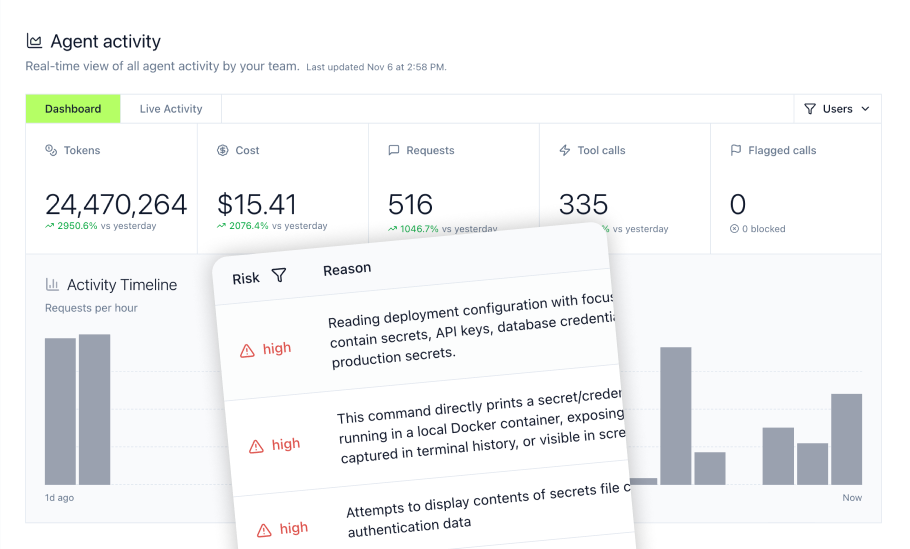
The MintMCP LLM Proxy addresses this gap by sitting between your AI client and the model itself, monitoring every MCP tool invocation, bash command, and file operation from coding agents. This provides essential visibility into what agents access and enables blocking of dangerous commands before execution.
Security capabilities include:
- Tracking every tool call and bash command across coding agents
- Complete MCP inventory showing all installed servers and their permissions
- Real-time blocking of risky operations like reading environment secrets
- Complete audit trail of every operation for security review
Automated security scans for AI codebases
Integrate security scanning into your AI-assisted development workflow:
- Secrets detection: GitGuardian, Secretlint, or Trufflehog on pre-commit hooks
- Package vetting: Socket.dev or Snyk for supply chain protection
- Code review: GitHub Advanced Security for vulnerability scanning of AI-generated code
- Security rules: Deploy cursor-security-rules for language-specific guardrails
Mitigating shadow AI: Centralized governance for Cursor use
Shadow AI adoption is rapidly accelerating, creating compliance and security blind spots when developers adopt AI tools without IT oversight.
Turning shadow AI into sanctioned AI
The MintMCP Gateway transforms unmanaged AI tool usage into governed enterprise infrastructure through:
- Unified authentication: OAuth 2.0, SAML, and SSO integration for all MCP servers
- Centralized audit logging: Complete trails of every MCP interaction, access request, and configuration change
- Granular tool access control: Configure tool access by role—enable read-only operations while excluding write tools
- Rate control: Prevent abuse and manage costs across teams
This approach enables organizations to deploy MCP tools without slowing developers.
Implementing enterprise-wide AI usage policies
Effective governance requires documented policies covering:
- Approved versus prohibited Cursor features
- MCP server approval and review process
- Rules file change management procedures
- Incident response for AI-generated vulnerabilities
Ensuring data protection and compliance with Cursor
Cursor's Privacy Mode architecture provides technical guarantees for data protection through a multi-layered approach.
Achieving regulatory compliance for AI workloads
How Privacy Mode works:
- Each request includes an
x-ghost-modeheader indicating privacy status - Proxy routes requests to separate replicas with log functions disabled
- Zero data retention agreements with OpenAI, Anthropic, Google Vertex, and other providers
- Team-level enforcement with server verification every 5 minutes
- Failsafe defaults to privacy mode if verification fails
Compliance implications:
- SOC 2: Full Type II certification meets data protection and access control requirements
- HIPAA: Not explicitly compliant; requires Business Associate Agreement (not currently offered)
For organizations requiring complete enterprise compliance auditing, MintMCP's gateway provides enterprise-grade logging and compliance documentation beyond Cursor's native capabilities.
Monitoring and observability for Cursor security
Without logging and monitoring, prompt injection and context poisoning attacks go undetected for weeks or months.
Tracking every AI tool interaction
MintMCP provides real-time usage tracking across Claude Code, Cursor, ChatGPT, and other AI clients through:
- Live dashboards for server health, usage patterns, and security alerts
- Data access logs showing exactly what each AI tool accesses and when
- Cost analytics tracking spending per team, project, and tool
- Performance metrics measuring response times, error rates, and usage patterns
Detecting malicious activity in development environments
Establish monitoring procedures including:
- Weekly audit of Cursor directories (
~/Library/Application Support/Cursor/) - Monthly review of all
.cursorrulesfiles for unauthorized changes - Quarterly security assessments of AI-assisted workflows
- Automated alerts for anomalous command patterns
Implementing secure access controls and authentication
Enterprise Cursor deployments require identity management beyond individual user settings.
Centralized user and access management
Cursor's Teams plan provides team management, SSO, and admin controls for organization-wide policy enforcement. However, comprehensive AI governance across multiple tools requires external solutions.
The MintMCP Gateway adds:
- Enterprise SSO with SAML and OIDC integration
- Role-based access control defining who can use which AI tools
- Centralized credentials management for all AI tool API keys
- User provisioning with team-based access controls
Protecting sensitive files and commands in Cursor workflows
Coding agents operate with extensive system access, making file and command protection critical.
Safeguarding critical configuration files
The LLM Proxy prevents access to sensitive files including:
.envfiles containing environment variables and secrets- SSH keys and configuration files
- API tokens and credentials
- Database connection strings
Controlling execution of potentially dangerous commands
Implement command filtering through:
- Allowlisting approved operations for each project
- Denylisting known dangerous patterns (
rm -rf, credential access) - Sandboxing high-risk operations in isolated environments
- Requiring human approval for system-modifying commands
Building Enterprise-Grade security infrastructure
Production Cursor deployments require reliability guarantees and deployment flexibility.
Achieving enterprise slas for AI infrastructure
MintMCP's infrastructure provides:
- High availability: Automatic failover and redundancy
- Enterprise SLAs: Guaranteed uptime and support response times
- Self-hosted options: Deploy on your infrastructure with full control
Frequently asked questions
What is the difference between cursor's privacy mode and standard operation?
Privacy Mode routes all requests through separate server replicas where logging functions are disabled by default. Cursor maintains zero data retention agreements with AI providers including OpenAI and Anthropic, ensuring code data is never stored or used for training. Standard operation may retain interaction data for service improvement. Team administrators in the Business tier can enforce Privacy Mode organization-wide, with the system verifying compliance every 5 minutes and defaulting to privacy mode if verification fails.
How does cursor's security compare to GitHub copilot?
Cursor has a built-in Privacy Mode that enables zero data retention for its model providers, though Cursor may still store some code data for features (and “Privacy Mode (Legacy)” is stricter). Cursor states it is SOC 2 Type II certified. By default, Cursor disables VS Code Workspace Trust and does not verify extension signatures, while VS Code verifies Marketplace extension signatures by default. GitHub Copilot now has SOC 2 Type II reports available. Copilot in VS Code also supports MCP servers, so “tool access” risks can apply depending on MCP configuration; VS Code warns MCP servers can run arbitrary code and provides trust prompts and org controls.
What should I do if I suspect my Cursor installation has been compromised?
check your workspace MCP configuration file (`.cursor/mcp.json`) for unauthorized changes
—this was the primary attack vector in CVE-2025-54135. Review command history and audit logs for unusual activity. Update to Cursor 1.3.9 or later to patch known vulnerabilities. Rotate any credentials that may have been exposed, including API keys, SSH keys, and database passwords. Report the incident to your security team and consider engaging forensic analysis if sensitive data was potentially accessed.
Can Cursor access my production databases or cloud infrastructure?
By default, Cursor cannot access external systems. However, MCP servers can enable connections to databases, APIs, and cloud services if configured. This creates risk if MCP configurations are compromised—attackers could gain access to production systems through the AI agent. Organizations should implement strict MCP server approval processes, use read-only database credentials where possible, and deploy monitoring solutions to track all external connections initiated by AI agents.
How do I secure Cursor for a development team with varying security expertise?
Deploy Cursor Business tier for centralized admin controls and SSO enforcement. Pre-configure security settings including disabled auto-run mode, enabled dotfile protection, and MCP tool restrictions before distributing to team members. Implement .cursorignore files in all repositories as part of project templates. Provide security training covering prompt injection awareness and safe cursor rule management. Consider deploying an LLM proxy solution for real-time monitoring and automatic blocking of risky operations regardless of individual user settings.