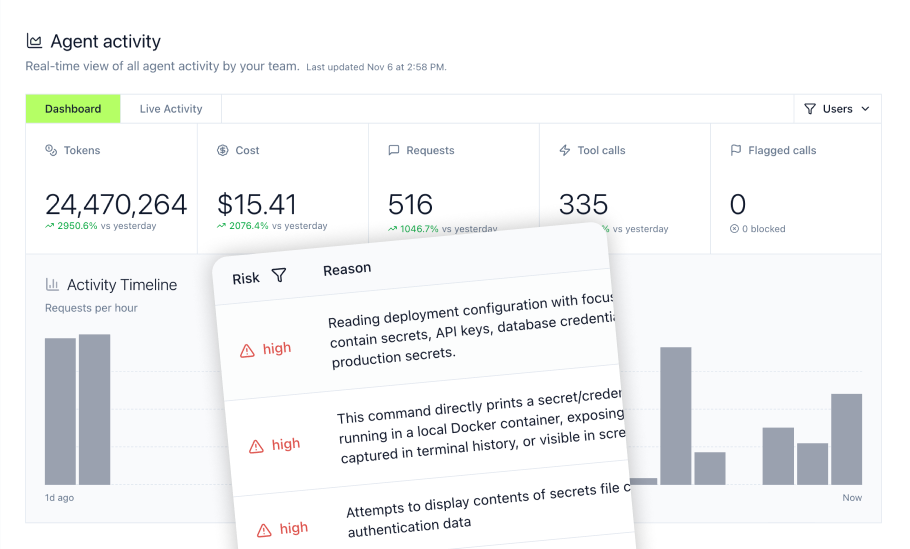
Claude Code operates directly in developers' terminals with the same permissions as the user—reading files, executing commands, and accessing production systems through MCP tools. Without proper governance, organizations cannot see what these agents access or control their actions. Enterprises need comprehensive security controls that include permission management, network isolation, audit logging, and compliance frameworks to protect sensitive code and intellectual property. An LLM Proxy provides essential visibility and control over how Claude Code and other coding agents interact with your systems, transforming shadow AI into sanctioned AI while maintaining developer productivity.
This article outlines actionable strategies for securing Claude Code deployments, covering enterprise configuration, risk mitigation, compliance alignment, and operational monitoring to ensure both security and development velocity.
Key takeaways
- Sandboxing achieves 84% reduction in permission prompts while maintaining security through OS-level isolation
- Recent security vulnerabilities demonstrate real risks requiring active mitigation and version verification—always deploy the latest Claude Code version
- Deploying Claude Code via AWS Bedrock or Google Vertex AI can improve network control so traffic can avoid the public internet, while still using managed cloud services
- Zero-Data-Retention (ZDR) mode requires Enterprise plan addendum for processing PHI or sensitive data
- Managed-settings.json enables organization-wide policies that cannot be overridden by individual developers
- SOC 2 Type II is available under NDA; Enterprise orgs can export audit logs (metadata-based; chat/project titles/content are not included in audit-log exports), and customers must still run their own access management and vendor-risk controls.
Understanding the Claude code security landscape
Claude Code represents a fundamental shift in how AI assists developers—operating not as a sandboxed chatbot but as an agent with extensive system access to files, commands, and production infrastructure. This capability demands enterprise-grade security controls that traditional software governance frameworks never anticipated.
The rise of coding agents and their security implications
Unlike traditional IDE plugins, Claude Code runs with the same permissions as the developer who invokes it. The agent can read any file the user can access, execute bash commands, modify projects across multiple files simultaneously, and integrate with external tools through the Model Context Protocol (MCP). This power creates substantial attack surface:
- File access: Claude Code can read .env files, SSH keys, and credentials unless explicitly blocked
- Command execution: The agent executes bash commands in the developer's shell context
- MCP integrations: External tool connections can expose APIs, databases, and third-party services
- Data transmission: Code and context are sent to Anthropic servers for processing
Organizations must treat Claude Code as a "brilliant but untrusted intern"—capable of excellent work but requiring human review of all security-critical changes.
Identifying unsanctioned AI use
Shadow AI grows as developers adopt tools without IT approval. Without centralized monitoring, security teams cannot track which MCP tools are installed, what files agents access, or which commands they execute. An MCP Gateway provides unified authentication, audit logging, and rate control for all Claude Code connections—giving organizations visibility into AI tool usage across teams.
Establishing enterprise best practices for Claude code
Effective security requires configuring Claude Code at the enterprise level before individual developers begin using the tool. Policy-first deployment defines allow/deny/ask rules before rollout rather than relying on defaults.
Centralizing identity and access management
Enterprise deployment requires integration with corporate identity providers through SAML 2.0 or OIDC. This enables:
- Single Sign-On: Developers authenticate through existing corporate credentials
- Domain capture: All users with corporate email domains automatically route to enterprise workspace
- Just-in-time provisioning: User accounts created automatically upon first SSO login
- Role-based access: Primary Owner, Admin, and Member roles control administrative functions
Enterprise SSO setup requires domain ownership verification via DNS TXT record and IdP metadata upload to the Claude Admin Console. Organizations using Okta, Azure AD, or Auth0 can complete configuration within 2-4 hours.
Implementing granular tool access control
The managed-settings.json configuration file provides organization-wide policy enforcement that individual developers cannot override.
Key configuration elements include:
- Permission tiers: Deny rules block dangerous operations; Ask rules require user approval; Allow rules auto-approve safe commands
- Hook controls: Disabling all hooks prevents persistent malicious code from executing between sessions
- MCP server allowlists: Only approved external integrations can connect
- Transcript retention: Short cleanup periods (7-14 days) limit exposure of sensitive data in logs
MintMCP's tool governance features enable granular tool access control configured by role—for example, enabling read-only operations while excluding write tools for specific teams.
Securing API access and credentials
Never run Claude Code as root—AI agents should never have admin powers. Additional credential security measures include:
- Deny rules for sensitive files: Block access to
.env,~/.ssh/,secrets/, and credential directories - Network command restrictions: Default deny for curl, wget, and other data exfiltration vectors
- API key rotation: Regular rotation of Anthropic API keys and monitoring for unauthorized usage
- Centralized credential management: Store all AI tool API keys and tokens in a unified secrets manager
Risk mitigation strategies for Claude code deployments
Proactive risk mitigation requires layered security combining Claude's built-in controls with external tools and network isolation.
Proactive threat detection and blocking
Recent security research has identified vulnerabilities in Claude Code including path restriction bypasses and command injection vectors. These issues have been addressed in current versions—verify Claude Code is on the latest stable release across developer machines (check with /status or release notes) and keep auto-updates enabled where possible.
Ongoing security challenges require continuous mitigation:
Prompt injection attacks: Malicious instructions embedded in files, READMEs, or comments can manipulate Claude's behavior. Mitigation includes enabling sandbox mode via the /sandbox command, using deny rules for network commands, implementing external SAST/DAST scanning tools like Semgrep or StackHawk, and never bypassing permissions mode.
Data exfiltration risks: Claude Code sends code to Anthropic servers for processing. Mitigation includes using Zero-Data-Retention mode (Enterprise only) for no prompt/output persistence, deploying via AWS Bedrock or Vertex AI with VPC isolation, and configuring deny rules for sensitive files.
MintMCP's LLM Proxy blocks dangerous commands in real-time and protects sensitive files from access while maintaining complete audit trails of all operations.
Ensuring data locality and compliance
VPC-isolated deployment ensures traffic never leaves enterprise networks. Deployment options by security strength:
- Direct Anthropic Cloud: Medium security, low complexity—suitable for small teams with non-sensitive code
- AWS Bedrock (Public): High security, medium complexity—recommended for most enterprises
- AWS Bedrock (VPC): Very high security, high complexity—required for regulated industries
- Google Vertex AI (PSC): Very high security, high complexity—preferred for GCP-native organizations
Data residency controls enable compliance with regional requirements. MintMCP provides multi-region support with data residency controls for global deployment scenarios.
Ensuring compliance for Claude code with industry standards
Regulatory alignment requires both platform certifications and organization-level controls.
Achieving SOC 2 and HIPAA readiness
Anthropic holds SOC 2 Type II certification (available under NDA). However, organizations must maintain their own controls including:
- Access management: Document user provisioning and deprovisioning procedures
- Audit logging: Maintain 90+ days log retention through monitoring stack configuration
- Vendor risk assessment: Evaluate Anthropic's security posture and contractual obligations
For HIPAA compliance:
- ZDR addendum required for processing Protected Health Information
- Mandatory human review of all outputs involving patient data
- Audit trail of every patient data interaction
The Enterprise plan provides Compliance API for real-time programmatic access to usage data, enabling automated compliance reporting.
GDPR compliance in AI agent interactions
GDPR requirements for Claude Code deployments include:
- Data residency: Use AWS EU regions or Google Vertex AI with Private Service Connect
- Right to deletion: Use documented data export/deletion workflows and your internal retention controls; if needed, use the Compliance API for programmatic governance/monitoring and coordinate DSAR processes with Anthropic
- Data minimization: Configure deny rules to block PII file access
- Purpose limitation: Document approved use cases for AI processing
MintMCP's audit observability features provide complete audit logs for SOC2, HIPAA, and GDPR compliance requirements.
Operationalizing Claude code security: Monitoring & observability
Continuous monitoring transforms security from a point-in-time assessment into ongoing operational practice.
Tracking AI tool usage and performance
Enterprise audit logging captures every Claude Code interaction including:
- Tool invocations and MCP server calls
- File access patterns and modifications
- Command execution history
- User attribution for all actions
The recommended monitoring cadence:
- Daily: Automated security alerts for denied actions
- Weekly: DevOps review of usage patterns and anomalies
- Monthly: Audit managed-settings.json for configuration drift
- Quarterly: Security team review of Claude Code usage reports
OpenTelemetry integration with CloudWatch dashboards enables per-user cost tracking, code metrics, and audit trails when deploying via AWS Bedrock.
Detecting anomalies in AI agent behavior
Red flags requiring investigation:
- Developers bypassing permissions: May indicate overly restrictive policies or inadequate training
- High deny-action rates: Could signal misconfiguration or malicious activity attempts
- Repeated prompt injection attempts: Check audit logs for patterns targeting specific files or commands
- Unexplained network traffic: Verify sandbox and proxy configuration integrity
MintMCP's real-time monitoring provides live dashboards for server health, usage patterns, and security alerts—enabling immediate response to anomalous behavior.
Securely connecting Claude code to enterprise data & tools
Claude Code's value increases when it can access internal data sources—but each integration expands the attack surface.
Integrating Claude code with internal databases
The Model Context Protocol enables secure database connections through controlled server configurations. Enterprise deployment patterns include:
- Read-only access by default: Enable write operations only through explicit approval workflows
- Query logging: Capture all database interactions for audit purposes
- Row-level security: Enforce data access policies at the database layer
- Connection pooling: Manage database load from AI agent queries
MintMCP provides native connectors for enterprise data platforms including Elasticsearch for knowledge base search and Snowflake for data warehouse analytics—each with centralized authentication and audit logging.
Enabling AI agents for customer support workflows
Connecting Claude Code to customer-facing systems requires additional safeguards:
- PII handling policies: Define explicit rules for customer data access and retention
- Response validation: Implement human review for customer-facing AI outputs
- Escalation paths: Ensure AI agents can route complex issues to human support
- Audit trails: Maintain complete logs of all customer data interactions
Accelerating secure deployment of Claude code
Speed-to-deployment matters—but not at the expense of security. Enterprise customers achieve 2-10x developer velocity with proper controls in place.
Deploying Claude code servers instantly
Implementation typically follows a phased approach:
Phase 1: Pilot (Weeks 1-4)
- Deploy to 5-20 developers across different teams
- Use basic Anthropic cloud with Team plan
- Collect usage data and feedback
Phase 2: Hardening (Weeks 5-8)
- Deploy managed-settings.json with security policies
- Integrate SAST/DAST tools into CI/CD
- Set up audit logging and monitoring
Phase 3: Enterprise Deployment (Weeks 9-16)
- Migrate to AWS Bedrock or Vertex AI with VPC isolation
- Enable SSO and RBAC
- Implement Compliance API for regulatory requirements
Direct IdP integration using AWS IAM federation provides full user attribution, MFA enforcement, and 12-hour session duration—deployable in 2-4 hours.
Transforming local AI servers to production
MintMCP's one-click deployment transforms STDIO-based MCP servers into production-ready services with monitoring, logging, and compliance—deploying in minutes rather than days. The platform handles:
- OAuth protection: Add SSO and OAuth to any local MCP server automatically
- Containerization: Host stdio servers on MintMCP instead of running locally
- High availability: Enterprise SLAs with automatic failover
- Self-service access: Developers request and receive AI tool access instantly
For teams evaluating enterprise MCP deployment, MintMCP provides the security, governance, and ease-of-use that enterprises need to deploy at scale.
Frequently asked questions
What is the total cost of ownership for enterprise Claude code deployment?
Costs vary widely by model, usage, and provider. Use Anthropic’s Claude Code cost guidance as a baseline (often cited in the ~$100–$200 per developer per month range for typical usage) and then add your org-specific costs for security tooling, rollout, and compliance based on internal estimates.
How does Claude code's sandboxing actually work at the OS level?
Claude Code's sandbox uses OS-level isolation mechanisms including bubblewrap on Linux and seatbelt on macOS. The sandbox blocks filesystem access outside designated directories, prevents network requests except to explicitly allowed domains, isolates process execution from the host system, and maintains a separate environment for each session. Static analysis runs before command execution to flag risky operations automatically, and the sandbox achieves 84% reduction in permission prompts while maintaining security guarantees.
Can Claude code integrate with air-gapped or highly restricted networks?
Yes, but with limitations. On-premise sandboxed deployment provides high security for air-gapped environments, though it requires careful configuration of proxy allowlists for necessary domains. Organizations must balance isolation requirements against Claude Code's need to communicate with Anthropic's API. For fully air-gapped environments, consider whether the operational constraints justify the implementation complexity versus alternative solutions.
What happens when Claude code produces insecure code despite security configurations?
Claude Code's /security-review command provides AI-powered vulnerability scanning, but it produces false positives and negatives. Treat AI security review as a first pass only—never as a definitive audit. Integrate deterministic SAST/DAST tools (Semgrep, StackHawk, Snyk) into CI/CD pipelines. Require human code review for all AI-generated changes, especially those touching authentication, authorization, cryptography, or data handling. Maintain security champions within development teams who understand both AI capabilities and limitations.
How do I handle Claude code usage when developers work with multiple clients or projects?
Project isolation requires careful configuration. Use separate MCP server configurations per client engagement, implement workspace-level managed settings that restrict access to project-specific directories, configure deny rules preventing cross-project file access, and maintain separate API keys or authentication contexts per client. The Compliance API can generate per-project usage reports for client billing and audit purposes. Document data handling procedures in client contracts, especially regarding AI processing of proprietary code.