The GitHub MCP Server connects AI agents to your repositories, enabling Claude, Cursor, ChatGPT, and custom agents to read code, manage pull requests, and execute automated workflows through natural language commands. Unlike traditional API integrations requiring custom development, the GitHub MCP Server provides a standardized Model Context Protocol interface that supported MCP clients can use, subject to each host's connection and authentication support. For organizations scaling beyond individual developer setups, an MCP Gateway can add centralized cross-tool governance, tool-level policy enforcement, and MCP-specific audit visibility on top of GitHub's native authentication, repository permissions, and audit controls. MintMCP's Agent Gateway builds on that foundation with agent identities, permissions, memory, and monitoring.
This guide covers step-by-step setup for both remote and local deployments, core capabilities for AI coding assistants, and the governance strategies enterprises need to deploy GitHub MCP at scale without compromising security or compliance.
Key Takeaways
- GitHub offers both hosted remote and local deployment options; the remote server avoids running the server locally, while GitHub Enterprise Server requires a local deployment
- GitHub MCP can support AI-assisted pull request review workflows, but time savings depend on the team's review process and should not be presented as a universal percentage without benchmark data
- Code review remains a workflow bottleneck, and AI-assisted triage can reduce manual routing and review work, but improvement varies by team and workflow
- Read-only mode (
GITHUB_READ_ONLY=1) should be the default for initial deployments; expand to write permissions only after teams understand AI behavior patterns - GitHub provides native API audit logging where available, but it does not provide a purpose-built MCP tool-call audit layer with the agent-level context a centralized governance platform can add
- Additional enterprise governance can extend GitHub's native controls with cross-tool policy enforcement, DLP, MCP-specific audit context, and per-agent identity management
- Lockdown mode limits untrusted public-repository content by surfacing content only from users with push access; read-only mode and tool selection provide separate controls
Setting Up Your GitHub MCP Server: A Step-by-Step Guide
Engineering teams deploying GitHub MCP face a choice between direct connection and governed deployment. Direct connections can work well for individual or limited-team use cases, while organizations with broader access-control, audit, and DLP requirements may benefit from centralized governance.
Generating Your GitHub Personal Access Token
For the remote GitHub MCP Server, OAuth is the default in supported hosts and a PAT is optional. If you use PAT authentication, grant only the repository access and permissions required by the toolsets you enable; organization and enterprise policies may further restrict PAT or OAuth access.
Store tokens in a password manager or secure environment variable. Never commit tokens to version control.
Choosing Remote vs. Local Deployment
Remote Server (Recommended for most teams):
- No installation required
- Hosted by GitHub at
https://api.githubcopilot.com/mcp/ - Works with VS Code 1.101+, Claude Desktop, and Cursor
Local Docker Server:
- Required for GitHub Enterprise Server
- Supported for GitHub Enterprise Cloud with data residency
- Supports enterprise instances through
GITHUB_HOSTor the equivalent host configuration
Configuring VS Code for Remote Server
Open the Command Palette and search "MCP: Add Server." Select GitHub from the registry, or manually add to .vscode/mcp.json:
{

  "servers": {

    "github": {

      "url": "https://api.githubcopilot.com/mcp/",

      "requestInit": {

        "headers": {

          "Authorization": "Bearer YOUR_GITHUB_PAT"

        }

      }

    }

  }

}
After saving the configuration, restart or reload the host if needed, then verify that the GitHub tools are available.
Configuring Claude Desktop for Local Docker
Edit the configuration file at ~/Library/Application Support/Claude/claude_desktop_config.json (Mac) or %APPDATA%\Claude\claude_desktop_config.json (Windows):
{

  "mcpServers": {

    "github": {

      "command": "docker",

      "args": [

        "run", "-i", "--rm",

        "-e", "GITHUB_PERSONAL_ACCESS_TOKEN",

        "ghcr.io/github/github-mcp-server"

      ],

      "env": {

        "GITHUB_PERSONAL_ACCESS_TOKEN": "YOUR_TOKEN_HERE"

      }

    }

  }

}
Restart Claude Desktop. Verify connection by asking: "List the 5 most recent pull requests in [owner]/[repo]."
Troubleshooting Common Setup Issues
| Issue | Cause | Solution |
|---|---|---|
| 401 Unauthorized | Authentication is invalid, expired, or missing required permissions | Verify the authentication method and grant only the permissions required by the enabled tools |
| Tools not appearing | Server not registered or client needs restart | Verify JSON syntax, restart IDE completely |
| Docker permission denied | Docker Desktop not running | Start Docker Desktop; add user to docker group on Linux |
| Rate limit exceeded (403) | Primary or secondary API limit reached | Check GitHub's rate-limit headers and authentication context |
Unlocking AI Coding Assistant Potential with GitHub MCP
The GitHub MCP Server transforms static repository data into actionable intelligence. AI coding assistants like Cursor, Claude Code, and GitHub Copilot can now read repositories, analyze pull requests, and monitor CI/CD pipelines through conversational prompts.
Core Capabilities by Toolset
Repository Intelligence:
- Search code across all accessible repositories
- Retrieve file contents and analyze commit history
- Browse repository structures through natural language queries
Pull Request Automation:
- Review PR diffs and submit structured feedback
- Manage approval workflows and track review status
- Surface changes requiring attention without manual navigation
CI/CD Visibility:
- Monitor GitHub Actions workflow runs
- Retrieve job logs and analyze failure patterns
- Trigger automated incident responses when builds break
Issue and Project Management:
- Create, update, search, and triage issues
- Manage labels and assignments
- Coordinate project tracking through AI-driven workflows
Connecting AI Assistants to Development Workflows
Enable specific toolsets based on your use case:
repos,pull_requestsfor PR reviewsactionsfor CI/CD monitoringcode_securityfor code scanningdependabotfor Dependabot alertssecret_protectionfor secret scanningissuesfor project management
Restricting toolsets to only what you need minimizes context window bloat and reduces the attack surface for potential prompt injection.
Enterprise-Grade Governance for GitHub MCP Servers
Direct GitHub MCP Server connections inherit GitHub's native authentication, repository permissions, app policies, and audit controls. Enterprises that need broader AI governance may still require additional infrastructure for capabilities GitHub does not provide at the MCP layer, including:
- Centralized policy enforcement across AI tools and MCP connections
- MCP-specific audit visibility showing which agent invoked which tool
- Data loss prevention policies on MCP requests and responses
- Consistent per-agent identity and access controls across multiple enterprise systems
Implementing Role-Based Access Control
Enterprise deployments require team-based access policies. MintMCP's Virtual MCP Bundles address this by packaging tool access, policy enforcement, and audit logging into governance units aligned with teams or roles. Each Bundle connects to identity providers through SCIM, so access automatically adjusts when employees change teams or leave the organization.
For GitHub specifically, Bundles can:
- Enable PR read access for all engineering teams
- Restrict write operations to senior developers
- Allow security teams to access security toolsets exclusively
- Block repository access for contractors except on assigned projects
Ensuring Compliance and Auditability
Every AI agent action needs logging with user identity, tool invoked, parameters, and results. GitHub logs underlying API calls in its audit log when available, but those records are not a purpose-built MCP tool-call trail showing which MCP tool or agent context produced each action.
MintMCP's security governance capabilities provide:
- Full conversation-level logging with configurable retention
- Export to SIEM or observability platforms through OTLP/HTTP or Splunk HEC
- Per-user attribution for every tool call
- Immutable audit records for compliance investigations
For regulated industries, this audit infrastructure can support access-monitoring and evidence-collection requirements within broader SOC 2 and HIPAA programs, while aligning with broader AI risk management practices for governing AI systems.
Observability and Shadow AI Detection in GitHub Environments
Enterprise security teams face a visibility problem: developers install MCP servers locally, connect AI agents to GitHub, and security has no awareness of what data flows through these connections.
Monitoring AI Agent Activity Beyond the Gateway
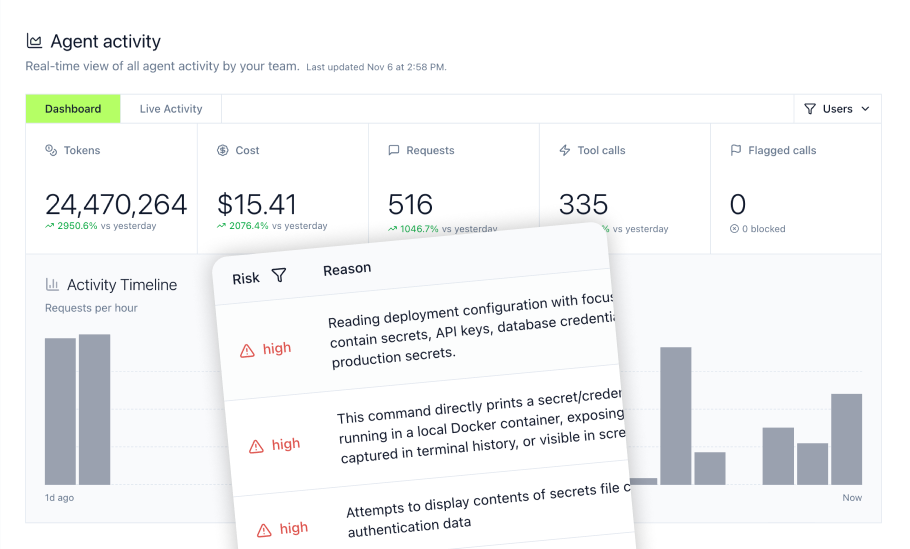
MintMCP's Agent Monitor tracks agent activity in real-time across the organization, including MCP calls made outside the gateway through hooks in Cursor and Claude Code. This addresses the "shadow AI" problem where developers use ungoverned AI tools with corporate data.
Detection capabilities include:
- PII exposure in AI responses
- Credential leakage (API keys, tokens)
- Risky bash commands
- Prompt injection attempts
MDM Integration for Consistent Policy Enforcement
For organizations using mobile device management, Agent Monitor configurations can be pushed to developer machines in detect-only or enforce mode. This ensures consistent policy application regardless of whether developers route traffic through the central gateway.
Securing AI Agent Access to GitHub: Best Practices
Code review includes many tasks beyond defect finding, creating opportunities for automation. But enabling AI to comment on PRs requires write access that, if compromised, could inject malicious code.
Implementing Per-Agent Credentials
Each AI agent should have its own credentials rather than sharing developer tokens. MintMCP's Agent Identities provide:
- Per-agent OAuth 2.0 client credentials
- Independent rotation and revocation
- Permission scopes specific to the agent's purpose
- M2M authentication separate from human user flows
Per-agent credentials let teams scope, rotate, and revoke agent access independently of human users while preserving agent-level audit attribution.
Protecting Against Prompt Injection
PRs from external contributors can contain untrusted instructions. GitHub's lockdown mode reduces exposure by only surfacing public-repository content from users with push access; private repositories are unaffected.
Use lockdown mode alongside:
- Read-only mode when write operations are unnecessary
- Toolset and tool exclusions to limit available actions
- GitHub repository permissions to constrain accessible data
Integrating GitHub MCP with Enterprise Security Tools
Organizations with existing DLP, SIEM, and identity management investments need GitHub MCP to integrate with those systems rather than operate in isolation.
Connecting to SIEM Platforms
MintMCP exports activity logs to SIEM and observability platforms through OTLP/HTTP or Splunk HEC. GitHub MCP activity routed through MintMCP can be included in this centralized security telemetry.
Custom Policy Enforcement
MintMCP's Gateway Middleware runs custom JavaScript on every tool call. This enables:
- Inline DLP integration with AWS Bedrock Guardrails, Google Cloud DLP, Microsoft Purview, Nightfall, and Skyflow
- Token masking in responses before they reach AI models
- Content inspection for sensitive data patterns
- Custom blocking rules based on repository sensitivity classifications
For teams with existing security tool investments, the middleware layer means GitHub MCP governance integrates with your current stack rather than requiring parallel systems.
Streamlining DevOps Automation with GitHub MCP Servers
Beyond code review, GitHub MCP enables AI-driven DevOps workflows that connect repositories to broader operational systems.
Automated CI/CD Failure Triage
Configure AI agents to monitor GitHub Actions workflow runs. When the agent also has governed access to PagerDuty and Slack, a multi-tool workflow can:
- Fetch GitHub Actions job logs
- Analyze the failure and correlate it with recent commits
- Create a PagerDuty incident through a separate PagerDuty integration
- Post a summary to Slack through a separate Slack integration
This workflow can reduce manual handoffs during incident triage, with results depending on the broader agent configuration and integrations.
Security Advisory Management
Enable the dependabot toolset for Dependabot alerts and secret_protection for secret scanning findings; use code_security for code scanning. AI agents can:
- Generate weekly security posture reports
- Create Jira tickets for critical vulnerabilities when a Jira integration is also available to the agent
- Track remediation progress through natural language queries
- Correlate advisories with the repositories and teams they affect
MintMCP: The Foundation for Enterprise GitHub MCP Deployment
In December 2025, the MCP project reported more than 97 million monthly SDK downloads as MCP became a founding project of the Linux Foundation's Agentic AI Foundation. This standardization wave positions MCP gateways as infrastructure analogous to API gateways in the previous decade.
MintMCP is positioned at this intersection of MCP Gateway (governed data and tool connections for AI systems) and Agent Gateway (identities, permissions, memory, and monitoring for agents that work alongside users). For GitHub integration specifically, this means:
MCP Gateway handles the connection between AI clients and GitHub repositories, providing:
- Centralized authentication and token management across tools
- Cross-tool policy enforcement and DLP integration
- MCP-specific audit trails with tool-call and parameter visibility
- Enterprise-grade access controls layered on top of GitHub's native permissions
Agent Gateway ensures each agent has proper identity, scoped permissions, and auditable actions through:
- Per-agent OAuth 2.0 credentials independent of human users
- Agent-specific memory stores with team, org, and customer scopes
- Real-time monitoring of agent behavior across governed and ungoverned connections
- Git-like version control, review workflows, and portability for agent memory
As enterprises move from experimental AI deployments to production systems, governance becomes the foundation rather than an afterthought. CISA's guidance on the secure adoption of agentic AI similarly emphasizes managing cybersecurity risks as organizations introduce autonomous AI systems. Teams that establish proper controls now avoid the costly retrofitting that comes from scaling ungoverned AI access. For organizations ready to move beyond individual developer setups, MintMCP's GitHub MCP integration guide provides detailed configuration for enterprise deployment.
Frequently Asked Questions
What permissions does the GitHub MCP Server require at minimum?
Minimum permissions depend on the authentication method and toolsets you enable. With remote OAuth, approve only the scopes required by the requested tools. With PAT authentication, use the narrowest repository access and permissions that support your use case. Classic repo access is broad rather than a universal minimum, and code scanning, Dependabot, and secret protection use separate capabilities and permission requirements.
How does GitHub MCP Server handle rate limiting?
Rate limits depend on the authentication method and organization context. Qualifying GitHub Enterprise Cloud-owned app requests can receive higher limits, while other GitHub App requests may use different limits. The MCP server remains subject to GitHub's primary and secondary API rate limits.
Can GitHub MCP Server work with GitHub Enterprise Server (on-premises)?
Yes. GitHub Enterprise Server requires the local MCP server, configured with GITHUB_HOST or the equivalent host option. GitHub Enterprise Cloud with data residency supports both local and remote MCP, but its remote configuration uses an enterprise-specific copilot-api.<subdomain>.ghe.com/mcp endpoint rather than the standard GitHub.com endpoint.
What happens if an AI agent follows malicious instructions in a PR?
PRs from external contributors can contain untrusted instructions. GitHub's lockdown mode reduces exposure by only surfacing public-repository content from users with push access; private repositories are unaffected. Use lockdown mode alongside read-only mode when write operations are unnecessary, toolset and tool exclusions to limit available actions, and GitHub repository permissions to constrain accessible data. Enterprise governance platforms add content inspection layers that detect and block injection attempts before they reach the AI model.
How do I migrate from individual developer setups to enterprise governance?
Start by inventorying current GitHub MCP usage across your organization. Deploy a governance platform like MintMCP in parallel, initially mirroring existing access patterns. Transition teams gradually, starting with those handling sensitive repositories. Use the governance audit logs to identify access patterns that need refinement before enforcing stricter policies.