Enterprise teams are deploying AI agents faster than they can govern them. Claude, Cursor, ChatGPT, Copilot, and custom agents now touch production databases, internal tools, and sensitive data across organizations of every size. The question is no longer whether to use AI agents, but how to govern them without creating security blind spots or slowing teams down.
Credal has positioned itself as an enterprise agent platform with registry and lifecycle management capabilities. Many organizations evaluating Credal find themselves asking: what if governance requirements extend to deeper MCP control, per-agent identity with independent credential rotation, or visibility beyond centralized gateway traffic? This guide examines Credal alternatives, with particular attention to how MintMCP approaches enterprise AI agent governance through its connected MCP Gateway and Agent Gateway architecture.
Key takeaways
- MintMCP provides three integrated governance layers including MCP Gateway, Agent Gateway, and Agent Monitor in a unified platform, combining governed MCP access with first-class agent identity and visibility into supported agent activity
- Data-permissions-first architecture starts governance with controlled tool and data access rather than retrofitting security onto broad agent permissions after deployment
- Virtual MCP Bundles create per-use-case endpoints with SCIM-driven membership and curated tool lists, so different teams see only the tools relevant to their roles
- Agent identities as first-class principals give each autonomous agent its own credentials, permissions, and audit trail separate from human users
- Enterprise security controls include SSO, SCIM, RBAC, audit trails, SIEM export, credential controls, and operational shutdown controls
- Rapid deployment with one-click MCP server setup and centralized configuration designed to reduce rollout friction
Credal and alternative comparison context
Credal operates as an enterprise agent platform focused on agent registry, lifecycle management, and multi-agent workflows. The platform provides SOC 2 Type II attestation and supports GDPR and CCPA requirements. For teams prioritizing agent building and RAG-focused deployments, Credal offers a platform scope that extends beyond pure gateway functionality.
Credal capabilities:
- Agent registry and lifecycle management
- Multi-agent workflow orchestration
- Enterprise search and RAG features
- SOC 2 Type II, GDPR, and CCPA alignment
- Permission mirroring for connected data sources
- Governed MCP server endpoints with tool-level controls
- Agent allowlists and per-agent identity
Where teams compare alternatives:
- How Credal's governed MCP server and registry model compares with Virtual MCP endpoints
- How each platform handles agent identity, machine-to-machine authentication, credential lifecycle, and audit attribution
- Whether monitoring extends beyond centralized gateway traffic into supported local agent activity
- How permission mirroring compares with a data-permissions-first governance model built around centrally governed tool access
- How HIPAA-related deployment requirements, documentation, and BAA terms compare
Credal already provides substantial MCP and agent governance capabilities, so comparisons should focus on the specific architecture, identity, monitoring, and operating model each platform uses rather than treating these areas as absent from Credal.
1. MintMCP: AI agent governance with unified architecture
MintMCP delivers enterprise infrastructure for governing AI clients and autonomous agents across the Model Context Protocol ecosystem. The platform addresses a consistent enterprise challenge: teams adopt AI systems faster than security and platform teams can govern what those systems access, whose credentials they use, what actions they take, and how those actions are attributed.
The platform combines MCP Gateway for governed data and tool connections with Agent Gateway for first-class agent identities. This architecture creates a data-permissions-first foundation where governance is built in from the start rather than retrofitted after deployment.
MintMCP capabilities for enterprise AI governance
Virtual MCP Bundles (VMCPs)
The core MCP Gateway abstraction bundles approved connectors and a curated tool surface behind one governed endpoint for each team, role, use case, or agent. A Virtual MCP serves as the unit of deployment, access control, tool curation, audit, and administration.
- Directory groups drive membership through SCIM synchronization
- Finance teams see Snowflake and QuickBooks; engineering sees GitHub and Jira
- Read-only and read-write access use different VMCPs over the same connector
- Tool governance happens at the bundle level, not per-user
First-class agent identities
The Agent Gateway treats autonomous agents as non-human principals with their own identity, credentials, and permissions:
- Bearer keys with individual expiry and revocation
- OAuth client-credentials / M2M tokens keeping secrets out of the request path
- Workload identity federation where the agent's own infrastructure mints short-lived OIDC tokens
- Independent credential rotation without touching human users or other agents
- Attributable audit trails showing exactly which agent took which action
Two-layer visibility
MintMCP separates gateway governance from broader agent activity visibility through Agent Monitor:
- MCP Gateway governs traffic routed through governed MCP connections
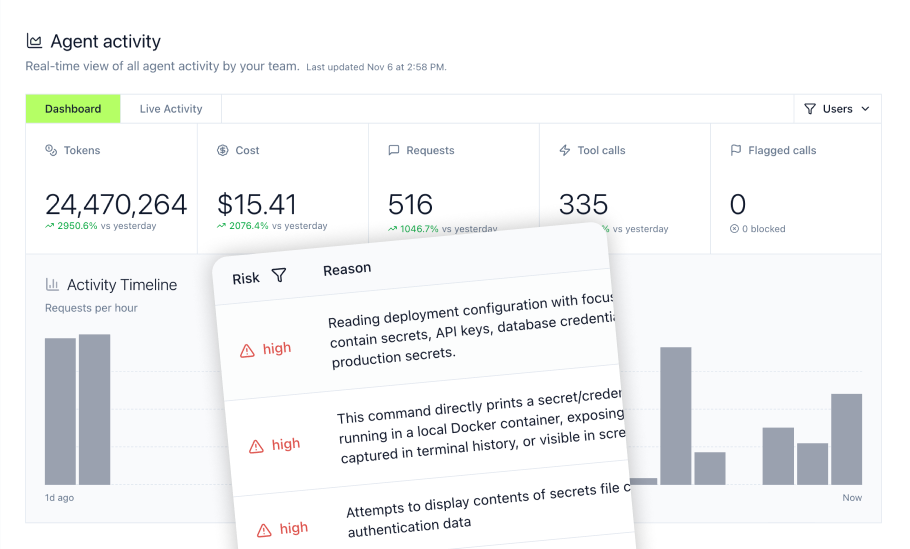
- Agent Monitor tracks prompts, commands, file access, MCP tool calls, usage, and token costs
- Coverage extends to Claude Code, Cursor, Codex, and GitHub Copilot activity
- SIEM export via OTLP or Splunk HEC integrates with existing security infrastructure
Runtime guardrails
Three coexisting control layers protect against dangerous agent actions:
- Mint Guard: Managed detection for prompt injection, credentials, PII, and harmful content
- Rules: Declarative matching on tool names, arguments, or content with flag/block/ask/mask/notify actions
- Gateway Middleware: Customer-authored JavaScript running in a sandbox for DLP integrations and custom policy enforcement
Enterprise security alignment
- SOC 2 Type II audited with continuous compliance monitoring
- Compliant with HIPAA standards with BAA availability
- SSO and SCIM integration with Okta, Entra ID, and Google
- Tamper-evident access-grant history signed at write time
- Operational controls including org-wide kill switch and per-VMCP disable
Deployment options:
- Managed SaaS with VPC and self-hosted options on request
- One-click deployment and centralized configuration
- Supported hosted connectors alongside a catalog of 10,000+ MCP servers
MintMCP fits IT, Security, AI Operations, and Platform owners who need governed MCP access for employees and internal agents across Claude, Cursor, ChatGPT, Gemini, and Copilot. Teams running multiple AI vendors benefit from vendor-neutral, cross-platform governance. Organizations wanting per-agent identity as a first-class primitive and audit trails find the unified architecture relevant for their requirements.
2. Portkey / Prisma AIRS AI Gateway
Palo Alto Networks completed its acquisition of Portkey on May 29, 2026, and Prisma AIRS AI Gateway became generally available in July 2026. Portkey's current product pages identify the platform as Prisma AIRS AI Gateway, combining model routing with MCP and agent governance capabilities.
Key capabilities
- Multi-provider LLM routing through a unified AI Gateway
- MIT-licensed open-source gateway core
- MCP Gateway with authentication, fine-grained access control, visibility, and policy enforcement
- Agent Gateway and Agent Registry capabilities for governing agent access and activity
- OAuth 2.1 support for MCP connections
- Guardrails, observability, and PII controls within the broader Prisma AIRS platform
Considerations
- The platform spans LLM, MCP, and agent gateway use cases rather than focusing exclusively on internal MCP governance
- Current packaging should be evaluated through Prisma AIRS documentation
3. Kong AI Gateway
Kong AI Gateway extends Kong's API management platform across LLM, MCP, and agent traffic, with authentication, policy enforcement, access controls, and observability.
Key capabilities
- Plugin-based architecture with self-hosted and Konnect deployment options
- AI Agent, AI Consumer, and AI MCP Server entities for governing AI traffic
- Kong Identity and OIDC-based authentication for AI Agent traffic
- MCP tool-level access controls through AI Consumer and Consumer Group ACLs
- Konnect Plus pricing of $100/month per proxied LLM model, with 1 million API requests included each month and $200 per additional 1 million requests
- Enterprise packaging with additional security and governance capabilities
Considerations
- Kong retains a broader API and connectivity-platform orientation rather than focusing exclusively on internal employee and agent governance
- Feature availability varies between Konnect and self-hosted deployments
- Enterprise plugins and other platform components can add to total cost
4. OneTrust AI Governance
OneTrust brings its privacy and consent management capabilities to AI governance. The platform emphasizes regulatory alignment and privacy controls alongside agent and MCP governance.
Key capabilities
- Privacy, consent, and regulatory compliance features
- EU AI Act alignment and support
- Agent and MCP governance with runtime monitoring and guardrails
- Guardian Agents for automated policy enforcement
- Integration with broader OneTrust privacy platform
Considerations
- OneTrust spans broad AI governance, privacy, risk, compliance, runtime monitoring, and agent governance rather than operating primarily as an MCP gateway
- Current capabilities include agent and MCP governance, runtime guardrails, and Guardian Agents alongside its broader governance platform
- Teams should compare its AI governance operating model with MCP-focused architectures such as Virtual MCPs and centrally hosted connectors
5. IBM watsonx.governance
IBM watsonx.governance provides GRC and AI assurance capabilities within the broader watsonx platform. The solution supports regulatory frameworks and emphasizes enterprise AI lifecycle management according to the NIST AI Risk Management Framework.
Key capabilities
- Regulatory framework mappings and support
- Governance Graph for mapping relationships across AI systems, risks, controls, and policies
- Asset inventory for AI model tracking
- Integration with IBM Cloud and hybrid cloud environments
- Enterprise-grade compliance and audit capabilities
Considerations
- Broader AI governance scope beyond MCP-specific controls
- Pricing and implementation scope vary by deployment, governance requirements, and configuration
- Integration considerations for organizations with existing IBM infrastructure
6. Google Agent Gateway
Google Agent Gateway is a managed networking and policy-enforcement component of the Gemini Enterprise Agent Platform. It governs agent interactions across MCP, A2A, REST, and other HTTP-based traffic through Google Cloud identity, registry, and security controls.
Key capabilities
- Managed Agent Gateway within Google's Agent Platform
- Agent Identity and Agent Registry integration
- IAM and Identity-Aware Proxy policy enforcement
- Model Armor integration for prompt injection, sensitive-data, and content protections
- Regional gateway resources with support for governed access to external MCP servers and APIs
Considerations
- The documented supported agent runtimes are Google Agent Runtime and Gemini Enterprise
- Agent-to-Anywhere mode can govern calls from those runtimes to external tools, APIs, agents, and MCP servers
- The architecture is closely integrated with Google Cloud's identity, networking, and security stack
7. Credo AI
Credo AI provides an AI governance platform focused on risk assessment and regulatory compliance. The platform emphasizes EU AI Act and NIST RMF alignment.
Key capabilities
- EU AI Act compliance alignment
- NIST Risk Management Framework support
- AI risk assessment and documentation
- Policy automation for AI deployments
- Regulatory reporting and audit capabilities
Considerations
- Risk and compliance focus rather than MCP tool access governance
- Broader AI governance scope beyond agent-to-tool connections
- Alignment with regulatory frameworks versus runtime MCP control
Why MintMCP for enterprise MCP governance
Organizations evaluating Credal alternatives typically need specific answers about how agents connect to enterprise systems, whose credentials they use, what tools they can invoke, and how those actions are attributed and controlled.
MintMCP addresses these requirements through a connected architecture:
- Virtual MCPs bundle approved connectors behind governed endpoints, so teams connect once instead of configuring each MCP server individually. Directory groups drive membership through SCIM, and different VMCPs expose read-only versus read-write tool sets over the same underlying connectors.
- Agent identities treat autonomous agents as first-class non-human principals with bearer keys, OAuth M2M tokens, or workload identity federation. Each agent has independent credential rotation, revocation, and attributable audit trails.
- Agent Monitor extends visibility beyond MCP Gateway traffic into supported local agent activity, covering prompts, file access, commands, and tool calls from Claude Code, Cursor, Codex, and GitHub Copilot.
- Runtime guardrails through Mint Guard, declarative rules, and customer middleware protect against prompt injection, credential leakage, PII exposure, and policy violations before tools execute.
- Enterprise security controls include SOC 2 Type II audited status, compliance with HIPAA standards with BAA availability, SSO/SCIM integration, tamper-evident access-grant history, SIEM export via OTLP or Splunk HEC, and operational shutdown controls.
The data-permissions-first approach means governance is the foundation, not an afterthought. Virtual MCPs bring order to tool access across teams. Agent identities solve the "who did what" attribution problem. The combination of MCP Gateway, Agent Gateway, and Agent Monitor creates a governance layer that works across Claude, Cursor, ChatGPT, Gemini, and Copilot without vendor lock-in.
Start with MintMCP's pricing options to evaluate how Virtual MCPs and Agent Gateway capabilities address specific governance requirements.
Frequently asked questions
How does agent identity support enterprise AI governance?
Agent identity gives autonomous agents an attributable identity rather than forcing them to operate through shared credentials or a human account. This allows organizations to scope permissions, manage credentials independently, attribute actions in audit logs, and revoke one agent without disrupting unrelated users or agents. MintMCP's Agent Gateway applies this model by treating autonomous agents as first-class non-human principals with their own authentication, permissions, and audit attribution.
How does MintMCP prevent agents from misusing credentials or accessing unauthorized tools?
MintMCP addresses credential misuse through multiple layers. Virtual MCPs bundle only approved connectors behind governed endpoints, so agents access only curated tool sets based on their role or identity. Credential injection means connectors never hold long-lived secrets; MintMCP injects credentials per call with encryption at rest. Agent identities allow independent credential rotation without affecting other agents or human users. Runtime guardrails through Mint Guard, Rules, and Gateway Middleware screen every tool call for dangerous patterns, PII, and prompt injection attempts.
Can MintMCP provide visibility into agent activities across an organization?
MintMCP's two-layer visibility model separates gateway traffic from broader agent activity. The MCP Gateway logs all tool calls routed through governed endpoints. Agent Monitor extends visibility to supported local activity including prompts, file access, commands, and MCP tool calls from Claude Code, Cursor, Codex, and GitHub Copilot. Coverage varies by client, agent, and hook phase. Organizations gain insight into both sanctioned MCP usage and potential shadow AI activity.
What are Virtual MCPs and how do they support governance?
Virtual MCPs (VMCPs) are the core abstraction in MintMCP's MCP Gateway. A VMCP bundles multiple connectors and a curated tool surface behind one governed endpoint. This design means users connect once to a VMCP instead of configuring each MCP server individually. VMCPs serve as the unit of deployment, access control, tool curation, audit, and administration. Directory groups drive membership through SCIM, so access policies apply consistently across teams. Different VMCPs can expose read-only versus read-write tool sets over the same underlying connectors.
How does MintMCP support SOC 2 or HIPAA requirements for AI agent usage?
MintMCP holds SOC 2 Type II audited with continuous compliance monitoring. For HIPAA requirements, MintMCP is compliant with HIPAA standards and signs BAAs for customers handling protected health information. The platform provides audit trails across tool calls, credential lifecycle events, and access policy changes. Tamper-evident access-grant history is signed at write time and verifiable offline. SIEM export via OTLP or Splunk HEC integrates with existing security infrastructure. These capabilities support compliance requirements but do not automatically make customers compliant; organizations must implement appropriate controls within their own processes.